
Oracle Critical Patch Update January 2025
Released January 2025 · Oracle's advisory ↗ · ← Critical Patch Update, October 2024 · Critical Patch Update, April 2025 →
253 CVEs in this release, one square each
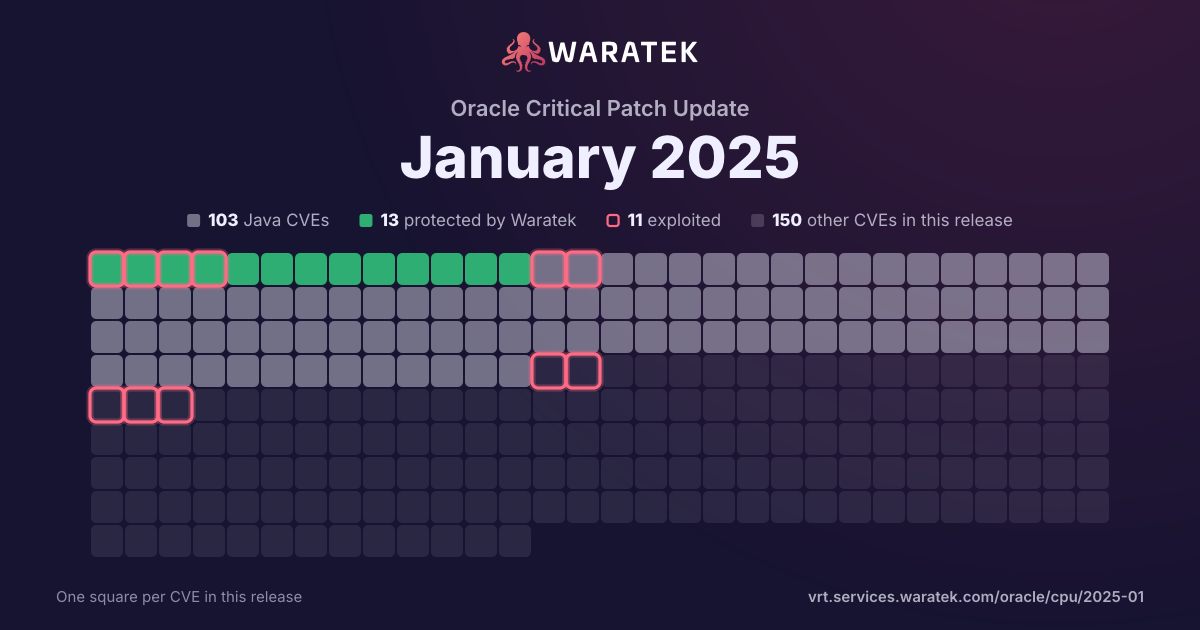
By status
13Protected by Waratek4Mitigation candidate86No exploit published17Outside Waratek scope133Not applicable
11Exploited, marked by the ring
No exploit published. For 48 of them, Oracle's security advisory is the source of public detail.
Protected by Waratek. Waratek RASP can block exploitation of these on systems that have not applied the patch yet.
Overview 6 matches · 0 in Waratek scope · 0 protected · 0 exploited · 0 CISA KEV · 0 public PoC · 0 EPSS ≥ 0.5
6matches
0in Waratek scope0.0%
0protected0.0%
0exploited0.0%
0CISA KEV0.0%
0public PoC0.0%
0EPSS ≥ 0.50.0%
Protected by Waratek
0
0.0%
Rule in development
0
0.0%
Mitigation candidate
0
0.0%
No exploit published
0
0.0%
Outside Waratek scope
0
0.0%
Not applicable
6
100.0%
Withdrawn CVE
0
0.0%
blocked by ARMR today
0
0.0%
partly blocked
0
0.0%
not blocked
6
100.0%
not established
0
0.0%
unrecorded
0
0.0%
Exploited
0
0.0%
Working exploit published
0
0.0%
Proof of concept only
1
16.7%
Forecast only
0
0.0%
No public exploit
5
83.3%
split by
peak 3 / month
Jul 24Aug 24Sep 24Oct 24Nov 24Dec 24Jan 25
| CVE | Severity | Published▾ | Status | Exploitation | Description |
|---|---|---|---|---|---|
| CVE-2025-21546 | Low | 2025-01-21 | Not applicable | No public exploit | Vulnerability in the MySQL Server product of Oracle MySQL (component: Server: Security: Privileges). Supported versions that are affected are 8.0.40 and prior, 8.4.3 and prior and 9.1.0 and prior. Easily exploitable vulnerability allows high privileged attacker with network access via multiple protocols to compromise MySQL Server. Successful attacks of this vulnerability can result in unauthorized update, insert or delete access to some of MySQL Server accessible data as well as unauthorized read access to a subset of MySQL Server accessible data. CVSS 3.1 Base Score 3.8 (Confidentiality and Integrity impacts). CVSS Vector: (CVSS:3.1/AV:N/AC:L/PR:H/UI:N/S:U/C:L/I:L/A:N). |
| CVE-2025-21520 | Low | 2025-01-21 | Not applicable | No public exploit | Vulnerability in the MySQL Server product of Oracle MySQL (component: Server: Options). Supported versions that are affected are 8.0.40 and prior, 8.4.3 and prior and 9.1.0 and prior. Difficult to exploit vulnerability allows high privileged attacker with logon to the infrastructure where MySQL Server executes to compromise MySQL Server. Successful attacks require human interaction from a person other than the attacker. Successful attacks of this vulnerability can result in unauthorized read access to a subset of MySQL Server accessible data. CVSS 3.1 Base Score 1.8 (Confidentiality impacts). CVSS Vector: (CVSS:3.1/AV:L/AC:H/PR:H/UI:R/S:U/C:L/I:N/A:N). |
| CVE-2024-37372 | Low | 2025-01-09 | Not applicable | No public exploit | The Permission Model assumes that any path starting with two backslashes \ has a four-character prefix that can be ignored, which is not always true. This subtle bug leads to vulnerable edge cases. |
| CVE-2024-11053 | Low | 2024-12-11 | Not applicable | Proof of concept only | When asked to both use a `.netrc` file for credentials and to follow HTTP redirects, curl could leak the password used for the first host to the followed-to host under certain circumstances. This flaw only manifests itself if the netrc file has an entry that matches the redirect target hostname but the entry either omits just the password or omits both login and password. |
| CVE-2024-36137 | Low | 2024-09-07 | Not applicable | No public exploit | A vulnerability has been identified in Node.js, affecting users of the experimental permission model when the --allow-fs-write flag is used. Node.js Permission Model do not operate on file descriptors, however, operations such as fs.fchown or fs.fchmod can use a "read-only" file descriptor to change the owner and permissions of a file. |
| CVE-2024-22018 | Low | 2024-07-10 | Not applicable | No public exploit | A vulnerability has been identified in Node.js, affecting users of the experimental permission model when the --allow-fs-read flag is used. This flaw arises from an inadequate permission model that fails to restrict file stats through the fs.lstat API. As a result, malicious actors can retrieve stats from files that they do not have explicit read access to. This vulnerability affects all users using the experimental permission model in Node.js 20 and Node.js 21. Please note that at the time this CVE was issued, the permission model is an experimental feature of Node.js. |