
Oracle Critical Patch Update January 2025
Released January 2025 · Oracle's advisory ↗ · ← Critical Patch Update, October 2024 · Critical Patch Update, April 2025 →
253 CVEs in this release, one square each
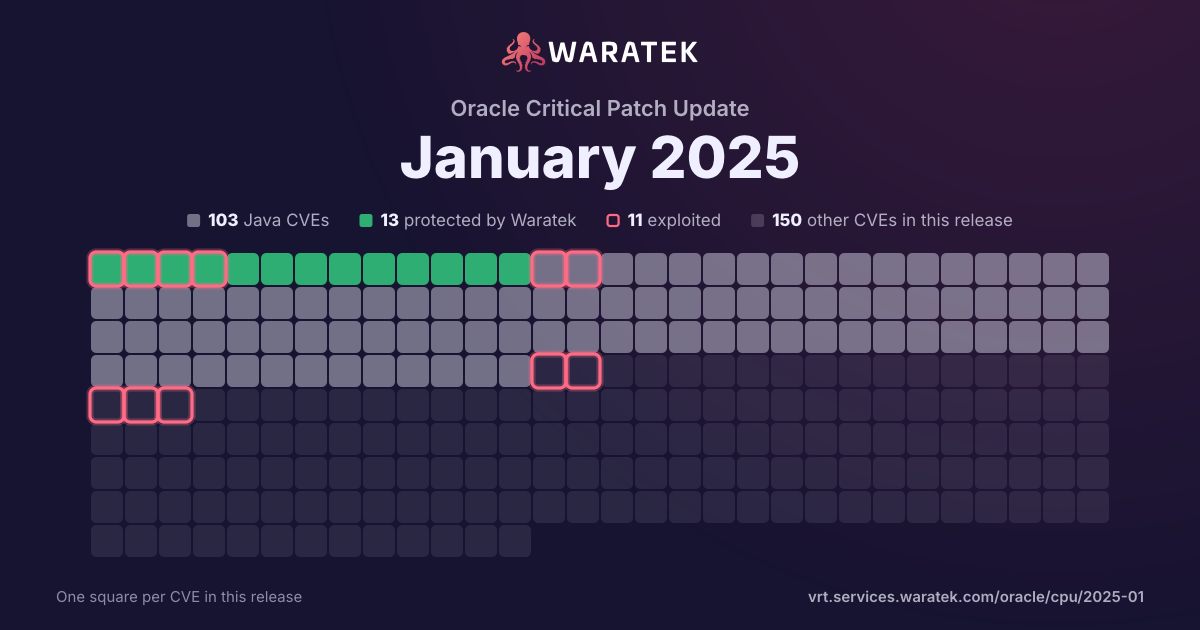
By status
13Protected by Waratek4Mitigation candidate86No exploit published17Outside Waratek scope133Not applicable
11Exploited, marked by the ring
No exploit published. For 48 of them, Oracle's security advisory is the source of public detail.
Protected by Waratek. Waratek RASP can block exploitation of these on systems that have not applied the patch yet.
Overview 12 matches · 0 in Waratek scope · 0 protected · 1 exploited · 1 CISA KEV · 2 public PoC · 1 EPSS ≥ 0.5
12matches
0in Waratek scope0.0%
0protected0.0%
1exploited8.3%
1CISA KEV8.3%
2public PoC16.7%
1EPSS ≥ 0.58.3%
Protected by Waratek
0
0.0%
Rule in development
0
0.0%
Mitigation candidate
0
0.0%
No exploit published
0
0.0%
Outside Waratek scope
0
0.0%
Not applicable
12
100.0%
Withdrawn CVE
0
0.0%
blocked by ARMR today
0
0.0%
partly blocked
0
0.0%
not blocked
12
100.0%
not established
0
0.0%
unrecorded
0
0.0%
Exploited
1
8.3%
Working exploit published
0
0.0%
Proof of concept only
1
8.3%
Forecast only
0
0.0%
No public exploit
10
83.3%
split by
peak 6 / quarter
Q3 191
Not applicable1
Critical1
not blocked1
No public exploit1
Q4 190
Q1 200
Q2 200
Q3 200
Q4 200
Q1 210
Q2 210
Q3 210
Q4 210
Q1 220
Q2 220
Q3 220
Q4 220
Q1 230
Q2 230
Q3 231
Not applicable1
Critical1
not blocked1
No public exploit1
Q4 231
Not applicable1
Critical1
not blocked1
No public exploit1
Q1 241
Not applicable1
Critical1
not blocked1
No public exploit1
Q2 242
Not applicable2
Critical2
not blocked2
No public exploit2
Q3 246
Not applicable6
Critical6
not blocked6
Exploited1
Proof of concept only1
No public exploit4
Q3 19Q1 20Q3 20Q1 21Q3 21Q1 22Q3 22Q1 23Q3 23Q1 24Q3 24
| CVE | Severity | Published▾ | Status | Exploitation | Description |
|---|---|---|---|---|---|
| CVE-2024-45492 | Critical | 2024-08-30 | Not applicable | No public exploit | An issue was discovered in libexpat before 2.6.3. nextScaffoldPart in xmlparse.c can have an integer overflow for m_groupSize on 32-bit platforms (where UINT_MAX equals SIZE_MAX). |
| CVE-2024-45491 | Critical | 2024-08-30 | Not applicable | No public exploit | An issue was discovered in libexpat before 2.6.3. dtdCopy in xmlparse.c can have an integer overflow for nDefaultAtts on 32-bit platforms (where UINT_MAX equals SIZE_MAX). |
| CVE-2024-45490 | Critical | 2024-08-30 | Not applicable | No public exploit | An issue was discovered in libexpat before 2.6.3. xmlparse.c does not reject a negative length for XML_ParseBuffer. |
| CVE-2024-40898 | Critical | 2024-07-18 | Not applicable | No public exploit | SSRF in Apache HTTP Server on Windows with mod_rewrite in server/vhost context, allows to potentially leak NTML hashes to a malicious server via SSRF and malicious requests. Users are recommended to upgrade to version 2.4.62 which fixes this issue. |
| CVE-2024-3596 | Critical | 2024-07-09 | Not applicable | Proof of concept only | RADIUS Protocol under RFC 2865 is susceptible to forgery attacks by a local attacker who can modify any valid Response (Access-Accept, Access-Reject, or Access-Challenge) to any other response using a chosen-prefix collision attack against MD5 Response Authenticator signature. |
| CVE-2024-38475 | Critical | 2024-07-01 | Not applicable | Exploited | Improper escaping of output in mod_rewrite in Apache HTTP Server 2.4.59 and earlier allows an attacker to map URLs to filesystem locations that are permitted to be served by the server but are not intentionally/directly reachable by any URL, resulting in code execution or source code disclosure. Substitutions in server context that use a backreferences or variables as the first segment of the substitution are affected. Some unsafe RewiteRules will be broken by this change and the rewrite flag "UnsafePrefixStat" can be used to opt back in once ensuring the substitution is appropriately constrained. |
| CVE-2024-37371 | Critical | 2024-06-28 | Not applicable | No public exploit | In MIT Kerberos 5 (aka krb5) before 1.21.3, an attacker can cause invalid memory reads during GSS message token handling by sending message tokens with invalid length fields. |
| CVE-2024-27280 | Critical | 2024-05-14 | Not applicable | No public exploit | A buffer-overread issue was discovered in StringIO 3.0.1, as distributed in Ruby 3.0.x through 3.0.6 and 3.1.x through 3.1.4. The ungetbyte and ungetc methods on a StringIO can read past the end of a string, and a subsequent call to StringIO.gets may return the memory value. 3.0.3 is the main fixed version; however, for Ruby 3.0 users, a fixed version is stringio 3.0.1.1, and for Ruby 3.1 users, a fixed version is stringio 3.0.1.2. |
| CVE-2024-23807 | Critical | 2024-02-29 | Not applicable | No public exploit | The Apache Xerces C++ XML parser on versions 3.0.0 before 3.2.5 contains a use-after-free error triggered during the scanning of external DTDs. Users are recommended to upgrade to version 3.2.5 which fixes the issue, or mitigate the issue by disabling DTD processing. This can be accomplished via the DOM using a standard parser feature, or via SAX using the XERCES_DISABLE_DTD environment variable. This issue has been disclosed before as CVE-2018-1311, but unfortunately that advisory incorrectly stated the issue would be fixed in version 3.2.3 or 3.2.4. |
| CVE-2023-3961 | Critical | 2023-11-03 | Not applicable | No public exploit | A path traversal vulnerability was identified in Samba when processing client pipe names connecting to Unix domain sockets within a private directory. Samba typically uses this mechanism to connect SMB clients to remote procedure call (RPC) services like SAMR LSA or SPOOLSS, which Samba initiates on demand. However, due to inadequate sanitization of incoming client pipe names, allowing a client to send a pipe name containing Unix directory traversal characters (../). This could result in SMB clients connecting as root to Unix domain sockets outside the private directory. If an attacker or client managed to send a pipe name resolving to an external service using an existing Unix domain socket, it could potentially lead to unauthorized access to the service and consequential adverse events, including compromise or service crashes. |
| CVE-2023-29824 | Critical | 2023-07-06 | Not applicable | No public exploit | A use-after-free issue was discovered in Py_FindObjects() function in SciPy versions prior to 1.8.0. NOTE: the vendor and discoverer indicate that this is not a security issue. |
| CVE-2019-15052 | Critical | 2019-08-14 | Not applicable | No public exploit | The HTTP client in Gradle before 5.6 sends authentication credentials originally destined for the configured host. If that host returns a 30x redirect, Gradle also sends those credentials to all subsequent hosts that the request redirects to. This is similar to CVE-2018-1000007. |