
Oracle Critical Patch Update January 2025
Released January 2025 · Oracle's advisory ↗ · ← Critical Patch Update, October 2024 · Critical Patch Update, April 2025 →
253 CVEs in this release, one square each
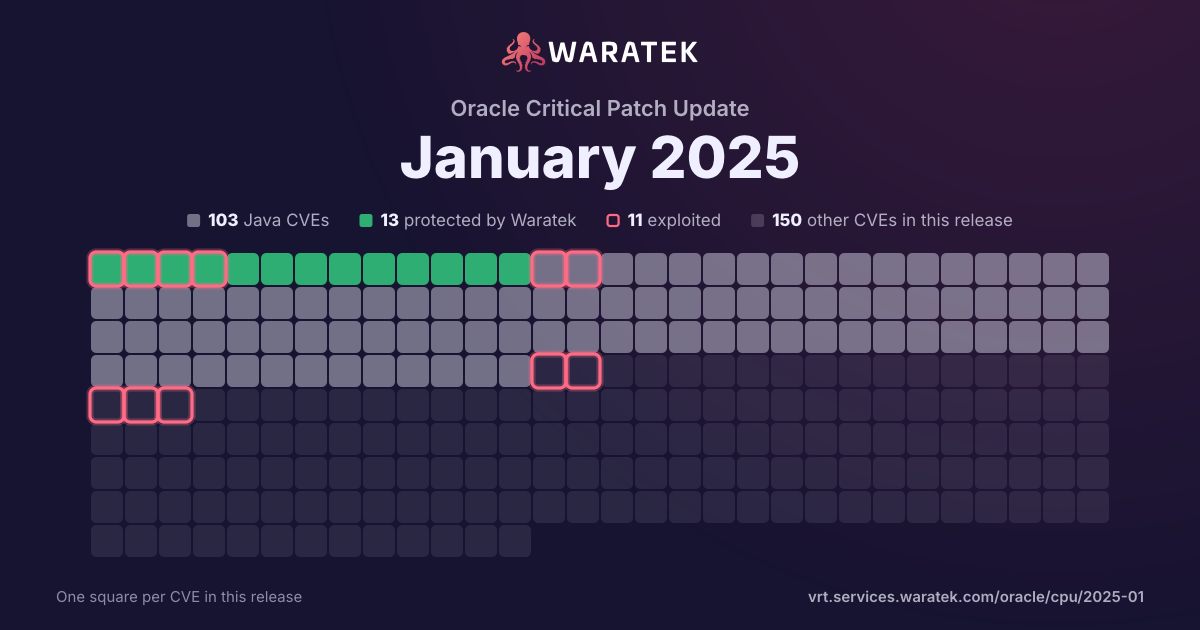
By status
13Protected by Waratek4Mitigation candidate86No exploit published17Outside Waratek scope133Not applicable
11Exploited, marked by the ring
No exploit published. For 48 of them, Oracle's security advisory is the source of public detail.
Protected by Waratek. Waratek RASP can block exploitation of these on systems that have not applied the patch yet.
Overview 82 matches · 32 in Waratek scope · 0 protected · 3 exploited · 1 CISA KEV · 8 public PoC · 5 EPSS ≥ 0.5
82matches
32in Waratek scope39.0%
0protected0.0%
3exploited3.7%
1CISA KEV1.2%
8public PoC9.8%
5EPSS ≥ 0.56.1%
Protected by Waratek
0
0.0%
Rule in development
0
0.0%
Mitigation candidate
2
2.4%
No exploit published
30
36.6%
Outside Waratek scope
7
8.5%
Not applicable
43
52.4%
Withdrawn CVE
0
0.0%
blocked by ARMR today
0
0.0%
partly blocked
0
0.0%
not blocked
82
100.0%
not established
0
0.0%
unrecorded
0
0.0%
split by
peak 19 / quarter
Q2 201
No exploit published1
High1
not blocked1
No public exploit1
Q3 200
Q4 203
No exploit published2
Not applicable1
High3
not blocked3
Proof of concept only1
No public exploit2
Q1 210
Q2 211
No exploit published1
High1
not blocked1
No public exploit1
Q3 211
Not applicable1
High1
not blocked1
No public exploit1
Q4 210
Q1 220
Q2 220
Q3 221
No exploit published1
High1
not blocked1
No public exploit1
Q4 220
Q1 232
No exploit published1
Not applicable1
High2
not blocked2
No public exploit2
Q2 232
No exploit published1
Not applicable1
High2
not blocked2
No public exploit2
Q3 235
Not applicable5
High5
not blocked5
No public exploit5
Q4 236
Mitigation candidate1
Not applicable5
High6
not blocked6
Exploited1
No public exploit5
Q1 2412
Mitigation candidate1
No exploit published3
Outside Waratek scope1
Not applicable7
High12
not blocked12
Proof of concept only3
No public exploit9
Q2 2419
No exploit published6
Outside Waratek scope3
Not applicable10
High19
not blocked19
Exploited2
Proof of concept only2
No public exploit15
Q3 2413
No exploit published4
Outside Waratek scope1
Not applicable8
High13
not blocked13
Working exploit published1
Proof of concept only2
Forecast only1
No public exploit9
Q4 243
Outside Waratek scope1
Not applicable2
High3
not blocked3
No public exploit3
Q1 2513
No exploit published10
Outside Waratek scope1
Not applicable2
High13
not blocked13
No public exploit13
Q3 20Q1 21Q3 21Q1 22Q3 22Q1 23Q3 23Q1 24Q3 24Q1 25
| CVE | Severity | Published▾ | Status | Exploitation | Description |
|---|---|---|---|---|---|
| CVE-2025-0509 | High | 2025-02-04 | Outside Waratek scope | No public exploit | A security issue was found in Sparkle before version 2.6.4. An attacker can replace an existing signed update with another payload, bypassing Sparkle’s (Ed)DSA signing checks. |
| CVE-2025-21571 | High | 2025-01-21 | Not applicable | No public exploit | Vulnerability in the Oracle VM VirtualBox product of Oracle Virtualization (component: Core). Supported versions that are affected are Prior to 7.0.24 and prior to 7.1.6. Easily exploitable vulnerability allows high privileged attacker with logon to the infrastructure where Oracle VM VirtualBox executes to compromise Oracle VM VirtualBox. While the vulnerability is in Oracle VM VirtualBox, attacks may significantly impact additional products (scope change). Successful attacks of this vulnerability can result in unauthorized creation, deletion or modification access to critical data or all Oracle VM VirtualBox accessible data as well as unauthorized read access to a subset of Oracle VM VirtualBox accessible data and unauthorized ability to cause a partial denial of service (partial DOS) of Oracle VM VirtualBox. CVSS 3.1 Base Score 7.3 (Confidentiality, Integrity and Availability impacts). CVSS Vector: (CVSS:3.1/AV:L/AC:L/PR:H/UI:N/S:C/C:L/I:H/A:L). |
| CVE-2025-21565 | High | 2025-01-21 | No exploit published | No public exploit | Vulnerability in the Oracle Agile PLM Framework product of Oracle Supply Chain (component: Install). The supported version that is affected is 9.3.6. Easily exploitable vulnerability allows unauthenticated attacker with network access via HTTP to compromise Oracle Agile PLM Framework. Successful attacks of this vulnerability can result in unauthorized access to critical data or complete access to all Oracle Agile PLM Framework accessible data. CVSS 3.1 Base Score 7.5 (Confidentiality impacts). CVSS Vector: (CVSS:3.1/AV:N/AC:L/PR:N/UI:N/S:U/C:H/I:N/A:N). |
| CVE-2025-21564 | High | 2025-01-21 | No exploit published | No public exploit | Vulnerability in the Oracle Agile PLM Framework product of Oracle Supply Chain (component: Agile Integration Services). The supported version that is affected is 9.3.6. Easily exploitable vulnerability allows low privileged attacker with network access via HTTP to compromise Oracle Agile PLM Framework. Successful attacks of this vulnerability can result in unauthorized access to critical data or complete access to all Oracle Agile PLM Framework accessible data and unauthorized ability to cause a hang or frequently repeatable crash (complete DOS) of Oracle Agile PLM Framework. CVSS 3.1 Base Score 8.1 (Confidentiality and Availability impacts). CVSS Vector: (CVSS:3.1/AV:N/AC:L/PR:L/UI:N/S:U/C:H/I:N/A:H). |
| CVE-2025-21549 | High | 2025-01-21 | No exploit published | No public exploit | Vulnerability in the Oracle WebLogic Server product of Oracle Fusion Middleware (component: Core). The supported version that is affected is 14.1.1.0.0. Easily exploitable vulnerability allows unauthenticated attacker with network access via HTTP/2 to compromise Oracle WebLogic Server. Successful attacks of this vulnerability can result in unauthorized ability to cause a hang or frequently repeatable crash (complete DOS) of Oracle WebLogic Server. CVSS 3.1 Base Score 7.5 (Availability impacts). CVSS Vector: (CVSS:3.1/AV:N/AC:L/PR:N/UI:N/S:U/C:N/I:N/A:H). |
| CVE-2025-21545 | High | 2025-01-21 | No exploit published | No public exploit | Vulnerability in the PeopleSoft Enterprise PeopleTools product of Oracle PeopleSoft (component: OpenSearch). Supported versions that are affected are 8.60 and 8.61. Easily exploitable vulnerability allows unauthenticated attacker with network access via HTTP to compromise PeopleSoft Enterprise PeopleTools. Successful attacks of this vulnerability can result in unauthorized ability to cause a hang or frequently repeatable crash (complete DOS) of PeopleSoft Enterprise PeopleTools. CVSS 3.1 Base Score 7.5 (Availability impacts). CVSS Vector: (CVSS:3.1/AV:N/AC:L/PR:N/UI:N/S:U/C:N/I:N/A:H). |
| CVE-2025-21532 | High | 2025-01-21 | No exploit published | No public exploit | Vulnerability in the Oracle Analytics Desktop product of Oracle Analytics (component: Install). Supported versions that are affected are Prior to 8.1.0. Easily exploitable vulnerability allows low privileged attacker with logon to the infrastructure where Oracle Analytics Desktop executes to compromise Oracle Analytics Desktop. Successful attacks of this vulnerability can result in takeover of Oracle Analytics Desktop. CVSS 3.1 Base Score 7.8 (Confidentiality, Integrity and Availability impacts). CVSS Vector: (CVSS:3.1/AV:L/AC:L/PR:L/UI:N/S:U/C:H/I:H/A:H). |
| CVE-2025-21521 | High | 2025-01-21 | Not applicable | No public exploit | Vulnerability in the MySQL Server product of Oracle MySQL (component: Server: Thread Pooling). Supported versions that are affected are 8.0.39 and prior, 8.4.2 and prior and 9.0.1 and prior. Easily exploitable vulnerability allows unauthenticated attacker with network access via multiple protocols to compromise MySQL Server. Successful attacks of this vulnerability can result in unauthorized ability to cause a hang or frequently repeatable crash (complete DOS) of MySQL Server. CVSS 3.1 Base Score 7.5 (Availability impacts). CVSS Vector: (CVSS:3.1/AV:N/AC:L/PR:N/UI:N/S:U/C:N/I:N/A:H). |
| CVE-2025-21516 | High | 2025-01-21 | No exploit published | No public exploit | Vulnerability in the Oracle Customer Care product of Oracle E-Business Suite (component: Service Requests). Supported versions that are affected are 12.2.5-12.2.13. Easily exploitable vulnerability allows low privileged attacker with network access via HTTP to compromise Oracle Customer Care. Successful attacks of this vulnerability can result in unauthorized creation, deletion or modification access to critical data or all Oracle Customer Care accessible data as well as unauthorized access to critical data or complete access to all Oracle Customer Care accessible data. CVSS 3.1 Base Score 8.1 (Confidentiality and Integrity impacts). CVSS Vector: (CVSS:3.1/AV:N/AC:L/PR:L/UI:N/S:U/C:H/I:H/A:N). |
| CVE-2025-21515 | High | 2025-01-21 | No exploit published | No public exploit | Vulnerability in the JD Edwards EnterpriseOne Tools product of Oracle JD Edwards (component: Web Runtime SEC). Supported versions that are affected are Prior to 9.2.9.0. Easily exploitable vulnerability allows low privileged attacker with network access via HTTP to compromise JD Edwards EnterpriseOne Tools. Successful attacks of this vulnerability can result in takeover of JD Edwards EnterpriseOne Tools. CVSS 3.1 Base Score 8.8 (Confidentiality, Integrity and Availability impacts). CVSS Vector: (CVSS:3.1/AV:N/AC:L/PR:L/UI:N/S:U/C:H/I:H/A:H). |
| CVE-2025-21511 | High | 2025-01-21 | No exploit published | No public exploit | Vulnerability in the JD Edwards EnterpriseOne Tools product of Oracle JD Edwards (component: Web Runtime SEC). Supported versions that are affected are Prior to 9.2.9.0. Easily exploitable vulnerability allows unauthenticated attacker with network access via HTTP to compromise JD Edwards EnterpriseOne Tools. Successful attacks of this vulnerability can result in unauthorized access to critical data or complete access to all JD Edwards EnterpriseOne Tools accessible data. CVSS 3.1 Base Score 7.5 (Confidentiality impacts). CVSS Vector: (CVSS:3.1/AV:N/AC:L/PR:N/UI:N/S:U/C:H/I:N/A:N). |
| CVE-2025-21510 | High | 2025-01-21 | No exploit published | No public exploit | Vulnerability in the JD Edwards EnterpriseOne Tools product of Oracle JD Edwards (component: Web Runtime SEC). Supported versions that are affected are Prior to 9.2.9.0. Easily exploitable vulnerability allows unauthenticated attacker with network access via HTTP to compromise JD Edwards EnterpriseOne Tools. Successful attacks of this vulnerability can result in unauthorized access to critical data or complete access to all JD Edwards EnterpriseOne Tools accessible data. CVSS 3.1 Base Score 7.5 (Confidentiality impacts). CVSS Vector: (CVSS:3.1/AV:N/AC:L/PR:N/UI:N/S:U/C:H/I:N/A:N). |
| CVE-2025-21506 | High | 2025-01-21 | No exploit published | No public exploit | Vulnerability in the Oracle Project Foundation product of Oracle E-Business Suite (component: Technology Foundation). Supported versions that are affected are 12.2.3-12.2.13. Easily exploitable vulnerability allows low privileged attacker with network access via HTTP to compromise Oracle Project Foundation. Successful attacks of this vulnerability can result in unauthorized creation, deletion or modification access to critical data or all Oracle Project Foundation accessible data as well as unauthorized access to critical data or complete access to all Oracle Project Foundation accessible data. CVSS 3.1 Base Score 8.1 (Confidentiality and Integrity impacts). CVSS Vector: (CVSS:3.1/AV:N/AC:L/PR:L/UI:N/S:U/C:H/I:H/A:N). |
| CVE-2024-47072 | High | 2024-11-08 | Not applicable | No public exploit | XStream is a simple library to serialize objects to XML and back again. This vulnerability may allow a remote attacker to terminate the application with a stack overflow error resulting in a denial of service only by manipulating the processed input stream when XStream is configured to use the BinaryStreamDriver. XStream 1.4.21 has been patched to detect the manipulation in the binary input stream causing the the stack overflow and raises an InputManipulationException instead. Users are advised to upgrade. Users unable to upgrade may catch the StackOverflowError in the client code calling XStream if XStream is configured to use the BinaryStreamDriver. |
| CVE-2024-9143 | High | 2024-10-16 | Outside Waratek scope | No public exploit | Issue summary: Use of the low-level GF(2^m) elliptic curve APIs with untrusted explicit values for the field polynomial can lead to out-of-bounds memory reads or writes. Impact summary: Out of bound memory writes can lead to an application crash or even a possibility of a remote code execution, however, in all the protocols involving Elliptic Curve Cryptography that we're aware of, either only "named curves" are supported, or, if explicit curve parameters are supported, they specify an X9.62 encoding of binary (GF(2^m)) curves that can't represent problematic input values. Thus the likelihood of existence of a vulnerable application is low. In particular, the X9.62 encoding is used for ECC keys in X.509 certificates, so problematic inputs cannot occur in the context of processing X.509 certificates. Any problematic use-cases would have to be using an "exotic" curve encoding. The affected APIs include: EC_GROUP_new_curve_GF2m(), EC_GROUP_new_from_params(), and various supporting BN_GF2m_*() functions. Applications working with "exotic" explicit binary (GF(2^m)) curve parameters, that make it possible to represent invalid field polynomials with a zero constant term, via the above or similar APIs, may terminate abruptly as a result of reading or writing outside of array bounds. Remote code execution cannot easily be ruled out. The FIPS modules in 3.3, 3.2, 3.1 and 3.0 are not affected by this issue. |
| CVE-2024-8927 | High | 2024-10-08 | Not applicable | No public exploit | In PHP versions 8.1.* before 8.1.30, 8.2.* before 8.2.24, 8.3.* before 8.3.12, HTTP_REDIRECT_STATUS variable is used to check whether or not CGI binary is being run by the HTTP server. However, in certain scenarios, the content of this variable can be controlled by the request submitter via HTTP headers, which can lead to cgi.force_redirect option not being correctly applied. In certain configurations this may lead to arbitrary file inclusion in PHP. |
| CVE-2024-7254 | High | 2024-09-19 | No exploit published | No public exploit | Any project that parses untrusted Protocol Buffers data containing an arbitrary number of nested groups / series of SGROUP tags can corrupted by exceeding the stack limit i.e. StackOverflow. Parsing nested groups as unknown fields with DiscardUnknownFieldsParser or Java Protobuf Lite parser, or against Protobuf map fields, creates unbounded recursions that can be abused by an attacker. |
| CVE-2024-45801 | High | 2024-09-16 | Not applicable | No public exploit | DOMPurify is a DOM-only, super-fast, uber-tolerant XSS sanitizer for HTML, MathML and SVG. It has been discovered that malicious HTML using special nesting techniques can bypass the depth checking added to DOMPurify in recent releases. It was also possible to use Prototype Pollution to weaken the depth check. This renders dompurify unable to avoid cross site scripting (XSS) attacks. This issue has been addressed in versions 2.5.4 and 3.1.3 of DOMPurify. All users are advised to upgrade. There are no known workarounds for this vulnerability. |
| CVE-2024-36138 | High | 2024-09-07 | Not applicable | No public exploit | Bypass incomplete fix of CVE-2024-27980, that arises from improper handling of batch files with all possible extensions on Windows via child_process.spawn / child_process.spawnSync. A malicious command line argument can inject arbitrary commands and achieve code execution even if the shell option is not enabled. |
| CVE-2024-6232 | High | 2024-09-03 | Not applicable | No public exploit | There is a MEDIUM severity vulnerability affecting CPython. Regular expressions that allowed excessive backtracking during tarfile.TarFile header parsing are vulnerable to ReDoS via specifically-crafted tar archives. |
| CVE-2024-6119 | High | 2024-09-03 | Outside Waratek scope | Forecast only | Issue summary: Applications performing certificate name checks (e.g., TLS clients checking server certificates) may attempt to read an invalid memory address resulting in abnormal termination of the application process. Impact summary: Abnormal termination of an application can a cause a denial of service. Applications performing certificate name checks (e.g., TLS clients checking server certificates) may attempt to read an invalid memory address when comparing the expected name with an `otherName` subject alternative name of an X.509 certificate. This may result in an exception that terminates the application program. Note that basic certificate chain validation (signatures, dates, ...) is not affected, the denial of service can occur only when the application also specifies an expected DNS name, Email address or IP address. TLS servers rarely solicit client certificates, and even when they do, they generally don't perform a name check against a reference identifier (expected identity), but rather extract the presented identity after checking the certificate chain. So TLS servers are generally not affected and the severity of the issue is Moderate. The FIPS modules in 3.3, 3.2, 3.1 and 3.0 are not affected by this issue. |
| CVE-2024-7885 | High | 2024-08-21 | No exploit published | No public exploit | A vulnerability was found in Undertow where the ProxyProtocolReadListener reuses the same StringBuilder instance across multiple requests. This issue occurs when the parseProxyProtocolV1 method processes multiple requests on the same HTTP connection. As a result, different requests may share the same StringBuilder instance, potentially leading to information leakage between requests or responses. In some cases, a value from a previous request or response may be erroneously reused, which could lead to unintended data exposure. This issue primarily results in errors and connection termination but creates a risk of data leakage in multi-request environments. |
| CVE-2024-7592 | High | 2024-08-19 | Not applicable | Proof of concept only | There is a LOW severity vulnerability affecting CPython, specifically the 'http.cookies' standard library module. When parsing cookies that contained backslashes for quoted characters in the cookie value, the parser would use an algorithm with quadratic complexity, resulting in excess CPU resources being used while parsing the value. |
| CVE-2024-41817 | High | 2024-07-29 | Not applicable | Proof of concept only | ImageMagick is a free and open-source software suite, used for editing and manipulating digital images. The `AppImage` version `ImageMagick` might use an empty path when setting `MAGICK_CONFIGURE_PATH` and `LD_LIBRARY_PATH` environment variables while executing, which might lead to arbitrary code execution by loading malicious configuration files or shared libraries in the current working directory while executing `ImageMagick`. The vulnerability is fixed in 7.11-36. |
| CVE-2024-25638 | High | 2024-07-22 | No exploit published | No public exploit | dnsjava is an implementation of DNS in Java. Records in DNS replies are not checked for their relevance to the query, allowing an attacker to respond with RRs from different zones. This vulnerability is fixed in 3.6.0. |
| CVE-2023-7272 | High | 2024-07-17 | Not applicable | No public exploit | In Eclipse Parsson before 1.0.4 and 1.1.3, a document with a large depth of nested objects can allow an attacker to cause a Java stack overflow exception and denial of service. Eclipse Parsson allows processing (e.g. parse, generate, transform and query) JSON documents. |
| CVE-2024-34750 | High | 2024-07-03 | No exploit published | No public exploit | Improper Handling of Exceptional Conditions, Uncontrolled Resource Consumption vulnerability in Apache Tomcat. When processing an HTTP/2 stream, Tomcat did not handle some cases of excessive HTTP headers correctly. This led to a miscounting of active HTTP/2 streams which in turn led to the use of an incorrect infinite timeout which allowed connections to remain open which should have been closed. This issue affects Apache Tomcat: from 11.0.0-M1 through 11.0.0-M20, from 10.1.0-M1 through 10.1.24, from 9.0.0-M1 through 9.0.89. The following versions were EOL at the time the CVE was created but are known to be affected: 8.5.0 though 8.5.100. Other EOL versions may also be affected. Users are recommended to upgrade to version 11.0.0-M21, 10.1.25 or 9.0.90, which fixes the issue. |
| CVE-2024-24791 | High | 2024-07-02 | Not applicable | No public exploit | The net/http HTTP/1.1 client mishandled the case where a server responds to a request with an "Expect: 100-continue" header with a non-informational (200 or higher) status. This mishandling could leave a client connection in an invalid state, where the next request sent on the connection will fail. An attacker sending a request to a net/http/httputil.ReverseProxy proxy can exploit this mishandling to cause a denial of service by sending "Expect: 100-continue" requests which elicit a non-informational response from the backend. Each such request leaves the proxy with an invalid connection, and causes one subsequent request using that connection to fail. |
| CVE-2024-38473 | High | 2024-07-01 | Not applicable | Working exploit published | Encoding problem in mod_proxy in Apache HTTP Server 2.4.59 and earlier allows request URLs with incorrect encoding to be sent to backend services, potentially bypassing authentication via crafted requests. Users are recommended to upgrade to version 2.4.60, which fixes this issue. |
| CVE-2024-37370 | High | 2024-06-28 | Not applicable | No public exploit | In MIT Kerberos 5 (aka krb5) before 1.21.3, an attacker can modify the plaintext Extra Count field of a confidential GSS krb5 wrap token, causing the unwrapped token to appear truncated to the application. |
| CVE-2024-38526 | High | 2024-06-26 | Not applicable | Exploited | pdoc provides API Documentation for Python Projects. Documentation generated with `pdoc --math` linked to JavaScript files from polyfill.io. The polyfill.io CDN has been sold and now serves malicious code. This issue has been fixed in pdoc 14.5.1. |
| CVE-2024-6162 | High | 2024-06-20 | No exploit published | No public exploit | A vulnerability was found in Undertow, where URL-encoded request paths can be mishandled during concurrent requests on the AJP listener. This issue arises because the same buffer is used to decode the paths for multiple requests simultaneously, leading to incorrect path information being processed. As a result, the server may attempt to access the wrong path, causing errors such as "404 Not Found" or other application failures. This flaw can potentially lead to a denial of service, as legitimate resources become inaccessible due to the path mix-up. |
| CVE-2024-4032 | High | 2024-06-17 | Not applicable | No public exploit | The “ipaddress” module contained incorrect information about whether certain IPv4 and IPv6 addresses were designated as “globally reachable” or “private”. This affected the is_private and is_global properties of the ipaddress.IPv4Address, ipaddress.IPv4Network, ipaddress.IPv6Address, and ipaddress.IPv6Network classes, where values wouldn’t be returned in accordance with the latest information from the IANA Special-Purpose Address Registries. CPython 3.12.4 and 3.13.0a6 contain updated information from these registries and thus have the intended behavior. |
| CVE-2024-0397 | High | 2024-06-17 | Not applicable | No public exploit | A defect was discovered in the Python “ssl” module where there is a memory race condition with the ssl.SSLContext methods “cert_store_stats()” and “get_ca_certs()”. The race condition can be triggered if the methods are called at the same time as certificates are loaded into the SSLContext, such as during the TLS handshake with a certificate directory configured. This issue is fixed in CPython 3.10.14, 3.11.9, 3.12.3, and 3.13.0a5. |
| CVE-2024-36114 | High | 2024-05-29 | No exploit published | No public exploit | Aircompressor is a library with ports of the Snappy, LZO, LZ4, and Zstandard compression algorithms to Java. All decompressor implementations of Aircompressor (LZ4, LZO, Snappy, Zstandard) can crash the JVM for certain input, and in some cases also leak the content of other memory of the Java process (which could contain sensitive information). When decompressing certain data, the decompressors try to access memory outside the bounds of the given byte arrays or byte buffers. Because Aircompressor uses the JDK class `sun.misc.Unsafe` to speed up memory access, no additional bounds checks are performed and this has similar security consequences as out-of-bounds access in C or C++, namely it can lead to non-deterministic behavior or crash the JVM. Users should update to Aircompressor 0.27 or newer where these issues have been fixed. When decompressing data from untrusted users, this can be exploited for a denial-of-service attack by crashing the JVM, or to leak other sensitive information from the Java process. There are no known workarounds for this issue. |
| CVE-2024-30172 | High | 2024-05-14 | No exploit published | No public exploit | An issue was discovered in Bouncy Castle Java Cryptography APIs before 1.78. An Ed25519 verification code infinite loop can occur via a crafted signature and public key. |
| CVE-2024-29857 | High | 2024-05-14 | No exploit published | No public exploit | An issue was discovered in ECCurve.java and ECCurve.cs in Bouncy Castle Java (BC Java) before 1.78, BC Java LTS before 2.73.6, BC-FJA before 1.0.2.5, and BC C# .Net before 2.3.1. Importing an EC certificate with crafted F2m parameters can lead to excessive CPU consumption during the evaluation of the curve parameters. |
| CVE-2024-4030 | High | 2024-05-07 | Not applicable | No public exploit | On Windows a directory returned by tempfile.mkdtemp() would not always have permissions set to restrict reading and writing to the temporary directory by other users, instead usually inheriting the correct permissions from the default location. Alternate configurations or users without a profile directory may not have the intended permissions. If you’re not using Windows or haven’t changed the temporary directory location then you aren’t affected by this vulnerability. On other platforms the returned directory is consistently readable and writable only by the current user. This issue was caused by Python not supporting Unix permissions on Windows. The fix adds support for Unix “700” for the mkdir function on Windows which is used by mkdtemp() to ensure the newly created directory has the proper permissions. |
| CVE-2024-33602 | High | 2024-05-06 | Outside Waratek scope | No public exploit | nscd: netgroup cache assumes NSS callback uses in-buffer strings The Name Service Cache Daemon's (nscd) netgroup cache can corrupt memory when the NSS callback does not store all strings in the provided buffer. The flaw was introduced in glibc 2.15 when the cache was added to nscd. This vulnerability is only present in the nscd binary. |
| CVE-2024-33601 | High | 2024-05-06 | Not applicable | No public exploit | nscd: netgroup cache may terminate daemon on memory allocation failure The Name Service Cache Daemon's (nscd) netgroup cache uses xmalloc or xrealloc and these functions may terminate the process due to a memory allocation failure resulting in a denial of service to the clients. The flaw was introduced in glibc 2.15 when the cache was added to nscd. This vulnerability is only present in the nscd binary. |
| CVE-2024-33599 | High | 2024-05-06 | Not applicable | No public exploit | nscd: Stack-based buffer overflow in netgroup cache If the Name Service Cache Daemon's (nscd) fixed size cache is exhausted by client requests then a subsequent client request for netgroup data may result in a stack-based buffer overflow. This flaw was introduced in glibc 2.15 when the cache was added to nscd. This vulnerability is only present in the nscd binary. |
| CVE-2024-34447 | High | 2024-05-03 | No exploit published | No public exploit | An issue was discovered in the Bouncy Castle Crypto Package For Java before BC TLS Java 1.0.19 (ships with BC Java 1.78, BC Java (LTS) 2.73.6) and before BC FIPS TLS Java 1.0.19. When endpoint identification is enabled in the BCJSSE and an SSL socket is created without an explicit hostname (as happens with HttpsURLConnection), hostname verification could be performed against a DNS-resolved IP address in some situations, opening up a possibility of DNS poisoning. |
| CVE-2024-2961 | High | 2024-04-17 | Outside Waratek scope | Exploited | The iconv() function in the GNU C Library versions 2.39 and older may overflow the output buffer passed to it by up to 4 bytes when converting strings to the ISO-2022-CN-EXT character set, which may be used to crash an application or overwrite a neighbouring variable. |
| CVE-2024-1135 | High | 2024-04-16 | Not applicable | No public exploit | Gunicorn fails to properly validate Transfer-Encoding headers, leading to HTTP Request Smuggling (HRS) vulnerabilities. By crafting requests with conflicting Transfer-Encoding headers, attackers can bypass security restrictions and access restricted endpoints. This issue is due to Gunicorn's handling of Transfer-Encoding headers, where it incorrectly processes requests with multiple, conflicting Transfer-Encoding headers, treating them as chunked regardless of the final encoding specified. This vulnerability allows for a range of attacks including cache poisoning, session manipulation, and data exposure. |
| CVE-2024-27309 | High | 2024-04-12 | No exploit published | No public exploit | While an Apache Kafka cluster is being migrated from ZooKeeper mode to KRaft mode, in some cases ACLs will not be correctly enforced. Two preconditions are needed to trigger the bug: 1. The administrator decides to remove an ACL 2. The resource associated with the removed ACL continues to have two or more other ACLs associated with it after the removal. When those two preconditions are met, Kafka will treat the resource as if it had only one ACL associated with it after the removal, rather than the two or more that would be correct. The incorrect condition is cleared by removing all brokers in ZK mode, or by adding a new ACL to the affected resource. Once the migration is completed, there is no metadata loss (the ACLs all remain). The full impact depends on the ACLs in use. If only ALLOW ACLs were configured during the migration, the impact would be limited to availability impact. if DENY ACLs were configured, the impact could include confidentiality and integrity impact depending on the ACLs configured, as the DENY ACLs might be ignored due to this vulnerability during the migration period. |
| CVE-2023-52070 | High | 2024-04-10 | Not applicable | No public exploit | JFreeChart v1.5.4 was discovered to be vulnerable to ArrayIndexOutOfBounds via the 'setSeriesNeedle(int index, int type)' method. NOTE: this is disputed by multiple third parties who believe there was not reasonable evidence to determine the existence of a vulnerability. The submission may have been based on a tool that is not sufficiently robust for vulnerability identification. |
| CVE-2024-27983 | High | 2024-04-09 | Not applicable | Proof of concept only | An attacker can make the Node.js HTTP/2 server completely unavailable by sending a small amount of HTTP/2 frames packets with a few HTTP/2 frames inside. It is possible to leave some data in nghttp2 memory after reset when headers with HTTP/2 CONTINUATION frame are sent to the server and then a TCP connection is abruptly closed by the client triggering the Http2Session destructor while header frames are still being processed (and stored in memory) causing a race condition. |
| CVE-2023-38709 | High | 2024-04-04 | Outside Waratek scope | Proof of concept only | Faulty input validation in the core of Apache allows malicious or exploitable backend/content generators to split HTTP responses. This issue affects Apache HTTP Server: through 2.4.58. |
| CVE-2024-29131 | High | 2024-03-21 | No exploit published | No public exploit | Out-of-bounds Write vulnerability in Apache Commons Configuration.This issue affects Apache Commons Configuration: from 2.0 before 2.10.1. Users are recommended to upgrade to version 2.10.1, which fixes the issue. |
| CVE-2023-6597 | High | 2024-03-19 | Not applicable | No public exploit | An issue was found in the CPython `tempfile.TemporaryDirectory` class affecting versions 3.12.1, 3.11.7, 3.10.13, 3.9.18, and 3.8.18 and prior. The tempfile.TemporaryDirectory class would dereference symlinks during cleanup of permissions-related errors. This means users which can run privileged programs are potentially able to modify permissions of files referenced by symlinks in some circumstances. |
| CVE-2024-24549 | High | 2024-03-13 | Mitigation candidate | Proof of concept only | Denial of Service due to improper input validation vulnerability for HTTP/2 requests in Apache Tomcat. When processing an HTTP/2 request, if the request exceeded any of the configured limits for headers, the associated HTTP/2 stream was not reset until after all of the headers had been processed.This issue affects Apache Tomcat: from 11.0.0-M1 through 11.0.0-M16, from 10.1.0-M1 through 10.1.18, from 9.0.0-M1 through 9.0.85, from 8.5.0 through 8.5.98. Other, older, EOL versions may also be affected. Users are recommended to upgrade to version 11.0.0-M17, 10.1.19, 9.0.86 or 8.5.99 which fix the issue. |
| CVE-2024-1442 | High | 2024-03-07 | Not applicable | No public exploit | A user with the permissions to create a data source can use Grafana API to create a data source with UID set to *. Doing this will grant the user access to read, query, edit and delete all data sources within the organization. |
| CVE-2024-24786 | High | 2024-03-05 | Not applicable | No public exploit | The protojson.Unmarshal function can enter an infinite loop when unmarshaling certain forms of invalid JSON. This condition can occur when unmarshaling into a message which contains a google.protobuf.Any value, or when the UnmarshalOptions.DiscardUnknown option is set. |
| CVE-2024-26130 | High | 2024-02-21 | Not applicable | No public exploit | cryptography is a package designed to expose cryptographic primitives and recipes to Python developers. Starting in version 38.0.0 and prior to version 42.0.4, if `pkcs12.serialize_key_and_certificates` is called with both a certificate whose public key did not match the provided private key and an `encryption_algorithm` with `hmac_hash` set (via `PrivateFormat.PKCS12.encryption_builder().hmac_hash(...)`, then a NULL pointer dereference would occur, crashing the Python process. This has been resolved in version 42.0.4, the first version in which a `ValueError` is properly raised. |
| CVE-2024-22019 | High | 2024-02-20 | Not applicable | No public exploit | A vulnerability in Node.js HTTP servers allows an attacker to send a specially crafted HTTP request with chunked encoding, leading to resource exhaustion and denial of service (DoS). The server reads an unbounded number of bytes from a single connection, exploiting the lack of limitations on chunk extension bytes. The issue can cause CPU and network bandwidth exhaustion, bypassing standard safeguards like timeouts and body size limits. |
| CVE-2024-25710 | High | 2024-02-19 | No exploit published | No public exploit | Loop with Unreachable Exit Condition ('Infinite Loop') vulnerability in Apache Commons Compress.This issue affects Apache Commons Compress: from 1.3 through 1.25.0. Users are recommended to upgrade to version 1.26.0 which fixes the issue. |
| CVE-2023-50868 | High | 2024-02-14 | Outside Waratek scope | Proof of concept only | The Closest Encloser Proof aspect of the DNS protocol (in RFC 5155 when RFC 9276 guidance is skipped) allows remote attackers to cause a denial of service (CPU consumption for SHA-1 computations) via DNSSEC responses in a random subdomain attack, aka the "NSEC3" issue. The RFC 5155 specification implies that an algorithm must perform thousands of iterations of a hash function in certain situations. |
| CVE-2023-4408 | High | 2024-02-13 | Not applicable | No public exploit | The DNS message parsing code in `named` includes a section whose computational complexity is overly high. It does not cause problems for typical DNS traffic, but crafted queries and responses may cause excessive CPU load on the affected `named` instance by exploiting this flaw. This issue affects both authoritative servers and recursive resolvers. This issue affects BIND 9 versions 9.0.0 through 9.16.45, 9.18.0 through 9.18.21, 9.19.0 through 9.19.19, 9.9.3-S1 through 9.11.37-S1, 9.16.8-S1 through 9.16.45-S1, and 9.18.11-S1 through 9.18.21-S1. |
| CVE-2023-52428 | High | 2024-02-11 | No exploit published | No public exploit | In Connect2id Nimbus JOSE+JWT before 9.37.2, an attacker can cause a denial of service (resource consumption) via a large JWE p2c header value (aka iteration count) for the PasswordBasedDecrypter (PBKDF2) component. |
| CVE-2023-50782 | High | 2024-02-05 | Not applicable | Proof of concept only | A flaw was found in the python-cryptography package. This issue may allow a remote attacker to decrypt captured messages in TLS servers that use RSA key exchanges, which may lead to exposure of confidential or sensitive data. |
| CVE-2023-26031 | High | 2023-11-16 | Not applicable | No public exploit | Relative library resolution in linux container-executor binary in Apache Hadoop 3.3.1-3.3.4 on Linux allows local user to gain root privileges. If the YARN cluster is accepting work from remote (authenticated) users, this MAY permit remote users to gain root privileges. Hadoop 3.3.0 updated the " YARN Secure Containers https://hadoop.apache.org/docs/stable/hadoop-yarn/hadoop-yarn-site/SecureContainer.html " to add a feature for executing user-submitted applications in isolated linux containers. The native binary HADOOP_HOME/bin/container-executor is used to launch these containers; it must be owned by root and have the suid bit set in order for the YARN processes to run the containers as the specific users submitting the jobs. The patch " YARN-10495 https://issues.apache.org/jira/browse/YARN-10495 . make the rpath of container-executor configurable" modified the library loading path for loading .so files from "$ORIGIN/" to ""$ORIGIN/:../lib/native/". This is the a path through which libcrypto.so is located. Thus it is is possible for a user with reduced privileges to install a malicious libcrypto library into a path to which they have write access, invoke the container-executor command, and have their modified library executed as root. If the YARN cluster is accepting work from remote (authenticated) users, and these users' submitted job are executed in the physical host, rather than a container, then the CVE permits remote users to gain root privileges. The fix for the vulnerability is to revert the change, which is done in YARN-11441 https://issues.apache.org/jira/browse/YARN-11441 , "Revert YARN-10495". This patch is in hadoop-3.3.5. To determine whether a version of container-executor is vulnerable, use the readelf command. If the RUNPATH or RPATH value contains the relative path "./lib/native/" then it is at risk $ readelf -d container-executor|grep 'RUNPATH\|RPATH' 0x000000000000001d (RUNPATH) Library runpath: [$ORIGIN/:../lib/native/] If it does not, then it is safe: $ readelf -d container-executor|grep 'RUNPATH\|RPATH' 0x000000000000001d (RUNPATH) Library runpath: [$ORIGIN/] For an at-risk version of container-executor to enable privilege escalation, the owner must be root and the suid bit must be set $ ls -laF /opt/hadoop/bin/container-executor ---Sr-s---. 1 root hadoop 802968 May 9 20:21 /opt/hadoop/bin/container-executor A safe installation lacks the suid bit; ideally is also not owned by root. $ ls -laF /opt/hadoop/bin/container-executor -rwxr-xr-x. 1 yarn hadoop 802968 May 9 20:21 /opt/hadoop/bin/container-executor This configuration does not support Yarn Secure Containers, but all other hadoop services, including YARN job execution outside secure containers continue to work. |
| CVE-2023-38552 | High | 2023-10-18 | Not applicable | No public exploit | When the Node.js policy feature checks the integrity of a resource against a trusted manifest, the application can intercept the operation and return a forged checksum to the node's policy implementation, thus effectively disabling the integrity check. Impacts: This vulnerability affects all users using the experimental policy mechanism in all active release lines: 18.x and, 20.x. Please note that at the time this CVE was issued, the policy mechanism is an experimental feature of Node.js. |
| CVE-2023-44487 | High | 2023-10-10 | Mitigation candidate | Exploited | The HTTP/2 protocol allows a denial of service (server resource consumption) because request cancellation can reset many streams quickly, as exploited in the wild in August through October 2023. |
| CVE-2023-36785 | High | 2023-10-10 | Not applicable | No public exploit | Microsoft ODBC Driver for SQL Server Remote Code Execution Vulnerability |
| CVE-2023-36730 | High | 2023-10-10 | Not applicable | No public exploit | Microsoft ODBC Driver for SQL Server Remote Code Execution Vulnerability |
| CVE-2023-43804 | High | 2023-10-04 | Not applicable | No public exploit | urllib3 is a user-friendly HTTP client library for Python. urllib3 doesn't treat the `Cookie` HTTP header special or provide any helpers for managing cookies over HTTP, that is the responsibility of the user. However, it is possible for a user to specify a `Cookie` header and unknowingly leak information via HTTP redirects to a different origin if that user doesn't disable redirects explicitly. This issue has been patched in urllib3 version 1.26.17 or 2.0.5. |
| CVE-2023-4785 | High | 2023-09-13 | Not applicable | No public exploit | Lack of error handling in the TCP server in Google's gRPC starting version 1.23 on posix-compatible platforms (ex. Linux) allows an attacker to cause a denial of service by initiating a significant number of connections with the server. Note that gRPC C++ Python, and Ruby are affected, but gRPC Java, and Go are NOT affected. |
| CVE-2023-4782 | High | 2023-09-08 | Not applicable | No public exploit | Terraform version 1.0.8 through 1.5.6 allows arbitrary file write during the `init` operation if run on maliciously crafted Terraform configuration. This vulnerability is fixed in Terraform 1.5.7. |
| CVE-2023-40577 | High | 2023-08-25 | Not applicable | No public exploit | Alertmanager handles alerts sent by client applications such as the Prometheus server. An attacker with the permission to perform POST requests on the /api/v1/alerts endpoint could be able to execute arbitrary JavaScript code on the users of Prometheus Alertmanager. This issue has been fixed in Alertmanager version 0.2.51. |
| CVE-2020-22218 | High | 2023-08-22 | Not applicable | No public exploit | An issue was discovered in function _libssh2_packet_add in libssh2 1.10.0 allows attackers to access out of bounds memory. |
| CVE-2023-33953 | High | 2023-08-09 | Not applicable | No public exploit | gRPC contains a vulnerability that allows hpack table accounting errors could lead to unwanted disconnects between clients and servers in exceptional cases/ Three vectors were found that allow the following DOS attacks: - Unbounded memory buffering in the HPACK parser - Unbounded CPU consumption in the HPACK parser The unbounded CPU consumption is down to a copy that occurred per-input-block in the parser, and because that could be unbounded due to the memory copy bug we end up with an O(n^2) parsing loop, with n selected by the client. The unbounded memory buffering bugs: - The header size limit check was behind the string reading code, so we needed to first buffer up to a 4 gigabyte string before rejecting it as longer than 8 or 16kb. - HPACK varints have an encoding quirk whereby an infinite number of 0’s can be added at the start of an integer. gRPC’s hpack parser needed to read all of them before concluding a parse. - gRPC’s metadata overflow check was performed per frame, so that the following sequence of frames could cause infinite buffering: HEADERS: containing a: 1 CONTINUATION: containing a: 2 CONTINUATION: containing a: 3 etc… |
| CVE-2023-35947 | High | 2023-06-30 | Not applicable | No public exploit | Gradle is a build tool with a focus on build automation and support for multi-language development. In affected versions when unpacking Tar archives, Gradle did not check that files could be written outside of the unpack location. This could lead to important files being overwritten anywhere the Gradle process has write permissions. For a build reading Tar entries from a Tar archive, this issue could allow Gradle to disclose information from sensitive files through an arbitrary file read. To exploit this behavior, an attacker needs to either control the source of an archive already used by the build or modify the build to interact with a malicious archive. It is unlikely that this would go unnoticed. A fix has been released in Gradle 7.6.2 and 8.2 to protect against this vulnerability. Starting from these versions, Gradle will refuse to handle Tar archives which contain path traversal elements in a Tar entry name. Users are advised to upgrade. There are no known workarounds for this vulnerability. ### Impact This is a path traversal vulnerability when Gradle deals with Tar archives, often referenced as TarSlip, a variant of ZipSlip. * When unpacking Tar archives, Gradle did not check that files could be written outside of the unpack location. This could lead to important files being overwritten anywhere the Gradle process has write permissions. * For a build reading Tar entries from a Tar archive, this issue could allow Gradle to disclose information from sensitive files through an arbitrary file read. To exploit this behavior, an attacker needs to either control the source of an archive already used by the build or modify the build to interact with a malicious archive. It is unlikely that this would go unnoticed. Gradle uses Tar archives for its [Build Cache](https://docs.gradle.org/current/userguide/build_cache.html). These archives are safe when created by Gradle. But if an attacker had control of a remote build cache server, they could inject malicious build cache entries that leverage this vulnerability. This attack vector could also be exploited if a man-in-the-middle can be performed between the remote cache and the build. ### Patches A fix has been released in Gradle 7.6.2 and 8.2 to protect against this vulnerability. Starting from these versions, Gradle will refuse to handle Tar archives which contain path traversal elements in a Tar entry name. It is recommended that users upgrade to a patched version. ### Workarounds There is no workaround. * If your build deals with Tar archives that you do not fully trust, you need to inspect them to confirm they do not attempt to leverage this vulnerability. * If you use the Gradle remote build cache, make sure only trusted parties have write access to it and that connections to the remote cache are properly secured. ### References * [CWE-22: Improper Limitation of a Pathname to a Restricted Directory ('Path Traversal')](https://cwe.mitre.org/data/definitions/22.html) * [Gradle Build Cache](https://docs.gradle.org/current/userguide/build_cache.html) * [ZipSlip](https://security.snyk.io/research/zip-slip-vulnerability) |
| CVE-2023-2976 | High | 2023-06-14 | No exploit published | No public exploit | Use of Java's default temporary directory for file creation in `FileBackedOutputStream` in Google Guava versions 1.0 to 31.1 on Unix systems and Android Ice Cream Sandwich allows other users and apps on the machine with access to the default Java temporary directory to be able to access the files created by the class. Even though the security vulnerability is fixed in version 32.0.0, we recommend using version 32.0.1 as version 32.0.0 breaks some functionality under Windows. |
| CVE-2023-24998 | High | 2023-02-20 | No exploit published | No public exploit | Apache Commons FileUpload before 1.5 does not limit the number of request parts to be processed resulting in the possibility of an attacker triggering a DoS with a malicious upload or series of uploads. Note that, like all of the file upload limits, the new configuration option (FileUploadBase#setFileCountMax) is not enabled by default and must be explicitly configured. |
| CVE-2022-26345 | High | 2023-02-16 | Not applicable | No public exploit | Uncontrolled search path element in the Intel(R) oneAPI Toolkit OpenMP before version 2022.1 may allow an authenticated user to potentially enable escalation of privilege via local access. |
| CVE-2022-40150 | High | 2022-09-16 | No exploit published | No public exploit | Those using Jettison to parse untrusted XML or JSON data may be vulnerable to Denial of Service attacks (DOS). If the parser is running on user supplied input, an attacker may supply content that causes the parser to crash by Out of memory. This effect may support a denial of service attack. |
| CVE-2021-32751 | High | 2021-07-20 | Not applicable | No public exploit | Gradle is a build tool with a focus on build automation. In versions prior to 7.2, start scripts generated by the `application` plugin and the `gradlew` script are both vulnerable to arbitrary code execution when an attacker is able to change environment variables for the user running the script. This may impact those who use `gradlew` on Unix-like systems or use the scripts generated by Gradle in thieir application on Unix-like systems. For this vulnerability to be exploitable, an attacker needs to be able to set the value of particular environment variables and have those environment variables be seen by the vulnerable scripts. This issue has been patched in Gradle 7.2 by removing the use of `eval` and requiring the use of the `bash` shell. There are a few workarounds available. For CI/CD systems using the Gradle build tool, one may ensure that untrusted users are unable to change environment variables for the user that executes `gradlew`. If one is unable to upgrade to Gradle 7.2, one may generate a new `gradlew` script with Gradle 7.2 and use it for older versions of Gradle. Fpplications using start scripts generated by Gradle, one may ensure that untrusted users are unable to change environment variables for the user that executes the start script. A vulnerable start script could be manually patched to remove the use of `eval` or the use of environment variables that affect the application's command-line. If the application is simple enough, one may be able to avoid the use of the start scripts by running the application directly with Java command. |
| CVE-2021-29428 | High | 2021-04-13 | No exploit published | No public exploit | In Gradle before version 7.0, on Unix-like systems, the system temporary directory can be created with open permissions that allow multiple users to create and delete files within it. Gradle builds could be vulnerable to a local privilege escalation from an attacker quickly deleting and recreating files in the system temporary directory. This vulnerability impacted builds using precompiled script plugins written in Kotlin DSL and tests for Gradle plugins written using ProjectBuilder or TestKit. If you are on Windows or modern versions of macOS, you are not vulnerable. If you are on a Unix-like operating system with the "sticky" bit set on your system temporary directory, you are not vulnerable. The problem has been patched and released with Gradle 7.0. As a workaround, on Unix-like operating systems, ensure that the "sticky" bit is set. This only allows the original user (or root) to delete a file. If you are unable to change the permissions of the system temporary directory, you can move the Java temporary directory by setting the System Property `java.io.tmpdir`. The new path needs to limit permissions to the build user only. For additional details refer to the referenced GitHub Security Advisory. |
| CVE-2020-28975 | High | 2020-11-21 | Not applicable | Proof of concept only | svm_predict_values in svm.cpp in Libsvm v324, as used in scikit-learn 0.23.2 and other products, allows attackers to cause a denial of service (segmentation fault) via a crafted model SVM (introduced via pickle, json, or any other model permanence standard) with a large value in the _n_support array. NOTE: the scikit-learn vendor's position is that the behavior can only occur if the library's API is violated by an application that changes a private attribute. |
| CVE-2020-7760 | High | 2020-10-30 | No exploit published | No public exploit | This affects the package codemirror before 5.58.2; the package org.apache.marmotta.webjars:codemirror before 5.58.2. The vulnerable regular expression is located in https://github.com/codemirror/CodeMirror/blob/cdb228ac736369c685865b122b736cd0d397836c/mode/javascript/javascript.jsL129. The ReDOS vulnerability of the regex is mainly due to the sub-pattern (s|/*.*?*/)* |
| CVE-2020-11979 | High | 2020-10-01 | No exploit published | No public exploit | As mitigation for CVE-2020-1945 Apache Ant 1.10.8 changed the permissions of temporary files it created so that only the current user was allowed to access them. Unfortunately the fixcrlf task deleted the temporary file and created a new one without said protection, effectively nullifying the effort. This would still allow an attacker to inject modified source files into the build process. |
| CVE-2020-2849 | High | 2020-04-15 | No exploit published | No public exploit | Vulnerability in the Oracle Depot Repair product of Oracle E-Business Suite (component: Estimate and Actual Charges). Supported versions that are affected are 12.1.1-12.1.3. Easily exploitable vulnerability allows unauthenticated attacker with network access via HTTP to compromise Oracle Depot Repair. Successful attacks require human interaction from a person other than the attacker and while the vulnerability is in Oracle Depot Repair, attacks may significantly impact additional products. Successful attacks of this vulnerability can result in unauthorized access to critical data or complete access to all Oracle Depot Repair accessible data as well as unauthorized update, insert or delete access to some of Oracle Depot Repair accessible data. CVSS 3.0 Base Score 8.2 (Confidentiality and Integrity impacts). CVSS Vector: (CVSS:3.0/AV:N/AC:L/PR:N/UI:R/S:C/C:H/I:L/A:N). |