
Oracle Critical Patch Update January 2025
Released January 2025 · Oracle's advisory ↗ · ← Critical Patch Update, October 2024 · Critical Patch Update, April 2025 →
253 CVEs in this release, one square each
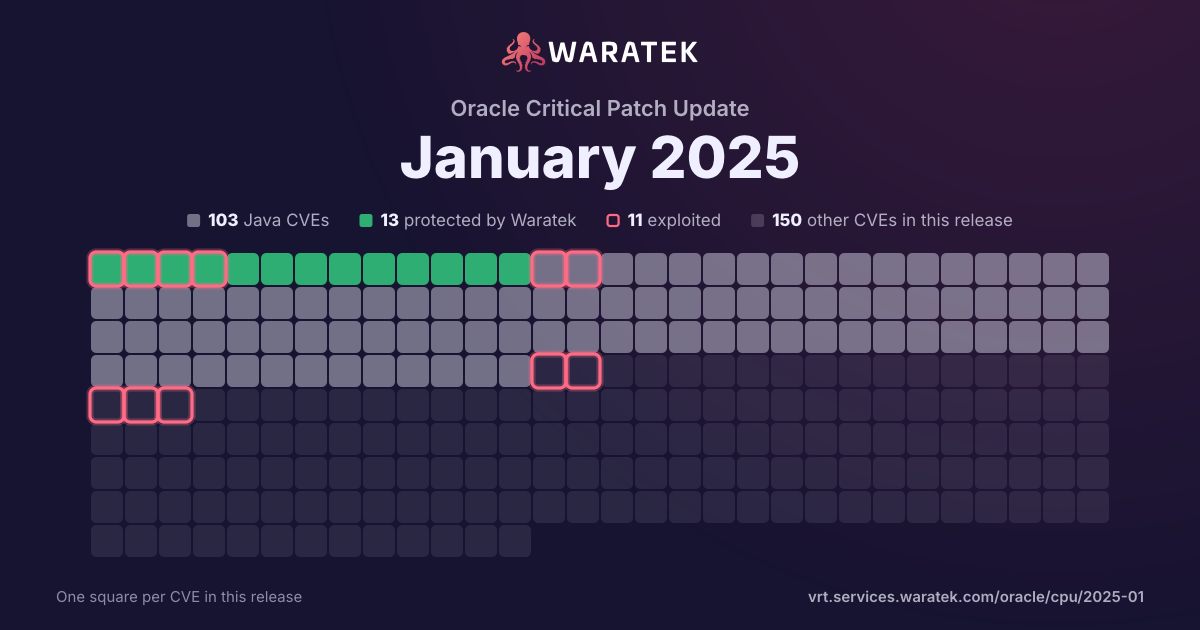
By status
13Protected by Waratek4Mitigation candidate86No exploit published17Outside Waratek scope133Not applicable
11Exploited, marked by the ring
No exploit published. For 48 of them, Oracle's security advisory is the source of public detail.
Protected by Waratek. Waratek RASP can block exploitation of these on systems that have not applied the patch yet.
Overview 133 matches · 0 in Waratek scope · 0 protected · 3 exploited · 1 CISA KEV · 5 public PoC · 2 EPSS ≥ 0.5
133matches
0in Waratek scope0.0%
0protected0.0%
3exploited2.3%
1CISA KEV0.8%
5public PoC3.8%
2EPSS ≥ 0.51.5%
Protected by Waratek
0
0.0%
Rule in development
0
0.0%
Mitigation candidate
0
0.0%
No exploit published
0
0.0%
Outside Waratek scope
0
0.0%
Not applicable
133
100.0%
Withdrawn CVE
0
0.0%
blocked by ARMR today
0
0.0%
partly blocked
0
0.0%
not blocked
133
100.0%
not established
0
0.0%
unrecorded
0
0.0%
split by
peak 38 / quarter
Q2 191
Not applicable1
Medium1
not blocked1
No public exploit1
Q3 191
Not applicable1
Critical1
not blocked1
No public exploit1
Q4 190
Q1 200
Q2 200
Q3 200
Q4 201
Not applicable1
High1
not blocked1
Proof of concept only1
Q1 210
Q2 210
Q3 211
Not applicable1
High1
not blocked1
No public exploit1
Q4 210
Q1 220
Q2 220
Q3 220
Q4 220
Q1 232
Not applicable2
High1
Medium1
not blocked2
No public exploit2
Q2 233
Not applicable3
High1
Medium2
not blocked3
No public exploit3
Q3 239
Not applicable9
Critical1
High5
Medium3
not blocked9
No public exploit9
Q4 2315
Not applicable15
Critical1
High5
Medium9
not blocked15
Proof of concept only2
No public exploit13
Q1 2417
Not applicable17
Critical1
High7
Medium9
not blocked17
Proof of concept only3
No public exploit14
Q2 2418
Not applicable18
Critical2
High10
Medium6
not blocked18
Exploited1
Proof of concept only2
No public exploit15
Q3 2422
Not applicable22
Critical6
High8
Medium6
Low2
not blocked22
Exploited1
Working exploit published1
Proof of concept only3
No public exploit17
Q4 245
Not applicable5
High2
Medium2
Low1
not blocked5
Exploited1
Proof of concept only1
No public exploit3
Q1 2538
Not applicable38
High2
Medium33
Low3
not blocked38
No public exploit38
Q3 19Q1 20Q3 20Q1 21Q3 21Q1 22Q3 22Q1 23Q3 23Q1 24Q3 24Q1 25
| CVE | Severity | Published▾ | Status | Exploitation | Description |
|---|---|---|---|---|---|
| CVE-2023-46219 | Medium | 2023-12-12 | Not applicable | Proof of concept only | When saving HSTS data to an excessively long file name, curl could end up removing all contents, making subsequent requests using that file unaware of the HSTS status they should otherwise use. |
| CVE-2023-46218 | Medium | 2023-12-07 | Not applicable | Proof of concept only | This flaw allows a malicious HTTP server to set "super cookies" in curl that are then passed back to more origins than what is otherwise allowed or possible. This allows a site to set cookies that then would get sent to different and unrelated sites and domains. It could do this by exploiting a mixed case flaw in curl's function that verifies a given cookie domain against the Public Suffix List (PSL). For example a cookie could be set with `domain=co.UK` when the URL used a lower case hostname `curl.co.uk`, even though `co.uk` is listed as a PSL domain. |
| CVE-2023-5981 | Medium | 2023-11-28 | Not applicable | No public exploit | A vulnerability was found that the response times to malformed ciphertexts in RSA-PSK ClientKeyExchange differ from response times of ciphertexts with correct PKCS#1 v1.5 padding. |
| CVE-2023-26031 | High | 2023-11-16 | Not applicable | No public exploit | Relative library resolution in linux container-executor binary in Apache Hadoop 3.3.1-3.3.4 on Linux allows local user to gain root privileges. If the YARN cluster is accepting work from remote (authenticated) users, this MAY permit remote users to gain root privileges. Hadoop 3.3.0 updated the " YARN Secure Containers https://hadoop.apache.org/docs/stable/hadoop-yarn/hadoop-yarn-site/SecureContainer.html " to add a feature for executing user-submitted applications in isolated linux containers. The native binary HADOOP_HOME/bin/container-executor is used to launch these containers; it must be owned by root and have the suid bit set in order for the YARN processes to run the containers as the specific users submitting the jobs. The patch " YARN-10495 https://issues.apache.org/jira/browse/YARN-10495 . make the rpath of container-executor configurable" modified the library loading path for loading .so files from "$ORIGIN/" to ""$ORIGIN/:../lib/native/". This is the a path through which libcrypto.so is located. Thus it is is possible for a user with reduced privileges to install a malicious libcrypto library into a path to which they have write access, invoke the container-executor command, and have their modified library executed as root. If the YARN cluster is accepting work from remote (authenticated) users, and these users' submitted job are executed in the physical host, rather than a container, then the CVE permits remote users to gain root privileges. The fix for the vulnerability is to revert the change, which is done in YARN-11441 https://issues.apache.org/jira/browse/YARN-11441 , "Revert YARN-10495". This patch is in hadoop-3.3.5. To determine whether a version of container-executor is vulnerable, use the readelf command. If the RUNPATH or RPATH value contains the relative path "./lib/native/" then it is at risk $ readelf -d container-executor|grep 'RUNPATH\|RPATH' 0x000000000000001d (RUNPATH) Library runpath: [$ORIGIN/:../lib/native/] If it does not, then it is safe: $ readelf -d container-executor|grep 'RUNPATH\|RPATH' 0x000000000000001d (RUNPATH) Library runpath: [$ORIGIN/] For an at-risk version of container-executor to enable privilege escalation, the owner must be root and the suid bit must be set $ ls -laF /opt/hadoop/bin/container-executor ---Sr-s---. 1 root hadoop 802968 May 9 20:21 /opt/hadoop/bin/container-executor A safe installation lacks the suid bit; ideally is also not owned by root. $ ls -laF /opt/hadoop/bin/container-executor -rwxr-xr-x. 1 yarn hadoop 802968 May 9 20:21 /opt/hadoop/bin/container-executor This configuration does not support Yarn Secure Containers, but all other hadoop services, including YARN job execution outside secure containers continue to work. |
| CVE-2023-5678 | Medium | 2023-11-06 | Not applicable | No public exploit | Issue summary: Generating excessively long X9.42 DH keys or checking excessively long X9.42 DH keys or parameters may be very slow. Impact summary: Applications that use the functions DH_generate_key() to generate an X9.42 DH key may experience long delays. Likewise, applications that use DH_check_pub_key(), DH_check_pub_key_ex() or EVP_PKEY_public_check() to check an X9.42 DH key or X9.42 DH parameters may experience long delays. Where the key or parameters that are being checked have been obtained from an untrusted source this may lead to a Denial of Service. While DH_check() performs all the necessary checks (as of CVE-2023-3817), DH_check_pub_key() doesn't make any of these checks, and is therefore vulnerable for excessively large P and Q parameters. Likewise, while DH_generate_key() performs a check for an excessively large P, it doesn't check for an excessively large Q. An application that calls DH_generate_key() or DH_check_pub_key() and supplies a key or parameters obtained from an untrusted source could be vulnerable to a Denial of Service attack. DH_generate_key() and DH_check_pub_key() are also called by a number of other OpenSSL functions. An application calling any of those other functions may similarly be affected. The other functions affected by this are DH_check_pub_key_ex(), EVP_PKEY_public_check(), and EVP_PKEY_generate(). Also vulnerable are the OpenSSL pkey command line application when using the "-pubcheck" option, as well as the OpenSSL genpkey command line application. The OpenSSL SSL/TLS implementation is not affected by this issue. The OpenSSL 3.0 and 3.1 FIPS providers are not affected by this issue. |
| CVE-2023-42669 | Medium | 2023-11-06 | Not applicable | No public exploit | A vulnerability was found in Samba's "rpcecho" development server, a non-Windows RPC server used to test Samba's DCE/RPC stack elements. This vulnerability stems from an RPC function that can be blocked indefinitely. The issue arises because the "rpcecho" service operates with only one worker in the main RPC task, allowing calls to the "rpcecho" server to be blocked for a specified time, causing service disruptions. This disruption is triggered by a "sleep()" call in the "dcesrv_echo_TestSleep()" function under specific conditions. Authenticated users or attackers can exploit this vulnerability to make calls to the "rpcecho" server, requesting it to block for a specified duration, effectively disrupting most services and leading to a complete denial of service on the AD DC. The DoS affects all other services as "rpcecho" runs in the main RPC task. |
| CVE-2023-4091 | Medium | 2023-11-03 | Not applicable | No public exploit | A vulnerability was discovered in Samba, where the flaw allows SMB clients to truncate files, even with read-only permissions when the Samba VFS module "acl_xattr" is configured with "acl_xattr:ignore system acls = yes". The SMB protocol allows opening files when the client requests read-only access but then implicitly truncates the opened file to 0 bytes if the client specifies a separate OVERWRITE create disposition request. The issue arises in configurations that bypass kernel file system permissions checks, relying solely on Samba's permissions. |
| CVE-2023-3961 | Critical | 2023-11-03 | Not applicable | No public exploit | A path traversal vulnerability was identified in Samba when processing client pipe names connecting to Unix domain sockets within a private directory. Samba typically uses this mechanism to connect SMB clients to remote procedure call (RPC) services like SAMR LSA or SPOOLSS, which Samba initiates on demand. However, due to inadequate sanitization of incoming client pipe names, allowing a client to send a pipe name containing Unix directory traversal characters (../). This could result in SMB clients connecting as root to Unix domain sockets outside the private directory. If an attacker or client managed to send a pipe name resolving to an external service using an existing Unix domain socket, it could potentially lead to unauthorized access to the service and consequential adverse events, including compromise or service crashes. |
| CVE-2023-38552 | High | 2023-10-18 | Not applicable | No public exploit | When the Node.js policy feature checks the integrity of a resource against a trusted manifest, the application can intercept the operation and return a forged checksum to the node's policy implementation, thus effectively disabling the integrity check. Impacts: This vulnerability affects all users using the experimental policy mechanism in all active release lines: 18.x and, 20.x. Please note that at the time this CVE was issued, the policy mechanism is an experimental feature of Node.js. |
| CVE-2023-45803 | Medium | 2023-10-17 | Not applicable | No public exploit | urllib3 is a user-friendly HTTP client library for Python. urllib3 previously wouldn't remove the HTTP request body when an HTTP redirect response using status 301, 302, or 303 after the request had its method changed from one that could accept a request body (like `POST`) to `GET` as is required by HTTP RFCs. Although this behavior is not specified in the section for redirects, it can be inferred by piecing together information from different sections and we have observed the behavior in other major HTTP client implementations like curl and web browsers. Because the vulnerability requires a previously trusted service to become compromised in order to have an impact on confidentiality we believe the exploitability of this vulnerability is low. Additionally, many users aren't putting sensitive data in HTTP request bodies, if this is the case then this vulnerability isn't exploitable. Both of the following conditions must be true to be affected by this vulnerability: 1. Using urllib3 and submitting sensitive information in the HTTP request body (such as form data or JSON) and 2. The origin service is compromised and starts redirecting using 301, 302, or 303 to a malicious peer or the redirected-to service becomes compromised. This issue has been addressed in versions 1.26.18 and 2.0.7 and users are advised to update to resolve this issue. Users unable to update should disable redirects for services that aren't expecting to respond with redirects with `redirects=False` and disable automatic redirects with `redirects=False` and handle 301, 302, and 303 redirects manually by stripping the HTTP request body. |
| CVE-2023-36785 | High | 2023-10-10 | Not applicable | No public exploit | Microsoft ODBC Driver for SQL Server Remote Code Execution Vulnerability |
| CVE-2023-36730 | High | 2023-10-10 | Not applicable | No public exploit | Microsoft ODBC Driver for SQL Server Remote Code Execution Vulnerability |
| CVE-2023-42445 | Medium | 2023-10-06 | Not applicable | No public exploit | Gradle is a build tool with a focus on build automation and support for multi-language development. In some cases, when Gradle parses XML files, resolving XML external entities is not disabled. Combined with an Out Of Band XXE attack (OOB-XXE), just parsing XML can lead to exfiltration of local text files to a remote server. Gradle parses XML files for several purposes. Most of the time, Gradle parses XML files it generated or were already present locally. Only Ivy XML descriptors and Maven POM files can be fetched from remote repositories and parsed by Gradle. In Gradle 7.6.3 and 8.4, resolving XML external entities has been disabled for all use cases to protect against this vulnerability. Gradle will now refuse to parse XML files that have XML external entities. |
| CVE-2023-44387 | Medium | 2023-10-05 | Not applicable | No public exploit | Gradle is a build tool with a focus on build automation and support for multi-language development. When copying or archiving symlinked files, Gradle resolves them but applies the permissions of the symlink itself instead of the permissions of the linked file to the resulting file. This leads to files having too much permissions given that symlinks usually are world readable and writeable. While it is unlikely this results in a direct vulnerability for the impacted build, it may open up attack vectors depending on where build artifacts end up being copied to or un-archived. In versions 7.6.3, 8.4 and above, Gradle will now properly use the permissions of the file pointed at by the symlink to set permissions of the copied or archived file. |
| CVE-2023-43804 | High | 2023-10-04 | Not applicable | No public exploit | urllib3 is a user-friendly HTTP client library for Python. urllib3 doesn't treat the `Cookie` HTTP header special or provide any helpers for managing cookies over HTTP, that is the responsibility of the user. However, it is possible for a user to specify a `Cookie` header and unknowingly leak information via HTTP redirects to a different origin if that user doesn't disable redirects explicitly. This issue has been patched in urllib3 version 1.26.17 or 2.0.5. |
| CVE-2023-4785 | High | 2023-09-13 | Not applicable | No public exploit | Lack of error handling in the TCP server in Google's gRPC starting version 1.23 on posix-compatible platforms (ex. Linux) allows an attacker to cause a denial of service by initiating a significant number of connections with the server. Note that gRPC C++ Python, and Ruby are affected, but gRPC Java, and Go are NOT affected. |
| CVE-2023-4782 | High | 2023-09-08 | Not applicable | No public exploit | Terraform version 1.0.8 through 1.5.6 allows arbitrary file write during the `init` operation if run on maliciously crafted Terraform configuration. This vulnerability is fixed in Terraform 1.5.7. |
| CVE-2023-40577 | High | 2023-08-25 | Not applicable | No public exploit | Alertmanager handles alerts sent by client applications such as the Prometheus server. An attacker with the permission to perform POST requests on the /api/v1/alerts endpoint could be able to execute arbitrary JavaScript code on the users of Prometheus Alertmanager. This issue has been fixed in Alertmanager version 0.2.51. |
| CVE-2020-22218 | High | 2023-08-22 | Not applicable | No public exploit | An issue was discovered in function _libssh2_packet_add in libssh2 1.10.0 allows attackers to access out of bounds memory. |
| CVE-2023-33953 | High | 2023-08-09 | Not applicable | No public exploit | gRPC contains a vulnerability that allows hpack table accounting errors could lead to unwanted disconnects between clients and servers in exceptional cases/ Three vectors were found that allow the following DOS attacks: - Unbounded memory buffering in the HPACK parser - Unbounded CPU consumption in the HPACK parser The unbounded CPU consumption is down to a copy that occurred per-input-block in the parser, and because that could be unbounded due to the memory copy bug we end up with an O(n^2) parsing loop, with n selected by the client. The unbounded memory buffering bugs: - The header size limit check was behind the string reading code, so we needed to first buffer up to a 4 gigabyte string before rejecting it as longer than 8 or 16kb. - HPACK varints have an encoding quirk whereby an infinite number of 0’s can be added at the start of an integer. gRPC’s hpack parser needed to read all of them before concluding a parse. - gRPC’s metadata overflow check was performed per frame, so that the following sequence of frames could cause infinite buffering: HEADERS: containing a: 1 CONTINUATION: containing a: 2 CONTINUATION: containing a: 3 etc… |
| CVE-2023-29408 | Medium | 2023-08-02 | Not applicable | No public exploit | The TIFF decoder does not place a limit on the size of compressed tile data. A maliciously-crafted image can exploit this to cause a small image (both in terms of pixel width/height, and encoded size) to make the decoder decode large amounts of compressed data, consuming excessive memory and CPU. |
| CVE-2023-29407 | Medium | 2023-08-02 | Not applicable | No public exploit | A maliciously-crafted image can cause excessive CPU consumption in decoding. A tiled image with a height of 0 and a very large width can cause excessive CPU consumption, despite the image size (width * height) appearing to be zero. |
| CVE-2023-29824 | Critical | 2023-07-06 | Not applicable | No public exploit | A use-after-free issue was discovered in Py_FindObjects() function in SciPy versions prior to 1.8.0. NOTE: the vendor and discoverer indicate that this is not a security issue. |
| CVE-2023-25399 | Medium | 2023-07-05 | Not applicable | No public exploit | A refcounting issue which leads to potential memory leak was discovered in scipy commit 8627df31ab in Py_FindObjects() function. Note: This is disputed as a bug and not a vulnerability. SciPy is not designed to be exposed to untrusted users or data directly. |
| CVE-2023-35947 | High | 2023-06-30 | Not applicable | No public exploit | Gradle is a build tool with a focus on build automation and support for multi-language development. In affected versions when unpacking Tar archives, Gradle did not check that files could be written outside of the unpack location. This could lead to important files being overwritten anywhere the Gradle process has write permissions. For a build reading Tar entries from a Tar archive, this issue could allow Gradle to disclose information from sensitive files through an arbitrary file read. To exploit this behavior, an attacker needs to either control the source of an archive already used by the build or modify the build to interact with a malicious archive. It is unlikely that this would go unnoticed. A fix has been released in Gradle 7.6.2 and 8.2 to protect against this vulnerability. Starting from these versions, Gradle will refuse to handle Tar archives which contain path traversal elements in a Tar entry name. Users are advised to upgrade. There are no known workarounds for this vulnerability. ### Impact This is a path traversal vulnerability when Gradle deals with Tar archives, often referenced as TarSlip, a variant of ZipSlip. * When unpacking Tar archives, Gradle did not check that files could be written outside of the unpack location. This could lead to important files being overwritten anywhere the Gradle process has write permissions. * For a build reading Tar entries from a Tar archive, this issue could allow Gradle to disclose information from sensitive files through an arbitrary file read. To exploit this behavior, an attacker needs to either control the source of an archive already used by the build or modify the build to interact with a malicious archive. It is unlikely that this would go unnoticed. Gradle uses Tar archives for its [Build Cache](https://docs.gradle.org/current/userguide/build_cache.html). These archives are safe when created by Gradle. But if an attacker had control of a remote build cache server, they could inject malicious build cache entries that leverage this vulnerability. This attack vector could also be exploited if a man-in-the-middle can be performed between the remote cache and the build. ### Patches A fix has been released in Gradle 7.6.2 and 8.2 to protect against this vulnerability. Starting from these versions, Gradle will refuse to handle Tar archives which contain path traversal elements in a Tar entry name. It is recommended that users upgrade to a patched version. ### Workarounds There is no workaround. * If your build deals with Tar archives that you do not fully trust, you need to inspect them to confirm they do not attempt to leverage this vulnerability. * If you use the Gradle remote build cache, make sure only trusted parties have write access to it and that connections to the remote cache are properly secured. ### References * [CWE-22: Improper Limitation of a Pathname to a Restricted Directory ('Path Traversal')](https://cwe.mitre.org/data/definitions/22.html) * [Gradle Build Cache](https://docs.gradle.org/current/userguide/build_cache.html) * [ZipSlip](https://security.snyk.io/research/zip-slip-vulnerability) |
| CVE-2023-35946 | Medium | 2023-06-30 | Not applicable | No public exploit | Gradle is a build tool with a focus on build automation and support for multi-language development. When Gradle writes a dependency into its dependency cache, it uses the dependency's coordinates to compute a file location. With specially crafted dependency coordinates, Gradle can be made to write files into an unintended location. The file may be written outside the dependency cache or over another file in the dependency cache. This vulnerability could be used to poison the dependency cache or overwrite important files elsewhere on the filesystem where the Gradle process has write permissions. Exploiting this vulnerability requires an attacker to have control over a dependency repository used by the Gradle build or have the ability to modify the build's configuration. It is unlikely that this would go unnoticed. A fix has been released in Gradle 7.6.2 and 8.2 to protect against this vulnerability. Gradle will refuse to cache dependencies that have path traversal elements in their dependency coordinates. It is recommended that users upgrade to a patched version. If you are unable to upgrade to Gradle 7.6.2 or 8.2, `dependency verification` will make this vulnerability more difficult to exploit. |
| CVE-2023-32732 | Medium | 2023-06-09 | Not applicable | No public exploit | gRPC contains a vulnerability whereby a client can cause a termination of connection between a HTTP2 proxy and a gRPC server: a base64 encoding error for `-bin` suffixed headers will result in a disconnection by the gRPC server, but is typically allowed by HTTP2 proxies. We recommend upgrading beyond the commit in https://github.com/grpc/grpc/pull/32309 https://www.google.com/url |
| CVE-2022-41727 | Medium | 2023-02-28 | Not applicable | No public exploit | An attacker can craft a malformed TIFF image which will consume a significant amount of memory when passed to DecodeConfig. This could lead to a denial of service. |
| CVE-2022-26345 | High | 2023-02-16 | Not applicable | No public exploit | Uncontrolled search path element in the Intel(R) oneAPI Toolkit OpenMP before version 2022.1 may allow an authenticated user to potentially enable escalation of privilege via local access. |
| CVE-2021-32751 | High | 2021-07-20 | Not applicable | No public exploit | Gradle is a build tool with a focus on build automation. In versions prior to 7.2, start scripts generated by the `application` plugin and the `gradlew` script are both vulnerable to arbitrary code execution when an attacker is able to change environment variables for the user running the script. This may impact those who use `gradlew` on Unix-like systems or use the scripts generated by Gradle in thieir application on Unix-like systems. For this vulnerability to be exploitable, an attacker needs to be able to set the value of particular environment variables and have those environment variables be seen by the vulnerable scripts. This issue has been patched in Gradle 7.2 by removing the use of `eval` and requiring the use of the `bash` shell. There are a few workarounds available. For CI/CD systems using the Gradle build tool, one may ensure that untrusted users are unable to change environment variables for the user that executes `gradlew`. If one is unable to upgrade to Gradle 7.2, one may generate a new `gradlew` script with Gradle 7.2 and use it for older versions of Gradle. Fpplications using start scripts generated by Gradle, one may ensure that untrusted users are unable to change environment variables for the user that executes the start script. A vulnerable start script could be manually patched to remove the use of `eval` or the use of environment variables that affect the application's command-line. If the application is simple enough, one may be able to avoid the use of the start scripts by running the application directly with Java command. |
| CVE-2020-28975 | High | 2020-11-21 | Not applicable | Proof of concept only | svm_predict_values in svm.cpp in Libsvm v324, as used in scikit-learn 0.23.2 and other products, allows attackers to cause a denial of service (segmentation fault) via a crafted model SVM (introduced via pickle, json, or any other model permanence standard) with a large value in the _n_support array. NOTE: the scikit-learn vendor's position is that the behavior can only occur if the library's API is violated by an application that changes a private attribute. |
| CVE-2019-15052 | Critical | 2019-08-14 | Not applicable | No public exploit | The HTTP client in Gradle before 5.6 sends authentication credentials originally destined for the configured host. If that host returns a 30x redirect, Gradle also sends those credentials to all subsequent hosts that the request redirects to. This is similar to CVE-2018-1000007. |
| CVE-2019-11065 | Medium | 2019-04-10 | Not applicable | No public exploit | Gradle versions from 1.4 to 5.3.1 use an insecure HTTP URL to download dependencies when the built-in JavaScript or CoffeeScript Gradle plugins are used. Dependency artifacts could have been maliciously compromised by a MITM attack against the ajax.googleapis.com web site. |