
Oracle Critical Patch Update January 2025
Released January 2025 · Oracle's advisory ↗ · ← Critical Patch Update, October 2024 · Critical Patch Update, April 2025 →
253 CVEs in this release, one square each
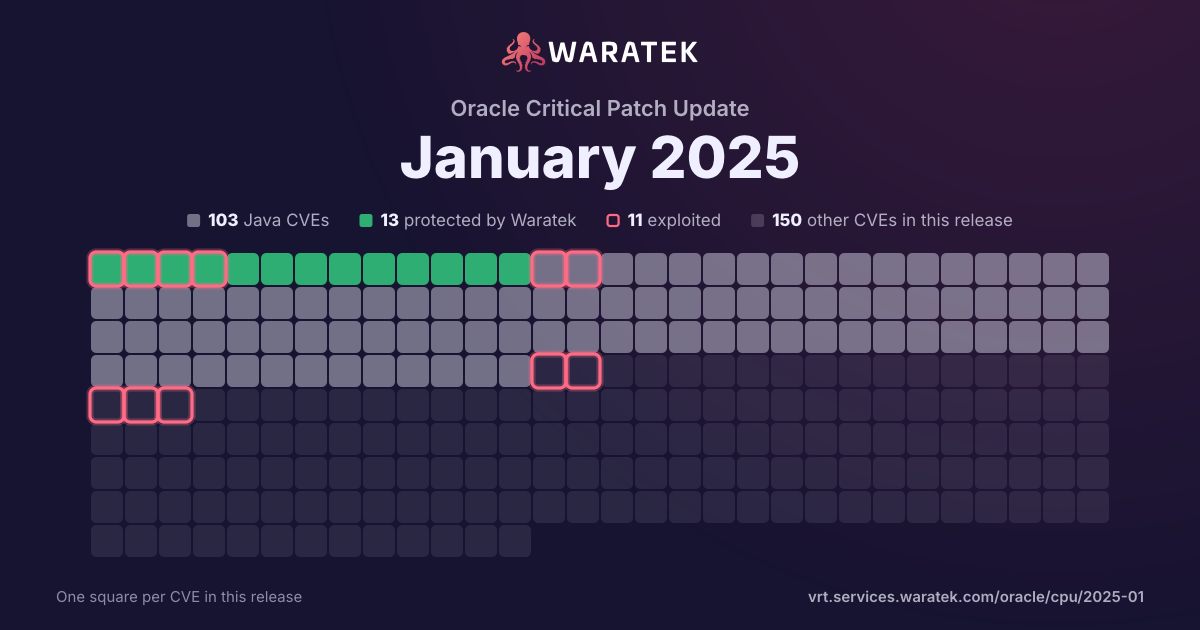
By status
13Protected by Waratek4Mitigation candidate86No exploit published17Outside Waratek scope133Not applicable
11Exploited, marked by the ring
No exploit published. For 48 of them, Oracle's security advisory is the source of public detail.
Protected by Waratek. Waratek RASP can block exploitation of these on systems that have not applied the patch yet.
Overview 134 matches · 54 in Waratek scope · 2 protected · 2 exploited · 0 CISA KEV · 1 public PoC · 2 EPSS ≥ 0.5
134matches
54in Waratek scope40.3%
2protected1.5%
2exploited1.5%
0CISA KEV0.0%
1public PoC0.7%
2EPSS ≥ 0.51.5%
Protected by Waratek
2
1.5%
Rule in development
0
0.0%
Mitigation candidate
0
0.0%
No exploit published
52
38.8%
Outside Waratek scope
8
6.0%
Not applicable
72
53.7%
Withdrawn CVE
0
0.0%
blocked by ARMR today
2
1.5%
partly blocked
0
0.0%
not blocked
132
98.5%
not established
0
0.0%
unrecorded
0
0.0%
Exploited
2
1.5%
Working exploit published
0
0.0%
Proof of concept only
10
7.5%
Forecast only
1
0.7%
No public exploit
121
90.3%
split by
peak 65 / quarter
Q2 191
Not applicable1
Medium1
not blocked1
No public exploit1
Q3 191
No exploit published1
Medium1
not blocked1
No public exploit1
Q4 191
Protected by Waratek1
Medium1
blocked by ARMR today1
No public exploit1
Q1 200
Q2 200
Q3 200
Q4 201
Outside Waratek scope1
Medium1
not blocked1
No public exploit1
Q1 210
Q2 211
No exploit published1
Medium1
not blocked1
No public exploit1
Q3 210
Q4 210
Q1 220
Q2 220
Q3 220
Q4 220
Q1 231
Not applicable1
Medium1
not blocked1
No public exploit1
Q2 232
Not applicable2
Medium2
not blocked2
No public exploit2
Q3 234
No exploit published1
Not applicable3
Medium4
not blocked4
No public exploit4
Q4 2313
No exploit published3
Outside Waratek scope1
Not applicable9
Medium13
not blocked13
Exploited1
Proof of concept only2
No public exploit10
Q1 2415
No exploit published6
Not applicable9
Medium15
not blocked15
Proof of concept only4
No public exploit11
Q2 2410
No exploit published1
Outside Waratek scope3
Not applicable6
Medium10
not blocked10
Proof of concept only1
Forecast only1
No public exploit8
Q3 247
Protected by Waratek1
Not applicable6
Medium7
blocked by ARMR today1
not blocked6
No public exploit7
Q4 2412
No exploit published8
Outside Waratek scope2
Not applicable2
Medium12
not blocked12
Exploited1
Proof of concept only3
No public exploit8
Q1 2565
No exploit published31
Outside Waratek scope1
Not applicable33
Medium65
not blocked65
No public exploit65
Q3 19Q1 20Q3 20Q1 21Q3 21Q1 22Q3 22Q1 23Q3 23Q1 24Q3 24Q1 25
| CVE | Severity | Published▾ | Status | Exploitation | Description |
|---|---|---|---|---|---|
| CVE-2024-28849 | Medium | 2024-03-14 | Not applicable | Proof of concept only | follow-redirects is an open source, drop-in replacement for Node's `http` and `https` modules that automatically follows redirects. In affected versions follow-redirects only clears authorization header during cross-domain redirect, but keep the proxy-authentication header which contains credentials too. This vulnerability may lead to credentials leak, but has been addressed in version 1.15.6. Users are advised to upgrade. There are no known workarounds for this vulnerability. |
| CVE-2024-23672 | Medium | 2024-03-13 | No exploit published | No public exploit | Denial of Service via incomplete cleanup vulnerability in Apache Tomcat. It was possible for WebSocket clients to keep WebSocket connections open leading to increased resource consumption.This issue affects Apache Tomcat: from 11.0.0-M1 through 11.0.0-M16, from 10.1.0-M1 through 10.1.18, from 9.0.0-M1 through 9.0.85, from 8.5.0 through 8.5.98. Older, EOL versions may also be affected. Users are recommended to upgrade to version 11.0.0-M17, 10.1.19, 9.0.86 or 8.5.99 which fix the issue. |
| CVE-2023-51775 | Medium | 2024-02-29 | No exploit published | Proof of concept only | The jose4j component before 0.9.4 for Java allows attackers to cause a denial of service (CPU consumption) via a large p2c (aka PBES2 Count) value. |
| CVE-2024-26308 | Medium | 2024-02-19 | No exploit published | No public exploit | Allocation of Resources Without Limits or Throttling vulnerability in Apache Commons Compress.This issue affects Apache Commons Compress: from 1.21 before 1.26. Users are recommended to upgrade to version 1.26, which fixes the issue. |
| CVE-2024-23635 | Medium | 2024-02-02 | No exploit published | No public exploit | AntiSamy is a library for performing fast, configurable cleansing of HTML coming from untrusted sources. Prior to 1.7.5, there is a potential for a mutation XSS (mXSS) vulnerability in AntiSamy caused by flawed parsing of the HTML being sanitized. To be subject to this vulnerability the `preserveComments` directive must be enabled in your policy file. As a result, certain crafty inputs can result in elements in comment tags being interpreted as executable when using AntiSamy's sanitized output. Patched in AntiSamy 1.7.5 and later. |
| CVE-2024-0727 | Medium | 2024-01-26 | Not applicable | No public exploit | Issue summary: Processing a maliciously formatted PKCS12 file may lead OpenSSL to crash leading to a potential Denial of Service attack Impact summary: Applications loading files in the PKCS12 format from untrusted sources might terminate abruptly. A file in PKCS12 format can contain certificates and keys and may come from an untrusted source. The PKCS12 specification allows certain fields to be NULL, but OpenSSL does not correctly check for this case. This can lead to a NULL pointer dereference that results in OpenSSL crashing. If an application processes PKCS12 files from an untrusted source using the OpenSSL APIs then that application will be vulnerable to this issue. OpenSSL APIs that are vulnerable to this are: PKCS12_parse(), PKCS12_unpack_p7data(), PKCS12_unpack_p7encdata(), PKCS12_unpack_authsafes() and PKCS12_newpass(). We have also fixed a similar issue in SMIME_write_PKCS7(). However since this function is related to writing data we do not consider it security significant. The FIPS modules in 3.2, 3.1 and 3.0 are not affected by this issue. |
| CVE-2024-0232 | Medium | 2024-01-16 | Not applicable | No public exploit | A heap use-after-free issue has been identified in SQLite in the jsonParseAddNodeArray() function in sqlite3.c. This flaw allows a local attacker to leverage a victim to pass specially crafted malicious input to the application, potentially causing a crash and leading to a denial of service. |
| CVE-2024-22195 | Medium | 2024-01-11 | Not applicable | No public exploit | Jinja is an extensible templating engine. Special placeholders in the template allow writing code similar to Python syntax. It is possible to inject arbitrary HTML attributes into the rendered HTML template, potentially leading to Cross-Site Scripting (XSS). The Jinja `xmlattr` filter can be abused to inject arbitrary HTML attribute keys and values, bypassing the auto escaping mechanism and potentially leading to XSS. It may also be possible to bypass attribute validation checks if they are blacklist-based. |
| CVE-2023-6129 | Medium | 2024-01-09 | Not applicable | No public exploit | Issue summary: The POLY1305 MAC (message authentication code) implementation contains a bug that might corrupt the internal state of applications running on PowerPC CPU based platforms if the CPU provides vector instructions. Impact summary: If an attacker can influence whether the POLY1305 MAC algorithm is used, the application state might be corrupted with various application dependent consequences. The POLY1305 MAC (message authentication code) implementation in OpenSSL for PowerPC CPUs restores the contents of vector registers in a different order than they are saved. Thus the contents of some of these vector registers are corrupted when returning to the caller. The vulnerable code is used only on newer PowerPC processors supporting the PowerISA 2.07 instructions. The consequences of this kind of internal application state corruption can be various - from no consequences, if the calling application does not depend on the contents of non-volatile XMM registers at all, to the worst consequences, where the attacker could get complete control of the application process. However unless the compiler uses the vector registers for storing pointers, the most likely consequence, if any, would be an incorrect result of some application dependent calculations or a crash leading to a denial of service. The POLY1305 MAC algorithm is most frequently used as part of the CHACHA20-POLY1305 AEAD (authenticated encryption with associated data) algorithm. The most common usage of this AEAD cipher is with TLS protocol versions 1.2 and 1.3. If this cipher is enabled on the server a malicious client can influence whether this AEAD cipher is used. This implies that TLS server applications using OpenSSL can be potentially impacted. However we are currently not aware of any concrete application that would be affected by this issue therefore we consider this a Low severity security issue. |
| CVE-2023-51074 | Medium | 2023-12-27 | No exploit published | No public exploit | json-path v2.8.0 was discovered to contain a stack overflow via the Criteria.parse() method. |
| CVE-2023-48795 | Medium | 2023-12-18 | Outside Waratek scope | Exploited | The SSH transport protocol with certain OpenSSH extensions, found in OpenSSH before 9.6 and other products, allows remote attackers to bypass integrity checks such that some packets are omitted (from the extension negotiation message), and a client and server may consequently end up with a connection for which some security features have been downgraded or disabled, aka a Terrapin attack. This occurs because the SSH Binary Packet Protocol (BPP), implemented by these extensions, mishandles the handshake phase and mishandles use of sequence numbers. For example, there is an effective attack against SSH's use of ChaCha20-Poly1305 (and CBC with Encrypt-then-MAC). The bypass occurs in chacha20-poly1305@openssh.com and (if CBC is used) the -etm@openssh.com MAC algorithms. This also affects Maverick Synergy Java SSH API before 3.1.0-SNAPSHOT, Dropbear through 2022.83, Ssh before 5.1.1 in Erlang/OTP, PuTTY before 0.80, AsyncSSH before 2.14.2, golang.org/x/crypto before 0.17.0, libssh before 0.10.6, libssh2 through 1.11.0, Thorn Tech SFTP Gateway before 3.4.6, Tera Term before 5.1, Paramiko before 3.4.0, jsch before 0.2.15, SFTPGo before 2.5.6, Netgate pfSense Plus through 23.09.1, Netgate pfSense CE through 2.7.2, HPN-SSH through 18.2.0, ProFTPD before 1.3.8b (and before 1.3.9rc2), ORYX CycloneSSH before 2.3.4, NetSarang XShell 7 before Build 0144, CrushFTP before 10.6.0, ConnectBot SSH library before 2.2.22, Apache MINA sshd through 2.11.0, sshj through 0.37.0, TinySSH through 20230101, trilead-ssh2 6401, LANCOM LCOS and LANconfig, FileZilla before 3.66.4, Nova before 11.8, PKIX-SSH before 14.4, SecureCRT before 9.4.3, Transmit5 before 5.10.4, Win32-OpenSSH before 9.5.0.0p1-Beta, WinSCP before 6.2.2, Bitvise SSH Server before 9.32, Bitvise SSH Client before 9.33, KiTTY through 0.76.1.13, the net-ssh gem 7.2.0 for Ruby, the mscdex ssh2 module before 1.15.0 for Node.js, the thrussh library before 0.35.1 for Rust, and the Russh crate before 0.40.2 for Rust. |
| CVE-2023-46219 | Medium | 2023-12-12 | Not applicable | Proof of concept only | When saving HSTS data to an excessively long file name, curl could end up removing all contents, making subsequent requests using that file unaware of the HSTS status they should otherwise use. |
| CVE-2023-46218 | Medium | 2023-12-07 | Not applicable | Proof of concept only | This flaw allows a malicious HTTP server to set "super cookies" in curl that are then passed back to more origins than what is otherwise allowed or possible. This allows a site to set cookies that then would get sent to different and unrelated sites and domains. It could do this by exploiting a mixed case flaw in curl's function that verifies a given cookie domain against the Public Suffix List (PSL). For example a cookie could be set with `domain=co.UK` when the URL used a lower case hostname `curl.co.uk`, even though `co.uk` is listed as a PSL domain. |
| CVE-2023-5981 | Medium | 2023-11-28 | Not applicable | No public exploit | A vulnerability was found that the response times to malformed ciphertexts in RSA-PSK ClientKeyExchange differ from response times of ciphertexts with correct PKCS#1 v1.5 padding. |
| CVE-2023-33202 | Medium | 2023-11-23 | No exploit published | No public exploit | Bouncy Castle for Java before 1.73 contains a potential Denial of Service (DoS) issue within the Bouncy Castle org.bouncycastle.openssl.PEMParser class. This class parses OpenSSL PEM encoded streams containing X.509 certificates, PKCS8 encoded keys, and PKCS7 objects. Parsing a file that has crafted ASN.1 data through the PEMParser causes an OutOfMemoryError, which can enable a denial of service attack. (For users of the FIPS Java API: BC-FJA 1.0.2.3 and earlier are affected; BC-FJA 1.0.2.4 is fixed.) |
| CVE-2023-5678 | Medium | 2023-11-06 | Not applicable | No public exploit | Issue summary: Generating excessively long X9.42 DH keys or checking excessively long X9.42 DH keys or parameters may be very slow. Impact summary: Applications that use the functions DH_generate_key() to generate an X9.42 DH key may experience long delays. Likewise, applications that use DH_check_pub_key(), DH_check_pub_key_ex() or EVP_PKEY_public_check() to check an X9.42 DH key or X9.42 DH parameters may experience long delays. Where the key or parameters that are being checked have been obtained from an untrusted source this may lead to a Denial of Service. While DH_check() performs all the necessary checks (as of CVE-2023-3817), DH_check_pub_key() doesn't make any of these checks, and is therefore vulnerable for excessively large P and Q parameters. Likewise, while DH_generate_key() performs a check for an excessively large P, it doesn't check for an excessively large Q. An application that calls DH_generate_key() or DH_check_pub_key() and supplies a key or parameters obtained from an untrusted source could be vulnerable to a Denial of Service attack. DH_generate_key() and DH_check_pub_key() are also called by a number of other OpenSSL functions. An application calling any of those other functions may similarly be affected. The other functions affected by this are DH_check_pub_key_ex(), EVP_PKEY_public_check(), and EVP_PKEY_generate(). Also vulnerable are the OpenSSL pkey command line application when using the "-pubcheck" option, as well as the OpenSSL genpkey command line application. The OpenSSL SSL/TLS implementation is not affected by this issue. The OpenSSL 3.0 and 3.1 FIPS providers are not affected by this issue. |
| CVE-2023-42669 | Medium | 2023-11-06 | Not applicable | No public exploit | A vulnerability was found in Samba's "rpcecho" development server, a non-Windows RPC server used to test Samba's DCE/RPC stack elements. This vulnerability stems from an RPC function that can be blocked indefinitely. The issue arises because the "rpcecho" service operates with only one worker in the main RPC task, allowing calls to the "rpcecho" server to be blocked for a specified time, causing service disruptions. This disruption is triggered by a "sleep()" call in the "dcesrv_echo_TestSleep()" function under specific conditions. Authenticated users or attackers can exploit this vulnerability to make calls to the "rpcecho" server, requesting it to block for a specified duration, effectively disrupting most services and leading to a complete denial of service on the AD DC. The DoS affects all other services as "rpcecho" runs in the main RPC task. |
| CVE-2023-4091 | Medium | 2023-11-03 | Not applicable | No public exploit | A vulnerability was discovered in Samba, where the flaw allows SMB clients to truncate files, even with read-only permissions when the Samba VFS module "acl_xattr" is configured with "acl_xattr:ignore system acls = yes". The SMB protocol allows opening files when the client requests read-only access but then implicitly truncates the opened file to 0 bytes if the client specifies a separate OVERWRITE create disposition request. The issue arises in configurations that bypass kernel file system permissions checks, relying solely on Samba's permissions. |
| CVE-2023-44483 | Medium | 2023-10-20 | No exploit published | No public exploit | All versions of Apache Santuario - XML Security for Java prior to 2.2.6, 2.3.4, and 3.0.3, when using the JSR 105 API, are vulnerable to an issue where a private key may be disclosed in log files when generating an XML Signature and logging with debug level is enabled. Users are recommended to upgrade to version 2.2.6, 2.3.4, or 3.0.3, which fixes this issue. |
| CVE-2023-45803 | Medium | 2023-10-17 | Not applicable | No public exploit | urllib3 is a user-friendly HTTP client library for Python. urllib3 previously wouldn't remove the HTTP request body when an HTTP redirect response using status 301, 302, or 303 after the request had its method changed from one that could accept a request body (like `POST`) to `GET` as is required by HTTP RFCs. Although this behavior is not specified in the section for redirects, it can be inferred by piecing together information from different sections and we have observed the behavior in other major HTTP client implementations like curl and web browsers. Because the vulnerability requires a previously trusted service to become compromised in order to have an impact on confidentiality we believe the exploitability of this vulnerability is low. Additionally, many users aren't putting sensitive data in HTTP request bodies, if this is the case then this vulnerability isn't exploitable. Both of the following conditions must be true to be affected by this vulnerability: 1. Using urllib3 and submitting sensitive information in the HTTP request body (such as form data or JSON) and 2. The origin service is compromised and starts redirecting using 301, 302, or 303 to a malicious peer or the redirected-to service becomes compromised. This issue has been addressed in versions 1.26.18 and 2.0.7 and users are advised to update to resolve this issue. Users unable to update should disable redirects for services that aren't expecting to respond with redirects with `redirects=False` and disable automatic redirects with `redirects=False` and handle 301, 302, and 303 redirects manually by stripping the HTTP request body. |
| CVE-2023-42445 | Medium | 2023-10-06 | Not applicable | No public exploit | Gradle is a build tool with a focus on build automation and support for multi-language development. In some cases, when Gradle parses XML files, resolving XML external entities is not disabled. Combined with an Out Of Band XXE attack (OOB-XXE), just parsing XML can lead to exfiltration of local text files to a remote server. Gradle parses XML files for several purposes. Most of the time, Gradle parses XML files it generated or were already present locally. Only Ivy XML descriptors and Maven POM files can be fetched from remote repositories and parsed by Gradle. In Gradle 7.6.3 and 8.4, resolving XML external entities has been disabled for all use cases to protect against this vulnerability. Gradle will now refuse to parse XML files that have XML external entities. |
| CVE-2023-44387 | Medium | 2023-10-05 | Not applicable | No public exploit | Gradle is a build tool with a focus on build automation and support for multi-language development. When copying or archiving symlinked files, Gradle resolves them but applies the permissions of the symlink itself instead of the permissions of the linked file to the resulting file. This leads to files having too much permissions given that symlinks usually are world readable and writeable. While it is unlikely this results in a direct vulnerability for the impacted build, it may open up attack vectors depending on where build artifacts end up being copied to or un-archived. In versions 7.6.3, 8.4 and above, Gradle will now properly use the permissions of the file pointed at by the symlink to set permissions of the copied or archived file. |
| CVE-2023-29408 | Medium | 2023-08-02 | Not applicable | No public exploit | The TIFF decoder does not place a limit on the size of compressed tile data. A maliciously-crafted image can exploit this to cause a small image (both in terms of pixel width/height, and encoded size) to make the decoder decode large amounts of compressed data, consuming excessive memory and CPU. |
| CVE-2023-29407 | Medium | 2023-08-02 | Not applicable | No public exploit | A maliciously-crafted image can cause excessive CPU consumption in decoding. A tiled image with a height of 0 and a very large width can cause excessive CPU consumption, despite the image size (width * height) appearing to be zero. |
| CVE-2023-33201 | Medium | 2023-07-05 | No exploit published | No public exploit | Bouncy Castle For Java before 1.74 is affected by an LDAP injection vulnerability. The vulnerability only affects applications that use an LDAP CertStore from Bouncy Castle to validate X.509 certificates. During the certificate validation process, Bouncy Castle inserts the certificate's Subject Name into an LDAP search filter without any escaping, which leads to an LDAP injection vulnerability. |
| CVE-2023-25399 | Medium | 2023-07-05 | Not applicable | No public exploit | A refcounting issue which leads to potential memory leak was discovered in scipy commit 8627df31ab in Py_FindObjects() function. Note: This is disputed as a bug and not a vulnerability. SciPy is not designed to be exposed to untrusted users or data directly. |
| CVE-2023-35946 | Medium | 2023-06-30 | Not applicable | No public exploit | Gradle is a build tool with a focus on build automation and support for multi-language development. When Gradle writes a dependency into its dependency cache, it uses the dependency's coordinates to compute a file location. With specially crafted dependency coordinates, Gradle can be made to write files into an unintended location. The file may be written outside the dependency cache or over another file in the dependency cache. This vulnerability could be used to poison the dependency cache or overwrite important files elsewhere on the filesystem where the Gradle process has write permissions. Exploiting this vulnerability requires an attacker to have control over a dependency repository used by the Gradle build or have the ability to modify the build's configuration. It is unlikely that this would go unnoticed. A fix has been released in Gradle 7.6.2 and 8.2 to protect against this vulnerability. Gradle will refuse to cache dependencies that have path traversal elements in their dependency coordinates. It is recommended that users upgrade to a patched version. If you are unable to upgrade to Gradle 7.6.2 or 8.2, `dependency verification` will make this vulnerability more difficult to exploit. |
| CVE-2023-32732 | Medium | 2023-06-09 | Not applicable | No public exploit | gRPC contains a vulnerability whereby a client can cause a termination of connection between a HTTP2 proxy and a gRPC server: a base64 encoding error for `-bin` suffixed headers will result in a disconnection by the gRPC server, but is typically allowed by HTTP2 proxies. We recommend upgrading beyond the commit in https://github.com/grpc/grpc/pull/32309 https://www.google.com/url |
| CVE-2022-41727 | Medium | 2023-02-28 | Not applicable | No public exploit | An attacker can craft a malformed TIFF image which will consume a significant amount of memory when passed to DecodeConfig. This could lead to a denial of service. |
| CVE-2021-29429 | Medium | 2021-04-12 | No exploit published | No public exploit | In Gradle before version 7.0, files created with open permissions in the system temporary directory can allow an attacker to access information downloaded by Gradle. Some builds could be vulnerable to a local information disclosure. Remote files accessed through TextResourceFactory are downloaded into the system temporary directory first. Sensitive information contained in these files can be exposed to other local users on the same system. If you do not use the `TextResourceFactory` API, you are not vulnerable. As of Gradle 7.0, uses of the system temporary directory have been moved to the Gradle User Home directory. By default, this directory is restricted to the user running the build. As a workaround, set a more restrictive umask that removes read access to other users. When files are created in the system temporary directory, they will not be accessible to other users. If you are unable to change your system's umask, you can move the Java temporary directory by setting the System Property `java.io.tmpdir`. The new path needs to limit permissions to the build user only. |
| CVE-2020-13956 | Medium | 2020-12-02 | Outside Waratek scope | No public exploit | Apache HttpClient versions prior to version 4.5.13 and 5.0.3 can misinterpret malformed authority component in request URIs passed to the library as java.net.URI object and pick the wrong target host for request execution. |
| CVE-2019-12415 | Medium | 2019-10-23 | Protected by Waratek | No public exploit | In Apache POI up to 4.1.0, when using the tool XSSFExportToXml to convert user-provided Microsoft Excel documents, a specially crafted document can allow an attacker to read files from the local filesystem or from internal network resources via XML External Entity (XXE) Processing. |
| CVE-2019-16370 | Medium | 2019-09-16 | No exploit published | No public exploit | The PGP signing plugin in Gradle before 6.0 relies on the SHA-1 algorithm, which might allow an attacker to replace an artifact with a different one that has the same SHA-1 message digest, a related issue to CVE-2005-4900. |
| CVE-2019-11065 | Medium | 2019-04-10 | Not applicable | No public exploit | Gradle versions from 1.4 to 5.3.1 use an insecure HTTP URL to download dependencies when the built-in JavaScript or CoffeeScript Gradle plugins are used. Dependency artifacts could have been maliciously compromised by a MITM attack against the ajax.googleapis.com web site. |