
Oracle Critical Patch Update January 2025
Released January 2025 · Oracle's advisory ↗ · ← Critical Patch Update, October 2024 · Critical Patch Update, April 2025 →
253 CVEs in this release, one square each
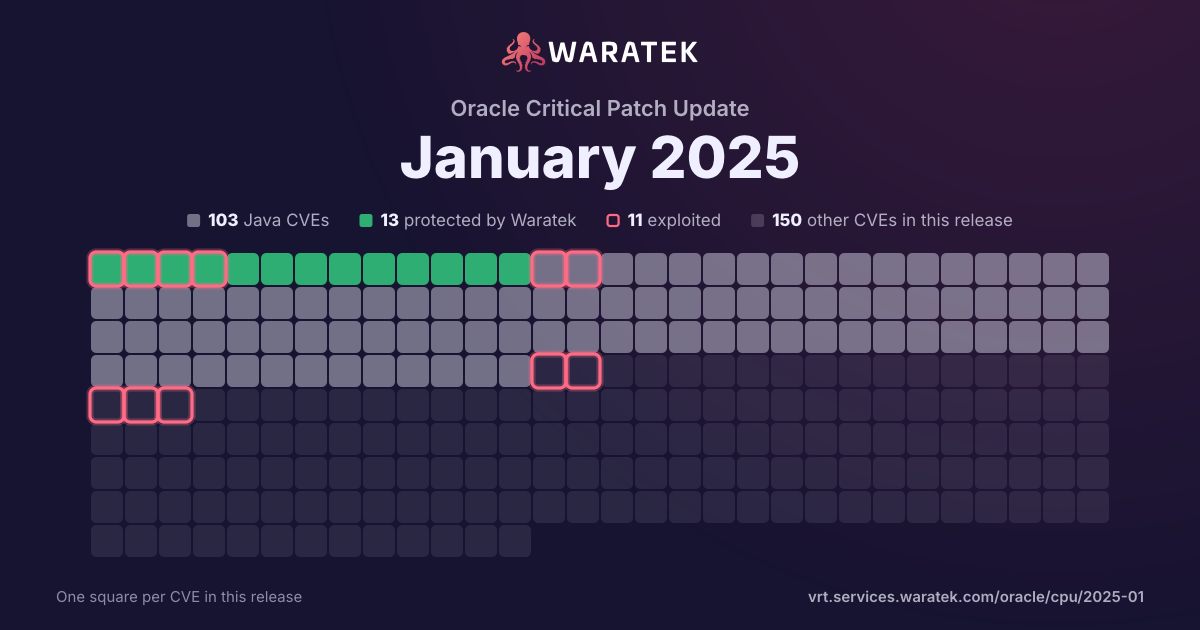
By status
13Protected by Waratek3Mitigation candidate93No exploit published3Outside Waratek scope141Not applicable
11Exploited, marked by the ring
No exploit published. For 45 of them, Oracle's security advisory is the source of public detail.
Protected by Waratek. Waratek RASP can block exploitation of these on systems that have not applied the patch yet.
Overview 8 matches · 3 in Waratek scope · 2 protected · 0 exploited · 0 CISA KEV · 3 public PoC · 0 EPSS ≥ 0.5
8matches
3in Waratek scope37.5%
2protected25.0%
0exploited0.0%
0CISA KEV0.0%
3public PoC37.5%
0EPSS ≥ 0.50.0%
Protected by Waratek
2
25.0%
Rule in development
0
0.0%
Mitigation candidate
0
0.0%
No exploit published
1
12.5%
Outside Waratek scope
1
12.5%
Not applicable
4
50.0%
Withdrawn CVE
0
0.0%
blocked by ARMR today
2
25.0%
partly blocked
0
0.0%
not blocked
6
75.0%
not established
0
0.0%
unrecorded
0
0.0%
Exploited
0
0.0%
Working exploit published
0
0.0%
Proof of concept only
8
100.0%
Forecast only
0
0.0%
No public exploit
0
0.0%
split by
peak 3 / quarter
Q1 201
Protected by Waratek1
Critical1
blocked by ARMR today1
Proof of concept only1
Q2 200
Q3 200
Q4 201
Not applicable1
High1
not blocked1
Proof of concept only1
Q1 210
Q2 210
Q3 210
Q4 210
Q1 220
Q2 220
Q3 221
Protected by Waratek1
High1
blocked by ARMR today1
Proof of concept only1
Q4 220
Q1 230
Q2 230
Q3 230
Q4 232
Not applicable2
Medium2
not blocked2
Proof of concept only2
Q1 243
No exploit published1
Outside Waratek scope1
Not applicable1
High2
Medium1
not blocked3
Proof of concept only3
Q1 20Q3 20Q1 21Q3 21Q1 22Q3 22Q1 23Q3 23Q1 24
| CVE | Severity | Published▾ | Status | Exploitation | Description |
|---|---|---|---|---|---|
| CVE-2023-51775 | Medium | 2024-02-29 | No exploit published | Proof of concept only | The jose4j component before 0.9.4 for Java allows attackers to cause a denial of service (CPU consumption) via a large p2c (aka PBES2 Count) value. |
| CVE-2023-50868 | High | 2024-02-14 | Outside Waratek scope | Proof of concept only | The Closest Encloser Proof aspect of the DNS protocol (in RFC 5155 when RFC 9276 guidance is skipped) allows remote attackers to cause a denial of service (CPU consumption for SHA-1 computations) via DNSSEC responses in a random subdomain attack, aka the "NSEC3" issue. The RFC 5155 specification implies that an algorithm must perform thousands of iterations of a hash function in certain situations. |
| CVE-2023-50782 | High | 2024-02-05 | Not applicable | Proof of concept only | A flaw was found in the python-cryptography package. This issue may allow a remote attacker to decrypt captured messages in TLS servers that use RSA key exchanges, which may lead to exposure of confidential or sensitive data. |
| CVE-2023-46219 | Medium | 2023-12-12 | Not applicable | Proof of concept only | When saving HSTS data to an excessively long file name, curl could end up removing all contents, making subsequent requests using that file unaware of the HSTS status they should otherwise use. |
| CVE-2023-46218 | Medium | 2023-12-07 | Not applicable | Proof of concept only | This flaw allows a malicious HTTP server to set "super cookies" in curl that are then passed back to more origins than what is otherwise allowed or possible. This allows a site to set cookies that then would get sent to different and unrelated sites and domains. It could do this by exploiting a mixed case flaw in curl's function that verifies a given cookie domain against the Public Suffix List (PSL). For example a cookie could be set with `domain=co.UK` when the URL used a lower case hostname `curl.co.uk`, even though `co.uk` is listed as a PSL domain. |
| CVE-2022-34169 | High | 2022-07-19 | Protected by Waratek | Proof of concept only | The Apache Xalan Java XSLT library is vulnerable to an integer truncation issue when processing malicious XSLT stylesheets. This can be used to corrupt Java class files generated by the internal XSLTC compiler and execute arbitrary Java bytecode. Users are recommended to update to version 2.7.3 or later. Note: Java runtimes (such as OpenJDK) include repackaged copies of Xalan. |
| CVE-2020-28975 | High | 2020-11-21 | Not applicable | Proof of concept only | svm_predict_values in svm.cpp in Libsvm v324, as used in scikit-learn 0.23.2 and other products, allows attackers to cause a denial of service (segmentation fault) via a crafted model SVM (introduced via pickle, json, or any other model permanence standard) with a large value in the _n_support array. NOTE: the scikit-learn vendor's position is that the behavior can only occur if the library's API is violated by an application that changes a private attribute. |
| CVE-2016-1000027 | Critical | 2020-01-02 | Protected by Waratek | Proof of concept only | Pivotal Spring Framework through 5.3.16 suffers from a potential remote code execution (RCE) issue if used for Java deserialization of untrusted data. Depending on how the library is implemented within a product, this issue may or not occur, and authentication may be required. NOTE: the vendor's position is that untrusted data is not an intended use case. The product's behavior will not be changed because some users rely on deserialization of trusted data. |