
Oracle Critical Patch Update January 2025
Released January 2025 · Oracle's advisory ↗ · ← Critical Patch Update, October 2024 · Critical Patch Update, April 2025 →
253 CVEs in this release, one square each
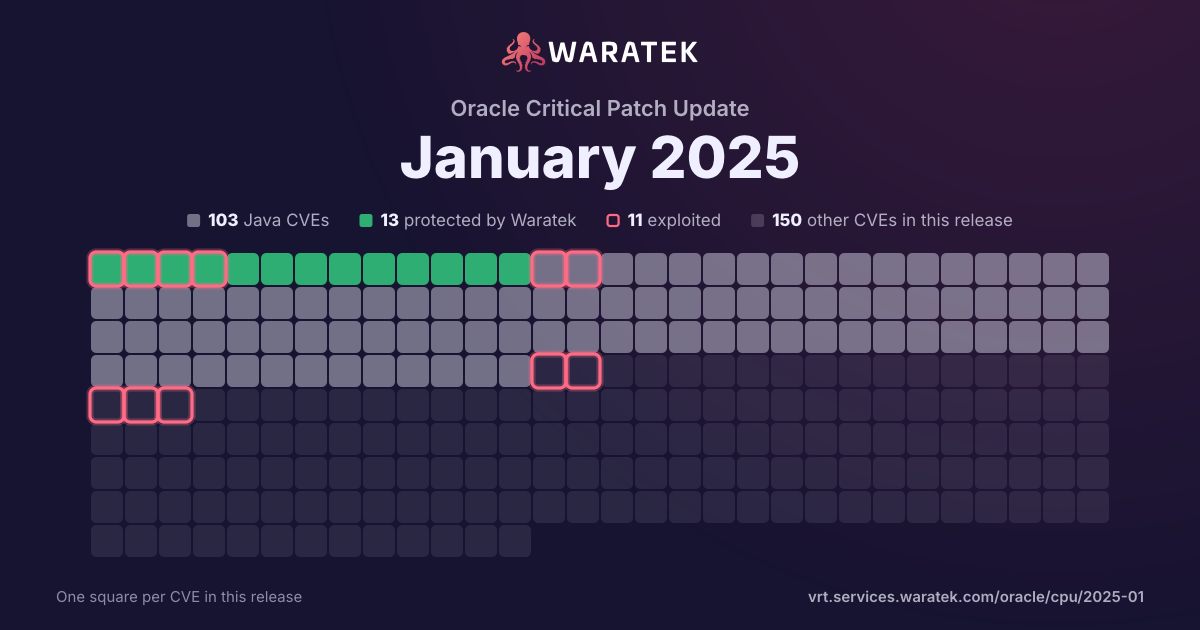
By status
13Protected by Waratek3Mitigation candidate93No exploit published3Outside Waratek scope141Not applicable
11Exploited, marked by the ring
No exploit published. For 45 of them, Oracle's security advisory is the source of public detail.
Protected by Waratek. Waratek RASP can block exploitation of these on systems that have not applied the patch yet.
Overview 2 matches · 1 in Waratek scope · 1 protected · 0 exploited · 0 CISA KEV · 1 public PoC · 0 EPSS ≥ 0.5
2matches
1in Waratek scope50.0%
1protected50.0%
0exploited0.0%
0CISA KEV0.0%
1public PoC50.0%
0EPSS ≥ 0.50.0%
Protected by Waratek
1
50.0%
Rule in development
0
0.0%
Mitigation candidate
0
0.0%
No exploit published
0
0.0%
Outside Waratek scope
0
0.0%
Not applicable
1
50.0%
Withdrawn CVE
0
0.0%
blocked by ARMR today
1
50.0%
partly blocked
0
0.0%
not blocked
1
50.0%
not established
0
0.0%
unrecorded
0
0.0%
Exploited
0
0.0%
Working exploit published
0
0.0%
Proof of concept only
2
100.0%
Forecast only
0
0.0%
No public exploit
0
0.0%
split by
peak 1 / month
Jan 20Feb 20Mar 20Apr 20May 20Jun 20Jul 20Aug 20Sep 20Oct 20Nov 20
| CVE | Severity | Published▾ | Status | Exploitation | Description |
|---|---|---|---|---|---|
| CVE-2020-28975 | High | 2020-11-21 | Not applicable | Proof of concept only | svm_predict_values in svm.cpp in Libsvm v324, as used in scikit-learn 0.23.2 and other products, allows attackers to cause a denial of service (segmentation fault) via a crafted model SVM (introduced via pickle, json, or any other model permanence standard) with a large value in the _n_support array. NOTE: the scikit-learn vendor's position is that the behavior can only occur if the library's API is violated by an application that changes a private attribute. |
| CVE-2016-1000027 | Critical | 2020-01-02 | Protected by Waratek | Proof of concept only | Pivotal Spring Framework through 5.3.16 suffers from a potential remote code execution (RCE) issue if used for Java deserialization of untrusted data. Depending on how the library is implemented within a product, this issue may or not occur, and authentication may be required. NOTE: the vendor's position is that untrusted data is not an intended use case. The product's behavior will not be changed because some users rely on deserialization of trusted data. |