
Oracle Critical Patch Update January 2025
Released January 2025 · Oracle's advisory ↗ · ← Critical Patch Update, October 2024 · Critical Patch Update, April 2025 →
253 CVEs in this release, one square each
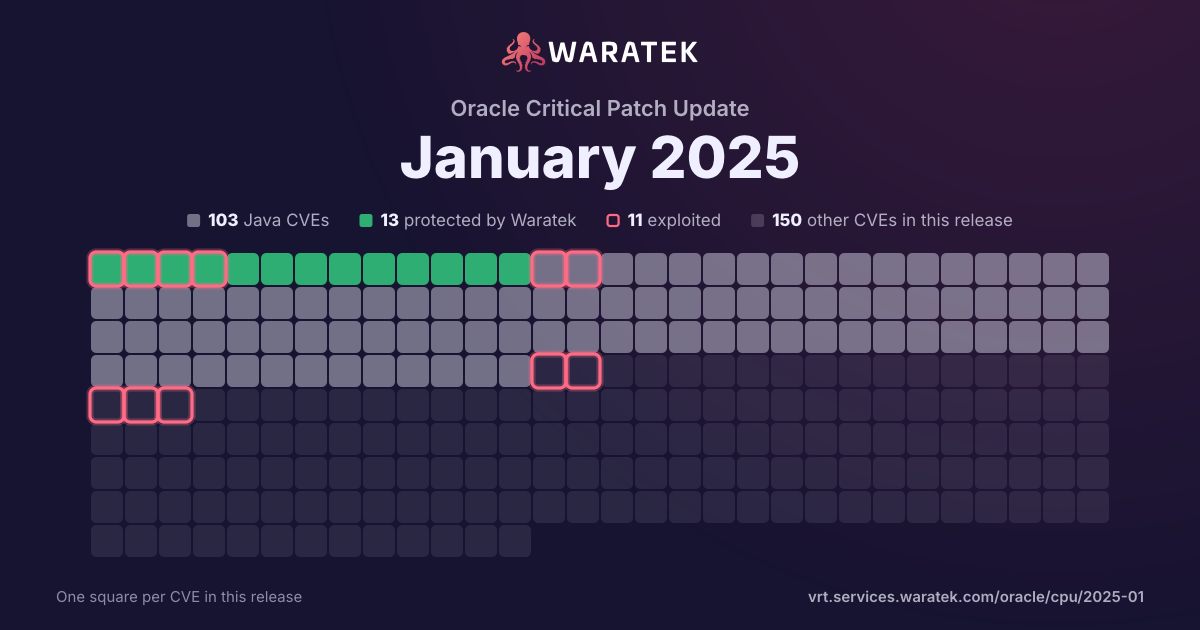
By status
13Protected by Waratek3Mitigation candidate93No exploit published3Outside Waratek scope141Not applicable
11Exploited, marked by the ring
No exploit published. For 45 of them, Oracle's security advisory is the source of public detail.
Protected by Waratek. Waratek RASP can block exploitation of these on systems that have not applied the patch yet.
Overview 11 matches · 0 protected · 0 exploited · 0 CISA KEV · 0 public PoC · 0 EPSS ≥ 0.5
11matches
0protected0.0%
0exploited0.0%
0CISA KEV0.0%
0public PoC0.0%
0EPSS ≥ 0.50.0%
Protected by Waratek
0
0.0%
Rule in development
0
0.0%
Mitigation candidate
0
0.0%
No exploit published
11
100.0%
blocked by ARMR today
0
0.0%
partly blocked
0
0.0%
not blocked
11
100.0%
not established
0
0.0%
unrecorded
0
0.0%
Exploited
0
0.0%
Working exploit published
0
0.0%
Proof of concept only
1
9.1%
Forecast only
0
0.0%
No public exploit
10
90.9%
split by
peak 2 / month
Oct 231
No exploit published1
Medium1
not blocked1
No public exploit1
Nov 230
Dec 231
No exploit published1
Medium1
not blocked1
No public exploit1
Jan 240
Feb 242
No exploit published2
Medium2
not blocked2
No public exploit2
Mar 242
No exploit published2
Medium2
not blocked2
Proof of concept only1
No public exploit1
Apr 240
May 240
Jun 240
Jul 240
Aug 240
Sep 240
Oct 242
No exploit published2
Medium2
not blocked2
No public exploit2
Nov 240
Dec 242
No exploit published2
Medium2
not blocked2
No public exploit2
Jan 251
No exploit published1
Medium1
not blocked1
No public exploit1
Nov 23Jan 24Mar 24May 24Jul 24Sep 24Nov 24Jan 25
| CVE | Severity | Published▾ | Status | Exploitation | Description |
|---|---|---|---|---|---|
| CVE-2025-21550 | Medium | 2025-01-21 | No exploit published | No public exploit | Vulnerability in the Oracle Financial Services Behavior Detection Platform product of Oracle Financial Services Applications (component: Web UI). Supported versions that are affected are 8.0.8.1, 8.1.2.7 and 8.1.2.8. Easily exploitable vulnerability allows unauthenticated attacker with network access via HTTP to compromise Oracle Financial Services Behavior Detection Platform. Successful attacks require human interaction from a person other than the attacker and while the vulnerability is in Oracle Financial Services Behavior Detection Platform, attacks may significantly impact additional products (scope change). Successful attacks of this vulnerability can result in unauthorized update, insert or delete access to some of Oracle Financial Services Behavior Detection Platform accessible data as well as unauthorized read access to a subset of Oracle Financial Services Behavior Detection Platform accessible data. CVSS 3.1 Base Score 6.1 (Confidentiality and Integrity impacts). CVSS Vector: (CVSS:3.1/AV:N/AC:L/PR:N/UI:R/S:C/C:L/I:L/A:N). |
| CVE-2024-54677 | Medium | 2024-12-17 | No exploit published | No public exploit | Uncontrolled Resource Consumption vulnerability in the examples web application provided with Apache Tomcat leads to denial of service. This issue affects Apache Tomcat: from 11.0.0-M1 through 11.0.1, from 10.1.0-M1 through 10.1.33, from 9.0.0.M1 through 9.9.97. The following versions were EOL at the time the CVE was created but are known to be affected: 8.5.0 though 8.5.100. Other, older, EOL versions may also be affected. Users are recommended to upgrade to version 11.0.2, 10.1.34 or 9.0.98, which fixes the issue. |
| CVE-2024-38827 | Medium | 2024-12-02 | No exploit published | No public exploit | The usage of String.toLowerCase() and String.toUpperCase() has some Locale dependent exceptions that could potentially result in authorization rules not working properly. |
| CVE-2024-38820 | Medium | 2024-10-18 | No exploit published | No public exploit | The fix for CVE-2022-22968 made disallowedFields patterns in DataBinder case insensitive. However, String.toLowerCase() has some Locale dependent exceptions that could potentially result in fields not protected as expected. |
| CVE-2024-47554 | Medium | 2024-10-03 | No exploit published | No public exploit | Uncontrolled Resource Consumption vulnerability in Apache Commons IO. The org.apache.commons.io.input.XmlStreamReader class may excessively consume CPU resources when processing maliciously crafted input. This issue affects Apache Commons IO: from 2.0 before 2.14.0. Users are recommended to upgrade to version 2.14.0 or later, which fixes the issue. |
| CVE-2024-29025 | Medium | 2024-03-25 | No exploit published | Proof of concept only | Netty is an asynchronous event-driven network application framework for rapid development of maintainable high performance protocol servers & clients. The `HttpPostRequestDecoder` can be tricked to accumulate data. While the decoder can store items on the disk if configured so, there are no limits to the number of fields the form can have, an attacher can send a chunked post consisting of many small fields that will be accumulated in the `bodyListHttpData` list. The decoder cumulates bytes in the `undecodedChunk` buffer until it can decode a field, this field can cumulate data without limits. This vulnerability is fixed in 4.1.108.Final. |
| CVE-2024-29133 | Medium | 2024-03-21 | No exploit published | No public exploit | Out-of-bounds Write vulnerability in Apache Commons Configuration.This issue affects Apache Commons Configuration: from 2.0 before 2.10.1. Users are recommended to upgrade to version 2.10.1, which fixes the issue. |
| CVE-2024-26308 | Medium | 2024-02-19 | No exploit published | No public exploit | Allocation of Resources Without Limits or Throttling vulnerability in Apache Commons Compress.This issue affects Apache Commons Compress: from 1.21 before 1.26. Users are recommended to upgrade to version 1.26, which fixes the issue. |
| CVE-2024-23635 | Medium | 2024-02-02 | No exploit published | No public exploit | AntiSamy is a library for performing fast, configurable cleansing of HTML coming from untrusted sources. Prior to 1.7.5, there is a potential for a mutation XSS (mXSS) vulnerability in AntiSamy caused by flawed parsing of the HTML being sanitized. To be subject to this vulnerability the `preserveComments` directive must be enabled in your policy file. As a result, certain crafty inputs can result in elements in comment tags being interpreted as executable when using AntiSamy's sanitized output. Patched in AntiSamy 1.7.5 and later. |
| CVE-2023-51074 | Medium | 2023-12-27 | No exploit published | No public exploit | json-path v2.8.0 was discovered to contain a stack overflow via the Criteria.parse() method. |
| CVE-2023-44483 | Medium | 2023-10-20 | No exploit published | No public exploit | All versions of Apache Santuario - XML Security for Java prior to 2.2.6, 2.3.4, and 3.0.3, when using the JSR 105 API, are vulnerable to an issue where a private key may be disclosed in log files when generating an XML Signature and logging with debug level is enabled. Users are recommended to upgrade to version 2.2.6, 2.3.4, or 3.0.3, which fixes this issue. |