
Oracle Critical Patch Update January 2025
Released January 2025 · Oracle's advisory ↗ · ← Critical Patch Update, October 2024 · Critical Patch Update, April 2025 →
253 CVEs in this release, one square each
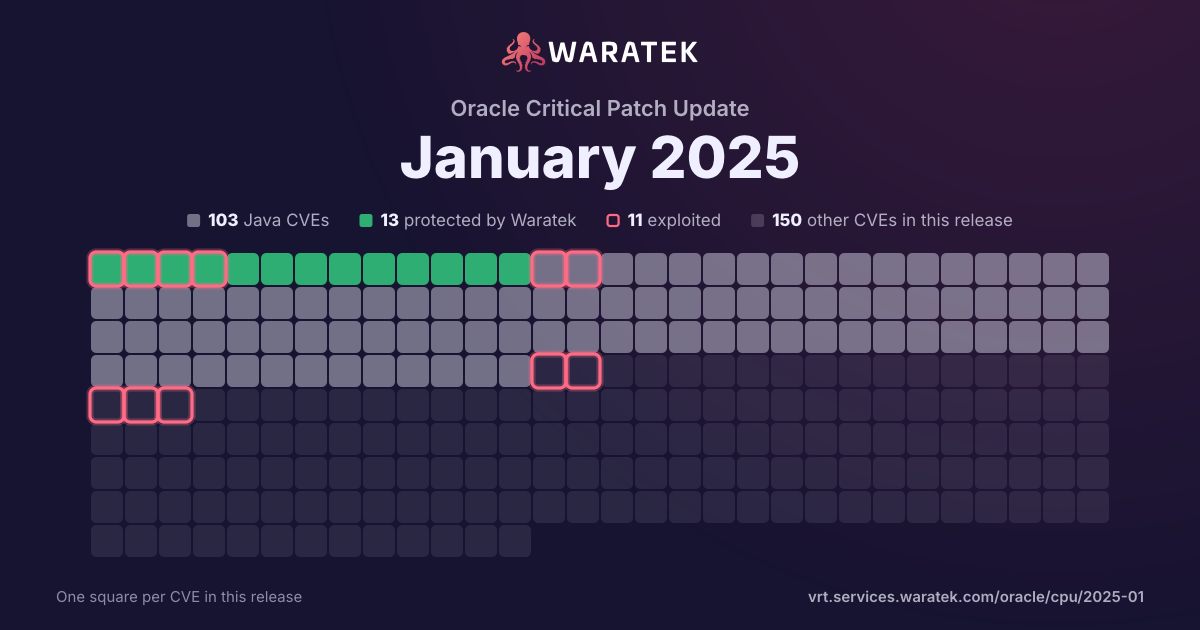
By status
13Protected by Waratek3Mitigation candidate93No exploit published3Outside Waratek scope141Not applicable
11Exploited, marked by the ring
No exploit published. For 45 of them, Oracle's security advisory is the source of public detail.
Protected by Waratek. Waratek RASP can block exploitation of these on systems that have not applied the patch yet.
Overview 15 matches · 1 protected · 0 exploited · 0 CISA KEV · 0 public PoC · 0 EPSS ≥ 0.5
Protected by Waratek
1
6.7%
Rule in development
0
0.0%
Mitigation candidate
0
0.0%
No exploit published
14
93.3%
blocked by ARMR today
1
6.7%
partly blocked
0
0.0%
not blocked
14
93.3%
not established
0
0.0%
unrecorded
0
0.0%
Exploited
0
0.0%
Working exploit published
0
0.0%
Proof of concept only
0
0.0%
Forecast only
0
0.0%
No public exploit
15
100.0%
split by
peak 3 / month
Dec 231
No exploit published1
Medium1
not blocked1
No public exploit1
Jan 240
Feb 243
No exploit published3
High1
Medium2
not blocked3
No public exploit3
Mar 242
No exploit published2
High1
Medium1
not blocked2
No public exploit2
Apr 240
May 240
Jun 240
Jul 241
No exploit published1
High1
not blocked1
No public exploit1
Aug 240
Sep 241
No exploit published1
High1
not blocked1
No public exploit1
Oct 243
Protected by Waratek1
No exploit published2
Critical1
Medium2
blocked by ARMR today1
not blocked2
No public exploit3
Nov 241
No exploit published1
High1
not blocked1
No public exploit1
Dec 242
No exploit published2
Medium2
not blocked2
No public exploit2
Jan 251
No exploit published1
Medium1
not blocked1
No public exploit1
Jan 24Mar 24May 24Jul 24Sep 24Nov 24Jan 25
| CVE | Severity | Published▾ | Status | Exploitation | Description |
|---|---|---|---|---|---|
| CVE-2025-21550 | Medium | 2025-01-21 | No exploit published | No public exploit | Vulnerability in the Oracle Financial Services Behavior Detection Platform product of Oracle Financial Services Applications (component: Web UI). Supported versions that are affected are 8.0.8.1, 8.1.2.7 and 8.1.2.8. Easily exploitable vulnerability allows unauthenticated attacker with network access via HTTP to compromise Oracle Financial Services Behavior Detection Platform. Successful attacks require human interaction from a person other than the attacker and while the vulnerability is in Oracle Financial Services Behavior Detection Platform, attacks may significantly impact additional products (scope change). Successful attacks of this vulnerability can result in unauthorized update, insert or delete access to some of Oracle Financial Services Behavior Detection Platform accessible data as well as unauthorized read access to a subset of Oracle Financial Services Behavior Detection Platform accessible data. CVSS 3.1 Base Score 6.1 (Confidentiality and Integrity impacts). CVSS Vector: (CVSS:3.1/AV:N/AC:L/PR:N/UI:R/S:C/C:L/I:L/A:N). |
| CVE-2024-54677 | Medium | 2024-12-17 | No exploit published | No public exploit | Uncontrolled Resource Consumption vulnerability in the examples web application provided with Apache Tomcat leads to denial of service. This issue affects Apache Tomcat: from 11.0.0-M1 through 11.0.1, from 10.1.0-M1 through 10.1.33, from 9.0.0.M1 through 9.9.97. The following versions were EOL at the time the CVE was created but are known to be affected: 8.5.0 though 8.5.100. Other, older, EOL versions may also be affected. Users are recommended to upgrade to version 11.0.2, 10.1.34 or 9.0.98, which fixes the issue. |
| CVE-2024-38827 | Medium | 2024-12-02 | No exploit published | No public exploit | The usage of String.toLowerCase() and String.toUpperCase() has some Locale dependent exceptions that could potentially result in authorization rules not working properly. |
| CVE-2024-47072 | High | 2024-11-08 | No exploit published | No public exploit | XStream is a simple library to serialize objects to XML and back again. This vulnerability may allow a remote attacker to terminate the application with a stack overflow error resulting in a denial of service only by manipulating the processed input stream when XStream is configured to use the BinaryStreamDriver. XStream 1.4.21 has been patched to detect the manipulation in the binary input stream causing the the stack overflow and raises an InputManipulationException instead. Users are advised to upgrade. Users unable to upgrade may catch the StackOverflowError in the client code calling XStream if XStream is configured to use the BinaryStreamDriver. |
| CVE-2024-38820 | Medium | 2024-10-18 | No exploit published | No public exploit | The fix for CVE-2022-22968 made disallowedFields patterns in DataBinder case insensitive. However, String.toLowerCase() has some Locale dependent exceptions that could potentially result in fields not protected as expected. |
| CVE-2024-47561 | Critical | 2024-10-03 | Protected by Waratek | No public exploit | Schema parsing in the Java SDK of Apache Avro 1.11.3 and previous versions allows bad actors to execute arbitrary code. Users are recommended to upgrade to version 1.11.4 or 1.12.0, which fix this issue. |
| CVE-2024-47554 | Medium | 2024-10-03 | No exploit published | No public exploit | Uncontrolled Resource Consumption vulnerability in Apache Commons IO. The org.apache.commons.io.input.XmlStreamReader class may excessively consume CPU resources when processing maliciously crafted input. This issue affects Apache Commons IO: from 2.0 before 2.14.0. Users are recommended to upgrade to version 2.14.0 or later, which fixes the issue. |
| CVE-2024-7254 | High | 2024-09-19 | No exploit published | No public exploit | Any project that parses untrusted Protocol Buffers data containing an arbitrary number of nested groups / series of SGROUP tags can corrupted by exceeding the stack limit i.e. StackOverflow. Parsing nested groups as unknown fields with DiscardUnknownFieldsParser or Java Protobuf Lite parser, or against Protobuf map fields, creates unbounded recursions that can be abused by an attacker. |
| CVE-2024-34750 | High | 2024-07-03 | No exploit published | No public exploit | Improper Handling of Exceptional Conditions, Uncontrolled Resource Consumption vulnerability in Apache Tomcat. When processing an HTTP/2 stream, Tomcat did not handle some cases of excessive HTTP headers correctly. This led to a miscounting of active HTTP/2 streams which in turn led to the use of an incorrect infinite timeout which allowed connections to remain open which should have been closed. This issue affects Apache Tomcat: from 11.0.0-M1 through 11.0.0-M20, from 10.1.0-M1 through 10.1.24, from 9.0.0-M1 through 9.0.89. The following versions were EOL at the time the CVE was created but are known to be affected: 8.5.0 though 8.5.100. Other EOL versions may also be affected. Users are recommended to upgrade to version 11.0.0-M21, 10.1.25 or 9.0.90, which fixes the issue. |
| CVE-2024-29133 | Medium | 2024-03-21 | No exploit published | No public exploit | Out-of-bounds Write vulnerability in Apache Commons Configuration.This issue affects Apache Commons Configuration: from 2.0 before 2.10.1. Users are recommended to upgrade to version 2.10.1, which fixes the issue. |
| CVE-2024-29131 | High | 2024-03-21 | No exploit published | No public exploit | Out-of-bounds Write vulnerability in Apache Commons Configuration.This issue affects Apache Commons Configuration: from 2.0 before 2.10.1. Users are recommended to upgrade to version 2.10.1, which fixes the issue. |
| CVE-2024-26308 | Medium | 2024-02-19 | No exploit published | No public exploit | Allocation of Resources Without Limits or Throttling vulnerability in Apache Commons Compress.This issue affects Apache Commons Compress: from 1.21 before 1.26. Users are recommended to upgrade to version 1.26, which fixes the issue. |
| CVE-2024-25710 | High | 2024-02-19 | No exploit published | No public exploit | Loop with Unreachable Exit Condition ('Infinite Loop') vulnerability in Apache Commons Compress.This issue affects Apache Commons Compress: from 1.3 through 1.25.0. Users are recommended to upgrade to version 1.26.0 which fixes the issue. |
| CVE-2024-23635 | Medium | 2024-02-02 | No exploit published | No public exploit | AntiSamy is a library for performing fast, configurable cleansing of HTML coming from untrusted sources. Prior to 1.7.5, there is a potential for a mutation XSS (mXSS) vulnerability in AntiSamy caused by flawed parsing of the HTML being sanitized. To be subject to this vulnerability the `preserveComments` directive must be enabled in your policy file. As a result, certain crafty inputs can result in elements in comment tags being interpreted as executable when using AntiSamy's sanitized output. Patched in AntiSamy 1.7.5 and later. |
| CVE-2023-51074 | Medium | 2023-12-27 | No exploit published | No public exploit | json-path v2.8.0 was discovered to contain a stack overflow via the Criteria.parse() method. |