
Oracle Critical Patch Update January 2025
Released January 2025 · Oracle's advisory ↗ · ← Critical Patch Update, October 2024 · Critical Patch Update, April 2025 →
253 CVEs in this release, one square each
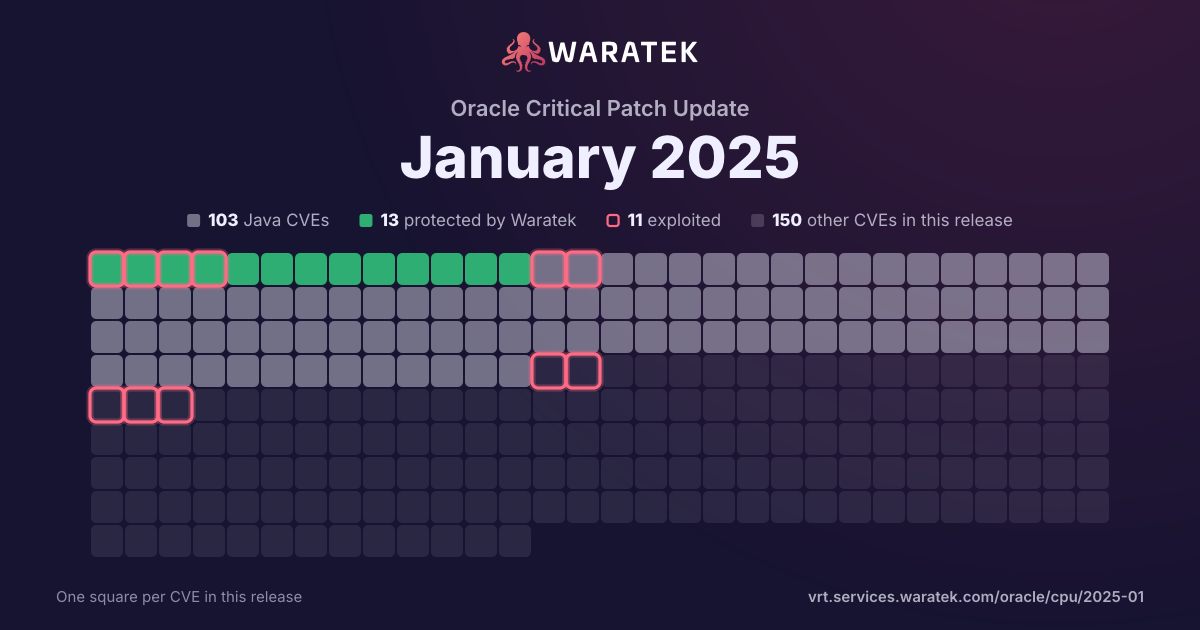
By status
13Protected by Waratek4Mitigation candidate86No exploit published17Outside Waratek scope133Not applicable
11Exploited, marked by the ring
No exploit published. For 48 of them, Oracle's security advisory is the source of public detail.
Protected by Waratek. Waratek RASP can block exploitation of these on systems that have not applied the patch yet.
Overview 240 matches · 90 in Waratek scope · 0 protected · 7 exploited · 2 CISA KEV · 12 public PoC · 8 EPSS ≥ 0.5
240matches
90in Waratek scope37.5%
0protected0.0%
7exploited2.9%
2CISA KEV0.8%
12public PoC5.0%
8EPSS ≥ 0.53.3%
Protected by Waratek
0
0.0%
Rule in development
0
0.0%
Mitigation candidate
4
1.7%
No exploit published
86
35.8%
Outside Waratek scope
17
7.1%
Not applicable
133
55.4%
Withdrawn CVE
0
0.0%
blocked by ARMR today
0
0.0%
partly blocked
0
0.0%
not blocked
240
100.0%
not established
0
0.0%
unrecorded
0
0.0%
split by
peak 84 / quarter
Q2 191
Not applicable1
Medium1
not blocked1
No public exploit1
Q3 192
No exploit published1
Not applicable1
Critical1
Medium1
not blocked2
No public exploit2
Q4 190
Q1 200
Q2 201
No exploit published1
High1
not blocked1
No public exploit1
Q3 200
Q4 204
No exploit published2
Outside Waratek scope1
Not applicable1
High3
Medium1
not blocked4
Proof of concept only1
No public exploit3
Q1 210
Q2 212
No exploit published2
High1
Medium1
not blocked2
No public exploit2
Q3 211
Not applicable1
High1
not blocked1
No public exploit1
Q4 210
Q1 220
Q2 220
Q3 221
No exploit published1
High1
not blocked1
No public exploit1
Q4 220
Q1 233
No exploit published1
Not applicable2
High2
Medium1
not blocked3
No public exploit3
Q2 234
No exploit published1
Not applicable3
High2
Medium2
not blocked4
No public exploit4
Q3 2310
No exploit published1
Not applicable9
Critical1
High5
Medium4
not blocked10
No public exploit10
Q4 2320
Mitigation candidate1
No exploit published3
Outside Waratek scope1
Not applicable15
Critical1
High6
Medium13
not blocked20
Exploited2
Proof of concept only2
No public exploit16
Q1 2428
Mitigation candidate1
No exploit published9
Outside Waratek scope1
Not applicable17
Critical1
High12
Medium15
not blocked28
Proof of concept only7
No public exploit21
Q2 2432
No exploit published7
Outside Waratek scope7
Not applicable18
Critical3
High19
Medium10
not blocked32
Exploited2
Proof of concept only3
Forecast only1
No public exploit26
Q3 2427
No exploit published4
Outside Waratek scope1
Not applicable22
Critical6
High13
Medium6
Low2
not blocked27
Exploited1
Working exploit published1
Proof of concept only3
Forecast only1
No public exploit21
Q4 2420
Mitigation candidate2
No exploit published9
Outside Waratek scope4
Not applicable5
Critical3
High3
Medium12
Low2
not blocked20
Exploited2
Proof of concept only5
No public exploit13
Q1 2584
No exploit published44
Outside Waratek scope2
Not applicable38
Critical3
High13
Medium65
Low3
not blocked84
No public exploit84
Q3 19Q1 20Q3 20Q1 21Q3 21Q1 22Q3 22Q1 23Q3 23Q1 24Q3 24Q1 25
| CVE | Severity | Published▾ | Status | Exploitation | Description |
|---|---|---|---|---|---|
| CVE-2025-0509 | High | 2025-02-04 | Outside Waratek scope | No public exploit | A security issue was found in Sparkle before version 2.6.4. An attacker can replace an existing signed update with another payload, bypassing Sparkle’s (Ed)DSA signing checks. |
| CVE-2025-21571 | High | 2025-01-21 | Not applicable | No public exploit | Vulnerability in the Oracle VM VirtualBox product of Oracle Virtualization (component: Core). Supported versions that are affected are Prior to 7.0.24 and prior to 7.1.6. Easily exploitable vulnerability allows high privileged attacker with logon to the infrastructure where Oracle VM VirtualBox executes to compromise Oracle VM VirtualBox. While the vulnerability is in Oracle VM VirtualBox, attacks may significantly impact additional products (scope change). Successful attacks of this vulnerability can result in unauthorized creation, deletion or modification access to critical data or all Oracle VM VirtualBox accessible data as well as unauthorized read access to a subset of Oracle VM VirtualBox accessible data and unauthorized ability to cause a partial denial of service (partial DOS) of Oracle VM VirtualBox. CVSS 3.1 Base Score 7.3 (Confidentiality, Integrity and Availability impacts). CVSS Vector: (CVSS:3.1/AV:L/AC:L/PR:H/UI:N/S:C/C:L/I:H/A:L). |
| CVE-2025-21570 | Medium | 2025-01-21 | No exploit published | No public exploit | Vulnerability in the Oracle Life Sciences Argus Safety product of Oracle Health Sciences Applications (component: Login). The supported version that is affected is 8.2.3. Easily exploitable vulnerability allows unauthenticated attacker with network access via HTTP to compromise Oracle Life Sciences Argus Safety. Successful attacks require human interaction from a person other than the attacker and while the vulnerability is in Oracle Life Sciences Argus Safety, attacks may significantly impact additional products (scope change). Successful attacks of this vulnerability can result in unauthorized update, insert or delete access to some of Oracle Life Sciences Argus Safety accessible data as well as unauthorized read access to a subset of Oracle Life Sciences Argus Safety accessible data. CVSS 3.1 Base Score 6.1 (Confidentiality and Integrity impacts). CVSS Vector: (CVSS:3.1/AV:N/AC:L/PR:N/UI:R/S:C/C:L/I:L/A:N). |
| CVE-2025-21569 | Medium | 2025-01-21 | No exploit published | No public exploit | Vulnerability in the Oracle Hyperion Data Relationship Management product of Oracle Hyperion (component: Web Services). The supported version that is affected is 11.2.19.0.000. Difficult to exploit vulnerability allows high privileged attacker with network access via HTTP to compromise Oracle Hyperion Data Relationship Management. Successful attacks of this vulnerability can result in takeover of Oracle Hyperion Data Relationship Management. CVSS 3.1 Base Score 6.6 (Confidentiality, Integrity and Availability impacts). CVSS Vector: (CVSS:3.1/AV:N/AC:H/PR:H/UI:N/S:U/C:H/I:H/A:H). |
| CVE-2025-21568 | Medium | 2025-01-21 | No exploit published | No public exploit | Vulnerability in the Oracle Hyperion Data Relationship Management product of Oracle Hyperion (component: Access and Security). The supported version that is affected is 11.2.19.0.000. Easily exploitable vulnerability allows high privileged attacker with network access via HTTP to compromise Oracle Hyperion Data Relationship Management. Successful attacks require human interaction from a person other than the attacker. Successful attacks of this vulnerability can result in unauthorized access to critical data or complete access to all Oracle Hyperion Data Relationship Management accessible data. CVSS 3.1 Base Score 4.5 (Confidentiality impacts). CVSS Vector: (CVSS:3.1/AV:N/AC:L/PR:H/UI:R/S:U/C:H/I:N/A:N). |
| CVE-2025-21567 | Medium | 2025-01-21 | Not applicable | No public exploit | Vulnerability in the MySQL Server product of Oracle MySQL (component: Server: Security: Privileges). Supported versions that are affected are 9.1.0 and prior. Easily exploitable vulnerability allows low privileged attacker with network access via multiple protocols to compromise MySQL Server. Successful attacks of this vulnerability can result in unauthorized read access to a subset of MySQL Server accessible data. CVSS 3.1 Base Score 4.3 (Confidentiality impacts). CVSS Vector: (CVSS:3.1/AV:N/AC:L/PR:L/UI:N/S:U/C:L/I:N/A:N). |
| CVE-2025-21566 | Medium | 2025-01-21 | Not applicable | No public exploit | Vulnerability in the MySQL Server product of Oracle MySQL (component: Server: Optimizer). Supported versions that are affected are 9.1.0 and prior. Easily exploitable vulnerability allows low privileged attacker with network access via multiple protocols to compromise MySQL Server. Successful attacks of this vulnerability can result in unauthorized ability to cause a hang or frequently repeatable crash (complete DOS) of MySQL Server. CVSS 3.1 Base Score 6.5 (Availability impacts). CVSS Vector: (CVSS:3.1/AV:N/AC:L/PR:L/UI:N/S:U/C:N/I:N/A:H). |
| CVE-2025-21565 | High | 2025-01-21 | No exploit published | No public exploit | Vulnerability in the Oracle Agile PLM Framework product of Oracle Supply Chain (component: Install). The supported version that is affected is 9.3.6. Easily exploitable vulnerability allows unauthenticated attacker with network access via HTTP to compromise Oracle Agile PLM Framework. Successful attacks of this vulnerability can result in unauthorized access to critical data or complete access to all Oracle Agile PLM Framework accessible data. CVSS 3.1 Base Score 7.5 (Confidentiality impacts). CVSS Vector: (CVSS:3.1/AV:N/AC:L/PR:N/UI:N/S:U/C:H/I:N/A:N). |
| CVE-2025-21564 | High | 2025-01-21 | No exploit published | No public exploit | Vulnerability in the Oracle Agile PLM Framework product of Oracle Supply Chain (component: Agile Integration Services). The supported version that is affected is 9.3.6. Easily exploitable vulnerability allows low privileged attacker with network access via HTTP to compromise Oracle Agile PLM Framework. Successful attacks of this vulnerability can result in unauthorized access to critical data or complete access to all Oracle Agile PLM Framework accessible data and unauthorized ability to cause a hang or frequently repeatable crash (complete DOS) of Oracle Agile PLM Framework. CVSS 3.1 Base Score 8.1 (Confidentiality and Availability impacts). CVSS Vector: (CVSS:3.1/AV:N/AC:L/PR:L/UI:N/S:U/C:H/I:N/A:H). |
| CVE-2025-21563 | Medium | 2025-01-21 | No exploit published | No public exploit | Vulnerability in the PeopleSoft Enterprise CC Common Application Objects product of Oracle PeopleSoft (component: Run Control Management). The supported version that is affected is 9.2. Easily exploitable vulnerability allows low privileged attacker with network access via HTTP to compromise PeopleSoft Enterprise CC Common Application Objects. Successful attacks of this vulnerability can result in unauthorized update, insert or delete access to some of PeopleSoft Enterprise CC Common Application Objects accessible data. CVSS 3.1 Base Score 4.3 (Integrity impacts). CVSS Vector: (CVSS:3.1/AV:N/AC:L/PR:L/UI:N/S:U/C:N/I:L/A:N). |
| CVE-2025-21562 | Medium | 2025-01-21 | No exploit published | No public exploit | Vulnerability in the PeopleSoft Enterprise CC Common Application Objects product of Oracle PeopleSoft (component: Run Control Management). The supported version that is affected is 9.2. Easily exploitable vulnerability allows low privileged attacker with network access via HTTP to compromise PeopleSoft Enterprise CC Common Application Objects. Successful attacks of this vulnerability can result in unauthorized read access to a subset of PeopleSoft Enterprise CC Common Application Objects accessible data. CVSS 3.1 Base Score 4.3 (Confidentiality impacts). CVSS Vector: (CVSS:3.1/AV:N/AC:L/PR:L/UI:N/S:U/C:L/I:N/A:N). |
| CVE-2025-21561 | Medium | 2025-01-21 | No exploit published | No public exploit | Vulnerability in the PeopleSoft Enterprise SCM Purchasing product of Oracle PeopleSoft (component: Purchasing). The supported version that is affected is 9.2. Easily exploitable vulnerability allows low privileged attacker with network access via HTTP to compromise PeopleSoft Enterprise SCM Purchasing. Successful attacks of this vulnerability can result in unauthorized update, insert or delete access to some of PeopleSoft Enterprise SCM Purchasing accessible data as well as unauthorized read access to a subset of PeopleSoft Enterprise SCM Purchasing accessible data. CVSS 3.1 Base Score 5.4 (Confidentiality and Integrity impacts). CVSS Vector: (CVSS:3.1/AV:N/AC:L/PR:L/UI:N/S:U/C:L/I:L/A:N). |
| CVE-2025-21560 | Medium | 2025-01-21 | No exploit published | No public exploit | Vulnerability in the Oracle Agile PLM Framework product of Oracle Supply Chain (component: SDK-Software Development Kit). The supported version that is affected is 9.3.6. Easily exploitable vulnerability allows low privileged attacker with network access via HTTP to compromise Oracle Agile PLM Framework. Successful attacks of this vulnerability can result in unauthorized access to critical data or complete access to all Oracle Agile PLM Framework accessible data. CVSS 3.1 Base Score 6.5 (Confidentiality impacts). CVSS Vector: (CVSS:3.1/AV:N/AC:L/PR:L/UI:N/S:U/C:H/I:N/A:N). |
| CVE-2025-21559 | Medium | 2025-01-21 | Not applicable | No public exploit | Vulnerability in the MySQL Server product of Oracle MySQL (component: InnoDB). Supported versions that are affected are 8.0.40 and prior, 8.4.3 and prior and 9.1.0 and prior. Easily exploitable vulnerability allows high privileged attacker with network access via multiple protocols to compromise MySQL Server. Successful attacks of this vulnerability can result in unauthorized ability to cause a hang or frequently repeatable crash (complete DOS) of MySQL Server as well as unauthorized update, insert or delete access to some of MySQL Server accessible data. CVSS 3.1 Base Score 5.5 (Integrity and Availability impacts). CVSS Vector: (CVSS:3.1/AV:N/AC:L/PR:H/UI:N/S:U/C:N/I:L/A:H). |
| CVE-2025-21558 | Medium | 2025-01-21 | No exploit published | No public exploit | Vulnerability in the Primavera P6 Enterprise Project Portfolio Management product of Oracle Construction and Engineering (component: Web Access). Supported versions that are affected are 20.12.1.0-20.12.21.5, 21.12.1.0-21.12.20.0 and 22.12.1.0. Easily exploitable vulnerability allows low privileged attacker with network access via HTTP to compromise Primavera P6 Enterprise Project Portfolio Management. Successful attacks require human interaction from a person other than the attacker and while the vulnerability is in Primavera P6 Enterprise Project Portfolio Management, attacks may significantly impact additional products (scope change). Successful attacks of this vulnerability can result in unauthorized update, insert or delete access to some of Primavera P6 Enterprise Project Portfolio Management accessible data as well as unauthorized read access to a subset of Primavera P6 Enterprise Project Portfolio Management accessible data. CVSS 3.1 Base Score 5.4 (Confidentiality and Integrity impacts). CVSS Vector: (CVSS:3.1/AV:N/AC:L/PR:L/UI:R/S:C/C:L/I:L/A:N). |
| CVE-2025-21557 | Medium | 2025-01-21 | Not applicable | No public exploit | Vulnerability in Oracle Application Express (component: General). Supported versions that are affected are 23.2 and 24.1. Easily exploitable vulnerability allows low privileged attacker with network access via HTTP to compromise Oracle Application Express. Successful attacks require human interaction from a person other than the attacker and while the vulnerability is in Oracle Application Express, attacks may significantly impact additional products (scope change). Successful attacks of this vulnerability can result in unauthorized update, insert or delete access to some of Oracle Application Express accessible data as well as unauthorized read access to a subset of Oracle Application Express accessible data. CVSS 3.1 Base Score 5.4 (Confidentiality and Integrity impacts). CVSS Vector: (CVSS:3.1/AV:N/AC:L/PR:L/UI:R/S:C/C:L/I:L/A:N). |
| CVE-2025-21556 | Critical | 2025-01-21 | No exploit published | No public exploit | Vulnerability in the Oracle Agile PLM Framework product of Oracle Supply Chain (component: Agile Integration Services). The supported version that is affected is 9.3.6. Easily exploitable vulnerability allows low privileged attacker with network access via HTTP to compromise Oracle Agile PLM Framework. While the vulnerability is in Oracle Agile PLM Framework, attacks may significantly impact additional products (scope change). Successful attacks of this vulnerability can result in takeover of Oracle Agile PLM Framework. CVSS 3.1 Base Score 9.9 (Confidentiality, Integrity and Availability impacts). CVSS Vector: (CVSS:3.1/AV:N/AC:L/PR:L/UI:N/S:C/C:H/I:H/A:H). |
| CVE-2025-21555 | Medium | 2025-01-21 | Not applicable | No public exploit | Vulnerability in the MySQL Server product of Oracle MySQL (component: InnoDB). Supported versions that are affected are 8.0.40 and prior, 8.4.3 and prior and 9.1.0 and prior. Easily exploitable vulnerability allows high privileged attacker with network access via multiple protocols to compromise MySQL Server. Successful attacks of this vulnerability can result in unauthorized ability to cause a hang or frequently repeatable crash (complete DOS) of MySQL Server as well as unauthorized update, insert or delete access to some of MySQL Server accessible data. CVSS 3.1 Base Score 5.5 (Integrity and Availability impacts). CVSS Vector: (CVSS:3.1/AV:N/AC:L/PR:H/UI:N/S:U/C:N/I:L/A:H). |
| CVE-2025-21554 | Medium | 2025-01-21 | No exploit published | No public exploit | Vulnerability in the Oracle Communications Order and Service Management product of Oracle Communications Applications (component: Security). Supported versions that are affected are 7.4.0, 7.4.1 and 7.5.0. Easily exploitable vulnerability allows unauthenticated attacker with network access via HTTP to compromise Oracle Communications Order and Service Management. Successful attacks of this vulnerability can result in unauthorized read access to a subset of Oracle Communications Order and Service Management accessible data. CVSS 3.1 Base Score 5.3 (Confidentiality impacts). CVSS Vector: (CVSS:3.1/AV:N/AC:L/PR:N/UI:N/S:U/C:L/I:N/A:N). |
| CVE-2025-21553 | Medium | 2025-01-21 | Not applicable | No public exploit | Vulnerability in the Java VM component of Oracle Database Server. Supported versions that are affected are 19.3-19.25, 21.3-21.16 and 23.4-23.6. Difficult to exploit vulnerability allows low privileged attacker having Create Session, Create Procedure privilege with network access via Oracle Net to compromise Java VM. Successful attacks of this vulnerability can result in unauthorized update, insert or delete access to some of Java VM accessible data as well as unauthorized read access to a subset of Java VM accessible data. CVSS 3.1 Base Score 4.2 (Confidentiality and Integrity impacts). CVSS Vector: (CVSS:3.1/AV:N/AC:H/PR:L/UI:N/S:U/C:L/I:L/A:N). |
| CVE-2025-21552 | Medium | 2025-01-21 | No exploit published | No public exploit | Vulnerability in the JD Edwards EnterpriseOne Orchestrator product of Oracle JD Edwards (component: E1 IOT Orchestrator Security). Supported versions that are affected are Prior to 9.2.9.2. Easily exploitable vulnerability allows low privileged attacker with network access via HTTP to compromise JD Edwards EnterpriseOne Orchestrator. Successful attacks of this vulnerability can result in unauthorized access to critical data or complete access to all JD Edwards EnterpriseOne Orchestrator accessible data. CVSS 3.1 Base Score 6.5 (Confidentiality impacts). CVSS Vector: (CVSS:3.1/AV:N/AC:L/PR:L/UI:N/S:U/C:H/I:N/A:N). |
| CVE-2025-21551 | Medium | 2025-01-21 | Not applicable | No public exploit | Vulnerability in the Oracle Solaris product of Oracle Systems (component: File system). The supported version that is affected is 11. Easily exploitable vulnerability allows high privileged attacker with logon to the infrastructure where Oracle Solaris executes to compromise Oracle Solaris. Successful attacks of this vulnerability can result in unauthorized creation, deletion or modification access to critical data or all Oracle Solaris accessible data and unauthorized ability to cause a hang or frequently repeatable crash (complete DOS) of Oracle Solaris. CVSS 3.1 Base Score 6.0 (Integrity and Availability impacts). CVSS Vector: (CVSS:3.1/AV:L/AC:L/PR:H/UI:N/S:U/C:N/I:H/A:H). |
| CVE-2025-21550 | Medium | 2025-01-21 | No exploit published | No public exploit | Vulnerability in the Oracle Financial Services Behavior Detection Platform product of Oracle Financial Services Applications (component: Web UI). Supported versions that are affected are 8.0.8.1, 8.1.2.7 and 8.1.2.8. Easily exploitable vulnerability allows unauthenticated attacker with network access via HTTP to compromise Oracle Financial Services Behavior Detection Platform. Successful attacks require human interaction from a person other than the attacker and while the vulnerability is in Oracle Financial Services Behavior Detection Platform, attacks may significantly impact additional products (scope change). Successful attacks of this vulnerability can result in unauthorized update, insert or delete access to some of Oracle Financial Services Behavior Detection Platform accessible data as well as unauthorized read access to a subset of Oracle Financial Services Behavior Detection Platform accessible data. CVSS 3.1 Base Score 6.1 (Confidentiality and Integrity impacts). CVSS Vector: (CVSS:3.1/AV:N/AC:L/PR:N/UI:R/S:C/C:L/I:L/A:N). |
| CVE-2025-21549 | High | 2025-01-21 | No exploit published | No public exploit | Vulnerability in the Oracle WebLogic Server product of Oracle Fusion Middleware (component: Core). The supported version that is affected is 14.1.1.0.0. Easily exploitable vulnerability allows unauthenticated attacker with network access via HTTP/2 to compromise Oracle WebLogic Server. Successful attacks of this vulnerability can result in unauthorized ability to cause a hang or frequently repeatable crash (complete DOS) of Oracle WebLogic Server. CVSS 3.1 Base Score 7.5 (Availability impacts). CVSS Vector: (CVSS:3.1/AV:N/AC:L/PR:N/UI:N/S:U/C:N/I:N/A:H). |
| CVE-2025-21548 | Medium | 2025-01-21 | Not applicable | No public exploit | Vulnerability in the MySQL Connectors product of Oracle MySQL (component: Connector/Python). Supported versions that are affected are 9.1.0 and prior. Easily exploitable vulnerability allows high privileged attacker with network access via multiple protocols to compromise MySQL Connectors. Successful attacks require human interaction from a person other than the attacker. Successful attacks of this vulnerability can result in unauthorized creation, deletion or modification access to critical data or all MySQL Connectors accessible data as well as unauthorized read access to a subset of MySQL Connectors accessible data and unauthorized ability to cause a hang or frequently repeatable crash (complete DOS) of MySQL Connectors. CVSS 3.1 Base Score 6.4 (Confidentiality, Integrity and Availability impacts). CVSS Vector: (CVSS:3.1/AV:N/AC:L/PR:H/UI:R/S:U/C:L/I:H/A:H). |
| CVE-2025-21547 | Critical | 2025-01-21 | No exploit published | No public exploit | Vulnerability in the Oracle Hospitality OPERA 5 product of Oracle Hospitality Applications (component: Opera Servlet). Supported versions that are affected are 5.6.19.20, 5.6.25.8, 5.6.26.6 and 5.6.27.1. Easily exploitable vulnerability allows unauthenticated attacker with network access via HTTP to compromise Oracle Hospitality OPERA 5. Successful attacks of this vulnerability can result in unauthorized access to critical data or complete access to all Oracle Hospitality OPERA 5 accessible data and unauthorized ability to cause a hang or frequently repeatable crash (complete DOS) of Oracle Hospitality OPERA 5. CVSS 3.1 Base Score 9.1 (Confidentiality and Availability impacts). CVSS Vector: (CVSS:3.1/AV:N/AC:L/PR:N/UI:N/S:U/C:H/I:N/A:H). |
| CVE-2025-21546 | Low | 2025-01-21 | Not applicable | No public exploit | Vulnerability in the MySQL Server product of Oracle MySQL (component: Server: Security: Privileges). Supported versions that are affected are 8.0.40 and prior, 8.4.3 and prior and 9.1.0 and prior. Easily exploitable vulnerability allows high privileged attacker with network access via multiple protocols to compromise MySQL Server. Successful attacks of this vulnerability can result in unauthorized update, insert or delete access to some of MySQL Server accessible data as well as unauthorized read access to a subset of MySQL Server accessible data. CVSS 3.1 Base Score 3.8 (Confidentiality and Integrity impacts). CVSS Vector: (CVSS:3.1/AV:N/AC:L/PR:H/UI:N/S:U/C:L/I:L/A:N). |
| CVE-2025-21545 | High | 2025-01-21 | No exploit published | No public exploit | Vulnerability in the PeopleSoft Enterprise PeopleTools product of Oracle PeopleSoft (component: OpenSearch). Supported versions that are affected are 8.60 and 8.61. Easily exploitable vulnerability allows unauthenticated attacker with network access via HTTP to compromise PeopleSoft Enterprise PeopleTools. Successful attacks of this vulnerability can result in unauthorized ability to cause a hang or frequently repeatable crash (complete DOS) of PeopleSoft Enterprise PeopleTools. CVSS 3.1 Base Score 7.5 (Availability impacts). CVSS Vector: (CVSS:3.1/AV:N/AC:L/PR:N/UI:N/S:U/C:N/I:N/A:H). |
| CVE-2025-21544 | Medium | 2025-01-21 | No exploit published | No public exploit | Vulnerability in the Oracle Communications Order and Service Management product of Oracle Communications Applications (component: Security). Supported versions that are affected are 7.4.0, 7.4.1 and 7.5.0. Easily exploitable vulnerability allows low privileged attacker with network access via HTTP to compromise Oracle Communications Order and Service Management. Successful attacks require human interaction from a person other than the attacker and while the vulnerability is in Oracle Communications Order and Service Management, attacks may significantly impact additional products (scope change). Successful attacks of this vulnerability can result in unauthorized update, insert or delete access to some of Oracle Communications Order and Service Management accessible data as well as unauthorized read access to a subset of Oracle Communications Order and Service Management accessible data. CVSS 3.1 Base Score 5.4 (Confidentiality and Integrity impacts). CVSS Vector: (CVSS:3.1/AV:N/AC:L/PR:L/UI:R/S:C/C:L/I:L/A:N). |
| CVE-2025-21543 | Medium | 2025-01-21 | Not applicable | No public exploit | Vulnerability in the MySQL Server product of Oracle MySQL (component: Server: Packaging). Supported versions that are affected are 8.0.40 and prior, 8.4.3 and prior and 9.1.0 and prior. Easily exploitable vulnerability allows high privileged attacker with network access via multiple protocols to compromise MySQL Server. Successful attacks of this vulnerability can result in unauthorized ability to cause a hang or frequently repeatable crash (complete DOS) of MySQL Server. CVSS 3.1 Base Score 4.9 (Availability impacts). CVSS Vector: (CVSS:3.1/AV:N/AC:L/PR:H/UI:N/S:U/C:N/I:N/A:H). |
| CVE-2025-21542 | Medium | 2025-01-21 | No exploit published | No public exploit | Vulnerability in the Oracle Communications Order and Service Management product of Oracle Communications Applications (component: Security). Supported versions that are affected are 7.4.0, 7.4.1 and 7.5.0. Easily exploitable vulnerability allows low privileged attacker with network access via HTTP to compromise Oracle Communications Order and Service Management. Successful attacks of this vulnerability can result in unauthorized update, insert or delete access to some of Oracle Communications Order and Service Management accessible data as well as unauthorized read access to a subset of Oracle Communications Order and Service Management accessible data and unauthorized ability to cause a partial denial of service (partial DOS) of Oracle Communications Order and Service Management. CVSS 3.1 Base Score 6.3 (Confidentiality, Integrity and Availability impacts). CVSS Vector: (CVSS:3.1/AV:N/AC:L/PR:L/UI:N/S:U/C:L/I:L/A:L). |
| CVE-2025-21541 | Medium | 2025-01-21 | No exploit published | No public exploit | Vulnerability in the Oracle Workflow product of Oracle E-Business Suite (component: Admin Screens and Grants UI). Supported versions that are affected are 12.2.3-12.2.14. Easily exploitable vulnerability allows low privileged attacker with network access via HTTP to compromise Oracle Workflow. Successful attacks of this vulnerability can result in unauthorized update, insert or delete access to some of Oracle Workflow accessible data as well as unauthorized read access to a subset of Oracle Workflow accessible data. CVSS 3.1 Base Score 5.4 (Confidentiality and Integrity impacts). CVSS Vector: (CVSS:3.1/AV:N/AC:L/PR:L/UI:N/S:U/C:L/I:L/A:N). |
| CVE-2025-21540 | Medium | 2025-01-21 | Not applicable | No public exploit | Vulnerability in the MySQL Server product of Oracle MySQL (component: Server: Security: Privileges). Supported versions that are affected are 8.0.40 and prior, 8.4.3 and prior and 9.1.0 and prior. Easily exploitable vulnerability allows low privileged attacker with network access via multiple protocols to compromise MySQL Server. Successful attacks of this vulnerability can result in unauthorized update, insert or delete access to some of MySQL Server accessible data as well as unauthorized read access to a subset of MySQL Server accessible data. CVSS 3.1 Base Score 5.4 (Confidentiality and Integrity impacts). CVSS Vector: (CVSS:3.1/AV:N/AC:L/PR:L/UI:N/S:U/C:L/I:L/A:N). |
| CVE-2025-21539 | Medium | 2025-01-21 | No exploit published | No public exploit | Vulnerability in the PeopleSoft Enterprise FIN eSettlements product of Oracle PeopleSoft (component: eSettlements). The supported version that is affected is 9.2. Easily exploitable vulnerability allows low privileged attacker with network access via HTTP to compromise PeopleSoft Enterprise FIN eSettlements. Successful attacks of this vulnerability can result in unauthorized update, insert or delete access to some of PeopleSoft Enterprise FIN eSettlements accessible data as well as unauthorized read access to a subset of PeopleSoft Enterprise FIN eSettlements accessible data. CVSS 3.1 Base Score 5.4 (Confidentiality and Integrity impacts). CVSS Vector: (CVSS:3.1/AV:N/AC:L/PR:L/UI:N/S:U/C:L/I:L/A:N). |
| CVE-2025-21538 | Medium | 2025-01-21 | No exploit published | No public exploit | Vulnerability in the JD Edwards EnterpriseOne Tools product of Oracle JD Edwards (component: Web Runtime SEC). Supported versions that are affected are Prior to 9.2.9.2. Easily exploitable vulnerability allows unauthenticated attacker with network access via HTTP to compromise JD Edwards EnterpriseOne Tools. Successful attacks require human interaction from a person other than the attacker and while the vulnerability is in JD Edwards EnterpriseOne Tools, attacks may significantly impact additional products (scope change). Successful attacks of this vulnerability can result in unauthorized update, insert or delete access to some of JD Edwards EnterpriseOne Tools accessible data as well as unauthorized read access to a subset of JD Edwards EnterpriseOne Tools accessible data. CVSS 3.1 Base Score 6.1 (Confidentiality and Integrity impacts). CVSS Vector: (CVSS:3.1/AV:N/AC:L/PR:N/UI:R/S:C/C:L/I:L/A:N). |
| CVE-2025-21537 | Medium | 2025-01-21 | No exploit published | No public exploit | Vulnerability in the PeopleSoft Enterprise FIN Cash Management product of Oracle PeopleSoft (component: Cash Management). The supported version that is affected is 9.2. Easily exploitable vulnerability allows low privileged attacker with network access via HTTP to compromise PeopleSoft Enterprise FIN Cash Management. Successful attacks of this vulnerability can result in unauthorized update, insert or delete access to some of PeopleSoft Enterprise FIN Cash Management accessible data as well as unauthorized read access to a subset of PeopleSoft Enterprise FIN Cash Management accessible data. CVSS 3.1 Base Score 5.4 (Confidentiality and Integrity impacts). CVSS Vector: (CVSS:3.1/AV:N/AC:L/PR:L/UI:N/S:U/C:L/I:L/A:N). |
| CVE-2025-21536 | Medium | 2025-01-21 | Not applicable | No public exploit | Vulnerability in the MySQL Server product of Oracle MySQL (component: Server: Optimizer). Supported versions that are affected are 8.0.39 and prior, 8.4.2 and prior and 9.0.1 and prior. Easily exploitable vulnerability allows high privileged attacker with network access via multiple protocols to compromise MySQL Server. Successful attacks of this vulnerability can result in unauthorized ability to cause a hang or frequently repeatable crash (complete DOS) of MySQL Server. CVSS 3.1 Base Score 4.9 (Availability impacts). CVSS Vector: (CVSS:3.1/AV:N/AC:L/PR:H/UI:N/S:U/C:N/I:N/A:H). |
| CVE-2025-21534 | Medium | 2025-01-21 | Not applicable | No public exploit | Vulnerability in the MySQL Server product of Oracle MySQL (component: Server: Performance Schema). Supported versions that are affected are 8.0.39 and prior, 8.4.2 and prior and 9.0.1 and prior. Easily exploitable vulnerability allows high privileged attacker with network access via multiple protocols to compromise MySQL Server. Successful attacks of this vulnerability can result in unauthorized ability to cause a hang or frequently repeatable crash (complete DOS) of MySQL Server. CVSS 3.1 Base Score 4.9 (Availability impacts). CVSS Vector: (CVSS:3.1/AV:N/AC:L/PR:H/UI:N/S:U/C:N/I:N/A:H). |
| CVE-2025-21533 | Medium | 2025-01-21 | Not applicable | No public exploit | Vulnerability in the Oracle VM VirtualBox product of Oracle Virtualization (component: Core). Supported versions that are affected are Prior to 7.0.24 and prior to 7.1.6. Easily exploitable vulnerability allows low privileged attacker with logon to the infrastructure where Oracle VM VirtualBox executes to compromise Oracle VM VirtualBox. Successful attacks of this vulnerability can result in unauthorized access to critical data or complete access to all Oracle VM VirtualBox accessible data. CVSS 3.1 Base Score 5.5 (Confidentiality impacts). CVSS Vector: (CVSS:3.1/AV:L/AC:L/PR:L/UI:N/S:U/C:H/I:N/A:N). |
| CVE-2025-21532 | High | 2025-01-21 | No exploit published | No public exploit | Vulnerability in the Oracle Analytics Desktop product of Oracle Analytics (component: Install). Supported versions that are affected are Prior to 8.1.0. Easily exploitable vulnerability allows low privileged attacker with logon to the infrastructure where Oracle Analytics Desktop executes to compromise Oracle Analytics Desktop. Successful attacks of this vulnerability can result in takeover of Oracle Analytics Desktop. CVSS 3.1 Base Score 7.8 (Confidentiality, Integrity and Availability impacts). CVSS Vector: (CVSS:3.1/AV:L/AC:L/PR:L/UI:N/S:U/C:H/I:H/A:H). |
| CVE-2025-21531 | Medium | 2025-01-21 | Not applicable | No public exploit | Vulnerability in the MySQL Server product of Oracle MySQL (component: InnoDB). Supported versions that are affected are 8.0.40 and prior, 8.4.3 and prior and 9.1.0 and prior. Easily exploitable vulnerability allows high privileged attacker with network access via multiple protocols to compromise MySQL Server. Successful attacks of this vulnerability can result in unauthorized ability to cause a hang or frequently repeatable crash (complete DOS) of MySQL Server. CVSS 3.1 Base Score 4.9 (Availability impacts). CVSS Vector: (CVSS:3.1/AV:N/AC:L/PR:H/UI:N/S:U/C:N/I:N/A:H). |
| CVE-2025-21530 | Medium | 2025-01-21 | No exploit published | No public exploit | Vulnerability in the PeopleSoft Enterprise PeopleTools product of Oracle PeopleSoft (component: Panel Processor). Supported versions that are affected are 8.60 and 8.61. Easily exploitable vulnerability allows low privileged attacker with network access via HTTP to compromise PeopleSoft Enterprise PeopleTools. Successful attacks of this vulnerability can result in unauthorized read access to a subset of PeopleSoft Enterprise PeopleTools accessible data. CVSS 3.1 Base Score 4.3 (Confidentiality impacts). CVSS Vector: (CVSS:3.1/AV:N/AC:L/PR:L/UI:N/S:U/C:L/I:N/A:N). |
| CVE-2025-21529 | Medium | 2025-01-21 | Not applicable | No public exploit | Vulnerability in the MySQL Server product of Oracle MySQL (component: Server: Information Schema). Supported versions that are affected are 8.0.40 and prior, 8.4.3 and prior and 9.1.0 and prior. Easily exploitable vulnerability allows high privileged attacker with network access via multiple protocols to compromise MySQL Server. Successful attacks of this vulnerability can result in unauthorized ability to cause a hang or frequently repeatable crash (complete DOS) of MySQL Server. CVSS 3.1 Base Score 4.9 (Availability impacts). CVSS Vector: (CVSS:3.1/AV:N/AC:L/PR:H/UI:N/S:U/C:N/I:N/A:H). |
| CVE-2025-21528 | Medium | 2025-01-21 | No exploit published | No public exploit | Vulnerability in the Primavera P6 Enterprise Project Portfolio Management product of Oracle Construction and Engineering (component: Web Access). Supported versions that are affected are 20.12.1.0-20.12.21.5, 21.12.1.0-21.12.20.0, 22.12.1.0-22.12.16.0 and 23.12.1.0-23.12.10.0. Easily exploitable vulnerability allows unauthenticated attacker with network access via HTTP to compromise Primavera P6 Enterprise Project Portfolio Management. Successful attacks require human interaction from a person other than the attacker. Successful attacks of this vulnerability can result in unauthorized update, insert or delete access to some of Primavera P6 Enterprise Project Portfolio Management accessible data. CVSS 3.1 Base Score 4.3 (Integrity impacts). CVSS Vector: (CVSS:3.1/AV:N/AC:L/PR:N/UI:R/S:U/C:N/I:L/A:N). |
| CVE-2025-21527 | Medium | 2025-01-21 | No exploit published | No public exploit | Vulnerability in the JD Edwards EnterpriseOne Tools product of Oracle JD Edwards (component: Design Tools SEC). Supported versions that are affected are Prior to 9.2.9.0. Easily exploitable vulnerability allows unauthenticated attacker with network access via HTTP to compromise JD Edwards EnterpriseOne Tools. Successful attacks require human interaction from a person other than the attacker and while the vulnerability is in JD Edwards EnterpriseOne Tools, attacks may significantly impact additional products (scope change). Successful attacks of this vulnerability can result in unauthorized update, insert or delete access to some of JD Edwards EnterpriseOne Tools accessible data as well as unauthorized read access to a subset of JD Edwards EnterpriseOne Tools accessible data. CVSS 3.1 Base Score 6.1 (Confidentiality and Integrity impacts). CVSS Vector: (CVSS:3.1/AV:N/AC:L/PR:N/UI:R/S:C/C:L/I:L/A:N). |
| CVE-2025-21526 | Medium | 2025-01-21 | No exploit published | No public exploit | Vulnerability in the Primavera P6 Enterprise Project Portfolio Management product of Oracle Construction and Engineering (component: Web Access). Supported versions that are affected are 20.12.1.0-20.12.21.5, 21.12.1.0-21.12.20.0, 22.12.1.0-22.12.16.0 and 23.12.1.0-23.12.10.0. Easily exploitable vulnerability allows low privileged attacker with network access via HTTP to compromise Primavera P6 Enterprise Project Portfolio Management. Successful attacks require human interaction from a person other than the attacker and while the vulnerability is in Primavera P6 Enterprise Project Portfolio Management, attacks may significantly impact additional products (scope change). Successful attacks of this vulnerability can result in unauthorized update, insert or delete access to some of Primavera P6 Enterprise Project Portfolio Management accessible data as well as unauthorized read access to a subset of Primavera P6 Enterprise Project Portfolio Management accessible data. CVSS 3.1 Base Score 5.4 (Confidentiality and Integrity impacts). CVSS Vector: (CVSS:3.1/AV:N/AC:L/PR:L/UI:R/S:C/C:L/I:L/A:N). |
| CVE-2025-21525 | Medium | 2025-01-21 | Not applicable | No public exploit | Vulnerability in the MySQL Server product of Oracle MySQL (component: Server: DDL). Supported versions that are affected are 8.0.39 and prior, 8.4.2 and prior and 9.0.1 and prior. Easily exploitable vulnerability allows high privileged attacker with network access via multiple protocols to compromise MySQL Server. Successful attacks of this vulnerability can result in unauthorized ability to cause a hang or frequently repeatable crash (complete DOS) of MySQL Server. CVSS 3.1 Base Score 4.9 (Availability impacts). CVSS Vector: (CVSS:3.1/AV:N/AC:L/PR:H/UI:N/S:U/C:N/I:N/A:H). |
| CVE-2025-21524 | Critical | 2025-01-21 | No exploit published | No public exploit | Vulnerability in the JD Edwards EnterpriseOne Tools product of Oracle JD Edwards (component: Monitoring and Diagnostics SEC). Supported versions that are affected are Prior to 9.2.9.0. Easily exploitable vulnerability allows unauthenticated attacker with network access via HTTP to compromise JD Edwards EnterpriseOne Tools. Successful attacks of this vulnerability can result in takeover of JD Edwards EnterpriseOne Tools. CVSS 3.1 Base Score 9.8 (Confidentiality, Integrity and Availability impacts). CVSS Vector: (CVSS:3.1/AV:N/AC:L/PR:N/UI:N/S:U/C:H/I:H/A:H). |
| CVE-2025-21523 | Medium | 2025-01-21 | Not applicable | No public exploit | Vulnerability in the MySQL Server product of Oracle MySQL (component: InnoDB). Supported versions that are affected are 8.0.40 and prior, 8.4.3 and prior and 9.1.0 and prior. Easily exploitable vulnerability allows high privileged attacker with network access via multiple protocols to compromise MySQL Server. Successful attacks of this vulnerability can result in unauthorized ability to cause a hang or frequently repeatable crash (complete DOS) of MySQL Server. CVSS 3.1 Base Score 4.9 (Availability impacts). CVSS Vector: (CVSS:3.1/AV:N/AC:L/PR:H/UI:N/S:U/C:N/I:N/A:H). |
| CVE-2025-21522 | Medium | 2025-01-21 | Not applicable | No public exploit | Vulnerability in the MySQL Server product of Oracle MySQL (component: Server: Parser). Supported versions that are affected are 8.0.40 and prior, 8.4.3 and prior and 9.1.0 and prior. Easily exploitable vulnerability allows low privileged attacker with network access via multiple protocols to compromise MySQL Server. Successful attacks of this vulnerability can result in unauthorized ability to cause a hang or frequently repeatable crash (complete DOS) of MySQL Server. CVSS 3.1 Base Score 6.5 (Availability impacts). CVSS Vector: (CVSS:3.1/AV:N/AC:L/PR:L/UI:N/S:U/C:N/I:N/A:H). |
| CVE-2025-21521 | High | 2025-01-21 | Not applicable | No public exploit | Vulnerability in the MySQL Server product of Oracle MySQL (component: Server: Thread Pooling). Supported versions that are affected are 8.0.39 and prior, 8.4.2 and prior and 9.0.1 and prior. Easily exploitable vulnerability allows unauthenticated attacker with network access via multiple protocols to compromise MySQL Server. Successful attacks of this vulnerability can result in unauthorized ability to cause a hang or frequently repeatable crash (complete DOS) of MySQL Server. CVSS 3.1 Base Score 7.5 (Availability impacts). CVSS Vector: (CVSS:3.1/AV:N/AC:L/PR:N/UI:N/S:U/C:N/I:N/A:H). |
| CVE-2025-21520 | Low | 2025-01-21 | Not applicable | No public exploit | Vulnerability in the MySQL Server product of Oracle MySQL (component: Server: Options). Supported versions that are affected are 8.0.40 and prior, 8.4.3 and prior and 9.1.0 and prior. Difficult to exploit vulnerability allows high privileged attacker with logon to the infrastructure where MySQL Server executes to compromise MySQL Server. Successful attacks require human interaction from a person other than the attacker. Successful attacks of this vulnerability can result in unauthorized read access to a subset of MySQL Server accessible data. CVSS 3.1 Base Score 1.8 (Confidentiality impacts). CVSS Vector: (CVSS:3.1/AV:L/AC:H/PR:H/UI:R/S:U/C:L/I:N/A:N). |
| CVE-2025-21519 | Medium | 2025-01-21 | Not applicable | No public exploit | Vulnerability in the MySQL Server product of Oracle MySQL (component: Server: Security: Privileges). Supported versions that are affected are 8.0.40 and prior, 8.4.3 and prior and 9.1.0 and prior. Difficult to exploit vulnerability allows high privileged attacker with network access via multiple protocols to compromise MySQL Server. Successful attacks of this vulnerability can result in unauthorized ability to cause a hang or frequently repeatable crash (complete DOS) of MySQL Server. CVSS 3.1 Base Score 4.4 (Availability impacts). CVSS Vector: (CVSS:3.1/AV:N/AC:H/PR:H/UI:N/S:U/C:N/I:N/A:H). |
| CVE-2025-21518 | Medium | 2025-01-21 | Not applicable | No public exploit | Vulnerability in the MySQL Server product of Oracle MySQL (component: Server: Optimizer). Supported versions that are affected are 8.0.40 and prior, 8.4.3 and prior and 9.1.0 and prior. Easily exploitable vulnerability allows low privileged attacker with network access via multiple protocols to compromise MySQL Server. Successful attacks of this vulnerability can result in unauthorized ability to cause a hang or frequently repeatable crash (complete DOS) of MySQL Server. CVSS 3.1 Base Score 6.5 (Availability impacts). CVSS Vector: (CVSS:3.1/AV:N/AC:L/PR:L/UI:N/S:U/C:N/I:N/A:H). |
| CVE-2025-21517 | Medium | 2025-01-21 | No exploit published | No public exploit | Vulnerability in the JD Edwards EnterpriseOne Tools product of Oracle JD Edwards (component: Web Runtime SEC). Supported versions that are affected are Prior to 9.2.9.0. Easily exploitable vulnerability allows low privileged attacker with network access via HTTP to compromise JD Edwards EnterpriseOne Tools. Successful attacks of this vulnerability can result in unauthorized update, insert or delete access to some of JD Edwards EnterpriseOne Tools accessible data. CVSS 3.1 Base Score 4.3 (Integrity impacts). CVSS Vector: (CVSS:3.1/AV:N/AC:L/PR:L/UI:N/S:U/C:N/I:L/A:N). |
| CVE-2025-21516 | High | 2025-01-21 | No exploit published | No public exploit | Vulnerability in the Oracle Customer Care product of Oracle E-Business Suite (component: Service Requests). Supported versions that are affected are 12.2.5-12.2.13. Easily exploitable vulnerability allows low privileged attacker with network access via HTTP to compromise Oracle Customer Care. Successful attacks of this vulnerability can result in unauthorized creation, deletion or modification access to critical data or all Oracle Customer Care accessible data as well as unauthorized access to critical data or complete access to all Oracle Customer Care accessible data. CVSS 3.1 Base Score 8.1 (Confidentiality and Integrity impacts). CVSS Vector: (CVSS:3.1/AV:N/AC:L/PR:L/UI:N/S:U/C:H/I:H/A:N). |
| CVE-2025-21515 | High | 2025-01-21 | No exploit published | No public exploit | Vulnerability in the JD Edwards EnterpriseOne Tools product of Oracle JD Edwards (component: Web Runtime SEC). Supported versions that are affected are Prior to 9.2.9.0. Easily exploitable vulnerability allows low privileged attacker with network access via HTTP to compromise JD Edwards EnterpriseOne Tools. Successful attacks of this vulnerability can result in takeover of JD Edwards EnterpriseOne Tools. CVSS 3.1 Base Score 8.8 (Confidentiality, Integrity and Availability impacts). CVSS Vector: (CVSS:3.1/AV:N/AC:L/PR:L/UI:N/S:U/C:H/I:H/A:H). |
| CVE-2025-21514 | Medium | 2025-01-21 | No exploit published | No public exploit | Vulnerability in the JD Edwards EnterpriseOne Tools product of Oracle JD Edwards (component: Web Runtime SEC). Supported versions that are affected are Prior to 9.2.9.0. Easily exploitable vulnerability allows unauthenticated attacker with network access via HTTP to compromise JD Edwards EnterpriseOne Tools. Successful attacks of this vulnerability can result in unauthorized read access to a subset of JD Edwards EnterpriseOne Tools accessible data. CVSS 3.1 Base Score 5.3 (Confidentiality impacts). CVSS Vector: (CVSS:3.1/AV:N/AC:L/PR:N/UI:N/S:U/C:L/I:N/A:N). |
| CVE-2025-21513 | Medium | 2025-01-21 | No exploit published | No public exploit | Vulnerability in the JD Edwards EnterpriseOne Tools product of Oracle JD Edwards (component: Web Runtime SEC). Supported versions that are affected are Prior to 9.2.9.0. Easily exploitable vulnerability allows unauthenticated attacker with network access via HTTP to compromise JD Edwards EnterpriseOne Tools. Successful attacks require human interaction from a person other than the attacker and while the vulnerability is in JD Edwards EnterpriseOne Tools, attacks may significantly impact additional products (scope change). Successful attacks of this vulnerability can result in unauthorized update, insert or delete access to some of JD Edwards EnterpriseOne Tools accessible data as well as unauthorized read access to a subset of JD Edwards EnterpriseOne Tools accessible data. CVSS 3.1 Base Score 6.1 (Confidentiality and Integrity impacts). CVSS Vector: (CVSS:3.1/AV:N/AC:L/PR:N/UI:R/S:C/C:L/I:L/A:N). |
| CVE-2025-21512 | Medium | 2025-01-21 | No exploit published | No public exploit | Vulnerability in the JD Edwards EnterpriseOne Tools product of Oracle JD Edwards (component: Web Runtime SEC). Supported versions that are affected are Prior to 9.2.9.0. Easily exploitable vulnerability allows unauthenticated attacker with network access via HTTP to compromise JD Edwards EnterpriseOne Tools. Successful attacks require human interaction from a person other than the attacker and while the vulnerability is in JD Edwards EnterpriseOne Tools, attacks may significantly impact additional products (scope change). Successful attacks of this vulnerability can result in unauthorized update, insert or delete access to some of JD Edwards EnterpriseOne Tools accessible data as well as unauthorized read access to a subset of JD Edwards EnterpriseOne Tools accessible data. CVSS 3.1 Base Score 6.1 (Confidentiality and Integrity impacts). CVSS Vector: (CVSS:3.1/AV:N/AC:L/PR:N/UI:R/S:C/C:L/I:L/A:N). |
| CVE-2025-21511 | High | 2025-01-21 | No exploit published | No public exploit | Vulnerability in the JD Edwards EnterpriseOne Tools product of Oracle JD Edwards (component: Web Runtime SEC). Supported versions that are affected are Prior to 9.2.9.0. Easily exploitable vulnerability allows unauthenticated attacker with network access via HTTP to compromise JD Edwards EnterpriseOne Tools. Successful attacks of this vulnerability can result in unauthorized access to critical data or complete access to all JD Edwards EnterpriseOne Tools accessible data. CVSS 3.1 Base Score 7.5 (Confidentiality impacts). CVSS Vector: (CVSS:3.1/AV:N/AC:L/PR:N/UI:N/S:U/C:H/I:N/A:N). |
| CVE-2025-21510 | High | 2025-01-21 | No exploit published | No public exploit | Vulnerability in the JD Edwards EnterpriseOne Tools product of Oracle JD Edwards (component: Web Runtime SEC). Supported versions that are affected are Prior to 9.2.9.0. Easily exploitable vulnerability allows unauthenticated attacker with network access via HTTP to compromise JD Edwards EnterpriseOne Tools. Successful attacks of this vulnerability can result in unauthorized access to critical data or complete access to all JD Edwards EnterpriseOne Tools accessible data. CVSS 3.1 Base Score 7.5 (Confidentiality impacts). CVSS Vector: (CVSS:3.1/AV:N/AC:L/PR:N/UI:N/S:U/C:H/I:N/A:N). |
| CVE-2025-21509 | Medium | 2025-01-21 | No exploit published | No public exploit | Vulnerability in the JD Edwards EnterpriseOne Tools product of Oracle JD Edwards (component: Web Runtime SEC). Supported versions that are affected are Prior to 9.2.9.0. Easily exploitable vulnerability allows low privileged attacker with network access via HTTP to compromise JD Edwards EnterpriseOne Tools. Successful attacks of this vulnerability can result in unauthorized ability to cause a hang or frequently repeatable crash (complete DOS) of JD Edwards EnterpriseOne Tools. CVSS 3.1 Base Score 6.5 (Availability impacts). CVSS Vector: (CVSS:3.1/AV:N/AC:L/PR:L/UI:N/S:U/C:N/I:N/A:H). |
| CVE-2025-21508 | Medium | 2025-01-21 | No exploit published | No public exploit | Vulnerability in the JD Edwards EnterpriseOne Tools product of Oracle JD Edwards (component: Web Runtime SEC). Supported versions that are affected are Prior to 9.2.9.0. Easily exploitable vulnerability allows low privileged attacker with network access via HTTP to compromise JD Edwards EnterpriseOne Tools. Successful attacks of this vulnerability can result in unauthorized ability to cause a hang or frequently repeatable crash (complete DOS) of JD Edwards EnterpriseOne Tools. CVSS 3.1 Base Score 6.5 (Availability impacts). CVSS Vector: (CVSS:3.1/AV:N/AC:L/PR:L/UI:N/S:U/C:N/I:N/A:H). |
| CVE-2025-21507 | Medium | 2025-01-21 | No exploit published | No public exploit | Vulnerability in the JD Edwards EnterpriseOne Tools product of Oracle JD Edwards (component: Web Runtime SEC). Supported versions that are affected are Prior to 9.2.9.0. Easily exploitable vulnerability allows low privileged attacker with network access via HTTP to compromise JD Edwards EnterpriseOne Tools. Successful attacks require human interaction from a person other than the attacker and while the vulnerability is in JD Edwards EnterpriseOne Tools, attacks may significantly impact additional products (scope change). Successful attacks of this vulnerability can result in unauthorized update, insert or delete access to some of JD Edwards EnterpriseOne Tools accessible data as well as unauthorized read access to a subset of JD Edwards EnterpriseOne Tools accessible data. CVSS 3.1 Base Score 5.4 (Confidentiality and Integrity impacts). CVSS Vector: (CVSS:3.1/AV:N/AC:L/PR:L/UI:R/S:C/C:L/I:L/A:N). |
| CVE-2025-21506 | High | 2025-01-21 | No exploit published | No public exploit | Vulnerability in the Oracle Project Foundation product of Oracle E-Business Suite (component: Technology Foundation). Supported versions that are affected are 12.2.3-12.2.13. Easily exploitable vulnerability allows low privileged attacker with network access via HTTP to compromise Oracle Project Foundation. Successful attacks of this vulnerability can result in unauthorized creation, deletion or modification access to critical data or all Oracle Project Foundation accessible data as well as unauthorized access to critical data or complete access to all Oracle Project Foundation accessible data. CVSS 3.1 Base Score 8.1 (Confidentiality and Integrity impacts). CVSS Vector: (CVSS:3.1/AV:N/AC:L/PR:L/UI:N/S:U/C:H/I:H/A:N). |
| CVE-2025-21505 | Medium | 2025-01-21 | Not applicable | No public exploit | Vulnerability in the MySQL Server product of Oracle MySQL (component: Server: Components Services). Supported versions that are affected are 8.0.40 and prior, 8.4.3 and prior and 9.1.0 and prior. Easily exploitable vulnerability allows high privileged attacker with network access via multiple protocols to compromise MySQL Server. Successful attacks of this vulnerability can result in unauthorized ability to cause a hang or frequently repeatable crash (complete DOS) of MySQL Server. CVSS 3.1 Base Score 4.9 (Availability impacts). CVSS Vector: (CVSS:3.1/AV:N/AC:L/PR:H/UI:N/S:U/C:N/I:N/A:H). |
| CVE-2025-21504 | Medium | 2025-01-21 | Not applicable | No public exploit | Vulnerability in the MySQL Server product of Oracle MySQL (component: Server: Optimizer). Supported versions that are affected are 8.0.39 and prior, 8.4.2 and prior and 9.0.1 and prior. Easily exploitable vulnerability allows high privileged attacker with network access via multiple protocols to compromise MySQL Server. Successful attacks of this vulnerability can result in unauthorized ability to cause a hang or frequently repeatable crash (complete DOS) of MySQL Server. CVSS 3.1 Base Score 4.9 (Availability impacts). CVSS Vector: (CVSS:3.1/AV:N/AC:L/PR:H/UI:N/S:U/C:N/I:N/A:H). |
| CVE-2025-21503 | Medium | 2025-01-21 | Not applicable | No public exploit | Vulnerability in the MySQL Server product of Oracle MySQL (component: InnoDB). Supported versions that are affected are 8.0.40 and prior, 8.4.3 and prior and 9.1.0 and prior. Easily exploitable vulnerability allows high privileged attacker with network access via multiple protocols to compromise MySQL Server. Successful attacks of this vulnerability can result in unauthorized ability to cause a hang or frequently repeatable crash (complete DOS) of MySQL Server. CVSS 3.1 Base Score 4.9 (Availability impacts). CVSS Vector: (CVSS:3.1/AV:N/AC:L/PR:H/UI:N/S:U/C:N/I:N/A:H). |
| CVE-2025-21502 | Medium | 2025-01-21 | No exploit published | No public exploit | Vulnerability in the Oracle Java SE, Oracle GraalVM for JDK, Oracle GraalVM Enterprise Edition product of Oracle Java SE (component: Hotspot). Supported versions that are affected are Oracle Java SE: 8u431-perf, 11.0.25, 17.0.13, 21.0.5, 23.0.1; Oracle GraalVM for JDK: 17.0.13, 21.0.5, 23.0.1; Oracle GraalVM Enterprise Edition: 20.3.16 and 21.3.12. Difficult to exploit vulnerability allows unauthenticated attacker with network access via multiple protocols to compromise Oracle Java SE, Oracle GraalVM for JDK, Oracle GraalVM Enterprise Edition. Successful attacks of this vulnerability can result in unauthorized update, insert or delete access to some of Oracle Java SE, Oracle GraalVM for JDK, Oracle GraalVM Enterprise Edition accessible data as well as unauthorized read access to a subset of Oracle Java SE, Oracle GraalVM for JDK, Oracle GraalVM Enterprise Edition accessible data. Note: This vulnerability can be exploited by using APIs in the specified Component, e.g., through a web service which supplies data to the APIs. This vulnerability also applies to Java deployments, typically in clients running sandboxed Java Web Start applications or sandboxed Java applets, that load and run untrusted code (e.g., code that comes from the internet) and rely on the Java sandbox for security. CVSS 3.1 Base Score 4.8 (Confidentiality and Integrity impacts). CVSS Vector: (CVSS:3.1/AV:N/AC:H/PR:N/UI:N/S:U/C:L/I:L/A:N). |
| CVE-2025-21501 | Medium | 2025-01-21 | Not applicable | No public exploit | Vulnerability in the MySQL Server product of Oracle MySQL (component: Server: Optimizer). Supported versions that are affected are 8.0.40 and prior, 8.4.3 and prior and 9.1.0 and prior. Easily exploitable vulnerability allows low privileged attacker with network access via multiple protocols to compromise MySQL Server. Successful attacks of this vulnerability can result in unauthorized ability to cause a hang or frequently repeatable crash (complete DOS) of MySQL Server. CVSS 3.1 Base Score 6.5 (Availability impacts). CVSS Vector: (CVSS:3.1/AV:N/AC:L/PR:L/UI:N/S:U/C:N/I:N/A:H). |
| CVE-2025-21500 | Medium | 2025-01-21 | Not applicable | No public exploit | Vulnerability in the MySQL Server product of Oracle MySQL (component: Server: Optimizer). Supported versions that are affected are 8.0.40 and prior, 8.4.3 and prior and 9.1.0 and prior. Easily exploitable vulnerability allows low privileged attacker with network access via multiple protocols to compromise MySQL Server. Successful attacks of this vulnerability can result in unauthorized ability to cause a hang or frequently repeatable crash (complete DOS) of MySQL Server. CVSS 3.1 Base Score 6.5 (Availability impacts). CVSS Vector: (CVSS:3.1/AV:N/AC:L/PR:L/UI:N/S:U/C:N/I:N/A:H). |
| CVE-2025-21499 | Medium | 2025-01-21 | Not applicable | No public exploit | Vulnerability in the MySQL Server product of Oracle MySQL (component: Server: DDL). Supported versions that are affected are 8.4.3 and prior and 9.1.0 and prior. Easily exploitable vulnerability allows high privileged attacker with network access via multiple protocols to compromise MySQL Server. Successful attacks of this vulnerability can result in unauthorized ability to cause a hang or frequently repeatable crash (complete DOS) of MySQL Server. CVSS 3.1 Base Score 4.9 (Availability impacts). CVSS Vector: (CVSS:3.1/AV:N/AC:L/PR:H/UI:N/S:U/C:N/I:N/A:H). |
| CVE-2025-21498 | Medium | 2025-01-21 | Not applicable | No public exploit | Vulnerability in the Oracle HTTP Server product of Oracle Fusion Middleware (component: Core). The supported version that is affected is 12.2.1.4.0. Easily exploitable vulnerability allows unauthenticated attacker with network access via HTTP to compromise Oracle HTTP Server. Successful attacks of this vulnerability can result in unauthorized read access to a subset of Oracle HTTP Server accessible data. CVSS 3.1 Base Score 5.3 (Confidentiality impacts). CVSS Vector: (CVSS:3.1/AV:N/AC:L/PR:N/UI:N/S:U/C:L/I:N/A:N). |
| CVE-2025-21497 | Medium | 2025-01-21 | Not applicable | No public exploit | Vulnerability in the MySQL Server product of Oracle MySQL (component: InnoDB). Supported versions that are affected are 8.0.40 and prior, 8.4.3 and prior and 9.1.0 and prior. Easily exploitable vulnerability allows high privileged attacker with network access via multiple protocols to compromise MySQL Server. Successful attacks of this vulnerability can result in unauthorized ability to cause a hang or frequently repeatable crash (complete DOS) of MySQL Server as well as unauthorized update, insert or delete access to some of MySQL Server accessible data. CVSS 3.1 Base Score 5.5 (Integrity and Availability impacts). CVSS Vector: (CVSS:3.1/AV:N/AC:L/PR:H/UI:N/S:U/C:N/I:L/A:H). |
| CVE-2025-21495 | Medium | 2025-01-21 | Not applicable | No public exploit | Vulnerability in the MySQL Enterprise Firewall product of Oracle MySQL (component: Firewall). Supported versions that are affected are 8.0.40 and prior, 8.4.3 and prior and 9.1.0 and prior. Difficult to exploit vulnerability allows high privileged attacker with network access via multiple protocols to compromise MySQL Enterprise Firewall. Successful attacks of this vulnerability can result in unauthorized ability to cause a hang or frequently repeatable crash (complete DOS) of MySQL Enterprise Firewall. CVSS 3.1 Base Score 4.4 (Availability impacts). CVSS Vector: (CVSS:3.1/AV:N/AC:H/PR:H/UI:N/S:U/C:N/I:N/A:H). |
| CVE-2025-21494 | Medium | 2025-01-21 | Not applicable | No public exploit | Vulnerability in the MySQL Server product of Oracle MySQL (component: Server: Security: Privileges). Supported versions that are affected are 8.0.39 and prior, 8.4.2 and prior and 9.0.1 and prior. Difficult to exploit vulnerability allows high privileged attacker with logon to the infrastructure where MySQL Server executes to compromise MySQL Server. Successful attacks of this vulnerability can result in unauthorized ability to cause a hang or frequently repeatable crash (complete DOS) of MySQL Server. CVSS 3.1 Base Score 4.1 (Availability impacts). CVSS Vector: (CVSS:3.1/AV:L/AC:H/PR:H/UI:N/S:U/C:N/I:N/A:H). |
| CVE-2025-21493 | Medium | 2025-01-21 | Not applicable | No public exploit | Vulnerability in the MySQL Server product of Oracle MySQL (component: Server: Security: Privileges). Supported versions that are affected are 8.4.3 and prior and 9.1.0 and prior. Difficult to exploit vulnerability allows high privileged attacker with network access via multiple protocols to compromise MySQL Server. Successful attacks of this vulnerability can result in unauthorized ability to cause a hang or frequently repeatable crash (complete DOS) of MySQL Server. CVSS 3.1 Base Score 4.4 (Availability impacts). CVSS Vector: (CVSS:3.1/AV:N/AC:H/PR:H/UI:N/S:U/C:N/I:N/A:H). |
| CVE-2025-21492 | Medium | 2025-01-21 | Outside Waratek scope | No public exploit | Vulnerability in the MySQL Server product of Oracle MySQL (component: Server: Optimizer). Supported versions that are affected are 8.0.36 and prior and 8.4.0. Easily exploitable vulnerability allows high privileged attacker with network access via multiple protocols to compromise MySQL Server. Successful attacks of this vulnerability can result in unauthorized ability to cause a hang or frequently repeatable crash (complete DOS) of MySQL Server. CVSS 3.1 Base Score 4.9 (Availability impacts). CVSS Vector: (CVSS:3.1/AV:N/AC:L/PR:H/UI:N/S:U/C:N/I:N/A:H). |
| CVE-2025-21491 | Medium | 2025-01-21 | Not applicable | No public exploit | Vulnerability in the MySQL Server product of Oracle MySQL (component: InnoDB). Supported versions that are affected are 8.0.40 and prior, 8.4.3 and prior and 9.1.0 and prior. Easily exploitable vulnerability allows high privileged attacker with network access via multiple protocols to compromise MySQL Server. Successful attacks of this vulnerability can result in unauthorized ability to cause a hang or frequently repeatable crash (complete DOS) of MySQL Server. CVSS 3.1 Base Score 4.9 (Availability impacts). CVSS Vector: (CVSS:3.1/AV:N/AC:L/PR:H/UI:N/S:U/C:N/I:N/A:H). |
| CVE-2025-21490 | Medium | 2025-01-21 | Not applicable | No public exploit | Vulnerability in the MySQL Server product of Oracle MySQL (component: InnoDB). Supported versions that are affected are 8.0.40 and prior, 8.4.3 and prior and 9.1.0 and prior. Easily exploitable vulnerability allows high privileged attacker with network access via multiple protocols to compromise MySQL Server. Successful attacks of this vulnerability can result in unauthorized ability to cause a hang or frequently repeatable crash (complete DOS) of MySQL Server. CVSS 3.1 Base Score 4.9 (Availability impacts). CVSS Vector: (CVSS:3.1/AV:N/AC:L/PR:H/UI:N/S:U/C:N/I:N/A:H). |
| CVE-2025-21489 | Medium | 2025-01-21 | No exploit published | No public exploit | Vulnerability in the Oracle Advanced Outbound Telephony product of Oracle E-Business Suite (component: Region Mapping). Supported versions that are affected are 12.2.3-12.2.10. Easily exploitable vulnerability allows unauthenticated attacker with network access via HTTP to compromise Oracle Advanced Outbound Telephony. Successful attacks require human interaction from a person other than the attacker and while the vulnerability is in Oracle Advanced Outbound Telephony, attacks may significantly impact additional products (scope change). Successful attacks of this vulnerability can result in unauthorized update, insert or delete access to some of Oracle Advanced Outbound Telephony accessible data as well as unauthorized read access to a subset of Oracle Advanced Outbound Telephony accessible data. CVSS 3.1 Base Score 6.1 (Confidentiality and Integrity impacts). CVSS Vector: (CVSS:3.1/AV:N/AC:L/PR:N/UI:R/S:C/C:L/I:L/A:N). |
| CVE-2024-21245 | Medium | 2025-01-21 | No exploit published | No public exploit | Vulnerability in the JD Edwards EnterpriseOne Tools product of Oracle JD Edwards (component: Business Logic Infra SEC). Supported versions that are affected are Prior to 9.2.9.0. Easily exploitable vulnerability allows low privileged attacker with network access via HTTP to compromise JD Edwards EnterpriseOne Tools. Successful attacks require human interaction from a person other than the attacker and while the vulnerability is in JD Edwards EnterpriseOne Tools, attacks may significantly impact additional products (scope change). Successful attacks of this vulnerability can result in unauthorized update, insert or delete access to some of JD Edwards EnterpriseOne Tools accessible data as well as unauthorized read access to a subset of JD Edwards EnterpriseOne Tools accessible data. CVSS 3.1 Base Score 5.4 (Confidentiality and Integrity impacts). CVSS Vector: (CVSS:3.1/AV:N/AC:L/PR:L/UI:R/S:C/C:L/I:L/A:N). |
| CVE-2024-37372 | Low | 2025-01-09 | Not applicable | No public exploit | The Permission Model assumes that any path starting with two backslashes \ has a four-character prefix that can be ignored, which is not always true. This subtle bug leads to vulnerable edge cases. |
| CVE-2024-56337 | Critical | 2024-12-20 | Mitigation candidate | Exploited | Time-of-check Time-of-use (TOCTOU) Race Condition vulnerability in Apache Tomcat. This issue affects Apache Tomcat: from 11.0.0-M1 through 11.0.1, from 10.1.0-M1 through 10.1.33, from 9.0.0.M1 through 9.0.97. The following versions were EOL at the time the CVE was created but are known to be affected: 8.5.0 though 8.5.100. Other, older, EOL versions may also be affected. The mitigation for CVE-2024-50379 was incomplete. Users running Tomcat on a case insensitive file system with the default servlet write enabled (readonly initialisation parameter set to the non-default value of false) may need additional configuration to fully mitigate CVE-2024-50379 depending on which version of Java they are using with Tomcat: - running on Java 8 or Java 11: the system property sun.io.useCanonCaches must be explicitly set to false (it defaults to true) - running on Java 17: the system property sun.io.useCanonCaches, if set, must be set to false (it defaults to false) - running on Java 21 onwards: no further configuration is required (the system property and the problematic cache have been removed) Tomcat 11.0.3, 10.1.35 and 9.0.99 onwards will include checks that sun.io.useCanonCaches is set appropriately before allowing the default servlet to be write enabled on a case insensitive file system. Tomcat will also set sun.io.useCanonCaches to false by default where it can. |
| CVE-2024-54677 | Medium | 2024-12-17 | No exploit published | No public exploit | Uncontrolled Resource Consumption vulnerability in the examples web application provided with Apache Tomcat leads to denial of service. This issue affects Apache Tomcat: from 11.0.0-M1 through 11.0.1, from 10.1.0-M1 through 10.1.33, from 9.0.0.M1 through 9.9.97. The following versions were EOL at the time the CVE was created but are known to be affected: 8.5.0 though 8.5.100. Other, older, EOL versions may also be affected. Users are recommended to upgrade to version 11.0.2, 10.1.34 or 9.0.98, which fixes the issue. |
| CVE-2024-50379 | Critical | 2024-12-17 | Mitigation candidate | Proof of concept only | Time-of-check Time-of-use (TOCTOU) Race Condition vulnerability during JSP compilation in Apache Tomcat permits an RCE on case insensitive file systems when the default servlet is enabled for write (non-default configuration). This issue affects Apache Tomcat: from 11.0.0-M1 through 11.0.1, from 10.1.0-M1 through 10.1.33, from 9.0.0.M1 through 9.0.97. The following versions were EOL at the time the CVE was created but are known to be affected: 8.5.0 though 8.5.100. Other, older, EOL versions may also be affected. Users are recommended to upgrade to version 11.0.2, 10.1.34 or 9.0.98, which fixes the issue. |
| CVE-2024-11053 | Low | 2024-12-11 | Not applicable | Proof of concept only | When asked to both use a `.netrc` file for credentials and to follow HTTP redirects, curl could leak the password used for the first host to the followed-to host under certain circumstances. This flaw only manifests itself if the netrc file has an entry that matches the redirect target hostname but the entry either omits just the password or omits both login and password. |
| CVE-2024-38827 | Medium | 2024-12-02 | No exploit published | No public exploit | The usage of String.toLowerCase() and String.toUpperCase() has some Locale dependent exceptions that could potentially result in authorization rules not working properly. |
| CVE-2024-4741 | Critical | 2024-11-13 | Outside Waratek scope | No public exploit | Issue summary: Calling the OpenSSL API function SSL_free_buffers may cause memory to be accessed that was previously freed in some situations Impact summary: A use after free can have a range of potential consequences such as the corruption of valid data, crashes or execution of arbitrary code. However, only applications that directly call the SSL_free_buffers function are affected by this issue. Applications that do not call this function are not vulnerable. Our investigations indicate that this function is rarely used by applications. The SSL_free_buffers function is used to free the internal OpenSSL buffer used when processing an incoming record from the network. The call is only expected to succeed if the buffer is not currently in use. However, two scenarios have been identified where the buffer is freed even when still in use. The first scenario occurs where a record header has been received from the network and processed by OpenSSL, but the full record body has not yet arrived. In this case calling SSL_free_buffers will succeed even though a record has only been partially processed and the buffer is still in use. The second scenario occurs where a full record containing application data has been received and processed by OpenSSL but the application has only read part of this data. Again a call to SSL_free_buffers will succeed even though the buffer is still in use. While these scenarios could occur accidentally during normal operation a malicious attacker could attempt to engineer a stituation where this occurs. We are not aware of this issue being actively exploited. The FIPS modules in 3.3, 3.2, 3.1 and 3.0 are not affected by this issue. |
| CVE-2024-47535 | Medium | 2024-11-12 | No exploit published | Proof of concept only | Netty is an asynchronous event-driven network application framework for rapid development of maintainable high performance protocol servers & clients. An unsafe reading of environment file could potentially cause a denial of service in Netty. When loaded on an Windows application, Netty attempts to load a file that does not exist. If an attacker creates such a large file, the Netty application crashes. This vulnerability is fixed in 4.1.115. |
| CVE-2024-47072 | High | 2024-11-08 | Not applicable | No public exploit | XStream is a simple library to serialize objects to XML and back again. This vulnerability may allow a remote attacker to terminate the application with a stack overflow error resulting in a denial of service only by manipulating the processed input stream when XStream is configured to use the BinaryStreamDriver. XStream 1.4.21 has been patched to detect the manipulation in the binary input stream causing the the stack overflow and raises an InputManipulationException instead. Users are advised to upgrade. Users unable to upgrade may catch the StackOverflowError in the client code calling XStream if XStream is configured to use the BinaryStreamDriver. |
| CVE-2024-43382 | Medium | 2024-10-30 | No exploit published | No public exploit | Snowflake JDBC driver versions >= 3.2.6 and <= 3.19.1 have an Incorrect Security Setting that can result in data being uploaded to an encrypted stage without the additional layer of protection provided by client side encryption. |
| CVE-2024-50602 | Medium | 2024-10-27 | Outside Waratek scope | Proof of concept only | An issue was discovered in libexpat before 2.6.4. There is a crash within the XML_ResumeParser function because XML_StopParser can stop/suspend an unstarted parser. |
| CVE-2024-49767 | Medium | 2024-10-25 | Not applicable | No public exploit | Werkzeug is a Web Server Gateway Interface web application library. Applications using `werkzeug.formparser.MultiPartParser` corresponding to a version of Werkzeug prior to 3.0.6 to parse `multipart/form-data` requests (e.g. all flask applications) are vulnerable to a relatively simple but effective resource exhaustion (denial of service) attack. A specifically crafted form submission request can cause the parser to allocate and block 3 to 8 times the upload size in main memory. There is no upper limit; a single upload at 1 Gbit/s can exhaust 32 GB of RAM in less than 60 seconds. Werkzeug version 3.0.6 fixes this issue. |
| CVE-2024-49766 | Medium | 2024-10-25 | Not applicable | Exploited | Werkzeug is a Web Server Gateway Interface web application library. On Python < 3.11 on Windows, os.path.isabs() does not catch UNC paths like //server/share. Werkzeug's safe_join() relies on this check, and so can produce a path that is not safe, potentially allowing unintended access to data. Applications using Python >= 3.11, or not using Windows, are not vulnerable. Werkzeug version 3.0.6 contains a patch. |
| CVE-2024-38820 | Medium | 2024-10-18 | No exploit published | No public exploit | The fix for CVE-2022-22968 made disallowedFields patterns in DataBinder case insensitive. However, String.toLowerCase() has some Locale dependent exceptions that could potentially result in fields not protected as expected. |
| CVE-2024-9143 | High | 2024-10-16 | Outside Waratek scope | No public exploit | Issue summary: Use of the low-level GF(2^m) elliptic curve APIs with untrusted explicit values for the field polynomial can lead to out-of-bounds memory reads or writes. Impact summary: Out of bound memory writes can lead to an application crash or even a possibility of a remote code execution, however, in all the protocols involving Elliptic Curve Cryptography that we're aware of, either only "named curves" are supported, or, if explicit curve parameters are supported, they specify an X9.62 encoding of binary (GF(2^m)) curves that can't represent problematic input values. Thus the likelihood of existence of a vulnerable application is low. In particular, the X9.62 encoding is used for ECC keys in X.509 certificates, so problematic inputs cannot occur in the context of processing X.509 certificates. Any problematic use-cases would have to be using an "exotic" curve encoding. The affected APIs include: EC_GROUP_new_curve_GF2m(), EC_GROUP_new_from_params(), and various supporting BN_GF2m_*() functions. Applications working with "exotic" explicit binary (GF(2^m)) curve parameters, that make it possible to represent invalid field polynomials with a zero constant term, via the above or similar APIs, may terminate abruptly as a result of reading or writing outside of array bounds. Remote code execution cannot easily be ruled out. The FIPS modules in 3.3, 3.2, 3.1 and 3.0 are not affected by this issue. |
| CVE-2024-21211 | Low | 2024-10-15 | No exploit published | No public exploit | Vulnerability in the Oracle Java SE, Oracle GraalVM for JDK, Oracle GraalVM Enterprise Edition product of Oracle Java SE (component: Compiler). Supported versions that are affected are Oracle Java SE: 23; Oracle GraalVM for JDK: 17.0.12, 21.0.4, 23; Oracle GraalVM Enterprise Edition: 20.3.15 and 21.3.11. Difficult to exploit vulnerability allows unauthenticated attacker with network access via multiple protocols to compromise Oracle Java SE, Oracle GraalVM for JDK, Oracle GraalVM Enterprise Edition. Successful attacks of this vulnerability can result in unauthorized update, insert or delete access to some of Oracle Java SE, Oracle GraalVM for JDK, Oracle GraalVM Enterprise Edition accessible data. Note: This vulnerability can be exploited by using APIs in the specified Component, e.g., through a web service which supplies data to the APIs. This vulnerability also applies to Java deployments, typically in clients running sandboxed Java Web Start applications or sandboxed Java applets, that load and run untrusted code (e.g., code that comes from the internet) and rely on the Java sandbox for security. CVSS 3.1 Base Score 3.7 (Integrity impacts). CVSS Vector: (CVSS:3.1/AV:N/AC:H/PR:N/UI:N/S:U/C:N/I:L/A:N). |
| CVE-2024-6763 | Medium | 2024-10-14 | Outside Waratek scope | Proof of concept only | Eclipse Jetty is a lightweight, highly scalable, Java-based web server and Servlet engine . It includes a utility class, HttpURI, for URI/URL parsing. The HttpURI class does insufficient validation on the authority segment of a URI. However the behaviour of HttpURI differs from the common browsers in how it handles a URI that would be considered invalid if fully validated against the RRC. Specifically HttpURI and the browser may differ on the value of the host extracted from an invalid URI and thus a combination of Jetty and a vulnerable browser may be vulnerable to a open redirect attack or to a SSRF attack if the URI is used after passing validation checks. |