
Oracle Critical Patch Update January 2025
Released January 2025 · Oracle's advisory ↗ · ← Critical Patch Update, October 2024 · Critical Patch Update, April 2025 →
253 CVEs in this release, one square each
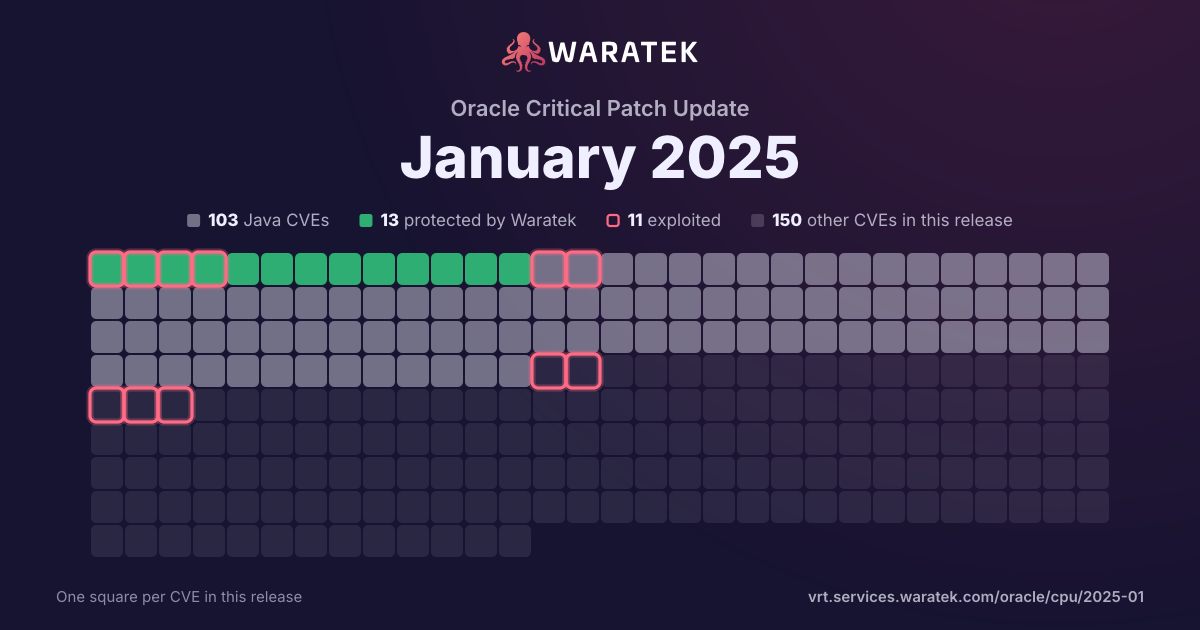
By status
13Protected by Waratek4Mitigation candidate86No exploit published17Outside Waratek scope133Not applicable
11Exploited, marked by the ring
No exploit published. For 48 of them, Oracle's security advisory is the source of public detail.
Protected by Waratek. Waratek RASP can block exploitation of these on systems that have not applied the patch yet.
Overview 133 matches · 0 in Waratek scope · 0 protected · 3 exploited · 1 CISA KEV · 5 public PoC · 2 EPSS ≥ 0.5
133matches
0in Waratek scope0.0%
0protected0.0%
3exploited2.3%
1CISA KEV0.8%
5public PoC3.8%
2EPSS ≥ 0.51.5%
Protected by Waratek
0
0.0%
Rule in development
0
0.0%
Mitigation candidate
0
0.0%
No exploit published
0
0.0%
Outside Waratek scope
0
0.0%
Not applicable
133
100.0%
Withdrawn CVE
0
0.0%
blocked by ARMR today
0
0.0%
partly blocked
0
0.0%
not blocked
133
100.0%
not established
0
0.0%
unrecorded
0
0.0%
split by
peak 38 / quarter
Q2 191
Not applicable1
Medium1
not blocked1
No public exploit1
Q3 191
Not applicable1
Critical1
not blocked1
No public exploit1
Q4 190
Q1 200
Q2 200
Q3 200
Q4 201
Not applicable1
High1
not blocked1
Proof of concept only1
Q1 210
Q2 210
Q3 211
Not applicable1
High1
not blocked1
No public exploit1
Q4 210
Q1 220
Q2 220
Q3 220
Q4 220
Q1 232
Not applicable2
High1
Medium1
not blocked2
No public exploit2
Q2 233
Not applicable3
High1
Medium2
not blocked3
No public exploit3
Q3 239
Not applicable9
Critical1
High5
Medium3
not blocked9
No public exploit9
Q4 2315
Not applicable15
Critical1
High5
Medium9
not blocked15
Proof of concept only2
No public exploit13
Q1 2417
Not applicable17
Critical1
High7
Medium9
not blocked17
Proof of concept only3
No public exploit14
Q2 2418
Not applicable18
Critical2
High10
Medium6
not blocked18
Exploited1
Proof of concept only2
No public exploit15
Q3 2422
Not applicable22
Critical6
High8
Medium6
Low2
not blocked22
Exploited1
Working exploit published1
Proof of concept only3
No public exploit17
Q4 245
Not applicable5
High2
Medium2
Low1
not blocked5
Exploited1
Proof of concept only1
No public exploit3
Q1 2538
Not applicable38
High2
Medium33
Low3
not blocked38
No public exploit38
Q3 19Q1 20Q3 20Q1 21Q3 21Q1 22Q3 22Q1 23Q3 23Q1 24Q3 24Q1 25
| CVE | Severity | Published▾ | Status | Exploitation | Description |
|---|---|---|---|---|---|
| CVE-2025-21571 | High | 2025-01-21 | Not applicable | No public exploit | Vulnerability in the Oracle VM VirtualBox product of Oracle Virtualization (component: Core). Supported versions that are affected are Prior to 7.0.24 and prior to 7.1.6. Easily exploitable vulnerability allows high privileged attacker with logon to the infrastructure where Oracle VM VirtualBox executes to compromise Oracle VM VirtualBox. While the vulnerability is in Oracle VM VirtualBox, attacks may significantly impact additional products (scope change). Successful attacks of this vulnerability can result in unauthorized creation, deletion or modification access to critical data or all Oracle VM VirtualBox accessible data as well as unauthorized read access to a subset of Oracle VM VirtualBox accessible data and unauthorized ability to cause a partial denial of service (partial DOS) of Oracle VM VirtualBox. CVSS 3.1 Base Score 7.3 (Confidentiality, Integrity and Availability impacts). CVSS Vector: (CVSS:3.1/AV:L/AC:L/PR:H/UI:N/S:C/C:L/I:H/A:L). |
| CVE-2025-21567 | Medium | 2025-01-21 | Not applicable | No public exploit | Vulnerability in the MySQL Server product of Oracle MySQL (component: Server: Security: Privileges). Supported versions that are affected are 9.1.0 and prior. Easily exploitable vulnerability allows low privileged attacker with network access via multiple protocols to compromise MySQL Server. Successful attacks of this vulnerability can result in unauthorized read access to a subset of MySQL Server accessible data. CVSS 3.1 Base Score 4.3 (Confidentiality impacts). CVSS Vector: (CVSS:3.1/AV:N/AC:L/PR:L/UI:N/S:U/C:L/I:N/A:N). |
| CVE-2025-21566 | Medium | 2025-01-21 | Not applicable | No public exploit | Vulnerability in the MySQL Server product of Oracle MySQL (component: Server: Optimizer). Supported versions that are affected are 9.1.0 and prior. Easily exploitable vulnerability allows low privileged attacker with network access via multiple protocols to compromise MySQL Server. Successful attacks of this vulnerability can result in unauthorized ability to cause a hang or frequently repeatable crash (complete DOS) of MySQL Server. CVSS 3.1 Base Score 6.5 (Availability impacts). CVSS Vector: (CVSS:3.1/AV:N/AC:L/PR:L/UI:N/S:U/C:N/I:N/A:H). |
| CVE-2025-21559 | Medium | 2025-01-21 | Not applicable | No public exploit | Vulnerability in the MySQL Server product of Oracle MySQL (component: InnoDB). Supported versions that are affected are 8.0.40 and prior, 8.4.3 and prior and 9.1.0 and prior. Easily exploitable vulnerability allows high privileged attacker with network access via multiple protocols to compromise MySQL Server. Successful attacks of this vulnerability can result in unauthorized ability to cause a hang or frequently repeatable crash (complete DOS) of MySQL Server as well as unauthorized update, insert or delete access to some of MySQL Server accessible data. CVSS 3.1 Base Score 5.5 (Integrity and Availability impacts). CVSS Vector: (CVSS:3.1/AV:N/AC:L/PR:H/UI:N/S:U/C:N/I:L/A:H). |
| CVE-2025-21557 | Medium | 2025-01-21 | Not applicable | No public exploit | Vulnerability in Oracle Application Express (component: General). Supported versions that are affected are 23.2 and 24.1. Easily exploitable vulnerability allows low privileged attacker with network access via HTTP to compromise Oracle Application Express. Successful attacks require human interaction from a person other than the attacker and while the vulnerability is in Oracle Application Express, attacks may significantly impact additional products (scope change). Successful attacks of this vulnerability can result in unauthorized update, insert or delete access to some of Oracle Application Express accessible data as well as unauthorized read access to a subset of Oracle Application Express accessible data. CVSS 3.1 Base Score 5.4 (Confidentiality and Integrity impacts). CVSS Vector: (CVSS:3.1/AV:N/AC:L/PR:L/UI:R/S:C/C:L/I:L/A:N). |
| CVE-2025-21555 | Medium | 2025-01-21 | Not applicable | No public exploit | Vulnerability in the MySQL Server product of Oracle MySQL (component: InnoDB). Supported versions that are affected are 8.0.40 and prior, 8.4.3 and prior and 9.1.0 and prior. Easily exploitable vulnerability allows high privileged attacker with network access via multiple protocols to compromise MySQL Server. Successful attacks of this vulnerability can result in unauthorized ability to cause a hang or frequently repeatable crash (complete DOS) of MySQL Server as well as unauthorized update, insert or delete access to some of MySQL Server accessible data. CVSS 3.1 Base Score 5.5 (Integrity and Availability impacts). CVSS Vector: (CVSS:3.1/AV:N/AC:L/PR:H/UI:N/S:U/C:N/I:L/A:H). |
| CVE-2025-21553 | Medium | 2025-01-21 | Not applicable | No public exploit | Vulnerability in the Java VM component of Oracle Database Server. Supported versions that are affected are 19.3-19.25, 21.3-21.16 and 23.4-23.6. Difficult to exploit vulnerability allows low privileged attacker having Create Session, Create Procedure privilege with network access via Oracle Net to compromise Java VM. Successful attacks of this vulnerability can result in unauthorized update, insert or delete access to some of Java VM accessible data as well as unauthorized read access to a subset of Java VM accessible data. CVSS 3.1 Base Score 4.2 (Confidentiality and Integrity impacts). CVSS Vector: (CVSS:3.1/AV:N/AC:H/PR:L/UI:N/S:U/C:L/I:L/A:N). |
| CVE-2025-21551 | Medium | 2025-01-21 | Not applicable | No public exploit | Vulnerability in the Oracle Solaris product of Oracle Systems (component: File system). The supported version that is affected is 11. Easily exploitable vulnerability allows high privileged attacker with logon to the infrastructure where Oracle Solaris executes to compromise Oracle Solaris. Successful attacks of this vulnerability can result in unauthorized creation, deletion or modification access to critical data or all Oracle Solaris accessible data and unauthorized ability to cause a hang or frequently repeatable crash (complete DOS) of Oracle Solaris. CVSS 3.1 Base Score 6.0 (Integrity and Availability impacts). CVSS Vector: (CVSS:3.1/AV:L/AC:L/PR:H/UI:N/S:U/C:N/I:H/A:H). |
| CVE-2025-21548 | Medium | 2025-01-21 | Not applicable | No public exploit | Vulnerability in the MySQL Connectors product of Oracle MySQL (component: Connector/Python). Supported versions that are affected are 9.1.0 and prior. Easily exploitable vulnerability allows high privileged attacker with network access via multiple protocols to compromise MySQL Connectors. Successful attacks require human interaction from a person other than the attacker. Successful attacks of this vulnerability can result in unauthorized creation, deletion or modification access to critical data or all MySQL Connectors accessible data as well as unauthorized read access to a subset of MySQL Connectors accessible data and unauthorized ability to cause a hang or frequently repeatable crash (complete DOS) of MySQL Connectors. CVSS 3.1 Base Score 6.4 (Confidentiality, Integrity and Availability impacts). CVSS Vector: (CVSS:3.1/AV:N/AC:L/PR:H/UI:R/S:U/C:L/I:H/A:H). |
| CVE-2025-21546 | Low | 2025-01-21 | Not applicable | No public exploit | Vulnerability in the MySQL Server product of Oracle MySQL (component: Server: Security: Privileges). Supported versions that are affected are 8.0.40 and prior, 8.4.3 and prior and 9.1.0 and prior. Easily exploitable vulnerability allows high privileged attacker with network access via multiple protocols to compromise MySQL Server. Successful attacks of this vulnerability can result in unauthorized update, insert or delete access to some of MySQL Server accessible data as well as unauthorized read access to a subset of MySQL Server accessible data. CVSS 3.1 Base Score 3.8 (Confidentiality and Integrity impacts). CVSS Vector: (CVSS:3.1/AV:N/AC:L/PR:H/UI:N/S:U/C:L/I:L/A:N). |
| CVE-2025-21543 | Medium | 2025-01-21 | Not applicable | No public exploit | Vulnerability in the MySQL Server product of Oracle MySQL (component: Server: Packaging). Supported versions that are affected are 8.0.40 and prior, 8.4.3 and prior and 9.1.0 and prior. Easily exploitable vulnerability allows high privileged attacker with network access via multiple protocols to compromise MySQL Server. Successful attacks of this vulnerability can result in unauthorized ability to cause a hang or frequently repeatable crash (complete DOS) of MySQL Server. CVSS 3.1 Base Score 4.9 (Availability impacts). CVSS Vector: (CVSS:3.1/AV:N/AC:L/PR:H/UI:N/S:U/C:N/I:N/A:H). |
| CVE-2025-21540 | Medium | 2025-01-21 | Not applicable | No public exploit | Vulnerability in the MySQL Server product of Oracle MySQL (component: Server: Security: Privileges). Supported versions that are affected are 8.0.40 and prior, 8.4.3 and prior and 9.1.0 and prior. Easily exploitable vulnerability allows low privileged attacker with network access via multiple protocols to compromise MySQL Server. Successful attacks of this vulnerability can result in unauthorized update, insert or delete access to some of MySQL Server accessible data as well as unauthorized read access to a subset of MySQL Server accessible data. CVSS 3.1 Base Score 5.4 (Confidentiality and Integrity impacts). CVSS Vector: (CVSS:3.1/AV:N/AC:L/PR:L/UI:N/S:U/C:L/I:L/A:N). |
| CVE-2025-21536 | Medium | 2025-01-21 | Not applicable | No public exploit | Vulnerability in the MySQL Server product of Oracle MySQL (component: Server: Optimizer). Supported versions that are affected are 8.0.39 and prior, 8.4.2 and prior and 9.0.1 and prior. Easily exploitable vulnerability allows high privileged attacker with network access via multiple protocols to compromise MySQL Server. Successful attacks of this vulnerability can result in unauthorized ability to cause a hang or frequently repeatable crash (complete DOS) of MySQL Server. CVSS 3.1 Base Score 4.9 (Availability impacts). CVSS Vector: (CVSS:3.1/AV:N/AC:L/PR:H/UI:N/S:U/C:N/I:N/A:H). |
| CVE-2025-21534 | Medium | 2025-01-21 | Not applicable | No public exploit | Vulnerability in the MySQL Server product of Oracle MySQL (component: Server: Performance Schema). Supported versions that are affected are 8.0.39 and prior, 8.4.2 and prior and 9.0.1 and prior. Easily exploitable vulnerability allows high privileged attacker with network access via multiple protocols to compromise MySQL Server. Successful attacks of this vulnerability can result in unauthorized ability to cause a hang or frequently repeatable crash (complete DOS) of MySQL Server. CVSS 3.1 Base Score 4.9 (Availability impacts). CVSS Vector: (CVSS:3.1/AV:N/AC:L/PR:H/UI:N/S:U/C:N/I:N/A:H). |
| CVE-2025-21533 | Medium | 2025-01-21 | Not applicable | No public exploit | Vulnerability in the Oracle VM VirtualBox product of Oracle Virtualization (component: Core). Supported versions that are affected are Prior to 7.0.24 and prior to 7.1.6. Easily exploitable vulnerability allows low privileged attacker with logon to the infrastructure where Oracle VM VirtualBox executes to compromise Oracle VM VirtualBox. Successful attacks of this vulnerability can result in unauthorized access to critical data or complete access to all Oracle VM VirtualBox accessible data. CVSS 3.1 Base Score 5.5 (Confidentiality impacts). CVSS Vector: (CVSS:3.1/AV:L/AC:L/PR:L/UI:N/S:U/C:H/I:N/A:N). |
| CVE-2025-21531 | Medium | 2025-01-21 | Not applicable | No public exploit | Vulnerability in the MySQL Server product of Oracle MySQL (component: InnoDB). Supported versions that are affected are 8.0.40 and prior, 8.4.3 and prior and 9.1.0 and prior. Easily exploitable vulnerability allows high privileged attacker with network access via multiple protocols to compromise MySQL Server. Successful attacks of this vulnerability can result in unauthorized ability to cause a hang or frequently repeatable crash (complete DOS) of MySQL Server. CVSS 3.1 Base Score 4.9 (Availability impacts). CVSS Vector: (CVSS:3.1/AV:N/AC:L/PR:H/UI:N/S:U/C:N/I:N/A:H). |
| CVE-2025-21529 | Medium | 2025-01-21 | Not applicable | No public exploit | Vulnerability in the MySQL Server product of Oracle MySQL (component: Server: Information Schema). Supported versions that are affected are 8.0.40 and prior, 8.4.3 and prior and 9.1.0 and prior. Easily exploitable vulnerability allows high privileged attacker with network access via multiple protocols to compromise MySQL Server. Successful attacks of this vulnerability can result in unauthorized ability to cause a hang or frequently repeatable crash (complete DOS) of MySQL Server. CVSS 3.1 Base Score 4.9 (Availability impacts). CVSS Vector: (CVSS:3.1/AV:N/AC:L/PR:H/UI:N/S:U/C:N/I:N/A:H). |
| CVE-2025-21525 | Medium | 2025-01-21 | Not applicable | No public exploit | Vulnerability in the MySQL Server product of Oracle MySQL (component: Server: DDL). Supported versions that are affected are 8.0.39 and prior, 8.4.2 and prior and 9.0.1 and prior. Easily exploitable vulnerability allows high privileged attacker with network access via multiple protocols to compromise MySQL Server. Successful attacks of this vulnerability can result in unauthorized ability to cause a hang or frequently repeatable crash (complete DOS) of MySQL Server. CVSS 3.1 Base Score 4.9 (Availability impacts). CVSS Vector: (CVSS:3.1/AV:N/AC:L/PR:H/UI:N/S:U/C:N/I:N/A:H). |
| CVE-2025-21523 | Medium | 2025-01-21 | Not applicable | No public exploit | Vulnerability in the MySQL Server product of Oracle MySQL (component: InnoDB). Supported versions that are affected are 8.0.40 and prior, 8.4.3 and prior and 9.1.0 and prior. Easily exploitable vulnerability allows high privileged attacker with network access via multiple protocols to compromise MySQL Server. Successful attacks of this vulnerability can result in unauthorized ability to cause a hang or frequently repeatable crash (complete DOS) of MySQL Server. CVSS 3.1 Base Score 4.9 (Availability impacts). CVSS Vector: (CVSS:3.1/AV:N/AC:L/PR:H/UI:N/S:U/C:N/I:N/A:H). |
| CVE-2025-21522 | Medium | 2025-01-21 | Not applicable | No public exploit | Vulnerability in the MySQL Server product of Oracle MySQL (component: Server: Parser). Supported versions that are affected are 8.0.40 and prior, 8.4.3 and prior and 9.1.0 and prior. Easily exploitable vulnerability allows low privileged attacker with network access via multiple protocols to compromise MySQL Server. Successful attacks of this vulnerability can result in unauthorized ability to cause a hang or frequently repeatable crash (complete DOS) of MySQL Server. CVSS 3.1 Base Score 6.5 (Availability impacts). CVSS Vector: (CVSS:3.1/AV:N/AC:L/PR:L/UI:N/S:U/C:N/I:N/A:H). |
| CVE-2025-21521 | High | 2025-01-21 | Not applicable | No public exploit | Vulnerability in the MySQL Server product of Oracle MySQL (component: Server: Thread Pooling). Supported versions that are affected are 8.0.39 and prior, 8.4.2 and prior and 9.0.1 and prior. Easily exploitable vulnerability allows unauthenticated attacker with network access via multiple protocols to compromise MySQL Server. Successful attacks of this vulnerability can result in unauthorized ability to cause a hang or frequently repeatable crash (complete DOS) of MySQL Server. CVSS 3.1 Base Score 7.5 (Availability impacts). CVSS Vector: (CVSS:3.1/AV:N/AC:L/PR:N/UI:N/S:U/C:N/I:N/A:H). |
| CVE-2025-21520 | Low | 2025-01-21 | Not applicable | No public exploit | Vulnerability in the MySQL Server product of Oracle MySQL (component: Server: Options). Supported versions that are affected are 8.0.40 and prior, 8.4.3 and prior and 9.1.0 and prior. Difficult to exploit vulnerability allows high privileged attacker with logon to the infrastructure where MySQL Server executes to compromise MySQL Server. Successful attacks require human interaction from a person other than the attacker. Successful attacks of this vulnerability can result in unauthorized read access to a subset of MySQL Server accessible data. CVSS 3.1 Base Score 1.8 (Confidentiality impacts). CVSS Vector: (CVSS:3.1/AV:L/AC:H/PR:H/UI:R/S:U/C:L/I:N/A:N). |
| CVE-2025-21519 | Medium | 2025-01-21 | Not applicable | No public exploit | Vulnerability in the MySQL Server product of Oracle MySQL (component: Server: Security: Privileges). Supported versions that are affected are 8.0.40 and prior, 8.4.3 and prior and 9.1.0 and prior. Difficult to exploit vulnerability allows high privileged attacker with network access via multiple protocols to compromise MySQL Server. Successful attacks of this vulnerability can result in unauthorized ability to cause a hang or frequently repeatable crash (complete DOS) of MySQL Server. CVSS 3.1 Base Score 4.4 (Availability impacts). CVSS Vector: (CVSS:3.1/AV:N/AC:H/PR:H/UI:N/S:U/C:N/I:N/A:H). |
| CVE-2025-21518 | Medium | 2025-01-21 | Not applicable | No public exploit | Vulnerability in the MySQL Server product of Oracle MySQL (component: Server: Optimizer). Supported versions that are affected are 8.0.40 and prior, 8.4.3 and prior and 9.1.0 and prior. Easily exploitable vulnerability allows low privileged attacker with network access via multiple protocols to compromise MySQL Server. Successful attacks of this vulnerability can result in unauthorized ability to cause a hang or frequently repeatable crash (complete DOS) of MySQL Server. CVSS 3.1 Base Score 6.5 (Availability impacts). CVSS Vector: (CVSS:3.1/AV:N/AC:L/PR:L/UI:N/S:U/C:N/I:N/A:H). |
| CVE-2025-21505 | Medium | 2025-01-21 | Not applicable | No public exploit | Vulnerability in the MySQL Server product of Oracle MySQL (component: Server: Components Services). Supported versions that are affected are 8.0.40 and prior, 8.4.3 and prior and 9.1.0 and prior. Easily exploitable vulnerability allows high privileged attacker with network access via multiple protocols to compromise MySQL Server. Successful attacks of this vulnerability can result in unauthorized ability to cause a hang or frequently repeatable crash (complete DOS) of MySQL Server. CVSS 3.1 Base Score 4.9 (Availability impacts). CVSS Vector: (CVSS:3.1/AV:N/AC:L/PR:H/UI:N/S:U/C:N/I:N/A:H). |
| CVE-2025-21504 | Medium | 2025-01-21 | Not applicable | No public exploit | Vulnerability in the MySQL Server product of Oracle MySQL (component: Server: Optimizer). Supported versions that are affected are 8.0.39 and prior, 8.4.2 and prior and 9.0.1 and prior. Easily exploitable vulnerability allows high privileged attacker with network access via multiple protocols to compromise MySQL Server. Successful attacks of this vulnerability can result in unauthorized ability to cause a hang or frequently repeatable crash (complete DOS) of MySQL Server. CVSS 3.1 Base Score 4.9 (Availability impacts). CVSS Vector: (CVSS:3.1/AV:N/AC:L/PR:H/UI:N/S:U/C:N/I:N/A:H). |
| CVE-2025-21503 | Medium | 2025-01-21 | Not applicable | No public exploit | Vulnerability in the MySQL Server product of Oracle MySQL (component: InnoDB). Supported versions that are affected are 8.0.40 and prior, 8.4.3 and prior and 9.1.0 and prior. Easily exploitable vulnerability allows high privileged attacker with network access via multiple protocols to compromise MySQL Server. Successful attacks of this vulnerability can result in unauthorized ability to cause a hang or frequently repeatable crash (complete DOS) of MySQL Server. CVSS 3.1 Base Score 4.9 (Availability impacts). CVSS Vector: (CVSS:3.1/AV:N/AC:L/PR:H/UI:N/S:U/C:N/I:N/A:H). |
| CVE-2025-21501 | Medium | 2025-01-21 | Not applicable | No public exploit | Vulnerability in the MySQL Server product of Oracle MySQL (component: Server: Optimizer). Supported versions that are affected are 8.0.40 and prior, 8.4.3 and prior and 9.1.0 and prior. Easily exploitable vulnerability allows low privileged attacker with network access via multiple protocols to compromise MySQL Server. Successful attacks of this vulnerability can result in unauthorized ability to cause a hang or frequently repeatable crash (complete DOS) of MySQL Server. CVSS 3.1 Base Score 6.5 (Availability impacts). CVSS Vector: (CVSS:3.1/AV:N/AC:L/PR:L/UI:N/S:U/C:N/I:N/A:H). |
| CVE-2025-21500 | Medium | 2025-01-21 | Not applicable | No public exploit | Vulnerability in the MySQL Server product of Oracle MySQL (component: Server: Optimizer). Supported versions that are affected are 8.0.40 and prior, 8.4.3 and prior and 9.1.0 and prior. Easily exploitable vulnerability allows low privileged attacker with network access via multiple protocols to compromise MySQL Server. Successful attacks of this vulnerability can result in unauthorized ability to cause a hang or frequently repeatable crash (complete DOS) of MySQL Server. CVSS 3.1 Base Score 6.5 (Availability impacts). CVSS Vector: (CVSS:3.1/AV:N/AC:L/PR:L/UI:N/S:U/C:N/I:N/A:H). |
| CVE-2025-21499 | Medium | 2025-01-21 | Not applicable | No public exploit | Vulnerability in the MySQL Server product of Oracle MySQL (component: Server: DDL). Supported versions that are affected are 8.4.3 and prior and 9.1.0 and prior. Easily exploitable vulnerability allows high privileged attacker with network access via multiple protocols to compromise MySQL Server. Successful attacks of this vulnerability can result in unauthorized ability to cause a hang or frequently repeatable crash (complete DOS) of MySQL Server. CVSS 3.1 Base Score 4.9 (Availability impacts). CVSS Vector: (CVSS:3.1/AV:N/AC:L/PR:H/UI:N/S:U/C:N/I:N/A:H). |
| CVE-2025-21498 | Medium | 2025-01-21 | Not applicable | No public exploit | Vulnerability in the Oracle HTTP Server product of Oracle Fusion Middleware (component: Core). The supported version that is affected is 12.2.1.4.0. Easily exploitable vulnerability allows unauthenticated attacker with network access via HTTP to compromise Oracle HTTP Server. Successful attacks of this vulnerability can result in unauthorized read access to a subset of Oracle HTTP Server accessible data. CVSS 3.1 Base Score 5.3 (Confidentiality impacts). CVSS Vector: (CVSS:3.1/AV:N/AC:L/PR:N/UI:N/S:U/C:L/I:N/A:N). |
| CVE-2025-21497 | Medium | 2025-01-21 | Not applicable | No public exploit | Vulnerability in the MySQL Server product of Oracle MySQL (component: InnoDB). Supported versions that are affected are 8.0.40 and prior, 8.4.3 and prior and 9.1.0 and prior. Easily exploitable vulnerability allows high privileged attacker with network access via multiple protocols to compromise MySQL Server. Successful attacks of this vulnerability can result in unauthorized ability to cause a hang or frequently repeatable crash (complete DOS) of MySQL Server as well as unauthorized update, insert or delete access to some of MySQL Server accessible data. CVSS 3.1 Base Score 5.5 (Integrity and Availability impacts). CVSS Vector: (CVSS:3.1/AV:N/AC:L/PR:H/UI:N/S:U/C:N/I:L/A:H). |
| CVE-2025-21495 | Medium | 2025-01-21 | Not applicable | No public exploit | Vulnerability in the MySQL Enterprise Firewall product of Oracle MySQL (component: Firewall). Supported versions that are affected are 8.0.40 and prior, 8.4.3 and prior and 9.1.0 and prior. Difficult to exploit vulnerability allows high privileged attacker with network access via multiple protocols to compromise MySQL Enterprise Firewall. Successful attacks of this vulnerability can result in unauthorized ability to cause a hang or frequently repeatable crash (complete DOS) of MySQL Enterprise Firewall. CVSS 3.1 Base Score 4.4 (Availability impacts). CVSS Vector: (CVSS:3.1/AV:N/AC:H/PR:H/UI:N/S:U/C:N/I:N/A:H). |
| CVE-2025-21494 | Medium | 2025-01-21 | Not applicable | No public exploit | Vulnerability in the MySQL Server product of Oracle MySQL (component: Server: Security: Privileges). Supported versions that are affected are 8.0.39 and prior, 8.4.2 and prior and 9.0.1 and prior. Difficult to exploit vulnerability allows high privileged attacker with logon to the infrastructure where MySQL Server executes to compromise MySQL Server. Successful attacks of this vulnerability can result in unauthorized ability to cause a hang or frequently repeatable crash (complete DOS) of MySQL Server. CVSS 3.1 Base Score 4.1 (Availability impacts). CVSS Vector: (CVSS:3.1/AV:L/AC:H/PR:H/UI:N/S:U/C:N/I:N/A:H). |
| CVE-2025-21493 | Medium | 2025-01-21 | Not applicable | No public exploit | Vulnerability in the MySQL Server product of Oracle MySQL (component: Server: Security: Privileges). Supported versions that are affected are 8.4.3 and prior and 9.1.0 and prior. Difficult to exploit vulnerability allows high privileged attacker with network access via multiple protocols to compromise MySQL Server. Successful attacks of this vulnerability can result in unauthorized ability to cause a hang or frequently repeatable crash (complete DOS) of MySQL Server. CVSS 3.1 Base Score 4.4 (Availability impacts). CVSS Vector: (CVSS:3.1/AV:N/AC:H/PR:H/UI:N/S:U/C:N/I:N/A:H). |
| CVE-2025-21491 | Medium | 2025-01-21 | Not applicable | No public exploit | Vulnerability in the MySQL Server product of Oracle MySQL (component: InnoDB). Supported versions that are affected are 8.0.40 and prior, 8.4.3 and prior and 9.1.0 and prior. Easily exploitable vulnerability allows high privileged attacker with network access via multiple protocols to compromise MySQL Server. Successful attacks of this vulnerability can result in unauthorized ability to cause a hang or frequently repeatable crash (complete DOS) of MySQL Server. CVSS 3.1 Base Score 4.9 (Availability impacts). CVSS Vector: (CVSS:3.1/AV:N/AC:L/PR:H/UI:N/S:U/C:N/I:N/A:H). |
| CVE-2025-21490 | Medium | 2025-01-21 | Not applicable | No public exploit | Vulnerability in the MySQL Server product of Oracle MySQL (component: InnoDB). Supported versions that are affected are 8.0.40 and prior, 8.4.3 and prior and 9.1.0 and prior. Easily exploitable vulnerability allows high privileged attacker with network access via multiple protocols to compromise MySQL Server. Successful attacks of this vulnerability can result in unauthorized ability to cause a hang or frequently repeatable crash (complete DOS) of MySQL Server. CVSS 3.1 Base Score 4.9 (Availability impacts). CVSS Vector: (CVSS:3.1/AV:N/AC:L/PR:H/UI:N/S:U/C:N/I:N/A:H). |
| CVE-2024-37372 | Low | 2025-01-09 | Not applicable | No public exploit | The Permission Model assumes that any path starting with two backslashes \ has a four-character prefix that can be ignored, which is not always true. This subtle bug leads to vulnerable edge cases. |
| CVE-2024-11053 | Low | 2024-12-11 | Not applicable | Proof of concept only | When asked to both use a `.netrc` file for credentials and to follow HTTP redirects, curl could leak the password used for the first host to the followed-to host under certain circumstances. This flaw only manifests itself if the netrc file has an entry that matches the redirect target hostname but the entry either omits just the password or omits both login and password. |
| CVE-2024-47072 | High | 2024-11-08 | Not applicable | No public exploit | XStream is a simple library to serialize objects to XML and back again. This vulnerability may allow a remote attacker to terminate the application with a stack overflow error resulting in a denial of service only by manipulating the processed input stream when XStream is configured to use the BinaryStreamDriver. XStream 1.4.21 has been patched to detect the manipulation in the binary input stream causing the the stack overflow and raises an InputManipulationException instead. Users are advised to upgrade. Users unable to upgrade may catch the StackOverflowError in the client code calling XStream if XStream is configured to use the BinaryStreamDriver. |
| CVE-2024-49767 | Medium | 2024-10-25 | Not applicable | No public exploit | Werkzeug is a Web Server Gateway Interface web application library. Applications using `werkzeug.formparser.MultiPartParser` corresponding to a version of Werkzeug prior to 3.0.6 to parse `multipart/form-data` requests (e.g. all flask applications) are vulnerable to a relatively simple but effective resource exhaustion (denial of service) attack. A specifically crafted form submission request can cause the parser to allocate and block 3 to 8 times the upload size in main memory. There is no upper limit; a single upload at 1 Gbit/s can exhaust 32 GB of RAM in less than 60 seconds. Werkzeug version 3.0.6 fixes this issue. |
| CVE-2024-49766 | Medium | 2024-10-25 | Not applicable | Exploited | Werkzeug is a Web Server Gateway Interface web application library. On Python < 3.11 on Windows, os.path.isabs() does not catch UNC paths like //server/share. Werkzeug's safe_join() relies on this check, and so can produce a path that is not safe, potentially allowing unintended access to data. Applications using Python >= 3.11, or not using Windows, are not vulnerable. Werkzeug version 3.0.6 contains a patch. |
| CVE-2024-8927 | High | 2024-10-08 | Not applicable | No public exploit | In PHP versions 8.1.* before 8.1.30, 8.2.* before 8.2.24, 8.3.* before 8.3.12, HTTP_REDIRECT_STATUS variable is used to check whether or not CGI binary is being run by the HTTP server. However, in certain scenarios, the content of this variable can be controlled by the request submitter via HTTP headers, which can lead to cgi.force_redirect option not being correctly applied. In certain configurations this may lead to arbitrary file inclusion in PHP. |
| CVE-2024-38809 | Medium | 2024-09-27 | Not applicable | No public exploit | Applications that parse ETags from "If-Match" or "If-None-Match" request headers are vulnerable to DoS attack. Users of affected versions should upgrade to the corresponding fixed version. Users of older, unsupported versions could enforce a size limit on "If-Match" and "If-None-Match" headers, e.g. through a Filter. |
| CVE-2024-45801 | High | 2024-09-16 | Not applicable | No public exploit | DOMPurify is a DOM-only, super-fast, uber-tolerant XSS sanitizer for HTML, MathML and SVG. It has been discovered that malicious HTML using special nesting techniques can bypass the depth checking added to DOMPurify in recent releases. It was also possible to use Prototype Pollution to weaken the depth check. This renders dompurify unable to avoid cross site scripting (XSS) attacks. This issue has been addressed in versions 2.5.4 and 3.1.3 of DOMPurify. All users are advised to upgrade. There are no known workarounds for this vulnerability. |
| CVE-2024-8096 | Medium | 2024-09-11 | Not applicable | No public exploit | When curl is told to use the Certificate Status Request TLS extension, often referred to as OCSP stapling, to verify that the server certificate is valid, it might fail to detect some OCSP problems and instead wrongly consider the response as fine. If the returned status reports another error than 'revoked' (like for example 'unauthorized') it is not treated as a bad certficate. |
| CVE-2024-36138 | High | 2024-09-07 | Not applicable | No public exploit | Bypass incomplete fix of CVE-2024-27980, that arises from improper handling of batch files with all possible extensions on Windows via child_process.spawn / child_process.spawnSync. A malicious command line argument can inject arbitrary commands and achieve code execution even if the shell option is not enabled. |
| CVE-2024-36137 | Low | 2024-09-07 | Not applicable | No public exploit | A vulnerability has been identified in Node.js, affecting users of the experimental permission model when the --allow-fs-write flag is used. Node.js Permission Model do not operate on file descriptors, however, operations such as fs.fchown or fs.fchmod can use a "read-only" file descriptor to change the owner and permissions of a file. |
| CVE-2024-6232 | High | 2024-09-03 | Not applicable | No public exploit | There is a MEDIUM severity vulnerability affecting CPython. Regular expressions that allowed excessive backtracking during tarfile.TarFile header parsing are vulnerable to ReDoS via specifically-crafted tar archives. |
| CVE-2024-8006 | Medium | 2024-08-31 | Not applicable | No public exploit | Remote packet capture support is disabled by default in libpcap. When a user builds libpcap with remote packet capture support enabled, one of the functions that become available is pcap_findalldevs_ex(). One of the function arguments can be a filesystem path, which normally means a directory with input data files. When the specified path cannot be used as a directory, the function receives NULL from opendir(), but does not check the return value and passes the NULL value to readdir(), which causes a NULL pointer derefence. |
| CVE-2023-7256 | Medium | 2024-08-31 | Not applicable | No public exploit | In affected libpcap versions during the setup of a remote packet capture the internal function sock_initaddress() calls getaddrinfo() and possibly freeaddrinfo(), but does not clearly indicate to the caller function whether freeaddrinfo() still remains to be called after the function returns. This makes it possible in some scenarios that both the function and its caller call freeaddrinfo() for the same allocated memory block. A similar problem was reported in Apple libpcap, to which Apple assigned CVE-2023-40400. |
| CVE-2024-45492 | Critical | 2024-08-30 | Not applicable | No public exploit | An issue was discovered in libexpat before 2.6.3. nextScaffoldPart in xmlparse.c can have an integer overflow for m_groupSize on 32-bit platforms (where UINT_MAX equals SIZE_MAX). |
| CVE-2024-45491 | Critical | 2024-08-30 | Not applicable | No public exploit | An issue was discovered in libexpat before 2.6.3. dtdCopy in xmlparse.c can have an integer overflow for nDefaultAtts on 32-bit platforms (where UINT_MAX equals SIZE_MAX). |
| CVE-2024-45490 | Critical | 2024-08-30 | Not applicable | No public exploit | An issue was discovered in libexpat before 2.6.3. xmlparse.c does not reject a negative length for XML_ParseBuffer. |
| CVE-2023-49582 | Medium | 2024-08-26 | Not applicable | No public exploit | Lax permissions set by the Apache Portable Runtime library on Unix platforms would allow local users read access to named shared memory segments, potentially revealing sensitive application data. This issue does not affect non-Unix platforms, or builds with APR_USE_SHMEM_SHMGET=1 (apr.h) Users are recommended to upgrade to APR version 1.7.5, which fixes this issue. |
| CVE-2024-7592 | High | 2024-08-19 | Not applicable | Proof of concept only | There is a LOW severity vulnerability affecting CPython, specifically the 'http.cookies' standard library module. When parsing cookies that contained backslashes for quoted characters in the cookie value, the parser would use an algorithm with quadratic complexity, resulting in excess CPU resources being used while parsing the value. |
| CVE-2024-41817 | High | 2024-07-29 | Not applicable | Proof of concept only | ImageMagick is a free and open-source software suite, used for editing and manipulating digital images. The `AppImage` version `ImageMagick` might use an empty path when setting `MAGICK_CONFIGURE_PATH` and `LD_LIBRARY_PATH` environment variables while executing, which might lead to arbitrary code execution by loading malicious configuration files or shared libraries in the current working directory while executing `ImageMagick`. The vulnerability is fixed in 7.11-36. |
| CVE-2024-40898 | Critical | 2024-07-18 | Not applicable | No public exploit | SSRF in Apache HTTP Server on Windows with mod_rewrite in server/vhost context, allows to potentially leak NTML hashes to a malicious server via SSRF and malicious requests. Users are recommended to upgrade to version 2.4.62 which fixes this issue. |
| CVE-2023-7272 | High | 2024-07-17 | Not applicable | No public exploit | In Eclipse Parsson before 1.0.4 and 1.1.3, a document with a large depth of nested objects can allow an attacker to cause a Java stack overflow exception and denial of service. Eclipse Parsson allows processing (e.g. parse, generate, transform and query) JSON documents. |
| CVE-2024-22018 | Low | 2024-07-10 | Not applicable | No public exploit | A vulnerability has been identified in Node.js, affecting users of the experimental permission model when the --allow-fs-read flag is used. This flaw arises from an inadequate permission model that fails to restrict file stats through the fs.lstat API. As a result, malicious actors can retrieve stats from files that they do not have explicit read access to. This vulnerability affects all users using the experimental permission model in Node.js 20 and Node.js 21. Please note that at the time this CVE was issued, the permission model is an experimental feature of Node.js. |
| CVE-2024-3596 | Critical | 2024-07-09 | Not applicable | Proof of concept only | RADIUS Protocol under RFC 2865 is susceptible to forgery attacks by a local attacker who can modify any valid Response (Access-Accept, Access-Reject, or Access-Challenge) to any other response using a chosen-prefix collision attack against MD5 Response Authenticator signature. |
| CVE-2024-22020 | Medium | 2024-07-09 | Not applicable | No public exploit | A security flaw in Node.js allows a bypass of network import restrictions. By embedding non-network imports in data URLs, an attacker can execute arbitrary code, compromising system security. Verified on various platforms, the vulnerability is mitigated by forbidding data URLs in network imports. Exploiting this flaw can violate network import security, posing a risk to developers and servers. |
| CVE-2024-24791 | High | 2024-07-02 | Not applicable | No public exploit | The net/http HTTP/1.1 client mishandled the case where a server responds to a request with an "Expect: 100-continue" header with a non-informational (200 or higher) status. This mishandling could leave a client connection in an invalid state, where the next request sent on the connection will fail. An attacker sending a request to a net/http/httputil.ReverseProxy proxy can exploit this mishandling to cause a denial of service by sending "Expect: 100-continue" requests which elicit a non-informational response from the backend. Each such request leaves the proxy with an invalid connection, and causes one subsequent request using that connection to fail. |
| CVE-2024-38475 | Critical | 2024-07-01 | Not applicable | Exploited | Improper escaping of output in mod_rewrite in Apache HTTP Server 2.4.59 and earlier allows an attacker to map URLs to filesystem locations that are permitted to be served by the server but are not intentionally/directly reachable by any URL, resulting in code execution or source code disclosure. Substitutions in server context that use a backreferences or variables as the first segment of the substitution are affected. Some unsafe RewiteRules will be broken by this change and the rewrite flag "UnsafePrefixStat" can be used to opt back in once ensuring the substitution is appropriately constrained. |
| CVE-2024-38473 | High | 2024-07-01 | Not applicable | Working exploit published | Encoding problem in mod_proxy in Apache HTTP Server 2.4.59 and earlier allows request URLs with incorrect encoding to be sent to backend services, potentially bypassing authentication via crafted requests. Users are recommended to upgrade to version 2.4.60, which fixes this issue. |
| CVE-2024-37371 | Critical | 2024-06-28 | Not applicable | No public exploit | In MIT Kerberos 5 (aka krb5) before 1.21.3, an attacker can cause invalid memory reads during GSS message token handling by sending message tokens with invalid length fields. |
| CVE-2024-37370 | High | 2024-06-28 | Not applicable | No public exploit | In MIT Kerberos 5 (aka krb5) before 1.21.3, an attacker can modify the plaintext Extra Count field of a confidential GSS krb5 wrap token, causing the unwrapped token to appear truncated to the application. |
| CVE-2024-38526 | High | 2024-06-26 | Not applicable | Exploited | pdoc provides API Documentation for Python Projects. Documentation generated with `pdoc --math` linked to JavaScript files from polyfill.io. The polyfill.io CDN has been sold and now serves malicious code. This issue has been fixed in pdoc 14.5.1. |
| CVE-2024-4032 | High | 2024-06-17 | Not applicable | No public exploit | The “ipaddress” module contained incorrect information about whether certain IPv4 and IPv6 addresses were designated as “globally reachable” or “private”. This affected the is_private and is_global properties of the ipaddress.IPv4Address, ipaddress.IPv4Network, ipaddress.IPv6Address, and ipaddress.IPv6Network classes, where values wouldn’t be returned in accordance with the latest information from the IANA Special-Purpose Address Registries. CPython 3.12.4 and 3.13.0a6 contain updated information from these registries and thus have the intended behavior. |
| CVE-2024-0397 | High | 2024-06-17 | Not applicable | No public exploit | A defect was discovered in the Python “ssl” module where there is a memory race condition with the ssl.SSLContext methods “cert_store_stats()” and “get_ca_certs()”. The race condition can be triggered if the methods are called at the same time as certificates are loaded into the SSLContext, such as during the TLS handshake with a certificate directory configured. This issue is fixed in CPython 3.10.14, 3.11.9, 3.12.3, and 3.13.0a5. |
| CVE-2024-35195 | Medium | 2024-05-20 | Not applicable | No public exploit | Requests is a HTTP library. Prior to 2.32.0, when making requests through a Requests `Session`, if the first request is made with `verify=False` to disable cert verification, all subsequent requests to the same host will continue to ignore cert verification regardless of changes to the value of `verify`. This behavior will continue for the lifecycle of the connection in the connection pool. This vulnerability is fixed in 2.32.0. |
| CVE-2024-4603 | Medium | 2024-05-16 | Not applicable | No public exploit | Issue summary: Checking excessively long DSA keys or parameters may be very slow. Impact summary: Applications that use the functions EVP_PKEY_param_check() or EVP_PKEY_public_check() to check a DSA public key or DSA parameters may experience long delays. Where the key or parameters that are being checked have been obtained from an untrusted source this may lead to a Denial of Service. The functions EVP_PKEY_param_check() or EVP_PKEY_public_check() perform various checks on DSA parameters. Some of those computations take a long time if the modulus (`p` parameter) is too large. Trying to use a very large modulus is slow and OpenSSL will not allow using public keys with a modulus which is over 10,000 bits in length for signature verification. However the key and parameter check functions do not limit the modulus size when performing the checks. An application that calls EVP_PKEY_param_check() or EVP_PKEY_public_check() and supplies a key or parameters obtained from an untrusted source could be vulnerable to a Denial of Service attack. These functions are not called by OpenSSL itself on untrusted DSA keys so only applications that directly call these functions may be vulnerable. Also vulnerable are the OpenSSL pkey and pkeyparam command line applications when using the `-check` option. The OpenSSL SSL/TLS implementation is not affected by this issue. The OpenSSL 3.0 and 3.1 FIPS providers are affected by this issue. |
| CVE-2024-27282 | Medium | 2024-05-14 | Not applicable | No public exploit | An issue was discovered in Ruby 3.x through 3.3.0. If attacker-supplied data is provided to the Ruby regex compiler, it is possible to extract arbitrary heap data relative to the start of the text, including pointers and sensitive strings. The fixed versions are 3.0.7, 3.1.5, 3.2.4, and 3.3.1. |
| CVE-2024-27281 | Medium | 2024-05-14 | Not applicable | Proof of concept only | An issue was discovered in RDoc 6.3.3 through 6.6.2, as distributed in Ruby 3.x through 3.3.0. When parsing .rdoc_options (used for configuration in RDoc) as a YAML file, object injection and resultant remote code execution are possible because there are no restrictions on the classes that can be restored. (When loading the documentation cache, object injection and resultant remote code execution are also possible if there were a crafted cache.) The main fixed version is 6.6.3.1. For Ruby 3.0 users, a fixed version is rdoc 6.3.4.1. For Ruby 3.1 users, a fixed version is rdoc 6.4.1.1. For Ruby 3.2 users, a fixed version is rdoc 6.5.1.1. |
| CVE-2024-27280 | Critical | 2024-05-14 | Not applicable | No public exploit | A buffer-overread issue was discovered in StringIO 3.0.1, as distributed in Ruby 3.0.x through 3.0.6 and 3.1.x through 3.1.4. The ungetbyte and ungetc methods on a StringIO can read past the end of a string, and a subsequent call to StringIO.gets may return the memory value. 3.0.3 is the main fixed version; however, for Ruby 3.0 users, a fixed version is stringio 3.0.1.1, and for Ruby 3.1 users, a fixed version is stringio 3.0.1.2. |
| CVE-2024-4030 | High | 2024-05-07 | Not applicable | No public exploit | On Windows a directory returned by tempfile.mkdtemp() would not always have permissions set to restrict reading and writing to the temporary directory by other users, instead usually inheriting the correct permissions from the default location. Alternate configurations or users without a profile directory may not have the intended permissions. If you’re not using Windows or haven’t changed the temporary directory location then you aren’t affected by this vulnerability. On other platforms the returned directory is consistently readable and writable only by the current user. This issue was caused by Python not supporting Unix permissions on Windows. The fix adds support for Unix “700” for the mkdir function on Windows which is used by mkdtemp() to ensure the newly created directory has the proper permissions. |
| CVE-2024-34064 | Medium | 2024-05-06 | Not applicable | No public exploit | Jinja is an extensible templating engine. The `xmlattr` filter in affected versions of Jinja accepts keys containing non-attribute characters. XML/HTML attributes cannot contain spaces, `/`, `>`, or `=`, as each would then be interpreted as starting a separate attribute. If an application accepts keys (as opposed to only values) as user input, and renders these in pages that other users see as well, an attacker could use this to inject other attributes and perform XSS. The fix for CVE-2024-22195 only addressed spaces but not other characters. Accepting keys as user input is now explicitly considered an unintended use case of the `xmlattr` filter, and code that does so without otherwise validating the input should be flagged as insecure, regardless of Jinja version. Accepting _values_ as user input continues to be safe. This vulnerability is fixed in 3.1.4. |
| CVE-2024-33601 | High | 2024-05-06 | Not applicable | No public exploit | nscd: netgroup cache may terminate daemon on memory allocation failure The Name Service Cache Daemon's (nscd) netgroup cache uses xmalloc or xrealloc and these functions may terminate the process due to a memory allocation failure resulting in a denial of service to the clients. The flaw was introduced in glibc 2.15 when the cache was added to nscd. This vulnerability is only present in the nscd binary. |
| CVE-2024-33599 | High | 2024-05-06 | Not applicable | No public exploit | nscd: Stack-based buffer overflow in netgroup cache If the Name Service Cache Daemon's (nscd) fixed size cache is exhausted by client requests then a subsequent client request for netgroup data may result in a stack-based buffer overflow. This flaw was introduced in glibc 2.15 when the cache was added to nscd. This vulnerability is only present in the nscd binary. |
| CVE-2024-1135 | High | 2024-04-16 | Not applicable | No public exploit | Gunicorn fails to properly validate Transfer-Encoding headers, leading to HTTP Request Smuggling (HRS) vulnerabilities. By crafting requests with conflicting Transfer-Encoding headers, attackers can bypass security restrictions and access restricted endpoints. This issue is due to Gunicorn's handling of Transfer-Encoding headers, where it incorrectly processes requests with multiple, conflicting Transfer-Encoding headers, treating them as chunked regardless of the final encoding specified. This vulnerability allows for a range of attacks including cache poisoning, session manipulation, and data exposure. |
| CVE-2023-52070 | High | 2024-04-10 | Not applicable | No public exploit | JFreeChart v1.5.4 was discovered to be vulnerable to ArrayIndexOutOfBounds via the 'setSeriesNeedle(int index, int type)' method. NOTE: this is disputed by multiple third parties who believe there was not reasonable evidence to determine the existence of a vulnerability. The submission may have been based on a tool that is not sufficiently robust for vulnerability identification. |
| CVE-2024-27983 | High | 2024-04-09 | Not applicable | Proof of concept only | An attacker can make the Node.js HTTP/2 server completely unavailable by sending a small amount of HTTP/2 frames packets with a few HTTP/2 frames inside. It is possible to leave some data in nghttp2 memory after reset when headers with HTTP/2 CONTINUATION frame are sent to the server and then a TCP connection is abruptly closed by the client triggering the Http2Session destructor while header frames are still being processed (and stored in memory) causing a race condition. |
| CVE-2024-28219 | Medium | 2024-04-03 | Not applicable | No public exploit | In _imagingcms.c in Pillow before 10.3.0, a buffer overflow exists because strcpy is used instead of strncpy. |
| CVE-2024-29041 | Medium | 2024-03-25 | Not applicable | No public exploit | Express.js minimalist web framework for node. Versions of Express.js prior to 4.19.0 and all pre-release alpha and beta versions of 5.0 are affected by an open redirect vulnerability using malformed URLs. When a user of Express performs a redirect using a user-provided URL Express performs an encode [using `encodeurl`](https://github.com/pillarjs/encodeurl) on the contents before passing it to the `location` header. This can cause malformed URLs to be evaluated in unexpected ways by common redirect allow list implementations in Express applications, leading to an Open Redirect via bypass of a properly implemented allow list. The main method impacted is `res.location()` but this is also called from within `res.redirect()`. The vulnerability is fixed in 4.19.2 and 5.0.0-beta.3. |
| CVE-2024-28835 | Medium | 2024-03-21 | Not applicable | No public exploit | A flaw has been discovered in GnuTLS where an application crash can be induced when attempting to verify a specially crafted .pem bundle using the "certtool --verify-chain" command. |
| CVE-2024-28834 | Medium | 2024-03-21 | Not applicable | No public exploit | A flaw was found in GnuTLS. The Minerva attack is a cryptographic vulnerability that exploits deterministic behavior in systems like GnuTLS, leading to side-channel leaks. In specific scenarios, such as when using the GNUTLS_PRIVKEY_FLAG_REPRODUCIBLE flag, it can result in a noticeable step in nonce size from 513 to 512 bits, exposing a potential timing side-channel. |
| CVE-2024-0450 | Medium | 2024-03-19 | Not applicable | Proof of concept only | An issue was found in the CPython `zipfile` module affecting versions 3.12.1, 3.11.7, 3.10.13, 3.9.18, and 3.8.18 and prior. The zipfile module is vulnerable to “quoted-overlap” zip-bombs which exploit the zip format to create a zip-bomb with a high compression ratio. The fixed versions of CPython makes the zipfile module reject zip archives which overlap entries in the archive. |
| CVE-2023-6597 | High | 2024-03-19 | Not applicable | No public exploit | An issue was found in the CPython `tempfile.TemporaryDirectory` class affecting versions 3.12.1, 3.11.7, 3.10.13, 3.9.18, and 3.8.18 and prior. The tempfile.TemporaryDirectory class would dereference symlinks during cleanup of permissions-related errors. This means users which can run privileged programs are potentially able to modify permissions of files referenced by symlinks in some circumstances. |
| CVE-2024-28849 | Medium | 2024-03-14 | Not applicable | Proof of concept only | follow-redirects is an open source, drop-in replacement for Node's `http` and `https` modules that automatically follows redirects. In affected versions follow-redirects only clears authorization header during cross-domain redirect, but keep the proxy-authentication header which contains credentials too. This vulnerability may lead to credentials leak, but has been addressed in version 1.15.6. Users are advised to upgrade. There are no known workarounds for this vulnerability. |
| CVE-2024-1442 | High | 2024-03-07 | Not applicable | No public exploit | A user with the permissions to create a data source can use Grafana API to create a data source with UID set to *. Doing this will grant the user access to read, query, edit and delete all data sources within the organization. |
| CVE-2024-24786 | High | 2024-03-05 | Not applicable | No public exploit | The protojson.Unmarshal function can enter an infinite loop when unmarshaling certain forms of invalid JSON. This condition can occur when unmarshaling into a message which contains a google.protobuf.Any value, or when the UnmarshalOptions.DiscardUnknown option is set. |
| CVE-2024-23807 | Critical | 2024-02-29 | Not applicable | No public exploit | The Apache Xerces C++ XML parser on versions 3.0.0 before 3.2.5 contains a use-after-free error triggered during the scanning of external DTDs. Users are recommended to upgrade to version 3.2.5 which fixes the issue, or mitigate the issue by disabling DTD processing. This can be accomplished via the DOM using a standard parser feature, or via SAX using the XERCES_DISABLE_DTD environment variable. This issue has been disclosed before as CVE-2018-1311, but unfortunately that advisory incorrectly stated the issue would be fixed in version 3.2.3 or 3.2.4. |
| CVE-2024-26130 | High | 2024-02-21 | Not applicable | No public exploit | cryptography is a package designed to expose cryptographic primitives and recipes to Python developers. Starting in version 38.0.0 and prior to version 42.0.4, if `pkcs12.serialize_key_and_certificates` is called with both a certificate whose public key did not match the provided private key and an `encryption_algorithm` with `hmac_hash` set (via `PrivateFormat.PKCS12.encryption_builder().hmac_hash(...)`, then a NULL pointer dereference would occur, crashing the Python process. This has been resolved in version 42.0.4, the first version in which a `ValueError` is properly raised. |
| CVE-2024-22019 | High | 2024-02-20 | Not applicable | No public exploit | A vulnerability in Node.js HTTP servers allows an attacker to send a specially crafted HTTP request with chunked encoding, leading to resource exhaustion and denial of service (DoS). The server reads an unbounded number of bytes from a single connection, exploiting the lack of limitations on chunk extension bytes. The issue can cause CPU and network bandwidth exhaustion, bypassing standard safeguards like timeouts and body size limits. |
| CVE-2023-4408 | High | 2024-02-13 | Not applicable | No public exploit | The DNS message parsing code in `named` includes a section whose computational complexity is overly high. It does not cause problems for typical DNS traffic, but crafted queries and responses may cause excessive CPU load on the affected `named` instance by exploiting this flaw. This issue affects both authoritative servers and recursive resolvers. This issue affects BIND 9 versions 9.0.0 through 9.16.45, 9.18.0 through 9.18.21, 9.19.0 through 9.19.19, 9.9.3-S1 through 9.11.37-S1, 9.16.8-S1 through 9.16.45-S1, and 9.18.11-S1 through 9.18.21-S1. |
| CVE-2023-50782 | High | 2024-02-05 | Not applicable | Proof of concept only | A flaw was found in the python-cryptography package. This issue may allow a remote attacker to decrypt captured messages in TLS servers that use RSA key exchanges, which may lead to exposure of confidential or sensitive data. |
| CVE-2024-0727 | Medium | 2024-01-26 | Not applicable | No public exploit | Issue summary: Processing a maliciously formatted PKCS12 file may lead OpenSSL to crash leading to a potential Denial of Service attack Impact summary: Applications loading files in the PKCS12 format from untrusted sources might terminate abruptly. A file in PKCS12 format can contain certificates and keys and may come from an untrusted source. The PKCS12 specification allows certain fields to be NULL, but OpenSSL does not correctly check for this case. This can lead to a NULL pointer dereference that results in OpenSSL crashing. If an application processes PKCS12 files from an untrusted source using the OpenSSL APIs then that application will be vulnerable to this issue. OpenSSL APIs that are vulnerable to this are: PKCS12_parse(), PKCS12_unpack_p7data(), PKCS12_unpack_p7encdata(), PKCS12_unpack_authsafes() and PKCS12_newpass(). We have also fixed a similar issue in SMIME_write_PKCS7(). However since this function is related to writing data we do not consider it security significant. The FIPS modules in 3.2, 3.1 and 3.0 are not affected by this issue. |
| CVE-2024-0232 | Medium | 2024-01-16 | Not applicable | No public exploit | A heap use-after-free issue has been identified in SQLite in the jsonParseAddNodeArray() function in sqlite3.c. This flaw allows a local attacker to leverage a victim to pass specially crafted malicious input to the application, potentially causing a crash and leading to a denial of service. |
| CVE-2024-22195 | Medium | 2024-01-11 | Not applicable | No public exploit | Jinja is an extensible templating engine. Special placeholders in the template allow writing code similar to Python syntax. It is possible to inject arbitrary HTML attributes into the rendered HTML template, potentially leading to Cross-Site Scripting (XSS). The Jinja `xmlattr` filter can be abused to inject arbitrary HTML attribute keys and values, bypassing the auto escaping mechanism and potentially leading to XSS. It may also be possible to bypass attribute validation checks if they are blacklist-based. |
| CVE-2023-6129 | Medium | 2024-01-09 | Not applicable | No public exploit | Issue summary: The POLY1305 MAC (message authentication code) implementation contains a bug that might corrupt the internal state of applications running on PowerPC CPU based platforms if the CPU provides vector instructions. Impact summary: If an attacker can influence whether the POLY1305 MAC algorithm is used, the application state might be corrupted with various application dependent consequences. The POLY1305 MAC (message authentication code) implementation in OpenSSL for PowerPC CPUs restores the contents of vector registers in a different order than they are saved. Thus the contents of some of these vector registers are corrupted when returning to the caller. The vulnerable code is used only on newer PowerPC processors supporting the PowerISA 2.07 instructions. The consequences of this kind of internal application state corruption can be various - from no consequences, if the calling application does not depend on the contents of non-volatile XMM registers at all, to the worst consequences, where the attacker could get complete control of the application process. However unless the compiler uses the vector registers for storing pointers, the most likely consequence, if any, would be an incorrect result of some application dependent calculations or a crash leading to a denial of service. The POLY1305 MAC algorithm is most frequently used as part of the CHACHA20-POLY1305 AEAD (authenticated encryption with associated data) algorithm. The most common usage of this AEAD cipher is with TLS protocol versions 1.2 and 1.3. If this cipher is enabled on the server a malicious client can influence whether this AEAD cipher is used. This implies that TLS server applications using OpenSSL can be potentially impacted. However we are currently not aware of any concrete application that would be affected by this issue therefore we consider this a Low severity security issue. |