
Oracle Critical Patch Update October 2024
Released October 2024 · Oracle's advisory ↗ · ← Critical Patch Update, July 2024 · Critical Patch Update, January 2025 →
278 CVEs in this release, one square each
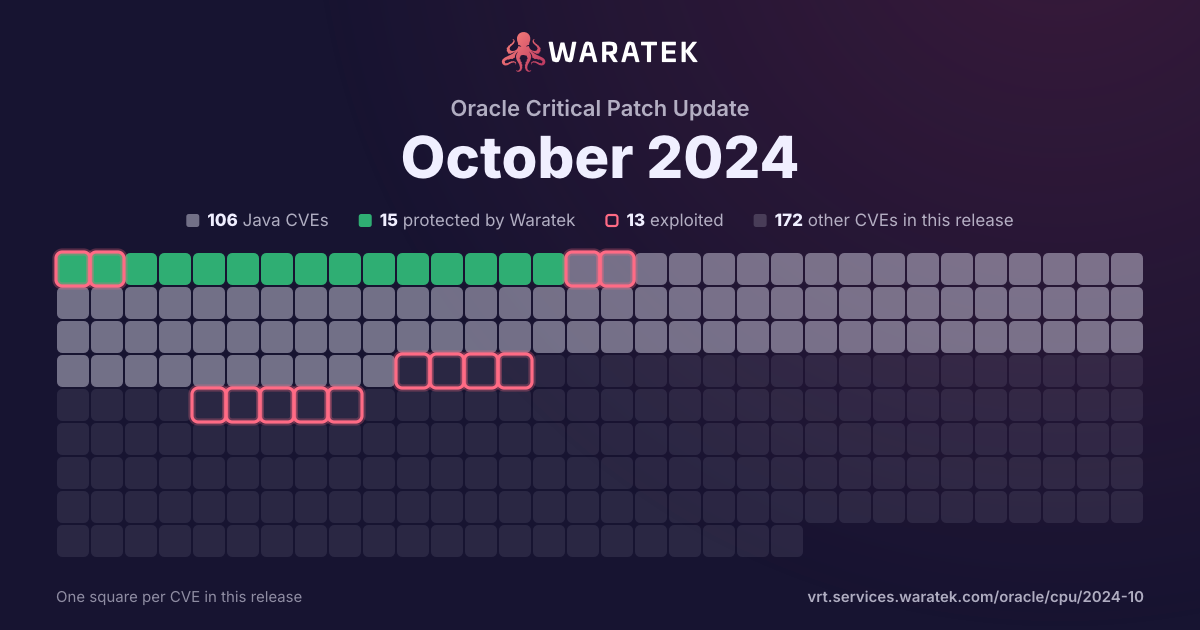
By status
15Protected by Waratek3Mitigation candidate88No exploit published26Outside Waratek scope144Not applicable2Withdrawn CVE
13Exploited, marked by the ring
No exploit published. For 51 of them, Oracle's security advisory is the source of public detail.
Protected by Waratek. Waratek RASP can block exploitation of these on systems that have not applied the patch yet.
Overview 15 matches · 0 in Waratek scope · 0 protected · 0 exploited · 0 CISA KEV · 0 public PoC · 0 EPSS ≥ 0.5
15matches
0in Waratek scope0.0%
0protected0.0%
0exploited0.0%
0CISA KEV0.0%
0public PoC0.0%
0EPSS ≥ 0.50.0%
Protected by Waratek
0
0.0%
Rule in development
0
0.0%
Mitigation candidate
0
0.0%
No exploit published
0
0.0%
Outside Waratek scope
0
0.0%
Not applicable
15
100.0%
Withdrawn CVE
0
0.0%
blocked by ARMR today
0
0.0%
partly blocked
0
0.0%
not blocked
15
100.0%
not established
0
0.0%
unrecorded
0
0.0%
Exploited
0
0.0%
Working exploit published
0
0.0%
Proof of concept only
0
0.0%
Forecast only
0
0.0%
No public exploit
15
100.0%
split by
peak 10 / quarter
Q1 221
Not applicable1
Low1
not blocked1
No public exploit1
Q2 220
Q3 220
Q4 220
Q1 230
Q2 230
Q3 230
Q4 230
Q1 240
Q2 240
Q3 243
Not applicable3
Low3
not blocked3
No public exploit3
Q4 2410
Not applicable10
Low10
not blocked10
No public exploit10
Q1 251
Not applicable1
Low1
not blocked1
No public exploit1
Q1 22Q3 22Q1 23Q3 23Q1 24Q3 24Q1 25
| CVE | Severity | Published▾ | Status | Exploitation | Description |
|---|---|---|---|---|---|
| CVE-2024-37372 | Low | 2025-01-09 | Not applicable | No public exploit | The Permission Model assumes that any path starting with two backslashes \ has a four-character prefix that can be ignored, which is not always true. This subtle bug leads to vulnerable edge cases. |
| CVE-2024-21253 | Low | 2024-10-15 | Not applicable | No public exploit | Vulnerability in the Oracle VM VirtualBox product of Oracle Virtualization (component: Core). Supported versions that are affected are Prior to 7.0.22. Easily exploitable vulnerability allows high privileged attacker with logon to the infrastructure where Oracle VM VirtualBox executes to compromise Oracle VM VirtualBox. Successful attacks of this vulnerability can result in unauthorized ability to cause a partial denial of service (partial DOS) of Oracle VM VirtualBox. CVSS 3.1 Base Score 2.3 (Availability impacts). CVSS Vector: (CVSS:3.1/AV:L/AC:L/PR:H/UI:N/S:U/C:N/I:N/A:L). |
| CVE-2024-21251 | Low | 2024-10-15 | Not applicable | No public exploit | Vulnerability in the Java VM component of Oracle Database Server. Supported versions that are affected are 19.3-19.24, 21.3-21.15 and 23.4-23.5. Difficult to exploit vulnerability allows low privileged attacker having Create Session, Create Procedure privilege with network access via Oracle Net to compromise Java VM. Successful attacks of this vulnerability can result in unauthorized update, insert or delete access to some of Java VM accessible data. CVSS 3.1 Base Score 3.1 (Integrity impacts). CVSS Vector: (CVSS:3.1/AV:N/AC:H/PR:L/UI:N/S:U/C:N/I:L/A:N). |
| CVE-2024-21247 | Low | 2024-10-15 | Not applicable | No public exploit | Vulnerability in the MySQL Client product of Oracle MySQL (component: Client: mysqldump). Supported versions that are affected are 8.0.39 and prior, 8.4.2 and prior and 9.0.1 and prior. Easily exploitable vulnerability allows high privileged attacker with network access via multiple protocols to compromise MySQL Client. Successful attacks of this vulnerability can result in unauthorized update, insert or delete access to some of MySQL Client accessible data as well as unauthorized read access to a subset of MySQL Client accessible data. CVSS 3.1 Base Score 3.8 (Confidentiality and Integrity impacts). CVSS Vector: (CVSS:3.1/AV:N/AC:L/PR:H/UI:N/S:U/C:L/I:L/A:N). |
| CVE-2024-21244 | Low | 2024-10-15 | Not applicable | No public exploit | Vulnerability in the MySQL Server product of Oracle MySQL (component: Server: Telemetry). Supported versions that are affected are 8.4.2 and prior and 9.0.1 and prior. Difficult to exploit vulnerability allows high privileged attacker with network access via multiple protocols to compromise MySQL Server. Successful attacks of this vulnerability can result in unauthorized read access to a subset of MySQL Server accessible data. CVSS 3.1 Base Score 2.2 (Confidentiality impacts). CVSS Vector: (CVSS:3.1/AV:N/AC:H/PR:H/UI:N/S:U/C:L/I:N/A:N). |
| CVE-2024-21243 | Low | 2024-10-15 | Not applicable | No public exploit | Vulnerability in the MySQL Server product of Oracle MySQL (component: Server: Telemetry). Supported versions that are affected are 8.4.2 and prior and 9.0.1 and prior. Difficult to exploit vulnerability allows high privileged attacker with network access via multiple protocols to compromise MySQL Server. Successful attacks of this vulnerability can result in unauthorized read access to a subset of MySQL Server accessible data. CVSS 3.1 Base Score 2.2 (Confidentiality impacts). CVSS Vector: (CVSS:3.1/AV:N/AC:H/PR:H/UI:N/S:U/C:L/I:N/A:N). |
| CVE-2024-21242 | Low | 2024-10-15 | Not applicable | No public exploit | Vulnerability in the XML Database component of Oracle Database Server. Supported versions that are affected are 19.3-19.24, 21.3-21.15 and 23.4-23.5. Easily exploitable vulnerability allows low privileged attacker having Create Session privilege with network access via HTTP to compromise XML Database. Successful attacks require human interaction from a person other than the attacker. Successful attacks of this vulnerability can result in unauthorized ability to cause a partial denial of service (partial DOS) of XML Database. CVSS 3.1 Base Score 3.5 (Availability impacts). CVSS Vector: (CVSS:3.1/AV:N/AC:L/PR:L/UI:R/S:U/C:N/I:N/A:L). |
| CVE-2024-21237 | Low | 2024-10-15 | Not applicable | No public exploit | Vulnerability in the MySQL Server product of Oracle MySQL (component: Server: Group Replication GCS). Supported versions that are affected are 8.0.39 and prior, 8.4.2 and prior and 9.0.1 and prior. Difficult to exploit vulnerability allows high privileged attacker with network access via multiple protocols to compromise MySQL Server. Successful attacks of this vulnerability can result in unauthorized ability to cause a partial denial of service (partial DOS) of MySQL Server. CVSS 3.1 Base Score 2.2 (Availability impacts). CVSS Vector: (CVSS:3.1/AV:N/AC:H/PR:H/UI:N/S:U/C:N/I:N/A:L). |
| CVE-2024-21232 | Low | 2024-10-15 | Not applicable | No public exploit | Vulnerability in the MySQL Server product of Oracle MySQL (component: Server: Components Services). Supported versions that are affected are 8.4.2 and prior and 9.0.1 and prior. Difficult to exploit vulnerability allows high privileged attacker with network access via multiple protocols to compromise MySQL Server. Successful attacks of this vulnerability can result in unauthorized ability to cause a partial denial of service (partial DOS) of MySQL Server. CVSS 3.1 Base Score 2.2 (Availability impacts). CVSS Vector: (CVSS:3.1/AV:N/AC:H/PR:H/UI:N/S:U/C:N/I:N/A:L). |
| CVE-2024-21231 | Low | 2024-10-15 | Not applicable | No public exploit | Vulnerability in the MySQL Server product of Oracle MySQL (component: Client programs). Supported versions that are affected are 8.0.39 and prior, 8.4.2 and prior and 9.0.1 and prior. Difficult to exploit vulnerability allows low privileged attacker with network access via multiple protocols to compromise MySQL Server. Successful attacks of this vulnerability can result in unauthorized ability to cause a partial denial of service (partial DOS) of MySQL Server. CVSS 3.1 Base Score 3.1 (Availability impacts). CVSS Vector: (CVSS:3.1/AV:N/AC:H/PR:L/UI:N/S:U/C:N/I:N/A:L). |
| CVE-2024-21209 | Low | 2024-10-15 | Not applicable | No public exploit | Vulnerability in the MySQL Client product of Oracle MySQL (component: Client: mysqldump). Supported versions that are affected are 8.4.2 and prior and 9.0.1 and prior. Difficult to exploit vulnerability allows high privileged attacker with network access via multiple protocols to compromise MySQL Client. Successful attacks require human interaction from a person other than the attacker. Successful attacks of this vulnerability can result in unauthorized read access to a subset of MySQL Client accessible data. CVSS 3.1 Base Score 2.0 (Confidentiality impacts). CVSS Vector: (CVSS:3.1/AV:N/AC:H/PR:H/UI:R/S:U/C:L/I:N/A:N). |
| CVE-2024-36137 | Low | 2024-09-07 | Not applicable | No public exploit | A vulnerability has been identified in Node.js, affecting users of the experimental permission model when the --allow-fs-write flag is used. Node.js Permission Model do not operate on file descriptors, however, operations such as fs.fchown or fs.fchmod can use a "read-only" file descriptor to change the owner and permissions of a file. |
| CVE-2024-43411 | Low | 2024-08-21 | Not applicable | No public exploit | CKEditor4 is an open source what-you-see-is-what-you-get HTML editor. A theoretical vulnerability has been identified in CKEditor 4.22 (and above). In a highly unlikely scenario where an attacker gains control over the https://cke4.ckeditor.com domain, they could potentially execute an attack on CKEditor 4 instances. The issue impacts only editor instances with enabled version notifications. Please note that this feature is disabled by default in all CKEditor 4 LTS versions. Therefore, if you use CKEditor 4 LTS, it is highly unlikely that you are affected by this vulnerability. If you are unsure, please contact us. The fix is available in version 4.25.0-lts. |
| CVE-2024-22018 | Low | 2024-07-10 | Not applicable | No public exploit | A vulnerability has been identified in Node.js, affecting users of the experimental permission model when the --allow-fs-read flag is used. This flaw arises from an inadequate permission model that fails to restrict file stats through the fs.lstat API. As a result, malicious actors can retrieve stats from files that they do not have explicit read access to. This vulnerability affects all users using the experimental permission model in Node.js 20 and Node.js 21. Please note that at the time this CVE was issued, the permission model is an experimental feature of Node.js. |
| CVE-2021-36368 | Low | 2022-03-13 | Not applicable | No public exploit | An issue was discovered in OpenSSH before 8.9. If a client is using public-key authentication with agent forwarding but without -oLogLevel=verbose, and an attacker has silently modified the server to support the None authentication option, then the user cannot determine whether FIDO authentication is going to confirm that the user wishes to connect to that server, or that the user wishes to allow that server to connect to a different server on the user's behalf. NOTE: the vendor's position is "this is not an authentication bypass, since nothing is being bypassed. |