
Oracle Critical Patch Update October 2024
Released October 2024 · Oracle's advisory ↗ · ← Critical Patch Update, July 2024 · Critical Patch Update, January 2025 →
278 CVEs in this release, one square each
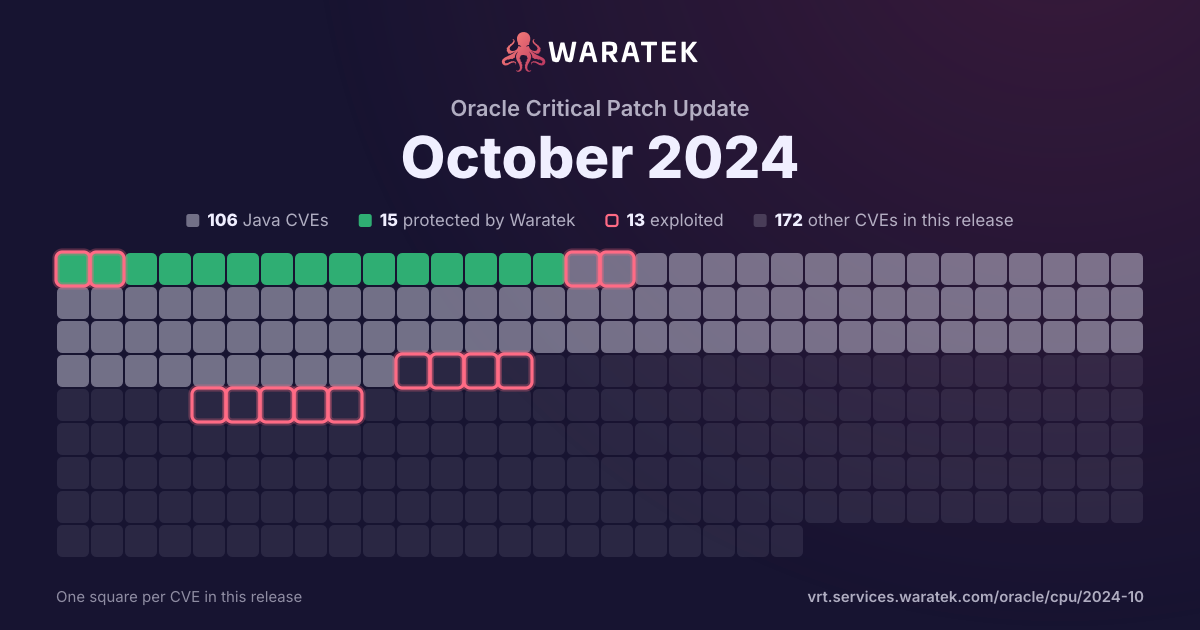
By status
15Protected by Waratek3Mitigation candidate88No exploit published26Outside Waratek scope144Not applicable2Withdrawn CVE
13Exploited, marked by the ring
No exploit published. For 51 of them, Oracle's security advisory is the source of public detail.
Protected by Waratek. Waratek RASP can block exploitation of these on systems that have not applied the patch yet.
Overview 5 matches · 0 protected · 0 exploited · 0 CISA KEV · 0 public PoC · 0 EPSS ≥ 0.5
5matches
0protected0.0%
0exploited0.0%
0CISA KEV0.0%
0public PoC0.0%
0EPSS ≥ 0.50.0%
Protected by Waratek
0
0.0%
Rule in development
0
0.0%
Mitigation candidate
0
0.0%
No exploit published
5
100.0%
blocked by ARMR today
0
0.0%
partly blocked
0
0.0%
not blocked
5
100.0%
not established
0
0.0%
unrecorded
0
0.0%
Exploited
0
0.0%
Working exploit published
0
0.0%
Proof of concept only
0
0.0%
Forecast only
0
0.0%
No public exploit
5
100.0%
split by
peak 2 / month
Nov 231
No exploit published1
Critical1
not blocked1
No public exploit1
Dec 230
Jan 240
Feb 240
Mar 241
No exploit published1
Critical1
not blocked1
No public exploit1
Apr 240
May 240
Jun 240
Jul 241
No exploit published1
Critical1
not blocked1
No public exploit1
Aug 240
Sep 240
Oct 242
No exploit published2
Critical2
not blocked2
No public exploit2
Nov 23Dec 23Jan 24Feb 24Mar 24Apr 24May 24Jun 24Jul 24Aug 24Sep 24Oct 24
| CVE | Severity | Published▾ | Status | Exploitation | Description |
|---|---|---|---|---|---|
| CVE-2024-21216 | Critical | 2024-10-15 | No exploit published | No public exploit | Vulnerability in the Oracle WebLogic Server product of Oracle Fusion Middleware (component: Core). Supported versions that are affected are 12.2.1.4.0 and 14.1.1.0.0. Easily exploitable vulnerability allows unauthenticated attacker with network access via T3, IIOP to compromise Oracle WebLogic Server. Successful attacks of this vulnerability can result in takeover of Oracle WebLogic Server. CVSS 3.1 Base Score 9.8 (Confidentiality, Integrity and Availability impacts). CVSS Vector: (CVSS:3.1/AV:N/AC:L/PR:N/UI:N/S:U/C:H/I:H/A:H). |
| CVE-2024-21172 | Critical | 2024-10-15 | No exploit published | No public exploit | Vulnerability in the Oracle Hospitality OPERA 5 product of Oracle Hospitality Applications (component: Opera Servlet). Supported versions that are affected are 5.6.19.19, 5.6.25.8 and 5.6.26.4. Difficult to exploit vulnerability allows unauthenticated attacker with network access via HTTP to compromise Oracle Hospitality OPERA 5. While the vulnerability is in Oracle Hospitality OPERA 5, attacks may significantly impact additional products (scope change). Successful attacks of this vulnerability can result in takeover of Oracle Hospitality OPERA 5. CVSS 3.1 Base Score 9.0 (Confidentiality, Integrity and Availability impacts). CVSS Vector: (CVSS:3.1/AV:N/AC:H/PR:N/UI:N/S:C/C:H/I:H/A:H). |
| CVE-2024-29736 | Critical | 2024-07-19 | No exploit published | No public exploit | A SSRF vulnerability in WADL service description in versions of Apache CXF before 4.0.5, 3.6.4 and 3.5.9 allows an attacker to perform SSRF style attacks on REST webservices. The attack only applies if a custom stylesheet parameter is configured. |
| CVE-2024-28752 | Critical | 2024-03-15 | No exploit published | No public exploit | A SSRF vulnerability using the Aegis DataBinding in versions of Apache CXF before 4.0.4, 3.6.3 and 3.5.8 allows an attacker to perform SSRF style attacks on webservices that take at least one parameter of any type. Users of other data bindings (including the default databinding) are not impacted. |
| CVE-2022-46337 | Critical | 2023-11-20 | No exploit published | No public exploit | A cleverly devised username might bypass LDAP authentication checks. In LDAP-authenticated Derby installations, this could let an attacker fill up the disk by creating junk Derby databases. In LDAP-authenticated Derby installations, this could also allow the attacker to execute malware which was visible to and executable by the account which booted the Derby server. In LDAP-protected databases which weren't also protected by SQL GRANT/REVOKE authorization, this vulnerability could also let an attacker view and corrupt sensitive data and run sensitive database functions and procedures. Mitigation: Users should upgrade to Java 21 and Derby 10.17.1.0. Alternatively, users who wish to remain on older Java versions should build their own Derby distribution from one of the release families to which the fix was backported: 10.16, 10.15, and 10.14. Those are the releases which correspond, respectively, with Java LTS versions 17, 11, and 8. |