
Oracle Critical Patch Update October 2024
Released October 2024 · Oracle's advisory ↗ · ← Critical Patch Update, July 2024 · Critical Patch Update, January 2025 →
278 CVEs in this release, one square each
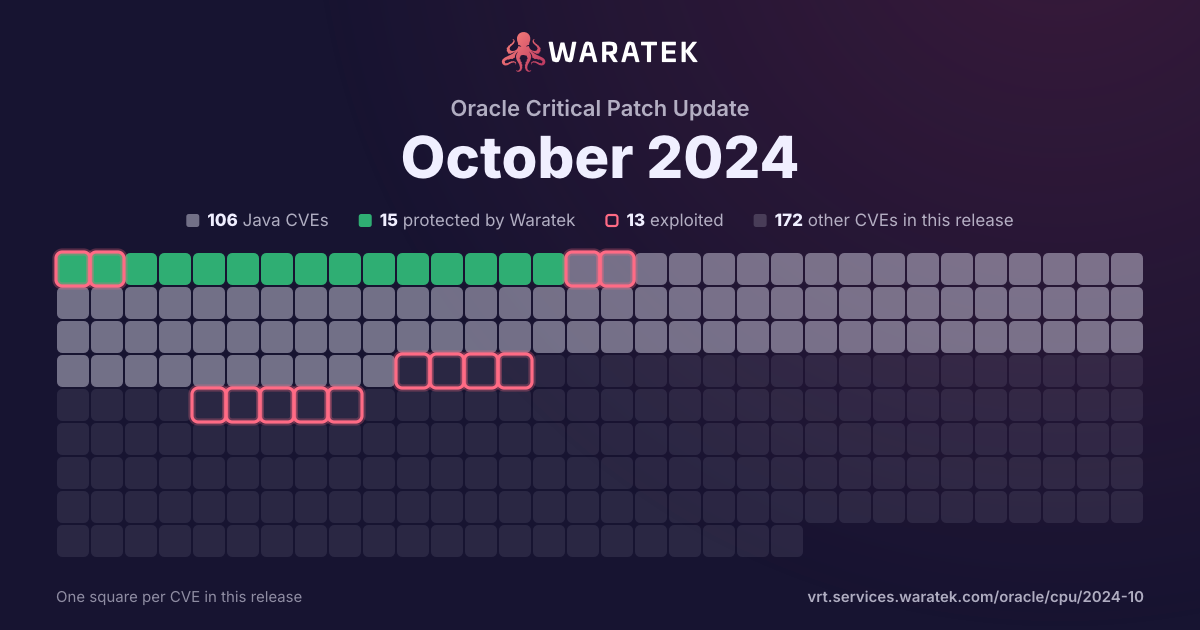
By status
14Protected by Waratek6Mitigation candidate92No exploit published4Outside Waratek scope160Not applicable2Withdrawn CVE
13Exploited, marked by the ring
No exploit published. For 44 of them, Oracle's security advisory is the source of public detail.
Protected by Waratek. Waratek RASP can block exploitation of these on systems that have not applied the patch yet.
Overview 4 matches · 0 protected · 0 exploited · 0 CISA KEV · 0 public PoC · 0 EPSS ≥ 0.5
4matches
0protected0.0%
0exploited0.0%
0CISA KEV0.0%
0public PoC0.0%
0EPSS ≥ 0.50.0%
Protected by Waratek
0
0.0%
Rule in development
0
0.0%
Mitigation candidate
0
0.0%
No exploit published
4
100.0%
blocked by ARMR today
0
0.0%
partly blocked
0
0.0%
not blocked
4
100.0%
not established
0
0.0%
unrecorded
0
0.0%
Exploited
0
0.0%
Working exploit published
0
0.0%
Proof of concept only
0
0.0%
Forecast only
0
0.0%
No public exploit
4
100.0%
split by
peak 4 / month
Aug 24
| CVE | Severity | Published▾ | Status | Exploitation | Description |
|---|---|---|---|---|---|
| CVE-2024-7885 | High | 2024-08-21 | No exploit published | No public exploit | A vulnerability was found in Undertow where the ProxyProtocolReadListener reuses the same StringBuilder instance across multiple requests. This issue occurs when the parseProxyProtocolV1 method processes multiple requests on the same HTTP connection. As a result, different requests may share the same StringBuilder instance, potentially leading to information leakage between requests or responses. In some cases, a value from a previous request or response may be erroneously reused, which could lead to unintended data exposure. This issue primarily results in errors and connection termination but creates a risk of data leakage in multi-request environments. |
| CVE-2024-38808 | Medium | 2024-08-20 | No exploit published | No public exploit | In Spring Framework versions 5.3.0 - 5.3.38 and older unsupported versions, it is possible for a user to provide a specially crafted Spring Expression Language (SpEL) expression that may cause a denial of service (DoS) condition. Specifically, an application is vulnerable when the following is true: * The application evaluates user-supplied SpEL expressions. |
| CVE-2024-41909 | Medium | 2024-08-12 | No exploit published | No public exploit | Like many other SSH implementations, Apache MINA SSHD suffered from the issue that is more widely known as CVE-2023-48795. An attacker that can intercept traffic between client and server could drop certain packets from the stream, potentially causing client and server to consequently end up with a connection for which some security features have been downgraded or disabled, aka a Terrapin attack The mitigations to prevent this type of attack were implemented in Apache MINA SSHD 2.12.0, both client and server side. Users are recommended to upgrade to at least this version. Note that both the client and the server implementation must have mitigations applied against this issue, otherwise the connection may still be affected. |
| CVE-2024-43045 | Medium | 2024-08-07 | No exploit published | No public exploit | Jenkins 2.470 and earlier, LTS 2.452.3 and earlier does not perform a permission check in an HTTP endpoint, allowing attackers with Overall/Read permission to access other users' "My Views". |