
Oracle Critical Patch Update October 2024
Released October 2024 · Oracle's advisory ↗ · ← Critical Patch Update, July 2024 · Critical Patch Update, January 2025 →
278 CVEs in this release, one square each
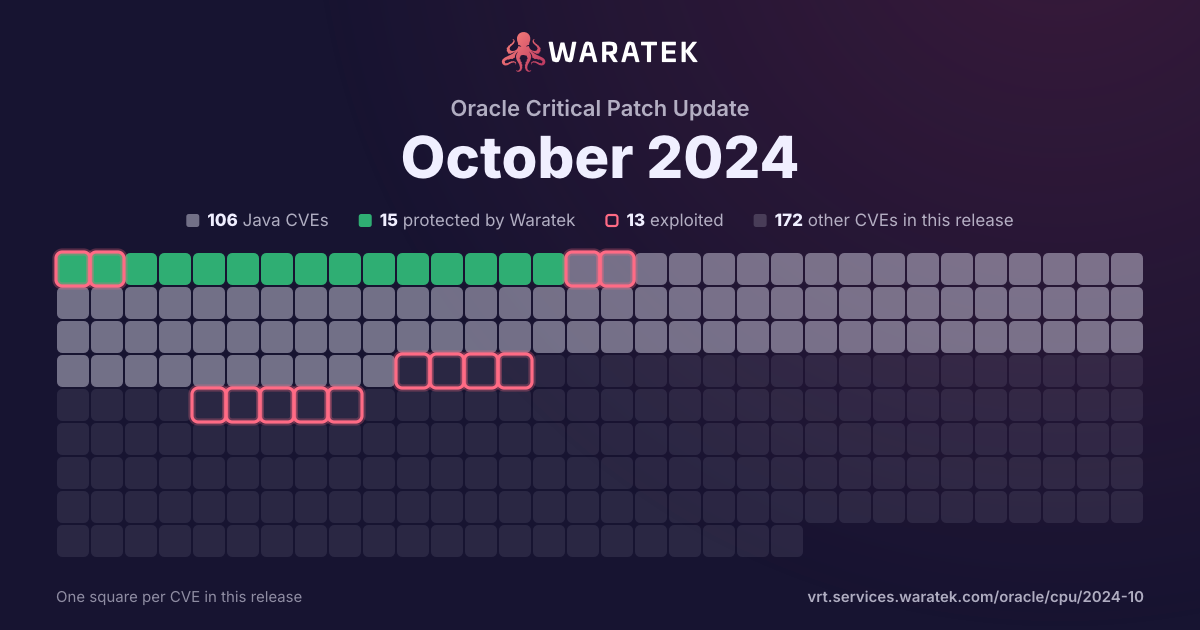
By status
14Protected by Waratek6Mitigation candidate92No exploit published4Outside Waratek scope160Not applicable2Withdrawn CVE
13Exploited, marked by the ring
No exploit published. For 44 of them, Oracle's security advisory is the source of public detail.
Protected by Waratek. Waratek RASP can block exploitation of these on systems that have not applied the patch yet.
Overview 13 matches · 0 protected · 0 exploited · 0 CISA KEV · 0 public PoC · 0 EPSS ≥ 0.5
13matches
0protected0.0%
0exploited0.0%
0CISA KEV0.0%
0public PoC0.0%
0EPSS ≥ 0.50.0%
Protected by Waratek
0
0.0%
Rule in development
0
0.0%
Mitigation candidate
0
0.0%
No exploit published
13
100.0%
blocked by ARMR today
0
0.0%
partly blocked
0
0.0%
not blocked
13
100.0%
not established
0
0.0%
unrecorded
0
0.0%
Exploited
0
0.0%
Working exploit published
0
0.0%
Proof of concept only
0
0.0%
Forecast only
0
0.0%
No public exploit
13
100.0%
| CVE | Severity | Published▾ | Status | Exploitation | Description |
|---|---|---|---|---|---|
| CVE-2024-38809 | Medium | 2024-09-27 | No exploit published | No public exploit | Applications that parse ETags from "If-Match" or "If-None-Match" request headers are vulnerable to DoS attack. Users of affected versions should upgrade to the corresponding fixed version. Users of older, unsupported versions could enforce a size limit on "If-Match" and "If-None-Match" headers, e.g. through a Filter. |
| CVE-2024-7254 | High | 2024-09-19 | No exploit published | No public exploit | Any project that parses untrusted Protocol Buffers data containing an arbitrary number of nested groups / series of SGROUP tags can corrupted by exceeding the stack limit i.e. StackOverflow. Parsing nested groups as unknown fields with DiscardUnknownFieldsParser or Java Protobuf Lite parser, or against Protobuf map fields, creates unbounded recursions that can be abused by an attacker. |
| CVE-2024-7885 | High | 2024-08-21 | No exploit published | No public exploit | A vulnerability was found in Undertow where the ProxyProtocolReadListener reuses the same StringBuilder instance across multiple requests. This issue occurs when the parseProxyProtocolV1 method processes multiple requests on the same HTTP connection. As a result, different requests may share the same StringBuilder instance, potentially leading to information leakage between requests or responses. In some cases, a value from a previous request or response may be erroneously reused, which could lead to unintended data exposure. This issue primarily results in errors and connection termination but creates a risk of data leakage in multi-request environments. |
| CVE-2024-38808 | Medium | 2024-08-20 | No exploit published | No public exploit | In Spring Framework versions 5.3.0 - 5.3.38 and older unsupported versions, it is possible for a user to provide a specially crafted Spring Expression Language (SpEL) expression that may cause a denial of service (DoS) condition. Specifically, an application is vulnerable when the following is true: * The application evaluates user-supplied SpEL expressions. |
| CVE-2024-41909 | Medium | 2024-08-12 | No exploit published | No public exploit | Like many other SSH implementations, Apache MINA SSHD suffered from the issue that is more widely known as CVE-2023-48795. An attacker that can intercept traffic between client and server could drop certain packets from the stream, potentially causing client and server to consequently end up with a connection for which some security features have been downgraded or disabled, aka a Terrapin attack The mitigations to prevent this type of attack were implemented in Apache MINA SSHD 2.12.0, both client and server side. Users are recommended to upgrade to at least this version. Note that both the client and the server implementation must have mitigations applied against this issue, otherwise the connection may still be affected. |
| CVE-2024-43045 | Medium | 2024-08-07 | No exploit published | No public exploit | Jenkins 2.470 and earlier, LTS 2.452.3 and earlier does not perform a permission check in an HTTP endpoint, allowing attackers with Overall/Read permission to access other users' "My Views". |
| CVE-2024-25638 | High | 2024-07-22 | No exploit published | No public exploit | dnsjava is an implementation of DNS in Java. Records in DNS replies are not checked for their relevance to the query, allowing an attacker to respond with RRs from different zones. This vulnerability is fixed in 3.6.0. |
| CVE-2024-41172 | High | 2024-07-19 | No exploit published | No public exploit | In versions of Apache CXF before 3.6.4 and 4.0.5 (3.5.x and lower versions are not impacted), a CXF HTTP client conduit may prevent HTTPClient instances from being garbage collected and it is possible that memory consumption will continue to increase, eventually causing the application to run out of memory |
| CVE-2024-32007 | High | 2024-07-19 | No exploit published | No public exploit | An improper input validation of the p2c parameter in the Apache CXF JOSE code before 4.0.5, 3.6.4 and 3.5.9 allows an attacker to perform a denial of service attack by specifying a large value for this parameter in a token. |
| CVE-2024-29736 | Critical | 2024-07-19 | No exploit published | No public exploit | A SSRF vulnerability in WADL service description in versions of Apache CXF before 4.0.5, 3.6.4 and 3.5.9 allows an attacker to perform SSRF style attacks on REST webservices. The attack only applies if a custom stylesheet parameter is configured. |
| CVE-2024-5971 | High | 2024-07-08 | No exploit published | No public exploit | A vulnerability was found in Undertow, where the chunked response hangs after the body was flushed. The response headers and body were sent but the client would continue waiting as Undertow does not send the expected 0\r\n termination of the chunked response. This results in uncontrolled resource consumption, leaving the server side to a denial of service attack. This happens only with Java 17 TLSv1.3 scenarios. |
| CVE-2024-3653 | Medium | 2024-07-08 | No exploit published | No public exploit | A vulnerability was found in Undertow. This issue requires enabling the learning-push handler in the server's config, which is disabled by default, leaving the maxAge config in the handler unconfigured. The default is -1, which makes the handler vulnerable. If someone overwrites that config, the server is not subject to the attack. The attacker needs to be able to reach the server with a normal HTTP request. |
| CVE-2024-34750 | High | 2024-07-03 | No exploit published | No public exploit | Improper Handling of Exceptional Conditions, Uncontrolled Resource Consumption vulnerability in Apache Tomcat. When processing an HTTP/2 stream, Tomcat did not handle some cases of excessive HTTP headers correctly. This led to a miscounting of active HTTP/2 streams which in turn led to the use of an incorrect infinite timeout which allowed connections to remain open which should have been closed. This issue affects Apache Tomcat: from 11.0.0-M1 through 11.0.0-M20, from 10.1.0-M1 through 10.1.24, from 9.0.0-M1 through 9.0.89. The following versions were EOL at the time the CVE was created but are known to be affected: 8.5.0 though 8.5.100. Other EOL versions may also be affected. Users are recommended to upgrade to version 11.0.0-M21, 10.1.25 or 9.0.90, which fixes the issue. |