
Oracle Critical Patch Update October 2024
Released October 2024 · Oracle's advisory ↗ · ← Critical Patch Update, July 2024 · Critical Patch Update, January 2025 →
278 CVEs in this release, one square each
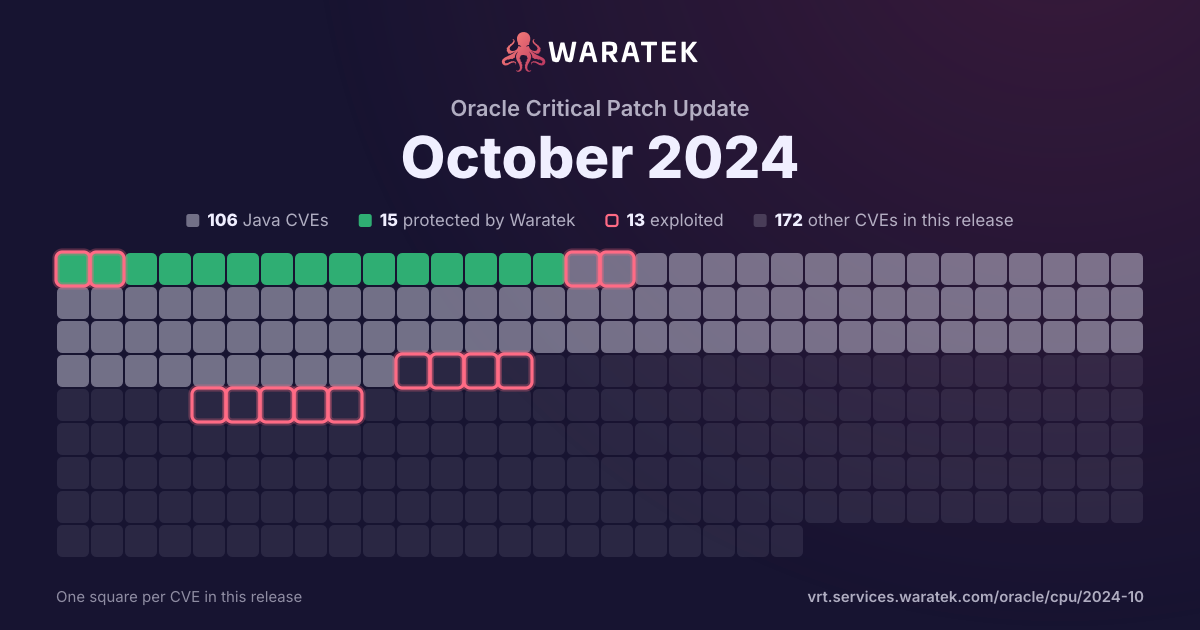
By status
15Protected by Waratek3Mitigation candidate88No exploit published26Outside Waratek scope144Not applicable2Withdrawn CVE
13Exploited, marked by the ring
No exploit published. For 51 of them, Oracle's security advisory is the source of public detail.
Protected by Waratek. Waratek RASP can block exploitation of these on systems that have not applied the patch yet.
Overview 9 matches · 0 in Waratek scope · 0 protected · 4 exploited · 2 CISA KEV · 6 EPSS ≥ 0.5
Protected by Waratek
0
0.0%
Rule in development
0
0.0%
Mitigation candidate
0
0.0%
No exploit published
0
0.0%
Outside Waratek scope
0
0.0%
Not applicable
9
100.0%
Withdrawn CVE
0
0.0%
blocked by ARMR today
0
0.0%
partly blocked
0
0.0%
not blocked
9
100.0%
not established
0
0.0%
unrecorded
0
0.0%
Exploited
4
44.4%
Working exploit published
2
22.2%
Proof of concept only
3
33.3%
Forecast only
0
0.0%
No public exploit
0
0.0%
split by
peak 5 / month
Jul 231
Not applicable1
Critical1
not blocked1
Exploited1
Aug 230
Sep 230
Oct 230
Nov 230
Dec 231
Not applicable1
Medium1
not blocked1
Proof of concept only1
Jan 240
Feb 240
Mar 240
Apr 241
Not applicable1
High1
not blocked1
Proof of concept only1
May 240
Jun 241
Not applicable1
Critical1
not blocked1
Exploited1
Jul 245
Not applicable5
Critical1
High3
Medium1
not blocked5
Exploited2
Working exploit published2
Proof of concept only1
Jul 23Sep 23Nov 23Jan 24Mar 24May 24Jul 24
| CVE | Severity | Published▾ | Status | Exploitation | Description |
|---|---|---|---|---|---|
| CVE-2024-40725 | Medium | 2024-07-18 | Not applicable | Proof of concept only | A partial fix for CVE-2024-39884 in the core of Apache HTTP Server 2.4.61 ignores some use of the legacy content-type based configuration of handlers. "AddType" and similar configuration, under some circumstances where files are requested indirectly, result in source code disclosure of local content. For example, PHP scripts may be served instead of interpreted. Users are recommended to upgrade to version 2.4.62, which fixes this issue. |
| CVE-2024-6387 | High | 2024-07-01 | Not applicable | Exploited | A security regression (CVE-2006-5051) was discovered in OpenSSH's server (sshd). There is a race condition which can lead sshd to handle some signals in an unsafe manner. An unauthenticated, remote attacker may be able to trigger it by failing to authenticate within a set time period. |
| CVE-2024-38475 | Critical | 2024-07-01 | Not applicable | Exploited | Improper escaping of output in mod_rewrite in Apache HTTP Server 2.4.59 and earlier allows an attacker to map URLs to filesystem locations that are permitted to be served by the server but are not intentionally/directly reachable by any URL, resulting in code execution or source code disclosure. Substitutions in server context that use a backreferences or variables as the first segment of the substitution are affected. Some unsafe RewiteRules will be broken by this change and the rewrite flag "UnsafePrefixStat" can be used to opt back in once ensuring the substitution is appropriately constrained. |
| CVE-2024-38473 | High | 2024-07-01 | Not applicable | Working exploit published | Encoding problem in mod_proxy in Apache HTTP Server 2.4.59 and earlier allows request URLs with incorrect encoding to be sent to backend services, potentially bypassing authentication via crafted requests. Users are recommended to upgrade to version 2.4.60, which fixes this issue. |
| CVE-2024-38472 | High | 2024-07-01 | Not applicable | Working exploit published | SSRF in Apache HTTP Server on Windows allows to potentially leak NTLM hashes to a malicious server via SSRF and malicious requests or content Users are recommended to upgrade to version 2.4.60 which fixes this issue. Note: Existing configurations that access UNC paths will have to configure new directive "UNCList" to allow access during request processing. |
| CVE-2024-4577 | Critical | 2024-06-09 | Not applicable | Exploited | In PHP versions 8.1.* before 8.1.29, 8.2.* before 8.2.20, 8.3.* before 8.3.8, when using Apache and PHP-CGI on Windows, if the system is set up to use certain code pages, Windows may use "Best-Fit" behavior to replace characters in command line given to Win32 API functions. PHP CGI module may misinterpret those characters as PHP options, which may allow a malicious user to pass options to PHP binary being run, and thus reveal the source code of scripts, run arbitrary PHP code on the server, etc. |
| CVE-2023-45288 | High | 2024-04-04 | Not applicable | Proof of concept only | An attacker may cause an HTTP/2 endpoint to read arbitrary amounts of header data by sending an excessive number of CONTINUATION frames. Maintaining HPACK state requires parsing and processing all HEADERS and CONTINUATION frames on a connection. When a request's headers exceed MaxHeaderBytes, no memory is allocated to store the excess headers, but they are still parsed. This permits an attacker to cause an HTTP/2 endpoint to read arbitrary amounts of header data, all associated with a request which is going to be rejected. These headers can include Huffman-encoded data which is significantly more expensive for the receiver to decode than for an attacker to send. The fix sets a limit on the amount of excess header frames we will process before closing a connection. |
| CVE-2023-51385 | Medium | 2023-12-18 | Not applicable | Proof of concept only | In ssh in OpenSSH before 9.6, OS command injection might occur if a user name or host name has shell metacharacters, and this name is referenced by an expansion token in certain situations. For example, an untrusted Git repository can have a submodule with shell metacharacters in a user name or host name. |
| CVE-2023-38408 | Critical | 2023-07-20 | Not applicable | Exploited | The PKCS#11 feature in ssh-agent in OpenSSH before 9.3p2 has an insufficiently trustworthy search path, leading to remote code execution if an agent is forwarded to an attacker-controlled system. (Code in /usr/lib is not necessarily safe for loading into ssh-agent.) NOTE: this issue exists because of an incomplete fix for CVE-2016-10009. |