
Oracle Critical Patch Update October 2024
Released October 2024 · Oracle's advisory ↗ · ← Critical Patch Update, July 2024 · Critical Patch Update, January 2025 →
278 CVEs in this release, one square each
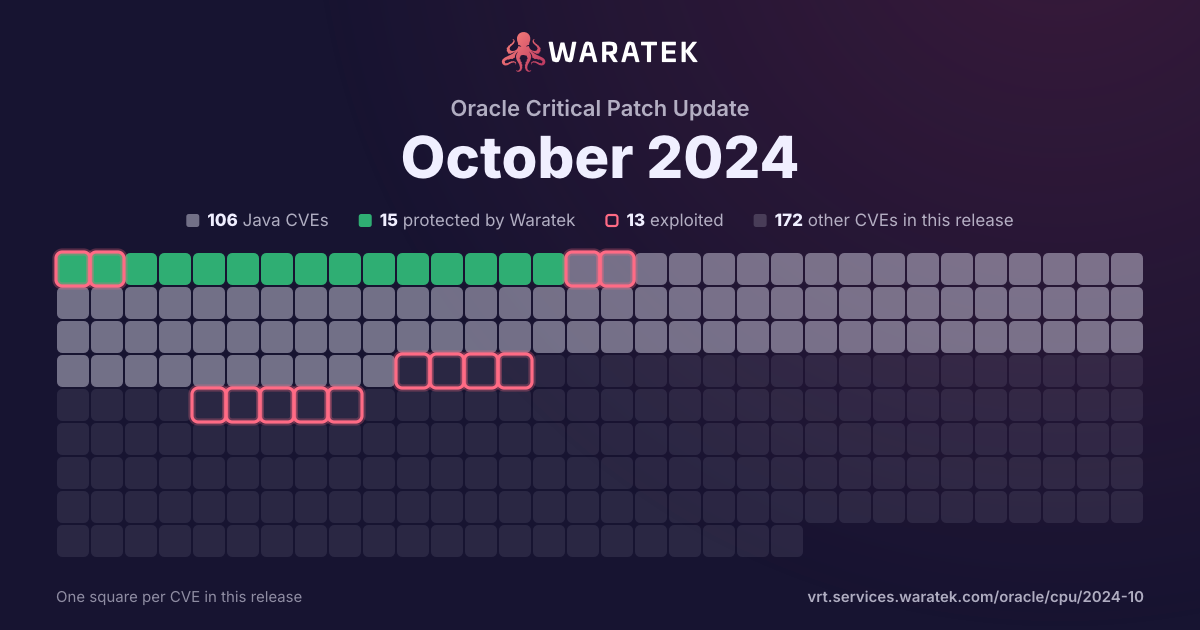
By status
15Protected by Waratek3Mitigation candidate88No exploit published26Outside Waratek scope144Not applicable2Withdrawn CVE
13Exploited, marked by the ring
No exploit published. For 51 of them, Oracle's security advisory is the source of public detail.
Protected by Waratek. Waratek RASP can block exploitation of these on systems that have not applied the patch yet.
Overview 11 matches · 5 in Waratek scope · 2 protected · 5 exploited · 1 CISA KEV · 5 EPSS ≥ 0.5
Protected by Waratek
2
18.2%
Rule in development
0
0.0%
Mitigation candidate
3
27.3%
No exploit published
0
0.0%
Outside Waratek scope
2
18.2%
Not applicable
4
36.4%
Withdrawn CVE
0
0.0%
blocked by ARMR today
2
18.2%
partly blocked
0
0.0%
not blocked
9
81.8%
not established
0
0.0%
unrecorded
0
0.0%
Exploited
5
45.5%
Working exploit published
2
18.2%
Proof of concept only
4
36.4%
Forecast only
0
0.0%
No public exploit
0
0.0%
split by
peak 5 / quarter
Q3 201
Outside Waratek scope1
High1
not blocked1
Proof of concept only1
Q4 200
Q1 210
Q2 210
Q3 210
Q4 210
Q1 220
Q2 220
Q3 220
Q4 220
Q1 230
Q2 230
Q3 230
Q4 231
Mitigation candidate1
High1
not blocked1
Exploited1
Q1 241
Mitigation candidate1
High1
not blocked1
Proof of concept only1
Q2 243
Mitigation candidate1
Outside Waratek scope1
Not applicable1
High3
not blocked3
Exploited2
Proof of concept only1
Q3 245
Protected by Waratek2
Not applicable3
High5
blocked by ARMR today2
not blocked3
Exploited2
Working exploit published2
Proof of concept only1
Q3 20Q1 21Q3 21Q1 22Q3 22Q1 23Q3 23Q1 24Q3 24
| CVE | Severity | Published▾ | Status | Exploitation | Description |
|---|---|---|---|---|---|
| CVE-2024-38816 | High | 2024-09-13 | Protected by Waratek | Exploited | Applications serving static resources through the functional web frameworks WebMvc.fn or WebFlux.fn are vulnerable to path traversal attacks. An attacker can craft malicious HTTP requests and obtain any file on the file system that is also accessible to the process in which the Spring application is running. Specifically, an application is vulnerable when both of the following are true: * the web application uses RouterFunctions to serve static resources * resource handling is explicitly configured with a FileSystemResource location However, malicious requests are blocked and rejected when any of the following is true: * the Spring Security HTTP Firewall https://docs.spring.io/spring-security/reference/servlet/exploits/firewall.html is in use * the application runs on Tomcat or Jetty |
| CVE-2024-43044 | High | 2024-08-07 | Protected by Waratek | Proof of concept only | Jenkins 2.470 and earlier, LTS 2.452.3 and earlier allows agent processes to read arbitrary files from the Jenkins controller file system by using the `ClassLoaderProxy#fetchJar` method in the Remoting library. |
| CVE-2024-6387 | High | 2024-07-01 | Not applicable | Exploited | A security regression (CVE-2006-5051) was discovered in OpenSSH's server (sshd). There is a race condition which can lead sshd to handle some signals in an unsafe manner. An unauthenticated, remote attacker may be able to trigger it by failing to authenticate within a set time period. |
| CVE-2024-38473 | High | 2024-07-01 | Not applicable | Working exploit published | Encoding problem in mod_proxy in Apache HTTP Server 2.4.59 and earlier allows request URLs with incorrect encoding to be sent to backend services, potentially bypassing authentication via crafted requests. Users are recommended to upgrade to version 2.4.60, which fixes this issue. |
| CVE-2024-38472 | High | 2024-07-01 | Not applicable | Working exploit published | SSRF in Apache HTTP Server on Windows allows to potentially leak NTLM hashes to a malicious server via SSRF and malicious requests or content Users are recommended to upgrade to version 2.4.60 which fixes this issue. Note: Existing configurations that access UNC paths will have to configure new directive "UNCList" to allow access during request processing. |
| CVE-2024-32114 | High | 2024-05-02 | Mitigation candidate | Exploited | In Apache ActiveMQ 6.x, the default configuration doesn't secure the API web context (where the Jolokia JMX REST API and the Message REST API are located). It means that anyone can use these layers without any required authentication. Potentially, anyone can interact with the broker (using Jolokia JMX REST API) and/or produce/consume messages or purge/delete destinations (using the Message REST API). To mitigate, users can update the default conf/jetty.xml configuration file to add authentication requirement: <bean id="securityConstraintMapping" class="org.eclipse.jetty.security.ConstraintMapping"> <property name="constraint" ref="securityConstraint" /> <property name="pathSpec" value="/" /> </bean> Or we encourage users to upgrade to Apache ActiveMQ 6.1.2 where the default configuration has been updated with authentication by default. |
| CVE-2024-2961 | High | 2024-04-17 | Outside Waratek scope | Exploited | The iconv() function in the GNU C Library versions 2.39 and older may overflow the output buffer passed to it by up to 4 bytes when converting strings to the ISO-2022-CN-EXT character set, which may be used to crash an application or overwrite a neighbouring variable. |
| CVE-2023-45288 | High | 2024-04-04 | Not applicable | Proof of concept only | An attacker may cause an HTTP/2 endpoint to read arbitrary amounts of header data by sending an excessive number of CONTINUATION frames. Maintaining HPACK state requires parsing and processing all HEADERS and CONTINUATION frames on a connection. When a request's headers exceed MaxHeaderBytes, no memory is allocated to store the excess headers, but they are still parsed. This permits an attacker to cause an HTTP/2 endpoint to read arbitrary amounts of header data, all associated with a request which is going to be rejected. These headers can include Huffman-encoded data which is significantly more expensive for the receiver to decode than for an attacker to send. The fix sets a limit on the amount of excess header frames we will process before closing a connection. |
| CVE-2024-24549 | High | 2024-03-13 | Mitigation candidate | Proof of concept only | Denial of Service due to improper input validation vulnerability for HTTP/2 requests in Apache Tomcat. When processing an HTTP/2 request, if the request exceeded any of the configured limits for headers, the associated HTTP/2 stream was not reset until after all of the headers had been processed.This issue affects Apache Tomcat: from 11.0.0-M1 through 11.0.0-M16, from 10.1.0-M1 through 10.1.18, from 9.0.0-M1 through 9.0.85, from 8.5.0 through 8.5.98. Other, older, EOL versions may also be affected. Users are recommended to upgrade to version 11.0.0-M17, 10.1.19, 9.0.86 or 8.5.99 which fix the issue. |
| CVE-2023-44487 | High | 2023-10-10 | Mitigation candidate | Exploited | The HTTP/2 protocol allows a denial of service (server resource consumption) because request cancellation can reset many streams quickly, as exploited in the wild in August through October 2023. |
| CVE-2020-15778 | High | 2020-07-24 | Outside Waratek scope | Proof of concept only | scp in OpenSSH through 8.3p1 allows command injection in the scp.c toremote function, as demonstrated by backtick characters in the destination argument. NOTE: the vendor reportedly has stated that they intentionally omit validation of "anomalous argument transfers" because that could "stand a great chance of breaking existing workflows." |