
Oracle Critical Patch Update October 2024
Released October 2024 · Oracle's advisory ↗ · ← Critical Patch Update, July 2024 · Critical Patch Update, January 2025 →
278 CVEs in this release, one square each
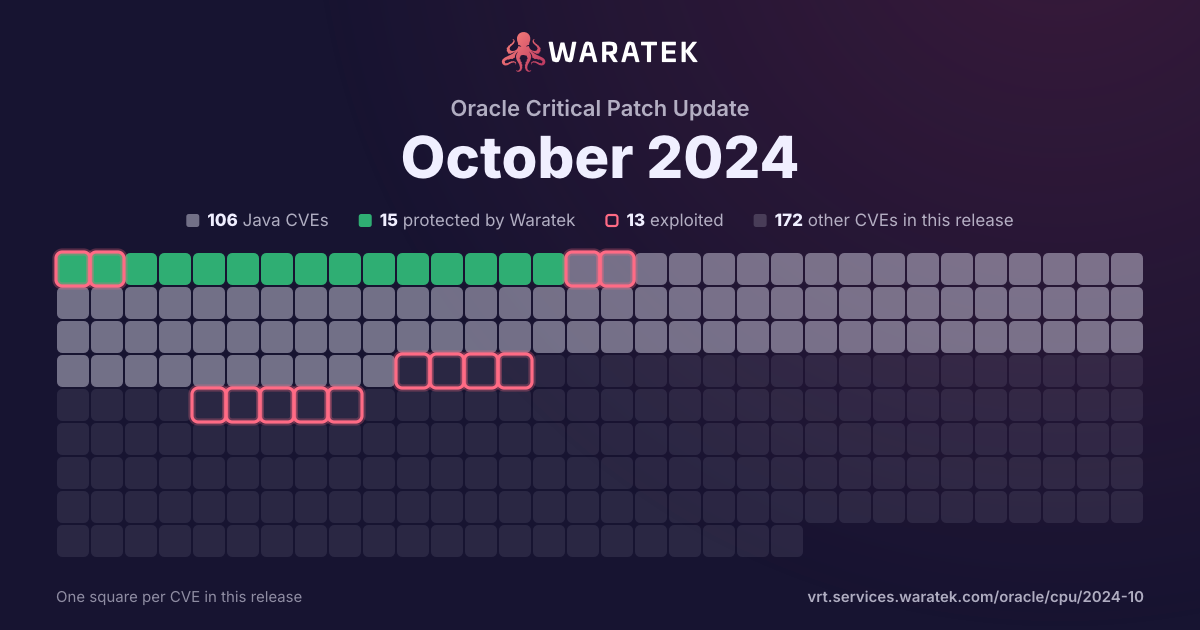
By status
15Protected by Waratek3Mitigation candidate88No exploit published26Outside Waratek scope144Not applicable2Withdrawn CVE
13Exploited, marked by the ring
No exploit published. For 51 of them, Oracle's security advisory is the source of public detail.
Protected by Waratek. Waratek RASP can block exploitation of these on systems that have not applied the patch yet.
Overview 119 matches · 62 in Waratek scope · 9 protected · 6 exploited · 1 CISA KEV · 11 public PoC · 9 EPSS ≥ 0.5
119matches
62in Waratek scope52.1%
9protected7.6%
6exploited5.0%
1CISA KEV0.8%
11public PoC9.2%
9EPSS ≥ 0.57.6%
Protected by Waratek
9
7.6%
Rule in development
0
0.0%
Mitigation candidate
3
2.5%
No exploit published
50
42.0%
Outside Waratek scope
7
5.9%
Not applicable
50
42.0%
Withdrawn CVE
0
0.0%
blocked by ARMR today
9
7.6%
partly blocked
0
0.0%
not blocked
110
92.4%
not established
0
0.0%
unrecorded
0
0.0%
split by
peak 32 / quarter
Q4 191
Protected by Waratek1
High1
blocked by ARMR today1
No public exploit1
Q1 200
Q2 200
Q3 201
Outside Waratek scope1
High1
not blocked1
Proof of concept only1
Q4 200
Q1 211
Not applicable1
High1
not blocked1
Proof of concept only1
Q2 210
Q3 210
Q4 212
Protected by Waratek1
Outside Waratek scope1
High2
blocked by ARMR today1
not blocked1
No public exploit2
Q1 222
Protected by Waratek2
High2
blocked by ARMR today2
Forecast only2
Q2 220
Q3 221
Not applicable1
High1
not blocked1
Proof of concept only1
Q4 222
Not applicable2
High2
not blocked2
No public exploit2
Q1 237
Protected by Waratek1
Not applicable6
High7
blocked by ARMR today1
not blocked6
Exploited1
Forecast only1
No public exploit5
Q2 232
No exploit published1
Outside Waratek scope1
High2
not blocked2
No public exploit2
Q3 235
Protected by Waratek1
No exploit published2
Not applicable2
High5
blocked by ARMR today1
not blocked4
No public exploit5
Q4 236
Mitigation candidate1
No exploit published2
Not applicable3
High6
not blocked6
Exploited1
Proof of concept only1
No public exploit4
Q1 2421
Mitigation candidate1
No exploit published5
Outside Waratek scope1
Not applicable14
High21
not blocked21
Proof of concept only3
No public exploit18
Q2 2417
Protected by Waratek1
Mitigation candidate1
No exploit published2
Outside Waratek scope2
Not applicable11
High17
blocked by ARMR today1
not blocked16
Exploited2
Proof of concept only4
No public exploit11
Q3 2419
Protected by Waratek2
No exploit published8
Outside Waratek scope1
Not applicable8
High19
blocked by ARMR today2
not blocked17
Exploited2
Working exploit published2
Proof of concept only3
Forecast only1
No public exploit11
Q4 2432
No exploit published30
Not applicable2
High32
not blocked32
No public exploit32
Q4 19Q2 20Q4 20Q2 21Q4 21Q2 22Q4 22Q2 23Q4 23Q2 24Q4 24
| CVE | Severity | Published▾ | Status | Exploitation | Description |
|---|---|---|---|---|---|
| CVE-2023-2976 | High | 2023-06-14 | No exploit published | No public exploit | Use of Java's default temporary directory for file creation in `FileBackedOutputStream` in Google Guava versions 1.0 to 31.1 on Unix systems and Android Ice Cream Sandwich allows other users and apps on the machine with access to the default Java temporary directory to be able to access the files created by the class. Even though the security vulnerability is fixed in version 32.0.0, we recommend using version 32.0.1 as version 32.0.0 breaks some functionality under Windows. |
| CVE-2023-2953 | High | 2023-05-30 | Outside Waratek scope | No public exploit | A vulnerability was found in openldap. This security flaw causes a null pointer dereference in ber_memalloc_x() function. |
| CVE-2023-26464 | High | 2023-03-10 | Protected by Waratek | Exploited | ** UNSUPPORTED WHEN ASSIGNED ** When using the Chainsaw or SocketAppender components with Log4j 1.x on JRE less than 1.7, an attacker that manages to cause a logging entry involving a specially-crafted (ie, deeply nested) hashmap or hashtable (depending on which logging component is in use) to be processed could exhaust the available memory in the virtual machine and achieve Denial of Service when the object is deserialized. This issue affects Apache Log4j before 2. Affected users are recommended to update to Log4j 2.x. NOTE: This vulnerability only affects products that are no longer supported by the maintainer. |
| CVE-2023-0401 | High | 2023-02-08 | Not applicable | No public exploit | A NULL pointer can be dereferenced when signatures are being verified on PKCS7 signed or signedAndEnveloped data. In case the hash algorithm used for the signature is known to the OpenSSL library but the implementation of the hash algorithm is not available the digest initialization will fail. There is a missing check for the return value from the initialization function which later leads to invalid usage of the digest API most likely leading to a crash. The unavailability of an algorithm can be caused by using FIPS enabled configuration of providers or more commonly by not loading the legacy provider. PKCS7 data is processed by the SMIME library calls and also by the time stamp (TS) library calls. The TLS implementation in OpenSSL does not call these functions however third party applications would be affected if they call these functions to verify signatures on untrusted data. |
| CVE-2023-0286 | High | 2023-02-08 | Not applicable | Forecast only | There is a type confusion vulnerability relating to X.400 address processing inside an X.509 GeneralName. X.400 addresses were parsed as an ASN1_STRING but the public structure definition for GENERAL_NAME incorrectly specified the type of the x400Address field as ASN1_TYPE. This field is subsequently interpreted by the OpenSSL function GENERAL_NAME_cmp as an ASN1_TYPE rather than an ASN1_STRING. When CRL checking is enabled (i.e. the application sets the X509_V_FLAG_CRL_CHECK flag), this vulnerability may allow an attacker to pass arbitrary pointers to a memcmp call, enabling them to read memory contents or enact a denial of service. In most cases, the attack requires the attacker to provide both the certificate chain and CRL, neither of which need to have a valid signature. If the attacker only controls one of these inputs, the other input must already contain an X.400 address as a CRL distribution point, which is uncommon. As such, this vulnerability is most likely to only affect applications which have implemented their own functionality for retrieving CRLs over a network. |
| CVE-2023-0217 | High | 2023-02-08 | Not applicable | No public exploit | An invalid pointer dereference on read can be triggered when an application tries to check a malformed DSA public key by the EVP_PKEY_public_check() function. This will most likely lead to an application crash. This function can be called on public keys supplied from untrusted sources which could allow an attacker to cause a denial of service attack. The TLS implementation in OpenSSL does not call this function but applications might call the function if there are additional security requirements imposed by standards such as FIPS 140-3. |
| CVE-2023-0216 | High | 2023-02-08 | Not applicable | No public exploit | An invalid pointer dereference on read can be triggered when an application tries to load malformed PKCS7 data with the d2i_PKCS7(), d2i_PKCS7_bio() or d2i_PKCS7_fp() functions. The result of the dereference is an application crash which could lead to a denial of service attack. The TLS implementation in OpenSSL does not call this function however third party applications might call these functions on untrusted data. |
| CVE-2023-0215 | High | 2023-02-08 | Not applicable | No public exploit | The public API function BIO_new_NDEF is a helper function used for streaming ASN.1 data via a BIO. It is primarily used internally to OpenSSL to support the SMIME, CMS and PKCS7 streaming capabilities, but may also be called directly by end user applications. The function receives a BIO from the caller, prepends a new BIO_f_asn1 filter BIO onto the front of it to form a BIO chain, and then returns the new head of the BIO chain to the caller. Under certain conditions, for example if a CMS recipient public key is invalid, the new filter BIO is freed and the function returns a NULL result indicating a failure. However, in this case, the BIO chain is not properly cleaned up and the BIO passed by the caller still retains internal pointers to the previously freed filter BIO. If the caller then goes on to call BIO_pop() on the BIO then a use-after-free will occur. This will most likely result in a crash. This scenario occurs directly in the internal function B64_write_ASN1() which may cause BIO_new_NDEF() to be called and will subsequently call BIO_pop() on the BIO. This internal function is in turn called by the public API functions PEM_write_bio_ASN1_stream, PEM_write_bio_CMS_stream, PEM_write_bio_PKCS7_stream, SMIME_write_ASN1, SMIME_write_CMS and SMIME_write_PKCS7. Other public API functions that may be impacted by this include i2d_ASN1_bio_stream, BIO_new_CMS, BIO_new_PKCS7, i2d_CMS_bio_stream and i2d_PKCS7_bio_stream. The OpenSSL cms and smime command line applications are similarly affected. |
| CVE-2022-4450 | High | 2023-02-08 | Not applicable | No public exploit | The function PEM_read_bio_ex() reads a PEM file from a BIO and parses and decodes the "name" (e.g. "CERTIFICATE"), any header data and the payload data. If the function succeeds then the "name_out", "header" and "data" arguments are populated with pointers to buffers containing the relevant decoded data. The caller is responsible for freeing those buffers. It is possible to construct a PEM file that results in 0 bytes of payload data. In this case PEM_read_bio_ex() will return a failure code but will populate the header argument with a pointer to a buffer that has already been freed. If the caller also frees this buffer then a double free will occur. This will most likely lead to a crash. This could be exploited by an attacker who has the ability to supply malicious PEM files for parsing to achieve a denial of service attack. The functions PEM_read_bio() and PEM_read() are simple wrappers around PEM_read_bio_ex() and therefore these functions are also directly affected. These functions are also called indirectly by a number of other OpenSSL functions including PEM_X509_INFO_read_bio_ex() and SSL_CTX_use_serverinfo_file() which are also vulnerable. Some OpenSSL internal uses of these functions are not vulnerable because the caller does not free the header argument if PEM_read_bio_ex() returns a failure code. These locations include the PEM_read_bio_TYPE() functions as well as the decoders introduced in OpenSSL 3.0. The OpenSSL asn1parse command line application is also impacted by this issue. |
| CVE-2022-2601 | High | 2022-12-14 | Not applicable | No public exploit | A buffer overflow was found in grub_font_construct_glyph(). A malicious crafted pf2 font can lead to an overflow when calculating the max_glyph_size value, allocating a smaller than needed buffer for the glyph, this further leads to a buffer overflow and a heap based out-of-bounds write. An attacker may use this vulnerability to circumvent the secure boot mechanism. |
| CVE-2022-3996 | High | 2022-12-13 | Not applicable | No public exploit | If an X.509 certificate contains a malformed policy constraint and policy processing is enabled, then a write lock will be taken twice recursively. On some operating systems (most widely: Windows) this results in a denial of service when the affected process hangs. Policy processing being enabled on a publicly facing server is not considered to be a common setup. Policy processing is enabled by passing the `-policy' argument to the command line utilities or by calling the `X509_VERIFY_PARAM_set1_policies()' function. Update (31 March 2023): The description of the policy processing enablement was corrected based on CVE-2023-0466. |
| CVE-2022-31129 | High | 2022-07-06 | Not applicable | Proof of concept only | moment is a JavaScript date library for parsing, validating, manipulating, and formatting dates. Affected versions of moment were found to use an inefficient parsing algorithm. Specifically using string-to-date parsing in moment (more specifically rfc2822 parsing, which is tried by default) has quadratic (N^2) complexity on specific inputs. Users may notice a noticeable slowdown is observed with inputs above 10k characters. Users who pass user-provided strings without sanity length checks to moment constructor are vulnerable to (Re)DoS attacks. The problem is patched in 2.29.4, the patch can be applied to all affected versions with minimal tweaking. Users are advised to upgrade. Users unable to upgrade should consider limiting date lengths accepted from user input. |
| CVE-2022-23307 | High | 2022-01-18 | Protected by Waratek | Forecast only | CVE-2020-9493 identified a deserialization issue that was present in Apache Chainsaw. Prior to Chainsaw V2.0 Chainsaw was a component of Apache Log4j 1.2.x where the same issue exists. |
| CVE-2022-23302 | High | 2022-01-18 | Protected by Waratek | Forecast only | JMSSink in all versions of Log4j 1.x is vulnerable to deserialization of untrusted data when the attacker has write access to the Log4j configuration or if the configuration references an LDAP service the attacker has access to. The attacker can provide a TopicConnectionFactoryBindingName configuration causing JMSSink to perform JNDI requests that result in remote code execution in a similar fashion to CVE-2021-4104. Note this issue only affects Log4j 1.x when specifically configured to use JMSSink, which is not the default. Apache Log4j 1.2 reached end of life in August 2015. Users should upgrade to Log4j 2 as it addresses numerous other issues from the previous versions. |
| CVE-2021-37137 | High | 2021-10-19 | Outside Waratek scope | No public exploit | The Snappy frame decoder function doesn't restrict the chunk length which may lead to excessive memory usage. Beside this it also may buffer reserved skippable chunks until the whole chunk was received which may lead to excessive memory usage as well. This vulnerability can be triggered by supplying malicious input that decompresses to a very big size (via a network stream or a file) or by sending a huge skippable chunk. |
| CVE-2021-37136 | High | 2021-10-19 | Protected by Waratek | No public exploit | The Bzip2 decompression decoder function doesn't allow setting size restrictions on the decompressed output data (which affects the allocation size used during decompression). All users of Bzip2Decoder are affected. The malicious input can trigger an OOME and so a DoS attack |
| CVE-2021-23358 | High | 2021-03-29 | Not applicable | Proof of concept only | The package underscore from 1.13.0-0 and before 1.13.0-2, from 1.3.2 and before 1.12.1 are vulnerable to Arbitrary Code Injection via the template function, particularly when a variable property is passed as an argument as it is not sanitized. |
| CVE-2020-15778 | High | 2020-07-24 | Outside Waratek scope | Proof of concept only | scp in OpenSSH through 8.3p1 allows command injection in the scp.c toremote function, as demonstrated by backtick characters in the destination argument. NOTE: the vendor reportedly has stated that they intentionally omit validation of "anomalous argument transfers" because that could "stand a great chance of breaking existing workflows." |
| CVE-2019-10172 | High | 2019-11-18 | Protected by Waratek | No public exploit | A flaw was found in org.codehaus.jackson:jackson-mapper-asl:1.9.x libraries. XML external entity vulnerabilities similar CVE-2016-3720 also affects codehaus jackson-mapper-asl libraries but in different classes. |