
Oracle Critical Patch Update October 2024
Released October 2024 · Oracle's advisory ↗ · ← Critical Patch Update, July 2024 · Critical Patch Update, January 2025 →
278 CVEs in this release, one square each
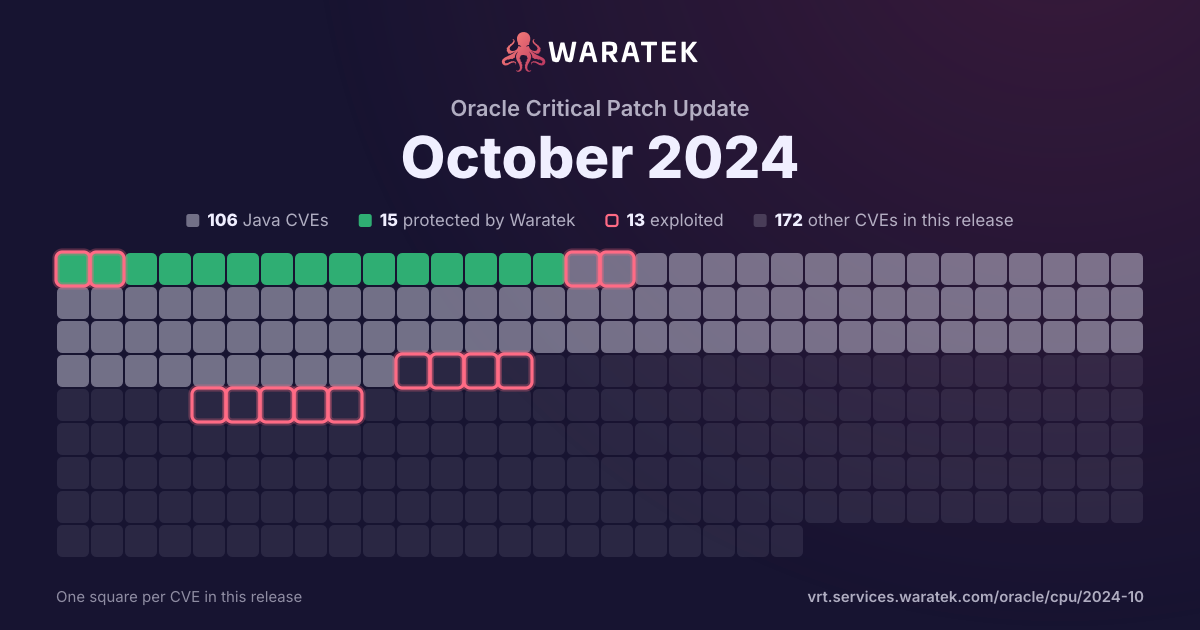
By status
15Protected by Waratek3Mitigation candidate88No exploit published26Outside Waratek scope144Not applicable2Withdrawn CVE
13Exploited, marked by the ring
No exploit published. For 51 of them, Oracle's security advisory is the source of public detail.
Protected by Waratek. Waratek RASP can block exploitation of these on systems that have not applied the patch yet.
Overview 93 matches · 52 in Waratek scope · 4 protected · 0 exploited · 0 CISA KEV · 0 public PoC · 0 EPSS ≥ 0.5
93matches
52in Waratek scope55.9%
4protected4.3%
0exploited0.0%
0CISA KEV0.0%
0public PoC0.0%
0EPSS ≥ 0.50.0%
Protected by Waratek
4
4.3%
Rule in development
0
0.0%
Mitigation candidate
0
0.0%
No exploit published
48
51.6%
Outside Waratek scope
4
4.3%
Not applicable
37
39.8%
Withdrawn CVE
0
0.0%
blocked by ARMR today
4
4.3%
partly blocked
0
0.0%
not blocked
89
95.7%
not established
0
0.0%
unrecorded
0
0.0%
Exploited
0
0.0%
Working exploit published
0
0.0%
Proof of concept only
0
0.0%
Forecast only
0
0.0%
No public exploit
93
100.0%
split by
peak 32 / quarter
Q4 191
Protected by Waratek1
High1
blocked by ARMR today1
No public exploit1
Q1 200
Q2 200
Q3 200
Q4 200
Q1 210
Q2 210
Q3 210
Q4 212
Protected by Waratek1
Outside Waratek scope1
High2
blocked by ARMR today1
not blocked1
No public exploit2
Q1 220
Q2 220
Q3 220
Q4 222
Not applicable2
High2
not blocked2
No public exploit2
Q1 235
Not applicable5
High5
not blocked5
No public exploit5
Q2 232
No exploit published1
Outside Waratek scope1
High2
not blocked2
No public exploit2
Q3 235
Protected by Waratek1
No exploit published2
Not applicable2
High5
blocked by ARMR today1
not blocked4
No public exploit5
Q4 234
No exploit published2
Not applicable2
High4
not blocked4
No public exploit4
Q1 2418
No exploit published4
Outside Waratek scope1
Not applicable13
High18
not blocked18
No public exploit18
Q2 2411
Protected by Waratek1
No exploit published2
Outside Waratek scope1
Not applicable7
High11
blocked by ARMR today1
not blocked10
No public exploit11
Q3 2411
No exploit published7
Not applicable4
High11
not blocked11
No public exploit11
Q4 2432
No exploit published30
Not applicable2
High32
not blocked32
No public exploit32
Q4 19Q2 20Q4 20Q2 21Q4 21Q2 22Q4 22Q2 23Q4 23Q2 24Q4 24
| CVE | Severity | Published▾ | Status | Exploitation | Description |
|---|---|---|---|---|---|
| CVE-2024-21285 | High | 2024-10-15 | No exploit published | No public exploit | Vulnerability in the Oracle Banking Liquidity Management product of Oracle Financial Services Applications (component: Reports). The supported version that is affected is 14.5.0.12.0. Difficult to exploit vulnerability allows low privileged attacker with network access via HTTP to compromise Oracle Banking Liquidity Management. Successful attacks require human interaction from a person other than the attacker. Successful attacks of this vulnerability can result in takeover of Oracle Banking Liquidity Management. CVSS 3.1 Base Score 7.1 (Confidentiality, Integrity and Availability impacts). CVSS Vector: (CVSS:3.1/AV:N/AC:H/PR:L/UI:R/S:U/C:H/I:H/A:H). |
| CVE-2024-21284 | High | 2024-10-15 | No exploit published | No public exploit | Vulnerability in the Oracle Banking Liquidity Management product of Oracle Financial Services Applications (component: Reports). The supported version that is affected is 14.5.0.12.0. Difficult to exploit vulnerability allows low privileged attacker with network access via HTTP to compromise Oracle Banking Liquidity Management. Successful attacks require human interaction from a person other than the attacker. Successful attacks of this vulnerability can result in takeover of Oracle Banking Liquidity Management. CVSS 3.1 Base Score 7.1 (Confidentiality, Integrity and Availability impacts). CVSS Vector: (CVSS:3.1/AV:N/AC:H/PR:L/UI:R/S:U/C:H/I:H/A:H). |
| CVE-2024-21283 | High | 2024-10-15 | No exploit published | No public exploit | Vulnerability in the PeopleSoft Enterprise HCM Global Payroll Core product of Oracle PeopleSoft (component: Global Payroll for Core). Supported versions that are affected are 9.2.48-9.2.50. Easily exploitable vulnerability allows low privileged attacker with network access via HTTP to compromise PeopleSoft Enterprise HCM Global Payroll Core. Successful attacks of this vulnerability can result in unauthorized creation, deletion or modification access to critical data or all PeopleSoft Enterprise HCM Global Payroll Core accessible data as well as unauthorized access to critical data or complete access to all PeopleSoft Enterprise HCM Global Payroll Core accessible data. CVSS 3.1 Base Score 8.1 (Confidentiality and Integrity impacts). CVSS Vector: (CVSS:3.1/AV:N/AC:L/PR:L/UI:N/S:U/C:H/I:H/A:N). |
| CVE-2024-21282 | High | 2024-10-15 | No exploit published | No public exploit | Vulnerability in the Oracle Financials product of Oracle E-Business Suite (component: Common Components). Supported versions that are affected are 12.2.3-12.2.13. Easily exploitable vulnerability allows low privileged attacker with network access via HTTP to compromise Oracle Financials. Successful attacks of this vulnerability can result in unauthorized creation, deletion or modification access to critical data or all Oracle Financials accessible data as well as unauthorized access to critical data or complete access to all Oracle Financials accessible data. CVSS 3.1 Base Score 8.1 (Confidentiality and Integrity impacts). CVSS Vector: (CVSS:3.1/AV:N/AC:L/PR:L/UI:N/S:U/C:H/I:H/A:N). |
| CVE-2024-21280 | High | 2024-10-15 | No exploit published | No public exploit | Vulnerability in the Oracle Service Contracts product of Oracle E-Business Suite (component: Authoring). Supported versions that are affected are 12.2.5-12.2.13. Easily exploitable vulnerability allows low privileged attacker with network access via HTTP to compromise Oracle Service Contracts. Successful attacks of this vulnerability can result in unauthorized creation, deletion or modification access to critical data or all Oracle Service Contracts accessible data as well as unauthorized access to critical data or complete access to all Oracle Service Contracts accessible data. CVSS 3.1 Base Score 8.1 (Confidentiality and Integrity impacts). CVSS Vector: (CVSS:3.1/AV:N/AC:L/PR:L/UI:N/S:U/C:H/I:H/A:N). |
| CVE-2024-21279 | High | 2024-10-15 | No exploit published | No public exploit | Vulnerability in the Oracle Sourcing product of Oracle E-Business Suite (component: Auctions). Supported versions that are affected are 12.2.3-12.2.13. Easily exploitable vulnerability allows low privileged attacker with network access via HTTP to compromise Oracle Sourcing. Successful attacks of this vulnerability can result in unauthorized creation, deletion or modification access to critical data or all Oracle Sourcing accessible data as well as unauthorized access to critical data or complete access to all Oracle Sourcing accessible data. CVSS 3.1 Base Score 8.1 (Confidentiality and Integrity impacts). CVSS Vector: (CVSS:3.1/AV:N/AC:L/PR:L/UI:N/S:U/C:H/I:H/A:N). |
| CVE-2024-21278 | High | 2024-10-15 | No exploit published | No public exploit | Vulnerability in the Oracle Contract Lifecycle Management for Public Sector product of Oracle E-Business Suite (component: Award Processes). Supported versions that are affected are 12.2.3-12.2.13. Easily exploitable vulnerability allows low privileged attacker with network access via HTTP to compromise Oracle Contract Lifecycle Management for Public Sector. Successful attacks of this vulnerability can result in unauthorized creation, deletion or modification access to critical data or all Oracle Contract Lifecycle Management for Public Sector accessible data as well as unauthorized access to critical data or complete access to all Oracle Contract Lifecycle Management for Public Sector accessible data. CVSS 3.1 Base Score 8.1 (Confidentiality and Integrity impacts). CVSS Vector: (CVSS:3.1/AV:N/AC:L/PR:L/UI:N/S:U/C:H/I:H/A:N). |
| CVE-2024-21277 | High | 2024-10-15 | No exploit published | No public exploit | Vulnerability in the Oracle MES for Process Manufacturing product of Oracle E-Business Suite (component: Device Integration). Supported versions that are affected are 12.2.3-12.2.13. Easily exploitable vulnerability allows low privileged attacker with network access via HTTP to compromise Oracle MES for Process Manufacturing. Successful attacks of this vulnerability can result in unauthorized creation, deletion or modification access to critical data or all Oracle MES for Process Manufacturing accessible data as well as unauthorized access to critical data or complete access to all Oracle MES for Process Manufacturing accessible data. CVSS 3.1 Base Score 8.1 (Confidentiality and Integrity impacts). CVSS Vector: (CVSS:3.1/AV:N/AC:L/PR:L/UI:N/S:U/C:H/I:H/A:N). |
| CVE-2024-21276 | High | 2024-10-15 | No exploit published | No public exploit | Vulnerability in the Oracle Work in Process product of Oracle E-Business Suite (component: Messages). Supported versions that are affected are 12.2.3-12.2.13. Easily exploitable vulnerability allows low privileged attacker with network access via HTTP to compromise Oracle Work in Process. Successful attacks of this vulnerability can result in unauthorized creation, deletion or modification access to critical data or all Oracle Work in Process accessible data as well as unauthorized access to critical data or complete access to all Oracle Work in Process accessible data. CVSS 3.1 Base Score 8.1 (Confidentiality and Integrity impacts). CVSS Vector: (CVSS:3.1/AV:N/AC:L/PR:L/UI:N/S:U/C:H/I:H/A:N). |
| CVE-2024-21275 | High | 2024-10-15 | No exploit published | No public exploit | Vulnerability in the Oracle Quoting product of Oracle E-Business Suite (component: User Interface). Supported versions that are affected are 12.2.7-12.2.13. Easily exploitable vulnerability allows low privileged attacker with network access via HTTP to compromise Oracle Quoting. Successful attacks of this vulnerability can result in unauthorized creation, deletion or modification access to critical data or all Oracle Quoting accessible data as well as unauthorized access to critical data or complete access to all Oracle Quoting accessible data. CVSS 3.1 Base Score 8.1 (Confidentiality and Integrity impacts). CVSS Vector: (CVSS:3.1/AV:N/AC:L/PR:L/UI:N/S:U/C:H/I:H/A:N). |
| CVE-2024-21274 | High | 2024-10-15 | No exploit published | No public exploit | Vulnerability in the Oracle WebLogic Server product of Oracle Fusion Middleware (component: Console). Supported versions that are affected are 12.2.1.4.0 and 14.1.1.0.0. Easily exploitable vulnerability allows unauthenticated attacker with network access via HTTP to compromise Oracle WebLogic Server. Successful attacks of this vulnerability can result in unauthorized ability to cause a hang or frequently repeatable crash (complete DOS) of Oracle WebLogic Server. CVSS 3.1 Base Score 7.5 (Availability impacts). CVSS Vector: (CVSS:3.1/AV:N/AC:L/PR:N/UI:N/S:U/C:N/I:N/A:H). |
| CVE-2024-21272 | High | 2024-10-15 | Not applicable | No public exploit | Vulnerability in the MySQL Connectors product of Oracle MySQL (component: Connector/Python). Supported versions that are affected are 9.0.0 and prior. Difficult to exploit vulnerability allows low privileged attacker with network access via multiple protocols to compromise MySQL Connectors. Successful attacks of this vulnerability can result in takeover of MySQL Connectors. CVSS 3.1 Base Score 7.5 (Confidentiality, Integrity and Availability impacts). CVSS Vector: (CVSS:3.1/AV:N/AC:H/PR:L/UI:N/S:U/C:H/I:H/A:H). |
| CVE-2024-21271 | High | 2024-10-15 | No exploit published | No public exploit | Vulnerability in the Oracle Field Service product of Oracle E-Business Suite (component: Field Service Engineer Portal). Supported versions that are affected are 12.2.3-12.2.13. Easily exploitable vulnerability allows low privileged attacker with network access via HTTP to compromise Oracle Field Service. Successful attacks of this vulnerability can result in unauthorized creation, deletion or modification access to critical data or all Oracle Field Service accessible data as well as unauthorized access to critical data or complete access to all Oracle Field Service accessible data. CVSS 3.1 Base Score 8.1 (Confidentiality and Integrity impacts). CVSS Vector: (CVSS:3.1/AV:N/AC:L/PR:L/UI:N/S:U/C:H/I:H/A:N). |
| CVE-2024-21270 | High | 2024-10-15 | No exploit published | No public exploit | Vulnerability in the Oracle Common Applications Calendar product of Oracle E-Business Suite (component: Tasks). Supported versions that are affected are 12.2.6-12.2.13. Easily exploitable vulnerability allows low privileged attacker with network access via HTTP to compromise Oracle Common Applications Calendar. Successful attacks of this vulnerability can result in unauthorized creation, deletion or modification access to critical data or all Oracle Common Applications Calendar accessible data as well as unauthorized access to critical data or complete access to all Oracle Common Applications Calendar accessible data. CVSS 3.1 Base Score 8.1 (Confidentiality and Integrity impacts). CVSS Vector: (CVSS:3.1/AV:N/AC:L/PR:L/UI:N/S:U/C:H/I:H/A:N). |
| CVE-2024-21269 | High | 2024-10-15 | No exploit published | No public exploit | Vulnerability in the Oracle Incentive Compensation product of Oracle E-Business Suite (component: Compensation Plan). Supported versions that are affected are 12.2.3-12.2.13. Easily exploitable vulnerability allows low privileged attacker with network access via HTTP to compromise Oracle Incentive Compensation. Successful attacks of this vulnerability can result in unauthorized creation, deletion or modification access to critical data or all Oracle Incentive Compensation accessible data as well as unauthorized access to critical data or complete access to all Oracle Incentive Compensation accessible data. CVSS 3.1 Base Score 8.1 (Confidentiality and Integrity impacts). CVSS Vector: (CVSS:3.1/AV:N/AC:L/PR:L/UI:N/S:U/C:H/I:H/A:N). |
| CVE-2024-21268 | High | 2024-10-15 | No exploit published | No public exploit | Vulnerability in the Oracle Applications Manager product of Oracle E-Business Suite (component: Diagnostics). Supported versions that are affected are 12.2.11-12.2.13. Easily exploitable vulnerability allows low privileged attacker with network access via HTTP to compromise Oracle Applications Manager. Successful attacks of this vulnerability can result in unauthorized creation, deletion or modification access to critical data or all Oracle Applications Manager accessible data as well as unauthorized access to critical data or complete access to all Oracle Applications Manager accessible data. CVSS 3.1 Base Score 8.1 (Confidentiality and Integrity impacts). CVSS Vector: (CVSS:3.1/AV:N/AC:L/PR:L/UI:N/S:U/C:H/I:H/A:N). |
| CVE-2024-21267 | High | 2024-10-15 | No exploit published | No public exploit | Vulnerability in the Oracle Cost Management product of Oracle E-Business Suite (component: Cost Planning). Supported versions that are affected are 12.2.12-12.2.13. Easily exploitable vulnerability allows low privileged attacker with network access via HTTP to compromise Oracle Cost Management. Successful attacks of this vulnerability can result in unauthorized creation, deletion or modification access to critical data or all Oracle Cost Management accessible data as well as unauthorized access to critical data or complete access to all Oracle Cost Management accessible data. CVSS 3.1 Base Score 8.1 (Confidentiality and Integrity impacts). CVSS Vector: (CVSS:3.1/AV:N/AC:L/PR:L/UI:N/S:U/C:H/I:H/A:N). |
| CVE-2024-21266 | High | 2024-10-15 | No exploit published | No public exploit | Vulnerability in the Oracle Advanced Pricing product of Oracle E-Business Suite (component: Price List). Supported versions that are affected are 12.2.3-12.2.13. Easily exploitable vulnerability allows low privileged attacker with network access via HTTP to compromise Oracle Advanced Pricing. Successful attacks of this vulnerability can result in unauthorized creation, deletion or modification access to critical data or all Oracle Advanced Pricing accessible data as well as unauthorized access to critical data or complete access to all Oracle Advanced Pricing accessible data. CVSS 3.1 Base Score 8.1 (Confidentiality and Integrity impacts). CVSS Vector: (CVSS:3.1/AV:N/AC:L/PR:L/UI:N/S:U/C:H/I:H/A:N). |
| CVE-2024-21265 | High | 2024-10-15 | No exploit published | No public exploit | Vulnerability in the Oracle Site Hub product of Oracle E-Business Suite (component: Site Hierarchy Flows). Supported versions that are affected are 12.2.3-12.2.13. Easily exploitable vulnerability allows low privileged attacker with network access via HTTP to compromise Oracle Site Hub. Successful attacks of this vulnerability can result in unauthorized creation, deletion or modification access to critical data or all Oracle Site Hub accessible data as well as unauthorized access to critical data or complete access to all Oracle Site Hub accessible data. CVSS 3.1 Base Score 8.1 (Confidentiality and Integrity impacts). CVSS Vector: (CVSS:3.1/AV:N/AC:L/PR:L/UI:N/S:U/C:H/I:H/A:N). |
| CVE-2024-21260 | High | 2024-10-15 | No exploit published | No public exploit | Vulnerability in the Oracle WebLogic Server product of Oracle Fusion Middleware (component: Core). Supported versions that are affected are 12.2.1.4.0 and 14.1.1.0.0. Easily exploitable vulnerability allows unauthenticated attacker with network access via T3, IIOP to compromise Oracle WebLogic Server. Successful attacks of this vulnerability can result in unauthorized ability to cause a hang or frequently repeatable crash (complete DOS) of Oracle WebLogic Server. CVSS 3.1 Base Score 7.5 (Availability impacts). CVSS Vector: (CVSS:3.1/AV:N/AC:L/PR:N/UI:N/S:U/C:N/I:N/A:H). |
| CVE-2024-21259 | High | 2024-10-15 | Not applicable | No public exploit | Vulnerability in the Oracle VM VirtualBox product of Oracle Virtualization (component: Core). Supported versions that are affected are Prior to 7.0.22 and prior to 7.1.2. Difficult to exploit vulnerability allows high privileged attacker with logon to the infrastructure where Oracle VM VirtualBox executes to compromise Oracle VM VirtualBox. While the vulnerability is in Oracle VM VirtualBox, attacks may significantly impact additional products (scope change). Successful attacks of this vulnerability can result in takeover of Oracle VM VirtualBox. CVSS 3.1 Base Score 7.5 (Confidentiality, Integrity and Availability impacts). CVSS Vector: (CVSS:3.1/AV:L/AC:H/PR:H/UI:N/S:C/C:H/I:H/A:H). |
| CVE-2024-21255 | High | 2024-10-15 | No exploit published | No public exploit | Vulnerability in the PeopleSoft Enterprise PeopleTools product of Oracle PeopleSoft (component: XMLPublisher). Supported versions that are affected are 8.59, 8.60 and 8.61. Easily exploitable vulnerability allows low privileged attacker with network access via HTTP to compromise PeopleSoft Enterprise PeopleTools. Successful attacks of this vulnerability can result in takeover of PeopleSoft Enterprise PeopleTools. CVSS 3.1 Base Score 8.8 (Confidentiality, Integrity and Availability impacts). CVSS Vector: (CVSS:3.1/AV:N/AC:L/PR:L/UI:N/S:U/C:H/I:H/A:H). |
| CVE-2024-21254 | High | 2024-10-15 | No exploit published | No public exploit | Vulnerability in the Oracle BI Publisher product of Oracle Analytics (component: Web Server). Supported versions that are affected are 7.0.0.0.0, 7.6.0.0.0 and 12.2.1.4.0. Easily exploitable vulnerability allows low privileged attacker with network access via HTTP to compromise Oracle BI Publisher. Successful attacks of this vulnerability can result in takeover of Oracle BI Publisher. CVSS 3.1 Base Score 8.8 (Confidentiality, Integrity and Availability impacts). CVSS Vector: (CVSS:3.1/AV:N/AC:L/PR:L/UI:N/S:U/C:H/I:H/A:H). |
| CVE-2024-21252 | High | 2024-10-15 | No exploit published | No public exploit | Vulnerability in the Oracle Product Hub product of Oracle E-Business Suite (component: Item Catalog). Supported versions that are affected are 12.2.3-12.2.13. Easily exploitable vulnerability allows low privileged attacker with network access via HTTP to compromise Oracle Product Hub. Successful attacks of this vulnerability can result in unauthorized creation, deletion or modification access to critical data or all Oracle Product Hub accessible data as well as unauthorized access to critical data or complete access to all Oracle Product Hub accessible data. CVSS 3.1 Base Score 8.1 (Confidentiality and Integrity impacts). CVSS Vector: (CVSS:3.1/AV:N/AC:L/PR:L/UI:N/S:U/C:H/I:H/A:N). |
| CVE-2024-21250 | High | 2024-10-15 | No exploit published | No public exploit | Vulnerability in the Oracle Process Manufacturing Product Development product of Oracle E-Business Suite (component: Quality Manager Specification). Supported versions that are affected are 12.2.13-12.2.14. Easily exploitable vulnerability allows low privileged attacker with network access via HTTP to compromise Oracle Process Manufacturing Product Development. Successful attacks of this vulnerability can result in unauthorized creation, deletion or modification access to critical data or all Oracle Process Manufacturing Product Development accessible data as well as unauthorized access to critical data or complete access to all Oracle Process Manufacturing Product Development accessible data. CVSS 3.1 Base Score 8.1 (Confidentiality and Integrity impacts). CVSS Vector: (CVSS:3.1/AV:N/AC:L/PR:L/UI:N/S:U/C:H/I:H/A:N). |
| CVE-2024-21246 | High | 2024-10-15 | No exploit published | No public exploit | Vulnerability in the Oracle Service Bus product of Oracle Fusion Middleware (component: OSB Core Functionality). The supported version that is affected is 12.2.1.4.0. Easily exploitable vulnerability allows unauthenticated attacker with network access via HTTP to compromise Oracle Service Bus. Successful attacks of this vulnerability can result in unauthorized access to critical data or complete access to all Oracle Service Bus accessible data. CVSS 3.1 Base Score 7.5 (Confidentiality impacts). CVSS Vector: (CVSS:3.1/AV:N/AC:L/PR:N/UI:N/S:U/C:H/I:N/A:N). |
| CVE-2024-21234 | High | 2024-10-15 | No exploit published | No public exploit | Vulnerability in the Oracle WebLogic Server product of Oracle Fusion Middleware (component: Core). Supported versions that are affected are 12.2.1.4.0 and 14.1.1.0.0. Easily exploitable vulnerability allows unauthenticated attacker with network access via T3, IIOP to compromise Oracle WebLogic Server. Successful attacks of this vulnerability can result in unauthorized access to critical data or complete access to all Oracle WebLogic Server accessible data. CVSS 3.1 Base Score 7.5 (Confidentiality impacts). CVSS Vector: (CVSS:3.1/AV:N/AC:L/PR:N/UI:N/S:U/C:H/I:N/A:N). |
| CVE-2024-21215 | High | 2024-10-15 | No exploit published | No public exploit | Vulnerability in the Oracle WebLogic Server product of Oracle Fusion Middleware (component: Core). Supported versions that are affected are 12.2.1.4.0 and 14.1.1.0.0. Easily exploitable vulnerability allows unauthenticated attacker with network access via HTTP to compromise Oracle WebLogic Server. Successful attacks of this vulnerability can result in unauthorized ability to cause a hang or frequently repeatable crash (complete DOS) of Oracle WebLogic Server. CVSS 3.1 Base Score 7.5 (Availability impacts). CVSS Vector: (CVSS:3.1/AV:N/AC:L/PR:N/UI:N/S:U/C:N/I:N/A:H). |
| CVE-2024-21214 | High | 2024-10-15 | No exploit published | No public exploit | Vulnerability in the PeopleSoft Enterprise PeopleTools product of Oracle PeopleSoft (component: Query). Supported versions that are affected are 8.59, 8.60 and 8.61. Easily exploitable vulnerability allows low privileged attacker with network access via HTTP to compromise PeopleSoft Enterprise PeopleTools. Successful attacks of this vulnerability can result in unauthorized creation, deletion or modification access to critical data or all PeopleSoft Enterprise PeopleTools accessible data as well as unauthorized access to critical data or complete access to all PeopleSoft Enterprise PeopleTools accessible data. CVSS 3.1 Base Score 8.1 (Confidentiality and Integrity impacts). CVSS Vector: (CVSS:3.1/AV:N/AC:L/PR:L/UI:N/S:U/C:H/I:H/A:N). |
| CVE-2024-21195 | High | 2024-10-15 | No exploit published | No public exploit | Vulnerability in the Oracle BI Publisher product of Oracle Analytics (component: Layout Templates). Supported versions that are affected are 7.0.0.0.0, 7.6.0.0.0 and 12.2.1.4.0. Easily exploitable vulnerability allows low privileged attacker with network access via HTTP to compromise Oracle BI Publisher. Successful attacks of this vulnerability can result in unauthorized access to critical data or complete access to all Oracle BI Publisher accessible data as well as unauthorized update, insert or delete access to some of Oracle BI Publisher accessible data and unauthorized ability to cause a partial denial of service (partial DOS) of Oracle BI Publisher. CVSS 3.1 Base Score 7.6 (Confidentiality, Integrity and Availability impacts). CVSS Vector: (CVSS:3.1/AV:N/AC:L/PR:L/UI:N/S:U/C:H/I:L/A:L). |
| CVE-2024-21191 | High | 2024-10-15 | No exploit published | No public exploit | Vulnerability in the Oracle Enterprise Manager Fusion Middleware Control product of Oracle Fusion Middleware (component: FMW Control Plugin). The supported version that is affected is 12.2.1.4.0. Easily exploitable vulnerability allows low privileged attacker with network access via HTTP to compromise Oracle Enterprise Manager Fusion Middleware Control. Successful attacks require human interaction from a person other than the attacker and while the vulnerability is in Oracle Enterprise Manager Fusion Middleware Control, attacks may significantly impact additional products (scope change). Successful attacks of this vulnerability can result in unauthorized access to critical data or complete access to all Oracle Enterprise Manager Fusion Middleware Control accessible data as well as unauthorized update, insert or delete access to some of Oracle Enterprise Manager Fusion Middleware Control accessible data. CVSS 3.1 Base Score 7.6 (Confidentiality and Integrity impacts). CVSS Vector: (CVSS:3.1/AV:N/AC:L/PR:L/UI:R/S:C/C:H/I:L/A:N). |
| CVE-2024-21190 | High | 2024-10-15 | No exploit published | No public exploit | Vulnerability in the Oracle Global Lifecycle Management FMW Installer product of Oracle Fusion Middleware (component: Cloning). The supported version that is affected is 12.2.1.4.0. Easily exploitable vulnerability allows unauthenticated attacker with network access via SFTP to compromise Oracle Global Lifecycle Management FMW Installer. Successful attacks of this vulnerability can result in unauthorized creation, deletion or modification access to critical data or all Oracle Global Lifecycle Management FMW Installer accessible data. CVSS 3.1 Base Score 7.5 (Integrity impacts). CVSS Vector: (CVSS:3.1/AV:N/AC:L/PR:N/UI:N/S:U/C:N/I:H/A:N). |
| CVE-2024-7254 | High | 2024-09-19 | No exploit published | No public exploit | Any project that parses untrusted Protocol Buffers data containing an arbitrary number of nested groups / series of SGROUP tags can corrupted by exceeding the stack limit i.e. StackOverflow. Parsing nested groups as unknown fields with DiscardUnknownFieldsParser or Java Protobuf Lite parser, or against Protobuf map fields, creates unbounded recursions that can be abused by an attacker. |
| CVE-2024-45801 | High | 2024-09-16 | Not applicable | No public exploit | DOMPurify is a DOM-only, super-fast, uber-tolerant XSS sanitizer for HTML, MathML and SVG. It has been discovered that malicious HTML using special nesting techniques can bypass the depth checking added to DOMPurify in recent releases. It was also possible to use Prototype Pollution to weaken the depth check. This renders dompurify unable to avoid cross site scripting (XSS) attacks. This issue has been addressed in versions 2.5.4 and 3.1.3 of DOMPurify. All users are advised to upgrade. There are no known workarounds for this vulnerability. |
| CVE-2024-36138 | High | 2024-09-07 | Not applicable | No public exploit | Bypass incomplete fix of CVE-2024-27980, that arises from improper handling of batch files with all possible extensions on Windows via child_process.spawn / child_process.spawnSync. A malicious command line argument can inject arbitrary commands and achieve code execution even if the shell option is not enabled. |
| CVE-2024-7885 | High | 2024-08-21 | No exploit published | No public exploit | A vulnerability was found in Undertow where the ProxyProtocolReadListener reuses the same StringBuilder instance across multiple requests. This issue occurs when the parseProxyProtocolV1 method processes multiple requests on the same HTTP connection. As a result, different requests may share the same StringBuilder instance, potentially leading to information leakage between requests or responses. In some cases, a value from a previous request or response may be erroneously reused, which could lead to unintended data exposure. This issue primarily results in errors and connection termination but creates a risk of data leakage in multi-request environments. |
| CVE-2024-25638 | High | 2024-07-22 | No exploit published | No public exploit | dnsjava is an implementation of DNS in Java. Records in DNS replies are not checked for their relevance to the query, allowing an attacker to respond with RRs from different zones. This vulnerability is fixed in 3.6.0. |
| CVE-2024-41172 | High | 2024-07-19 | No exploit published | No public exploit | In versions of Apache CXF before 3.6.4 and 4.0.5 (3.5.x and lower versions are not impacted), a CXF HTTP client conduit may prevent HTTPClient instances from being garbage collected and it is possible that memory consumption will continue to increase, eventually causing the application to run out of memory |
| CVE-2024-32007 | High | 2024-07-19 | No exploit published | No public exploit | An improper input validation of the p2c parameter in the Apache CXF JOSE code before 4.0.5, 3.6.4 and 3.5.9 allows an attacker to perform a denial of service attack by specifying a large value for this parameter in a token. |
| CVE-2024-5971 | High | 2024-07-08 | No exploit published | No public exploit | A vulnerability was found in Undertow, where the chunked response hangs after the body was flushed. The response headers and body were sent but the client would continue waiting as Undertow does not send the expected 0\r\n termination of the chunked response. This results in uncontrolled resource consumption, leaving the server side to a denial of service attack. This happens only with Java 17 TLSv1.3 scenarios. |
| CVE-2024-34750 | High | 2024-07-03 | No exploit published | No public exploit | Improper Handling of Exceptional Conditions, Uncontrolled Resource Consumption vulnerability in Apache Tomcat. When processing an HTTP/2 stream, Tomcat did not handle some cases of excessive HTTP headers correctly. This led to a miscounting of active HTTP/2 streams which in turn led to the use of an incorrect infinite timeout which allowed connections to remain open which should have been closed. This issue affects Apache Tomcat: from 11.0.0-M1 through 11.0.0-M20, from 10.1.0-M1 through 10.1.24, from 9.0.0-M1 through 9.0.89. The following versions were EOL at the time the CVE was created but are known to be affected: 8.5.0 though 8.5.100. Other EOL versions may also be affected. Users are recommended to upgrade to version 11.0.0-M21, 10.1.25 or 9.0.90, which fixes the issue. |
| CVE-2024-39573 | High | 2024-07-01 | Not applicable | No public exploit | Potential SSRF in mod_rewrite in Apache HTTP Server 2.4.59 and earlier allows an attacker to cause unsafe RewriteRules to unexpectedly setup URL's to be handled by mod_proxy. Users are recommended to upgrade to version 2.4.60, which fixes this issue. |
| CVE-2024-38477 | High | 2024-07-01 | Not applicable | No public exploit | null pointer dereference in mod_proxy in Apache HTTP Server 2.4.59 and earlier allows an attacker to crash the server via a malicious request. Users are recommended to upgrade to version 2.4.60, which fixes this issue. |
| CVE-2024-37370 | High | 2024-06-28 | Not applicable | No public exploit | In MIT Kerberos 5 (aka krb5) before 1.21.3, an attacker can modify the plaintext Extra Count field of a confidential GSS krb5 wrap token, causing the unwrapped token to appear truncated to the application. |
| CVE-2024-6162 | High | 2024-06-20 | No exploit published | No public exploit | A vulnerability was found in Undertow, where URL-encoded request paths can be mishandled during concurrent requests on the AJP listener. This issue arises because the same buffer is used to decode the paths for multiple requests simultaneously, leading to incorrect path information being processed. As a result, the server may attempt to access the wrong path, causing errors such as "404 Not Found" or other application failures. This flaw can potentially lead to a denial of service, as legitimate resources become inaccessible due to the path mix-up. |
| CVE-2024-29857 | High | 2024-05-14 | No exploit published | No public exploit | An issue was discovered in ECCurve.java and ECCurve.cs in Bouncy Castle Java (BC Java) before 1.78, BC Java LTS before 2.73.6, BC-FJA before 1.0.2.5, and BC C# .Net before 2.3.1. Importing an EC certificate with crafted F2m parameters can lead to excessive CPU consumption during the evaluation of the curve parameters. |
| CVE-2024-33602 | High | 2024-05-06 | Outside Waratek scope | No public exploit | nscd: netgroup cache assumes NSS callback uses in-buffer strings The Name Service Cache Daemon's (nscd) netgroup cache can corrupt memory when the NSS callback does not store all strings in the provided buffer. The flaw was introduced in glibc 2.15 when the cache was added to nscd. This vulnerability is only present in the nscd binary. |
| CVE-2024-33601 | High | 2024-05-06 | Not applicable | No public exploit | nscd: netgroup cache may terminate daemon on memory allocation failure The Name Service Cache Daemon's (nscd) netgroup cache uses xmalloc or xrealloc and these functions may terminate the process due to a memory allocation failure resulting in a denial of service to the clients. The flaw was introduced in glibc 2.15 when the cache was added to nscd. This vulnerability is only present in the nscd binary. |
| CVE-2024-33599 | High | 2024-05-06 | Not applicable | No public exploit | nscd: Stack-based buffer overflow in netgroup cache If the Name Service Cache Daemon's (nscd) fixed size cache is exhausted by client requests then a subsequent client request for netgroup data may result in a stack-based buffer overflow. This flaw was introduced in glibc 2.15 when the cache was added to nscd. This vulnerability is only present in the nscd binary. |
| CVE-2024-30251 | High | 2024-05-02 | Not applicable | No public exploit | aiohttp is an asynchronous HTTP client/server framework for asyncio and Python. In affected versions an attacker can send a specially crafted POST (multipart/form-data) request. When the aiohttp server processes it, the server will enter an infinite loop and be unable to process any further requests. An attacker can stop the application from serving requests after sending a single request. This issue has been addressed in version 3.9.4. Users are advised to upgrade. Users unable to upgrade may manually apply a patch to their systems. Please see the linked GHSA for instructions. |
| CVE-2024-31744 | High | 2024-04-19 | Not applicable | No public exploit | In Jasper 4.2.2, the jpc_streamlist_remove function in src/libjasper/jpc/jpc_dec.c:2407 has an assertion failure vulnerability, allowing attackers to cause a denial of service attack through a specific image file. |
| CVE-2024-22262 | High | 2024-04-16 | Protected by Waratek | No public exploit | Applications that use UriComponentsBuilder to parse an externally provided URL (e.g. through a query parameter) AND perform validation checks on the host of the parsed URL may be vulnerable to a open redirect https://cwe.mitre.org/data/definitions/601.html attack or to a SSRF attack if the URL is used after passing validation checks. This is the same as CVE-2024-22259 https://spring.io/security/cve-2024-22259 and CVE-2024-22243 https://spring.io/security/cve-2024-22243 , but with different input. |
| CVE-2024-31083 | High | 2024-04-05 | Not applicable | No public exploit | A use-after-free vulnerability was found in the ProcRenderAddGlyphs() function of Xorg servers. This issue occurs when AllocateGlyph() is called to store new glyphs sent by the client to the X server, potentially resulting in multiple entries pointing to the same non-refcounted glyphs. Consequently, ProcRenderAddGlyphs() may free a glyph, leading to a use-after-free scenario when the same glyph pointer is subsequently accessed. This flaw allows an authenticated attacker to execute arbitrary code on the system by sending a specially crafted request. |
| CVE-2024-31080 | High | 2024-04-04 | Not applicable | No public exploit | A heap-based buffer over-read vulnerability was found in the X.org server's ProcXIGetSelectedEvents() function. This issue occurs when byte-swapped length values are used in replies, potentially leading to memory leakage and segmentation faults, particularly when triggered by a client with a different endianness. This vulnerability could be exploited by an attacker to cause the X server to read heap memory values and then transmit them back to the client until encountering an unmapped page, resulting in a crash. Despite the attacker's inability to control the specific memory copied into the replies, the small length values typically stored in a 32-bit integer can result in significant attempted out-of-bounds reads. |
| CVE-2023-42950 | High | 2024-03-28 | Not applicable | No public exploit | A use after free issue was addressed with improved memory management. This issue is fixed in Safari 17.2, iOS 17.2 and iPadOS 17.2, tvOS 17.2, watchOS 10.2, macOS Sonoma 14.2. Processing maliciously crafted web content may lead to arbitrary code execution. |
| CVE-2024-2398 | High | 2024-03-27 | Outside Waratek scope | No public exploit | When an application tells libcurl it wants to allow HTTP/2 server push, and the amount of received headers for the push surpasses the maximum allowed limit (1000), libcurl aborts the server push. When aborting, libcurl inadvertently does not free all the previously allocated headers and instead leaks the memory. Further, this error condition fails silently and is therefore not easily detected by an application. |
| CVE-2023-5685 | High | 2024-03-22 | No exploit published | No public exploit | A flaw was found in XNIO. The XNIO NotifierState that can cause a Stack Overflow Exception when the chain of notifier states becomes problematically large can lead to uncontrolled resource management and a possible denial of service (DoS). |
| CVE-2024-29131 | High | 2024-03-21 | No exploit published | No public exploit | Out-of-bounds Write vulnerability in Apache Commons Configuration.This issue affects Apache Commons Configuration: from 2.0 before 2.10.1. Users are recommended to upgrade to version 2.10.1, which fixes the issue. |
| CVE-2023-6597 | High | 2024-03-19 | Not applicable | No public exploit | An issue was found in the CPython `tempfile.TemporaryDirectory` class affecting versions 3.12.1, 3.11.7, 3.10.13, 3.9.18, and 3.8.18 and prior. The tempfile.TemporaryDirectory class would dereference symlinks during cleanup of permissions-related errors. This means users which can run privileged programs are potentially able to modify permissions of files referenced by symlinks in some circumstances. |
| CVE-2024-22257 | High | 2024-03-18 | No exploit published | No public exploit | In Spring Security, versions 5.7.x prior to 5.7.12, 5.8.x prior to 5.8.11, versions 6.0.x prior to 6.0.9, versions 6.1.x prior to 6.1.8, versions 6.2.x prior to 6.2.3, an application is possible vulnerable to broken access control when it directly uses the AuthenticatedVoter#vote passing a null Authentication parameter. |
| CVE-2024-23280 | High | 2024-03-08 | Not applicable | No public exploit | An injection issue was addressed with improved validation. This issue is fixed in Safari 17.4, iOS 17.4 and iPadOS 17.4, macOS Sonoma 14.4, tvOS 17.4, watchOS 10.4. A maliciously crafted webpage may be able to fingerprint the user. |
| CVE-2024-23263 | High | 2024-03-08 | Not applicable | No public exploit | A logic issue was addressed with improved validation. This issue is fixed in Safari 17.4, iOS 16.7.6 and iPadOS 16.7.6, iOS 17.4 and iPadOS 17.4, macOS Sonoma 14.4, tvOS 17.4, visionOS 1.1, watchOS 10.4. Processing maliciously crafted web content may prevent Content Security Policy from being enforced. |
| CVE-2024-21886 | High | 2024-02-28 | Not applicable | No public exploit | A heap buffer overflow flaw was found in the DisableDevice function in the X.Org server. This issue may lead to an application crash or, in some circumstances, remote code execution in SSH X11 forwarding environments. |
| CVE-2024-21885 | High | 2024-02-28 | Not applicable | No public exploit | A flaw was found in X.Org server. In the XISendDeviceHierarchyEvent function, it is possible to exceed the allocated array length when certain new device IDs are added to the xXIHierarchyInfo struct. This can trigger a heap buffer overflow condition, which may lead to an application crash or remote code execution in SSH X11 forwarding environments. |
| CVE-2024-26130 | High | 2024-02-21 | Not applicable | No public exploit | cryptography is a package designed to expose cryptographic primitives and recipes to Python developers. Starting in version 38.0.0 and prior to version 42.0.4, if `pkcs12.serialize_key_and_certificates` is called with both a certificate whose public key did not match the provided private key and an `encryption_algorithm` with `hmac_hash` set (via `PrivateFormat.PKCS12.encryption_builder().hmac_hash(...)`, then a NULL pointer dereference would occur, crashing the Python process. This has been resolved in version 42.0.4, the first version in which a `ValueError` is properly raised. |
| CVE-2023-42843 | High | 2024-02-21 | Not applicable | No public exploit | An inconsistent user interface issue was addressed with improved state management. This issue is fixed in iOS 16.7.2 and iPadOS 16.7.2, iOS 17.1 and iPadOS 17.1, Safari 17.1, macOS Sonoma 14.1. Visiting a malicious website may lead to address bar spoofing. |
| CVE-2024-25710 | High | 2024-02-19 | No exploit published | No public exploit | Loop with Unreachable Exit Condition ('Infinite Loop') vulnerability in Apache Commons Compress.This issue affects Apache Commons Compress: from 1.3 through 1.25.0. Users are recommended to upgrade to version 1.26.0 which fixes the issue. |
| CVE-2024-24990 | High | 2024-02-14 | Not applicable | No public exploit | When NGINX Plus or NGINX OSS are configured to use the HTTP/3 QUIC module, undisclosed requests can cause NGINX worker processes to terminate. Note: The HTTP/3 QUIC module is not enabled by default and is considered experimental. For more information, refer to Support for QUIC and HTTP/3 https://nginx.org/en/docs/quic.html . Note: Software versions which have reached End of Technical Support (EoTS) are not evaluated |
| CVE-2024-24989 | High | 2024-02-14 | Not applicable | No public exploit | When NGINX Plus or NGINX OSS are configured to use the HTTP/3 QUIC module, undisclosed requests can cause NGINX worker processes to terminate. Note: The HTTP/3 QUIC module is not enabled by default and is considered experimental. For more information, refer to Support for QUIC and HTTP/3 https://nginx.org/en/docs/quic.html . NOTE: Software versions which have reached End of Technical Support (EoTS) are not evaluated |
| CVE-2024-0229 | High | 2024-02-09 | Not applicable | No public exploit | An out-of-bounds memory access flaw was found in the X.Org server. This issue can be triggered when a device frozen by a sync grab is reattached to a different master device. This issue may lead to an application crash, local privilege escalation (if the server runs with extended privileges), or remote code execution in SSH X11 forwarding environments. |
| CVE-2024-25062 | High | 2024-02-04 | Not applicable | No public exploit | An issue was discovered in libxml2 before 2.11.7 and 2.12.x before 2.12.5. When using the XML Reader interface with DTD validation and XInclude expansion enabled, processing crafted XML documents can lead to an xmlValidatePopElement use-after-free. |
| CVE-2023-50447 | High | 2024-01-19 | Not applicable | No public exploit | Pillow through 10.1.0 allows PIL.ImageMath.eval Arbitrary Code Execution via the environment parameter, a different vulnerability than CVE-2022-22817 (which was about the expression parameter). |
| CVE-2023-4043 | High | 2023-11-03 | No exploit published | No public exploit | In Eclipse Parsson before versions 1.1.4 and 1.0.5, Parsing JSON from untrusted sources can lead malicious actors to exploit the fact that the built-in support for parsing numbers with large scale in Java has a number of edge cases where the input text of a number can lead to much larger processing time than one would expect. To mitigate the risk, parsson put in place a size limit for the numbers as well as their scale. |
| CVE-2023-5363 | High | 2023-10-25 | Not applicable | No public exploit | Issue summary: A bug has been identified in the processing of key and initialisation vector (IV) lengths. This can lead to potential truncation or overruns during the initialisation of some symmetric ciphers. Impact summary: A truncation in the IV can result in non-uniqueness, which could result in loss of confidentiality for some cipher modes. When calling EVP_EncryptInit_ex2(), EVP_DecryptInit_ex2() or EVP_CipherInit_ex2() the provided OSSL_PARAM array is processed after the key and IV have been established. Any alterations to the key length, via the "keylen" parameter or the IV length, via the "ivlen" parameter, within the OSSL_PARAM array will not take effect as intended, potentially causing truncation or overreading of these values. The following ciphers and cipher modes are impacted: RC2, RC4, RC5, CCM, GCM and OCB. For the CCM, GCM and OCB cipher modes, truncation of the IV can result in loss of confidentiality. For example, when following NIST's SP 800-38D section 8.2.1 guidance for constructing a deterministic IV for AES in GCM mode, truncation of the counter portion could lead to IV reuse. Both truncations and overruns of the key and overruns of the IV will produce incorrect results and could, in some cases, trigger a memory exception. However, these issues are not currently assessed as security critical. Changing the key and/or IV lengths is not considered to be a common operation and the vulnerable API was recently introduced. Furthermore it is likely that application developers will have spotted this problem during testing since decryption would fail unless both peers in the communication were similarly vulnerable. For these reasons we expect the probability of an application being vulnerable to this to be quite low. However if an application is vulnerable then this issue is considered very serious. For these reasons we have assessed this issue as Moderate severity overall. The OpenSSL SSL/TLS implementation is not affected by this issue. The OpenSSL 3.0 and 3.1 FIPS providers are not affected by this because the issue lies outside of the FIPS provider boundary. OpenSSL 3.1 and 3.0 are vulnerable to this issue. |
| CVE-2023-46136 | High | 2023-10-25 | Not applicable | No public exploit | Werkzeug is a comprehensive WSGI web application library. In versions on the 3.x branch prior to 3.0.1 and on the 2.x branch prior to 2.3.8, if an upload of a file that starts with CR or LF and then is followed by megabytes of data without these characters: all of these bytes are appended chunk by chunk into internal bytearray and lookup for boundary is performed on growing buffer. This allows an attacker to cause a denial of service by sending crafted multipart data to an endpoint that will parse it. The amount of CPU time required can block worker processes from handling legitimate requests. This vulnerability has been patched in version 3.0.1 and 2.3.8. |
| CVE-2023-5072 | High | 2023-10-12 | No exploit published | No public exploit | Denial of Service in JSON-Java versions up to and including 20230618. A bug in the parser means that an input string of modest size can lead to indefinite amounts of memory being used. |
| CVE-2023-39410 | High | 2023-09-29 | Protected by Waratek | No public exploit | When deserializing untrusted or corrupted data, it is possible for a reader to consume memory beyond the allowed constraints and thus lead to out of memory on the system. This issue affects Java applications using Apache Avro Java SDK up to and including 1.11.2. Users should update to apache-avro version 1.11.3 which addresses this issue. |
| CVE-2023-4759 | High | 2023-09-12 | No exploit published | No public exploit | Arbitrary File Overwrite in Eclipse JGit <= 6.6.0 In Eclipse JGit, all versions <= 6.6.0.202305301015-r, a symbolic link present in a specially crafted git repository can be used to write a file to locations outside the working tree when this repository is cloned with JGit to a case-insensitive filesystem, or when a checkout from a clone of such a repository is performed on a case-insensitive filesystem. This can happen on checkout (DirCacheCheckout), merge (ResolveMerger via its WorkingTreeUpdater), pull (PullCommand using merge), and when applying a patch (PatchApplier). This can be exploited for remote code execution (RCE), for instance if the file written outside the working tree is a git filter that gets executed on a subsequent git command. The issue occurs only on case-insensitive filesystems, like the default filesystems on Windows and macOS. The user performing the clone or checkout must have the rights to create symbolic links for the problem to occur, and symbolic links must be enabled in the git configuration. Setting git configuration option core.symlinks = false before checking out avoids the problem. The issue was fixed in Eclipse JGit version 6.6.1.202309021850-r and 6.7.0.202309050840-r, available via Maven Central https://repo1.maven.org/maven2/org/eclipse/jgit/ and repo.eclipse.org https://repo.eclipse.org/content/repositories/jgit-releases/ . A backport is available in 5.13.3 starting from 5.13.3.202401111512-r. The JGit maintainers would like to thank RyotaK for finding and reporting this issue. |
| CVE-2023-4807 | High | 2023-09-08 | Not applicable | No public exploit | Issue summary: The POLY1305 MAC (message authentication code) implementation contains a bug that might corrupt the internal state of applications on the Windows 64 platform when running on newer X86_64 processors supporting the AVX512-IFMA instructions. Impact summary: If in an application that uses the OpenSSL library an attacker can influence whether the POLY1305 MAC algorithm is used, the application state might be corrupted with various application dependent consequences. The POLY1305 MAC (message authentication code) implementation in OpenSSL does not save the contents of non-volatile XMM registers on Windows 64 platform when calculating the MAC of data larger than 64 bytes. Before returning to the caller all the XMM registers are set to zero rather than restoring their previous content. The vulnerable code is used only on newer x86_64 processors supporting the AVX512-IFMA instructions. The consequences of this kind of internal application state corruption can be various - from no consequences, if the calling application does not depend on the contents of non-volatile XMM registers at all, to the worst consequences, where the attacker could get complete control of the application process. However given the contents of the registers are just zeroized so the attacker cannot put arbitrary values inside, the most likely consequence, if any, would be an incorrect result of some application dependent calculations or a crash leading to a denial of service. The POLY1305 MAC algorithm is most frequently used as part of the CHACHA20-POLY1305 AEAD (authenticated encryption with associated data) algorithm. The most common usage of this AEAD cipher is with TLS protocol versions 1.2 and 1.3 and a malicious client can influence whether this AEAD cipher is used by the server. This implies that server applications using OpenSSL can be potentially impacted. However we are currently not aware of any concrete application that would be affected by this issue therefore we consider this a Low severity security issue. As a workaround the AVX512-IFMA instructions support can be disabled at runtime by setting the environment variable OPENSSL_ia32cap: OPENSSL_ia32cap=:~0x200000 The FIPS provider is not affected by this issue. |
| CVE-2023-28823 | High | 2023-08-11 | Not applicable | No public exploit | Uncontrolled search path in some Intel(R) oneAPI Toolkit and component software installers before version 4.3.1.493 may allow an authenticated user to potentially enable escalation of privilege via local access. |
| CVE-2023-3635 | High | 2023-07-12 | No exploit published | No public exploit | GzipSource does not handle an exception that might be raised when parsing a malformed gzip buffer. This may lead to denial of service of the Okio client when handling a crafted GZIP archive, by using the GzipSource class. |
| CVE-2023-2976 | High | 2023-06-14 | No exploit published | No public exploit | Use of Java's default temporary directory for file creation in `FileBackedOutputStream` in Google Guava versions 1.0 to 31.1 on Unix systems and Android Ice Cream Sandwich allows other users and apps on the machine with access to the default Java temporary directory to be able to access the files created by the class. Even though the security vulnerability is fixed in version 32.0.0, we recommend using version 32.0.1 as version 32.0.0 breaks some functionality under Windows. |
| CVE-2023-2953 | High | 2023-05-30 | Outside Waratek scope | No public exploit | A vulnerability was found in openldap. This security flaw causes a null pointer dereference in ber_memalloc_x() function. |
| CVE-2023-0401 | High | 2023-02-08 | Not applicable | No public exploit | A NULL pointer can be dereferenced when signatures are being verified on PKCS7 signed or signedAndEnveloped data. In case the hash algorithm used for the signature is known to the OpenSSL library but the implementation of the hash algorithm is not available the digest initialization will fail. There is a missing check for the return value from the initialization function which later leads to invalid usage of the digest API most likely leading to a crash. The unavailability of an algorithm can be caused by using FIPS enabled configuration of providers or more commonly by not loading the legacy provider. PKCS7 data is processed by the SMIME library calls and also by the time stamp (TS) library calls. The TLS implementation in OpenSSL does not call these functions however third party applications would be affected if they call these functions to verify signatures on untrusted data. |
| CVE-2023-0217 | High | 2023-02-08 | Not applicable | No public exploit | An invalid pointer dereference on read can be triggered when an application tries to check a malformed DSA public key by the EVP_PKEY_public_check() function. This will most likely lead to an application crash. This function can be called on public keys supplied from untrusted sources which could allow an attacker to cause a denial of service attack. The TLS implementation in OpenSSL does not call this function but applications might call the function if there are additional security requirements imposed by standards such as FIPS 140-3. |
| CVE-2023-0216 | High | 2023-02-08 | Not applicable | No public exploit | An invalid pointer dereference on read can be triggered when an application tries to load malformed PKCS7 data with the d2i_PKCS7(), d2i_PKCS7_bio() or d2i_PKCS7_fp() functions. The result of the dereference is an application crash which could lead to a denial of service attack. The TLS implementation in OpenSSL does not call this function however third party applications might call these functions on untrusted data. |
| CVE-2023-0215 | High | 2023-02-08 | Not applicable | No public exploit | The public API function BIO_new_NDEF is a helper function used for streaming ASN.1 data via a BIO. It is primarily used internally to OpenSSL to support the SMIME, CMS and PKCS7 streaming capabilities, but may also be called directly by end user applications. The function receives a BIO from the caller, prepends a new BIO_f_asn1 filter BIO onto the front of it to form a BIO chain, and then returns the new head of the BIO chain to the caller. Under certain conditions, for example if a CMS recipient public key is invalid, the new filter BIO is freed and the function returns a NULL result indicating a failure. However, in this case, the BIO chain is not properly cleaned up and the BIO passed by the caller still retains internal pointers to the previously freed filter BIO. If the caller then goes on to call BIO_pop() on the BIO then a use-after-free will occur. This will most likely result in a crash. This scenario occurs directly in the internal function B64_write_ASN1() which may cause BIO_new_NDEF() to be called and will subsequently call BIO_pop() on the BIO. This internal function is in turn called by the public API functions PEM_write_bio_ASN1_stream, PEM_write_bio_CMS_stream, PEM_write_bio_PKCS7_stream, SMIME_write_ASN1, SMIME_write_CMS and SMIME_write_PKCS7. Other public API functions that may be impacted by this include i2d_ASN1_bio_stream, BIO_new_CMS, BIO_new_PKCS7, i2d_CMS_bio_stream and i2d_PKCS7_bio_stream. The OpenSSL cms and smime command line applications are similarly affected. |
| CVE-2022-4450 | High | 2023-02-08 | Not applicable | No public exploit | The function PEM_read_bio_ex() reads a PEM file from a BIO and parses and decodes the "name" (e.g. "CERTIFICATE"), any header data and the payload data. If the function succeeds then the "name_out", "header" and "data" arguments are populated with pointers to buffers containing the relevant decoded data. The caller is responsible for freeing those buffers. It is possible to construct a PEM file that results in 0 bytes of payload data. In this case PEM_read_bio_ex() will return a failure code but will populate the header argument with a pointer to a buffer that has already been freed. If the caller also frees this buffer then a double free will occur. This will most likely lead to a crash. This could be exploited by an attacker who has the ability to supply malicious PEM files for parsing to achieve a denial of service attack. The functions PEM_read_bio() and PEM_read() are simple wrappers around PEM_read_bio_ex() and therefore these functions are also directly affected. These functions are also called indirectly by a number of other OpenSSL functions including PEM_X509_INFO_read_bio_ex() and SSL_CTX_use_serverinfo_file() which are also vulnerable. Some OpenSSL internal uses of these functions are not vulnerable because the caller does not free the header argument if PEM_read_bio_ex() returns a failure code. These locations include the PEM_read_bio_TYPE() functions as well as the decoders introduced in OpenSSL 3.0. The OpenSSL asn1parse command line application is also impacted by this issue. |
| CVE-2022-2601 | High | 2022-12-14 | Not applicable | No public exploit | A buffer overflow was found in grub_font_construct_glyph(). A malicious crafted pf2 font can lead to an overflow when calculating the max_glyph_size value, allocating a smaller than needed buffer for the glyph, this further leads to a buffer overflow and a heap based out-of-bounds write. An attacker may use this vulnerability to circumvent the secure boot mechanism. |
| CVE-2022-3996 | High | 2022-12-13 | Not applicable | No public exploit | If an X.509 certificate contains a malformed policy constraint and policy processing is enabled, then a write lock will be taken twice recursively. On some operating systems (most widely: Windows) this results in a denial of service when the affected process hangs. Policy processing being enabled on a publicly facing server is not considered to be a common setup. Policy processing is enabled by passing the `-policy' argument to the command line utilities or by calling the `X509_VERIFY_PARAM_set1_policies()' function. Update (31 March 2023): The description of the policy processing enablement was corrected based on CVE-2023-0466. |
| CVE-2021-37137 | High | 2021-10-19 | Outside Waratek scope | No public exploit | The Snappy frame decoder function doesn't restrict the chunk length which may lead to excessive memory usage. Beside this it also may buffer reserved skippable chunks until the whole chunk was received which may lead to excessive memory usage as well. This vulnerability can be triggered by supplying malicious input that decompresses to a very big size (via a network stream or a file) or by sending a huge skippable chunk. |
| CVE-2021-37136 | High | 2021-10-19 | Protected by Waratek | No public exploit | The Bzip2 decompression decoder function doesn't allow setting size restrictions on the decompressed output data (which affects the allocation size used during decompression). All users of Bzip2Decoder are affected. The malicious input can trigger an OOME and so a DoS attack |
| CVE-2019-10172 | High | 2019-11-18 | Protected by Waratek | No public exploit | A flaw was found in org.codehaus.jackson:jackson-mapper-asl:1.9.x libraries. XML external entity vulnerabilities similar CVE-2016-3720 also affects codehaus jackson-mapper-asl libraries but in different classes. |