
Oracle Critical Patch Update October 2024
Released October 2024 · Oracle's advisory ↗ · ← Critical Patch Update, July 2024 · Critical Patch Update, January 2025 →
278 CVEs in this release, one square each
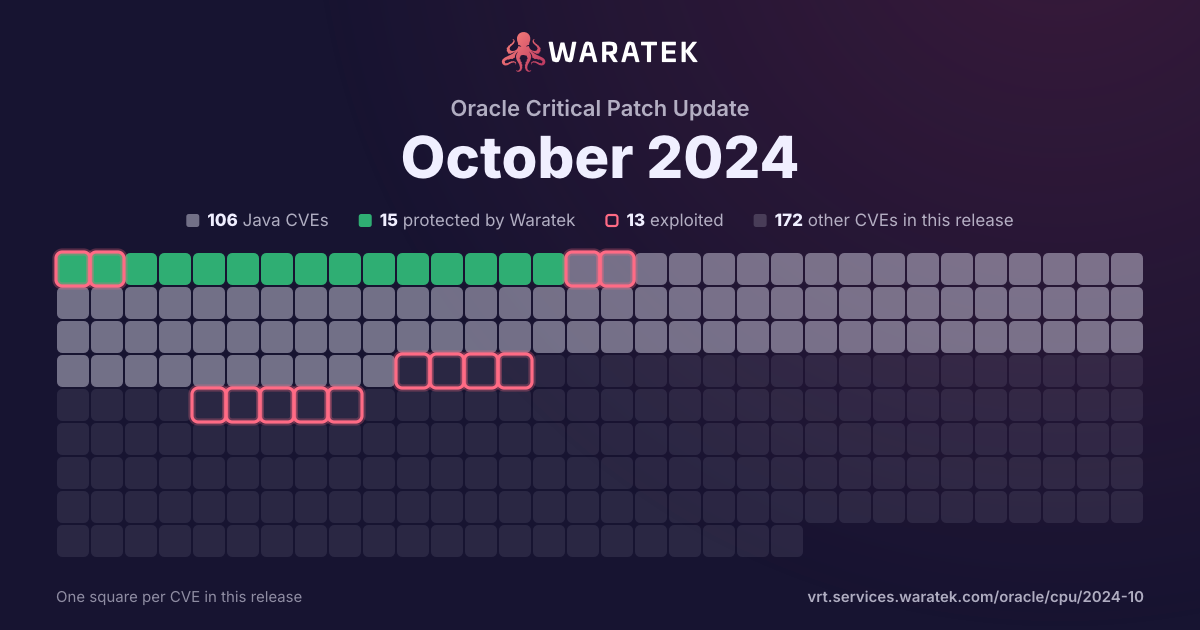
By status
14Protected by Waratek6Mitigation candidate92No exploit published4Outside Waratek scope160Not applicable2Withdrawn CVE
13Exploited, marked by the ring
No exploit published. For 44 of them, Oracle's security advisory is the source of public detail.
Protected by Waratek. Waratek RASP can block exploitation of these on systems that have not applied the patch yet.
Overview 12 matches · 1 in Waratek scope · 1 protected · 0 exploited · 0 CISA KEV · 4 public PoC · 0 EPSS ≥ 0.5
12matches
1in Waratek scope8.3%
1protected8.3%
0exploited0.0%
0CISA KEV0.0%
4public PoC33.3%
0EPSS ≥ 0.50.0%
Protected by Waratek
1
8.3%
Rule in development
0
0.0%
Mitigation candidate
0
0.0%
No exploit published
0
0.0%
Outside Waratek scope
0
0.0%
Not applicable
11
91.7%
Withdrawn CVE
0
0.0%
blocked by ARMR today
1
8.3%
partly blocked
0
0.0%
not blocked
11
91.7%
not established
0
0.0%
unrecorded
0
0.0%
Exploited
0
0.0%
Working exploit published
0
0.0%
Proof of concept only
12
100.0%
Forecast only
0
0.0%
No public exploit
0
0.0%
split by
peak 4 / month
Apr 243
Not applicable3
Critical1
High2
not blocked3
Proof of concept only3
May 241
Not applicable1
High1
not blocked1
Proof of concept only1
Jun 243
Not applicable3
High1
Medium2
not blocked3
Proof of concept only3
Jul 244
Not applicable4
Critical1
High2
Medium1
not blocked4
Proof of concept only4
Aug 241
Protected by Waratek1
High1
blocked by ARMR today1
Proof of concept only1
Apr 24May 24Jun 24Jul 24Aug 24
| CVE | Severity | Published▾ | Status | Exploitation | Description |
|---|---|---|---|---|---|
| CVE-2024-43044 | High | 2024-08-07 | Protected by Waratek | Proof of concept only | Jenkins 2.470 and earlier, LTS 2.452.3 and earlier allows agent processes to read arbitrary files from the Jenkins controller file system by using the `ClassLoaderProxy#fetchJar` method in the Remoting library. |
| CVE-2024-41817 | High | 2024-07-29 | Not applicable | Proof of concept only | ImageMagick is a free and open-source software suite, used for editing and manipulating digital images. The `AppImage` version `ImageMagick` might use an empty path when setting `MAGICK_CONFIGURE_PATH` and `LD_LIBRARY_PATH` environment variables while executing, which might lead to arbitrary code execution by loading malicious configuration files or shared libraries in the current working directory while executing `ImageMagick`. The vulnerability is fixed in 7.11-36. |
| CVE-2024-40725 | Medium | 2024-07-18 | Not applicable | Proof of concept only | A partial fix for CVE-2024-39884 in the core of Apache HTTP Server 2.4.61 ignores some use of the legacy content-type based configuration of handlers. "AddType" and similar configuration, under some circumstances where files are requested indirectly, result in source code disclosure of local content. For example, PHP scripts may be served instead of interpreted. Users are recommended to upgrade to version 2.4.62, which fixes this issue. |
| CVE-2024-6345 | High | 2024-07-15 | Not applicable | Proof of concept only | A vulnerability in the package_index module of pypa/setuptools versions up to 69.1.1 allows for remote code execution via its download functions. These functions, which are used to download packages from URLs provided by users or retrieved from package index servers, are susceptible to code injection. If these functions are exposed to user-controlled inputs, such as package URLs, they can execute arbitrary commands on the system. The issue is fixed in version 70.0. |
| CVE-2024-38999 | Critical | 2024-07-01 | Not applicable | Proof of concept only | jrburke requirejs v2.3.6 was discovered to contain a prototype pollution via the function s.contexts._.configure. This vulnerability allows attackers to execute arbitrary code or cause a Denial of Service (DoS) via injecting arbitrary properties. |
| CVE-2024-5585 | High | 2024-06-09 | Not applicable | Proof of concept only | In PHP versions 8.1.* before 8.1.29, 8.2.* before 8.2.20, 8.3.* before 8.3.8, the fix for CVE-2024-1874 does not work if the command name includes trailing spaces. Original issue: when using proc_open() command with array syntax, due to insufficient escaping, if the arguments of the executed command are controlled by a malicious user, the user can supply arguments that would execute arbitrary commands in Windows shell. |
| CVE-2024-5458 | Medium | 2024-06-09 | Not applicable | Proof of concept only | In PHP versions 8.1.* before 8.1.29, 8.2.* before 8.2.20, 8.3.* before 8.3.8, due to a code logic error, filtering functions such as filter_var when validating URLs (FILTER_VALIDATE_URL) for certain types of URLs the function will result in invalid user information (username + password part of URLs) being treated as valid user information. This may lead to the downstream code accepting invalid URLs as valid and parsing them incorrectly. |
| CVE-2024-2408 | Medium | 2024-06-09 | Not applicable | Proof of concept only | The openssl_private_decrypt function in PHP, when using PKCS1 padding (OPENSSL_PKCS1_PADDING, which is the default), is vulnerable to the Marvin Attack unless it is used with an OpenSSL version that includes the changes from this pull request: https://github.com/openssl/openssl/pull/13817 (rsa_pkcs1_implicit_rejection). These changes are part of OpenSSL 3.2 and have also been backported to stable versions of various Linux distributions, as well as to the PHP builds provided for Windows since the previous release. All distributors and builders should ensure that this version is used to prevent PHP from being vulnerable. PHP Windows builds for the versions 8.1.29, 8.2.20 and 8.3.8 and above include OpenSSL patches that fix the vulnerability. |
| CVE-2024-36052 | High | 2024-05-21 | Not applicable | Proof of concept only | RARLAB WinRAR before 7.00, on Windows, allows attackers to spoof the screen output via ANSI escape sequences, a different issue than CVE-2024-33899. |
| CVE-2024-33899 | High | 2024-04-29 | Not applicable | Proof of concept only | RARLAB WinRAR before 7.00, on Linux and UNIX platforms, allows attackers to spoof the screen output, or cause a denial of service, via ANSI escape sequences. |
| CVE-2024-1874 | Critical | 2024-04-29 | Not applicable | Proof of concept only | In PHP versions 8.1.* before 8.1.28, 8.2.* before 8.2.18, 8.3.* before 8.3.5, when using proc_open() command with array syntax, due to insufficient escaping, if the arguments of the executed command are controlled by a malicious user, the user can supply arguments that would execute arbitrary commands in Windows shell. |
| CVE-2023-45288 | High | 2024-04-04 | Not applicable | Proof of concept only | An attacker may cause an HTTP/2 endpoint to read arbitrary amounts of header data by sending an excessive number of CONTINUATION frames. Maintaining HPACK state requires parsing and processing all HEADERS and CONTINUATION frames on a connection. When a request's headers exceed MaxHeaderBytes, no memory is allocated to store the excess headers, but they are still parsed. This permits an attacker to cause an HTTP/2 endpoint to read arbitrary amounts of header data, all associated with a request which is going to be rejected. These headers can include Huffman-encoded data which is significantly more expensive for the receiver to decode than for an attacker to send. The fix sets a limit on the amount of excess header frames we will process before closing a connection. |