
Oracle Critical Patch Update October 2024
Released October 2024 · Oracle's advisory ↗ · ← Critical Patch Update, July 2024 · Critical Patch Update, January 2025 →
278 CVEs in this release, one square each
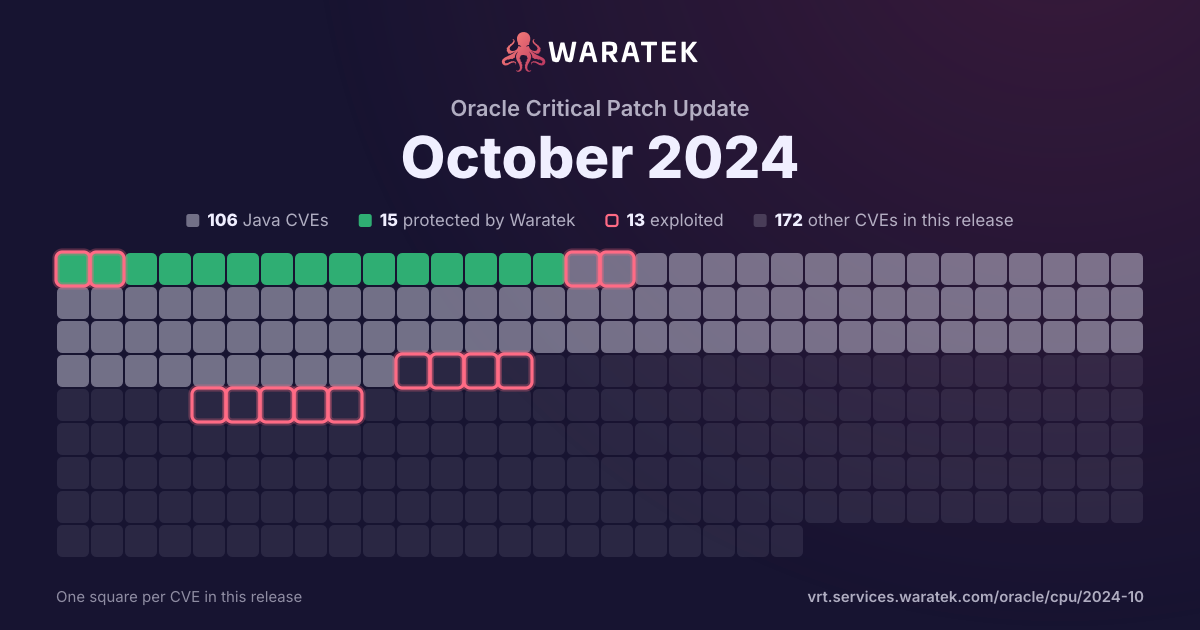
By status
15Protected by Waratek6Mitigation candidate93No exploit published4Outside Waratek scope158Not applicable2Withdrawn CVE
13Exploited, marked by the ring
No exploit published. For 50 of them, Oracle's security advisory is the source of public detail.
Protected by Waratek. Waratek RASP can block exploitation of these on systems that have not applied the patch yet.
Overview 11 matches · 4 in Waratek scope · 2 protected · 0 exploited · 0 CISA KEV · 4 EPSS ≥ 0.5
Protected by Waratek
2
18.2%
Rule in development
0
0.0%
Mitigation candidate
2
18.2%
No exploit published
0
0.0%
Outside Waratek scope
0
0.0%
Not applicable
7
63.6%
Withdrawn CVE
0
0.0%
blocked by ARMR today
2
18.2%
partly blocked
0
0.0%
not blocked
9
81.8%
not established
0
0.0%
unrecorded
0
0.0%
Exploited
0
0.0%
Working exploit published
0
0.0%
Proof of concept only
11
100.0%
Forecast only
0
0.0%
No public exploit
0
0.0%
split by
peak 3 / quarter
Q3 201
Not applicable1
High1
not blocked1
Proof of concept only1
Q4 200
Q1 210
Q2 210
Q3 210
Q4 211
Mitigation candidate1
Medium1
not blocked1
Proof of concept only1
Q1 221
Protected by Waratek1
Critical1
blocked by ARMR today1
Proof of concept only1
Q2 221
Not applicable1
Critical1
not blocked1
Proof of concept only1
Q3 220
Q4 220
Q1 230
Q2 230
Q3 230
Q4 232
Not applicable2
Critical1
Medium1
not blocked2
Proof of concept only2
Q1 241
Mitigation candidate1
High1
not blocked1
Proof of concept only1
Q2 241
Not applicable1
High1
not blocked1
Proof of concept only1
Q3 243
Protected by Waratek1
Not applicable2
High2
Medium1
blocked by ARMR today1
not blocked2
Proof of concept only3
Q3 20Q1 21Q3 21Q1 22Q3 22Q1 23Q3 23Q1 24Q3 24
| CVE | Severity | Published▾ | Status | Exploitation | Description |
|---|---|---|---|---|---|
| CVE-2024-43044 | High | 2024-08-07 | Protected by Waratek | Proof of concept only | Jenkins 2.470 and earlier, LTS 2.452.3 and earlier allows agent processes to read arbitrary files from the Jenkins controller file system by using the `ClassLoaderProxy#fetchJar` method in the Remoting library. |
| CVE-2024-41817 | High | 2024-07-29 | Not applicable | Proof of concept only | ImageMagick is a free and open-source software suite, used for editing and manipulating digital images. The `AppImage` version `ImageMagick` might use an empty path when setting `MAGICK_CONFIGURE_PATH` and `LD_LIBRARY_PATH` environment variables while executing, which might lead to arbitrary code execution by loading malicious configuration files or shared libraries in the current working directory while executing `ImageMagick`. The vulnerability is fixed in 7.11-36. |
| CVE-2024-40725 | Medium | 2024-07-18 | Not applicable | Proof of concept only | A partial fix for CVE-2024-39884 in the core of Apache HTTP Server 2.4.61 ignores some use of the legacy content-type based configuration of handlers. "AddType" and similar configuration, under some circumstances where files are requested indirectly, result in source code disclosure of local content. For example, PHP scripts may be served instead of interpreted. Users are recommended to upgrade to version 2.4.62, which fixes this issue. |
| CVE-2023-45288 | High | 2024-04-04 | Not applicable | Proof of concept only | An attacker may cause an HTTP/2 endpoint to read arbitrary amounts of header data by sending an excessive number of CONTINUATION frames. Maintaining HPACK state requires parsing and processing all HEADERS and CONTINUATION frames on a connection. When a request's headers exceed MaxHeaderBytes, no memory is allocated to store the excess headers, but they are still parsed. This permits an attacker to cause an HTTP/2 endpoint to read arbitrary amounts of header data, all associated with a request which is going to be rejected. These headers can include Huffman-encoded data which is significantly more expensive for the receiver to decode than for an attacker to send. The fix sets a limit on the amount of excess header frames we will process before closing a connection. |
| CVE-2024-24549 | High | 2024-03-13 | Mitigation candidate | Proof of concept only | Denial of Service due to improper input validation vulnerability for HTTP/2 requests in Apache Tomcat. When processing an HTTP/2 request, if the request exceeded any of the configured limits for headers, the associated HTTP/2 stream was not reset until after all of the headers had been processed.This issue affects Apache Tomcat: from 11.0.0-M1 through 11.0.0-M16, from 10.1.0-M1 through 10.1.18, from 9.0.0-M1 through 9.0.85, from 8.5.0 through 8.5.98. Other, older, EOL versions may also be affected. Users are recommended to upgrade to version 11.0.0-M17, 10.1.19, 9.0.86 or 8.5.99 which fix the issue. |
| CVE-2023-51385 | Medium | 2023-12-18 | Not applicable | Proof of concept only | In ssh in OpenSSH before 9.6, OS command injection might occur if a user name or host name has shell metacharacters, and this name is referenced by an expansion token in certain situations. For example, an untrusted Git repository can have a submodule with shell metacharacters in a user name or host name. |
| CVE-2023-38545 | Critical | 2023-10-18 | Not applicable | Proof of concept only | This flaw makes curl overflow a heap based buffer in the SOCKS5 proxy handshake. When curl is asked to pass along the host name to the SOCKS5 proxy to allow that to resolve the address instead of it getting done by curl itself, the maximum length that host name can be is 255 bytes. If the host name is detected to be longer, curl switches to local name resolving and instead passes on the resolved address only. Due to this bug, the local variable that means "let the host resolve the name" could get the wrong value during a slow SOCKS5 handshake, and contrary to the intention, copy the too long host name to the target buffer instead of copying just the resolved address there. The target buffer being a heap based buffer, and the host name coming from the URL that curl has been told to operate with. |
| CVE-2022-1292 | Critical | 2022-05-03 | Not applicable | Proof of concept only | The c_rehash script does not properly sanitise shell metacharacters to prevent command injection. This script is distributed by some operating systems in a manner where it is automatically executed. On such operating systems, an attacker could execute arbitrary commands with the privileges of the script. Use of the c_rehash script is considered obsolete and should be replaced by the OpenSSL rehash command line tool. Fixed in OpenSSL 3.0.3 (Affected 3.0.0,3.0.1,3.0.2). Fixed in OpenSSL 1.1.1o (Affected 1.1.1-1.1.1n). Fixed in OpenSSL 1.0.2ze (Affected 1.0.2-1.0.2zd). |
| CVE-2022-23305 | Critical | 2022-01-18 | Protected by Waratek | Proof of concept only | By design, the JDBCAppender in Log4j 1.2.x accepts an SQL statement as a configuration parameter where the values to be inserted are converters from PatternLayout. The message converter, %m, is likely to always be included. This allows attackers to manipulate the SQL by entering crafted strings into input fields or headers of an application that are logged allowing unintended SQL queries to be executed. Note this issue only affects Log4j 1.x when specifically configured to use the JDBCAppender, which is not the default. Beginning in version 2.0-beta8, the JDBCAppender was re-introduced with proper support for parameterized SQL queries and further customization over the columns written to in logs. Apache Log4j 1.2 reached end of life in August 2015. Users should upgrade to Log4j 2 as it addresses numerous other issues from the previous versions. |
| CVE-2021-41184 | Medium | 2021-10-26 | Mitigation candidate | Proof of concept only | jQuery-UI is the official jQuery user interface library. Prior to version 1.13.0, accepting the value of the `of` option of the `.position()` util from untrusted sources may execute untrusted code. The issue is fixed in jQuery UI 1.13.0. Any string value passed to the `of` option is now treated as a CSS selector. A workaround is to not accept the value of the `of` option from untrusted sources. |
| CVE-2020-15778 | High | 2020-07-24 | Not applicable | Proof of concept only | scp in OpenSSH through 8.3p1 allows command injection in the scp.c toremote function, as demonstrated by backtick characters in the destination argument. NOTE: the vendor reportedly has stated that they intentionally omit validation of "anomalous argument transfers" because that could "stand a great chance of breaking existing workflows." |