
Oracle Critical Patch Update October 2024
Released October 2024 · Oracle's advisory ↗ · ← Critical Patch Update, July 2024 · Critical Patch Update, January 2025 →
278 CVEs in this release, one square each
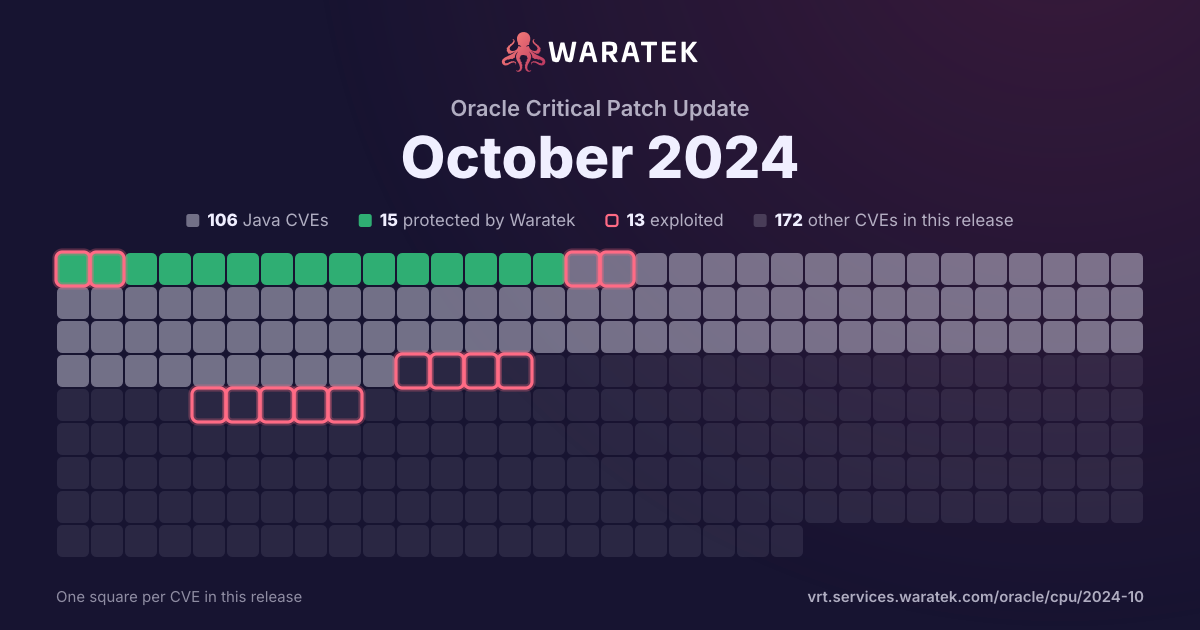
By status
14Protected by Waratek2Mitigation candidate90No exploit published4Outside Waratek scope166Not applicable2Withdrawn CVE
13Exploited, marked by the ring
No exploit published. For 44 of them, Oracle's security advisory is the source of public detail.
Protected by Waratek. Waratek RASP can block exploitation of these on systems that have not applied the patch yet.
Overview 7 matches · 0 protected · 0 exploited · 0 CISA KEV · 0 public PoC · 0 EPSS ≥ 0.5
7matches
0protected0.0%
0exploited0.0%
0CISA KEV0.0%
0public PoC0.0%
0EPSS ≥ 0.50.0%
Protected by Waratek
0
0.0%
Rule in development
0
0.0%
Mitigation candidate
0
0.0%
No exploit published
7
100.0%
blocked by ARMR today
0
0.0%
partly blocked
0
0.0%
not blocked
7
100.0%
not established
0
0.0%
unrecorded
0
0.0%
Exploited
0
0.0%
Working exploit published
0
0.0%
Proof of concept only
0
0.0%
Forecast only
0
0.0%
No public exploit
7
100.0%
| CVE | Severity | Published▾ | Status | Exploitation | Description |
|---|---|---|---|---|---|
| CVE-2024-21285 | High | 2024-10-15 | No exploit published | No public exploit | Vulnerability in the Oracle Banking Liquidity Management product of Oracle Financial Services Applications (component: Reports). The supported version that is affected is 14.5.0.12.0. Difficult to exploit vulnerability allows low privileged attacker with network access via HTTP to compromise Oracle Banking Liquidity Management. Successful attacks require human interaction from a person other than the attacker. Successful attacks of this vulnerability can result in takeover of Oracle Banking Liquidity Management. CVSS 3.1 Base Score 7.1 (Confidentiality, Integrity and Availability impacts). CVSS Vector: (CVSS:3.1/AV:N/AC:H/PR:L/UI:R/S:U/C:H/I:H/A:H). |
| CVE-2024-21284 | High | 2024-10-15 | No exploit published | No public exploit | Vulnerability in the Oracle Banking Liquidity Management product of Oracle Financial Services Applications (component: Reports). The supported version that is affected is 14.5.0.12.0. Difficult to exploit vulnerability allows low privileged attacker with network access via HTTP to compromise Oracle Banking Liquidity Management. Successful attacks require human interaction from a person other than the attacker. Successful attacks of this vulnerability can result in takeover of Oracle Banking Liquidity Management. CVSS 3.1 Base Score 7.1 (Confidentiality, Integrity and Availability impacts). CVSS Vector: (CVSS:3.1/AV:N/AC:H/PR:L/UI:R/S:U/C:H/I:H/A:H). |
| CVE-2024-21281 | Medium | 2024-10-15 | No exploit published | No public exploit | Vulnerability in the Oracle Banking Liquidity Management product of Oracle Financial Services Applications (component: Infrastructure). The supported version that is affected is 14.7.0.6.0. Difficult to exploit vulnerability allows high privileged attacker with network access via HTTP to compromise Oracle Banking Liquidity Management. Successful attacks require human interaction from a person other than the attacker. Successful attacks of this vulnerability can result in unauthorized creation, deletion or modification access to critical data or all Oracle Banking Liquidity Management accessible data as well as unauthorized read access to a subset of Oracle Banking Liquidity Management accessible data and unauthorized ability to cause a partial denial of service (partial DOS) of Oracle Banking Liquidity Management. CVSS 3.1 Base Score 5.3 (Confidentiality, Integrity and Availability impacts). CVSS Vector: (CVSS:3.1/AV:N/AC:H/PR:H/UI:R/S:U/C:L/I:H/A:L). |
| CVE-2024-7254 | High | 2024-09-19 | No exploit published | No public exploit | Any project that parses untrusted Protocol Buffers data containing an arbitrary number of nested groups / series of SGROUP tags can corrupted by exceeding the stack limit i.e. StackOverflow. Parsing nested groups as unknown fields with DiscardUnknownFieldsParser or Java Protobuf Lite parser, or against Protobuf map fields, creates unbounded recursions that can be abused by an attacker. |
| CVE-2024-41172 | High | 2024-07-19 | No exploit published | No public exploit | In versions of Apache CXF before 3.6.4 and 4.0.5 (3.5.x and lower versions are not impacted), a CXF HTTP client conduit may prevent HTTPClient instances from being garbage collected and it is possible that memory consumption will continue to increase, eventually causing the application to run out of memory |
| CVE-2024-32007 | High | 2024-07-19 | No exploit published | No public exploit | An improper input validation of the p2c parameter in the Apache CXF JOSE code before 4.0.5, 3.6.4 and 3.5.9 allows an attacker to perform a denial of service attack by specifying a large value for this parameter in a token. |
| CVE-2024-34750 | High | 2024-07-03 | No exploit published | No public exploit | Improper Handling of Exceptional Conditions, Uncontrolled Resource Consumption vulnerability in Apache Tomcat. When processing an HTTP/2 stream, Tomcat did not handle some cases of excessive HTTP headers correctly. This led to a miscounting of active HTTP/2 streams which in turn led to the use of an incorrect infinite timeout which allowed connections to remain open which should have been closed. This issue affects Apache Tomcat: from 11.0.0-M1 through 11.0.0-M20, from 10.1.0-M1 through 10.1.24, from 9.0.0-M1 through 9.0.89. The following versions were EOL at the time the CVE was created but are known to be affected: 8.5.0 though 8.5.100. Other EOL versions may also be affected. Users are recommended to upgrade to version 11.0.0-M21, 10.1.25 or 9.0.90, which fixes the issue. |