
Oracle Critical Patch Update October 2024
Released October 2024 · Oracle's advisory ↗ · ← Critical Patch Update, July 2024 · Critical Patch Update, January 2025 →
278 CVEs in this release, one square each
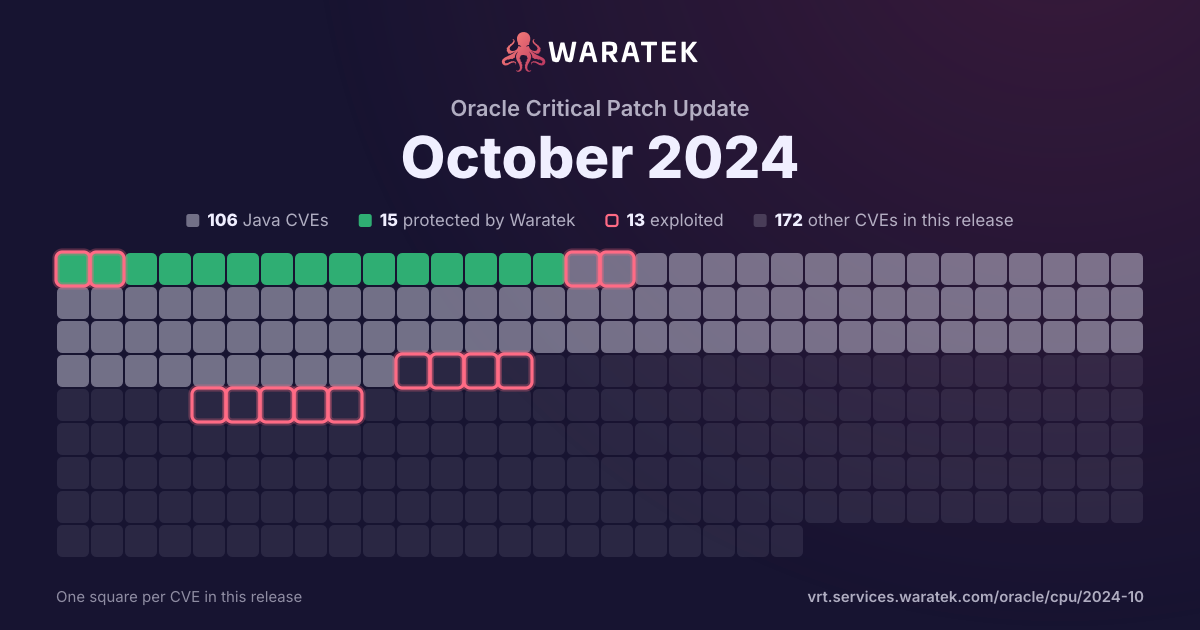
By status
14Protected by Waratek2Mitigation candidate90No exploit published4Outside Waratek scope166Not applicable2Withdrawn CVE
13Exploited, marked by the ring
No exploit published. For 44 of them, Oracle's security advisory is the source of public detail.
Protected by Waratek. Waratek RASP can block exploitation of these on systems that have not applied the patch yet.
Overview 3 matches · 0 protected · 0 exploited · 0 CISA KEV · 0 public PoC · 0 EPSS ≥ 0.5
3matches
0protected0.0%
0exploited0.0%
0CISA KEV0.0%
0public PoC0.0%
0EPSS ≥ 0.50.0%
Protected by Waratek
0
0.0%
Rule in development
0
0.0%
Mitigation candidate
0
0.0%
No exploit published
3
100.0%
blocked by ARMR today
0
0.0%
partly blocked
0
0.0%
not blocked
3
100.0%
not established
0
0.0%
unrecorded
0
0.0%
Exploited
0
0.0%
Working exploit published
0
0.0%
Proof of concept only
0
0.0%
Forecast only
0
0.0%
No public exploit
3
100.0%
split by
peak 2 / month
Aug 24Sep 24
| CVE | Severity | Published▾ | Status | Exploitation | Description |
|---|---|---|---|---|---|
| CVE-2024-7254 | High | 2024-09-19 | No exploit published | No public exploit | Any project that parses untrusted Protocol Buffers data containing an arbitrary number of nested groups / series of SGROUP tags can corrupted by exceeding the stack limit i.e. StackOverflow. Parsing nested groups as unknown fields with DiscardUnknownFieldsParser or Java Protobuf Lite parser, or against Protobuf map fields, creates unbounded recursions that can be abused by an attacker. |
| CVE-2024-7885 | High | 2024-08-21 | No exploit published | No public exploit | A vulnerability was found in Undertow where the ProxyProtocolReadListener reuses the same StringBuilder instance across multiple requests. This issue occurs when the parseProxyProtocolV1 method processes multiple requests on the same HTTP connection. As a result, different requests may share the same StringBuilder instance, potentially leading to information leakage between requests or responses. In some cases, a value from a previous request or response may be erroneously reused, which could lead to unintended data exposure. This issue primarily results in errors and connection termination but creates a risk of data leakage in multi-request environments. |
| CVE-2024-43045 | Medium | 2024-08-07 | No exploit published | No public exploit | Jenkins 2.470 and earlier, LTS 2.452.3 and earlier does not perform a permission check in an HTTP endpoint, allowing attackers with Overall/Read permission to access other users' "My Views". |