
Oracle Critical Patch Update October 2024
Released October 2024 · Oracle's advisory ↗ · ← Critical Patch Update, July 2024 · Critical Patch Update, January 2025 →
278 CVEs in this release, one square each
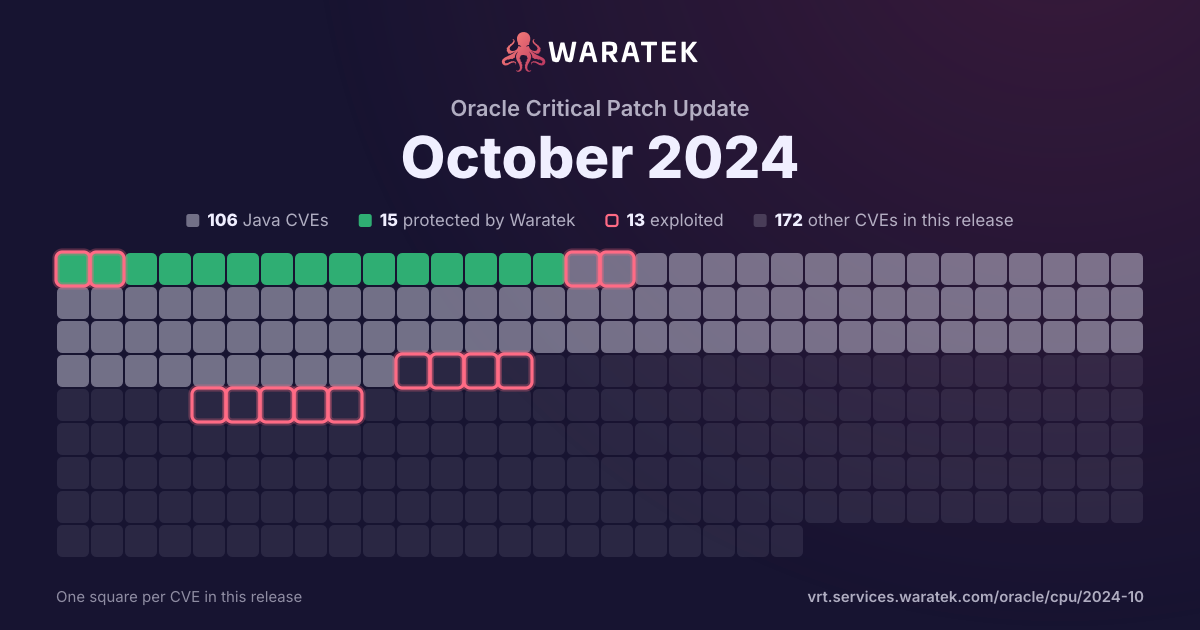
By status
15Protected by Waratek3Mitigation candidate88No exploit published26Outside Waratek scope144Not applicable2Withdrawn CVE
13Exploited, marked by the ring
No exploit published. For 51 of them, Oracle's security advisory is the source of public detail.
Protected by Waratek. Waratek RASP can block exploitation of these on systems that have not applied the patch yet.
Overview 9 matches · 3 in Waratek scope · 2 protected · 3 exploited · 1 CISA KEV · 5 public PoC
Protected by Waratek
2
22.2%
Rule in development
0
0.0%
Mitigation candidate
1
11.1%
No exploit published
0
0.0%
Outside Waratek scope
2
22.2%
Not applicable
4
44.4%
Withdrawn CVE
0
0.0%
blocked by ARMR today
2
22.2%
partly blocked
0
0.0%
not blocked
7
77.8%
not established
0
0.0%
unrecorded
0
0.0%
Exploited
3
33.3%
Working exploit published
1
11.1%
Proof of concept only
1
11.1%
Forecast only
4
44.4%
No public exploit
0
0.0%
split by
peak 3 / quarter
Q1 222
Protected by Waratek2
High2
blocked by ARMR today2
Forecast only2
Q2 220
Q3 220
Q4 220
Q1 231
Not applicable1
High1
not blocked1
Forecast only1
Q2 230
Q3 230
Q4 231
Mitigation candidate1
High1
not blocked1
Exploited1
Q1 240
Q2 242
Outside Waratek scope1
Not applicable1
High2
not blocked2
Exploited1
Proof of concept only1
Q3 243
Outside Waratek scope1
Not applicable2
High3
not blocked3
Exploited1
Working exploit published1
Forecast only1
Q1 22Q2 22Q3 22Q4 22Q1 23Q2 23Q3 23Q4 23Q1 24Q2 24Q3 24
| CVE | Severity | Published▾ | Status | Exploitation | Description |
|---|---|---|---|---|---|
| CVE-2024-6119 | High | 2024-09-03 | Outside Waratek scope | Forecast only | Issue summary: Applications performing certificate name checks (e.g., TLS clients checking server certificates) may attempt to read an invalid memory address resulting in abnormal termination of the application process. Impact summary: Abnormal termination of an application can a cause a denial of service. Applications performing certificate name checks (e.g., TLS clients checking server certificates) may attempt to read an invalid memory address when comparing the expected name with an `otherName` subject alternative name of an X.509 certificate. This may result in an exception that terminates the application program. Note that basic certificate chain validation (signatures, dates, ...) is not affected, the denial of service can occur only when the application also specifies an expected DNS name, Email address or IP address. TLS servers rarely solicit client certificates, and even when they do, they generally don't perform a name check against a reference identifier (expected identity), but rather extract the presented identity after checking the certificate chain. So TLS servers are generally not affected and the severity of the issue is Moderate. The FIPS modules in 3.3, 3.2, 3.1 and 3.0 are not affected by this issue. |
| CVE-2024-6387 | High | 2024-07-01 | Not applicable | Exploited | A security regression (CVE-2006-5051) was discovered in OpenSSH's server (sshd). There is a race condition which can lead sshd to handle some signals in an unsafe manner. An unauthenticated, remote attacker may be able to trigger it by failing to authenticate within a set time period. |
| CVE-2024-38472 | High | 2024-07-01 | Not applicable | Working exploit published | SSRF in Apache HTTP Server on Windows allows to potentially leak NTLM hashes to a malicious server via SSRF and malicious requests or content Users are recommended to upgrade to version 2.4.60 which fixes this issue. Note: Existing configurations that access UNC paths will have to configure new directive "UNCList" to allow access during request processing. |
| CVE-2024-2961 | High | 2024-04-17 | Outside Waratek scope | Exploited | The iconv() function in the GNU C Library versions 2.39 and older may overflow the output buffer passed to it by up to 4 bytes when converting strings to the ISO-2022-CN-EXT character set, which may be used to crash an application or overwrite a neighbouring variable. |
| CVE-2023-45288 | High | 2024-04-04 | Not applicable | Proof of concept only | An attacker may cause an HTTP/2 endpoint to read arbitrary amounts of header data by sending an excessive number of CONTINUATION frames. Maintaining HPACK state requires parsing and processing all HEADERS and CONTINUATION frames on a connection. When a request's headers exceed MaxHeaderBytes, no memory is allocated to store the excess headers, but they are still parsed. This permits an attacker to cause an HTTP/2 endpoint to read arbitrary amounts of header data, all associated with a request which is going to be rejected. These headers can include Huffman-encoded data which is significantly more expensive for the receiver to decode than for an attacker to send. The fix sets a limit on the amount of excess header frames we will process before closing a connection. |
| CVE-2023-44487 | High | 2023-10-10 | Mitigation candidate | Exploited | The HTTP/2 protocol allows a denial of service (server resource consumption) because request cancellation can reset many streams quickly, as exploited in the wild in August through October 2023. |
| CVE-2023-0286 | High | 2023-02-08 | Not applicable | Forecast only | There is a type confusion vulnerability relating to X.400 address processing inside an X.509 GeneralName. X.400 addresses were parsed as an ASN1_STRING but the public structure definition for GENERAL_NAME incorrectly specified the type of the x400Address field as ASN1_TYPE. This field is subsequently interpreted by the OpenSSL function GENERAL_NAME_cmp as an ASN1_TYPE rather than an ASN1_STRING. When CRL checking is enabled (i.e. the application sets the X509_V_FLAG_CRL_CHECK flag), this vulnerability may allow an attacker to pass arbitrary pointers to a memcmp call, enabling them to read memory contents or enact a denial of service. In most cases, the attack requires the attacker to provide both the certificate chain and CRL, neither of which need to have a valid signature. If the attacker only controls one of these inputs, the other input must already contain an X.400 address as a CRL distribution point, which is uncommon. As such, this vulnerability is most likely to only affect applications which have implemented their own functionality for retrieving CRLs over a network. |
| CVE-2022-23307 | High | 2022-01-18 | Protected by Waratek | Forecast only | CVE-2020-9493 identified a deserialization issue that was present in Apache Chainsaw. Prior to Chainsaw V2.0 Chainsaw was a component of Apache Log4j 1.2.x where the same issue exists. |
| CVE-2022-23302 | High | 2022-01-18 | Protected by Waratek | Forecast only | JMSSink in all versions of Log4j 1.x is vulnerable to deserialization of untrusted data when the attacker has write access to the Log4j configuration or if the configuration references an LDAP service the attacker has access to. The attacker can provide a TopicConnectionFactoryBindingName configuration causing JMSSink to perform JNDI requests that result in remote code execution in a similar fashion to CVE-2021-4104. Note this issue only affects Log4j 1.x when specifically configured to use JMSSink, which is not the default. Apache Log4j 1.2 reached end of life in August 2015. Users should upgrade to Log4j 2 as it addresses numerous other issues from the previous versions. |