
Oracle Critical Patch Update October 2024
Released October 2024 · Oracle's advisory ↗ · ← Critical Patch Update, July 2024 · Critical Patch Update, January 2025 →
278 CVEs in this release, one square each
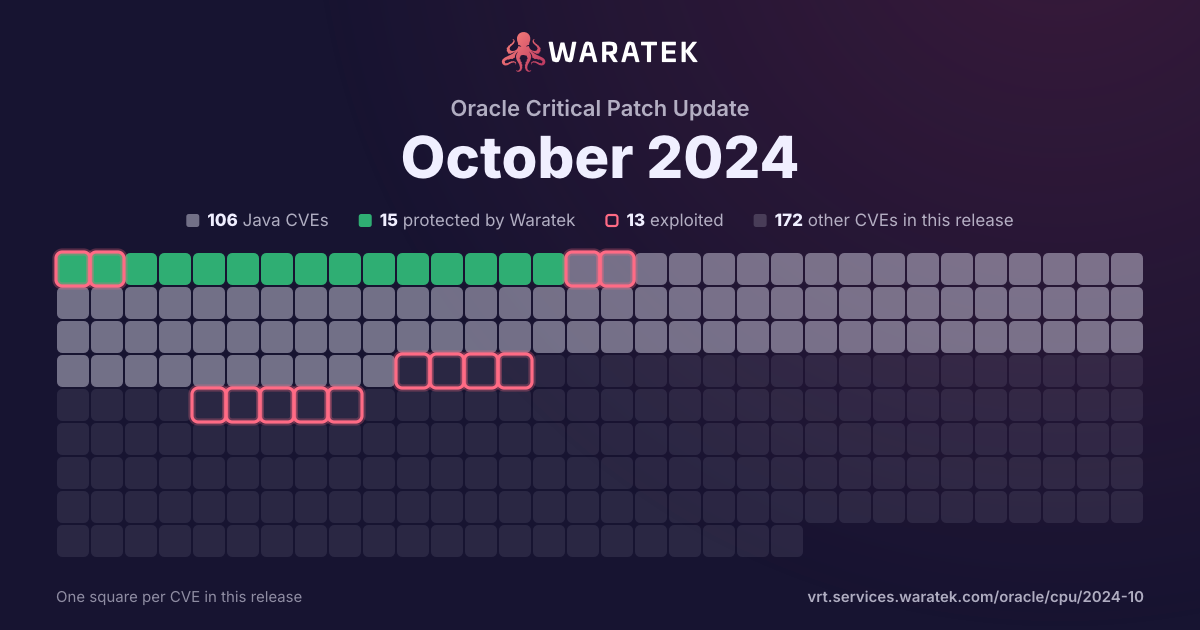
By status
15Protected by Waratek3Mitigation candidate88No exploit published26Outside Waratek scope144Not applicable2Withdrawn CVE
13Exploited, marked by the ring
No exploit published. For 51 of them, Oracle's security advisory is the source of public detail.
Protected by Waratek. Waratek RASP can block exploitation of these on systems that have not applied the patch yet.
Overview 26 matches · 0 in Waratek scope · 0 protected · 4 exploited · 1 CISA KEV · 8 public PoC · 9 EPSS ≥ 0.5
26matches
0in Waratek scope0.0%
0protected0.0%
4exploited15.4%
1CISA KEV3.8%
8public PoC30.8%
9EPSS ≥ 0.534.6%
Protected by Waratek
0
0.0%
Rule in development
0
0.0%
Mitigation candidate
0
0.0%
No exploit published
0
0.0%
Outside Waratek scope
26
100.0%
Not applicable
0
0.0%
Withdrawn CVE
0
0.0%
blocked by ARMR today
0
0.0%
partly blocked
0
0.0%
not blocked
26
100.0%
not established
0
0.0%
unrecorded
0
0.0%
Exploited
4
15.4%
Working exploit published
0
0.0%
Proof of concept only
6
23.1%
Forecast only
2
7.7%
No public exploit
14
53.8%
split by
peak 6 / quarter
Q2 203
Outside Waratek scope3
Medium3
not blocked3
Exploited2
No public exploit1
Q3 201
Outside Waratek scope1
High1
not blocked1
Proof of concept only1
Q4 201
Outside Waratek scope1
Medium1
not blocked1
No public exploit1
Q1 210
Q2 211
Outside Waratek scope1
Medium1
not blocked1
No public exploit1
Q3 210
Q4 214
Outside Waratek scope4
High1
Medium3
not blocked4
Proof of concept only1
No public exploit3
Q1 220
Q2 222
Outside Waratek scope2
Critical2
not blocked2
Proof of concept only2
Q3 221
Outside Waratek scope1
Medium1
not blocked1
Proof of concept only1
Q4 220
Q1 230
Q2 231
Outside Waratek scope1
High1
not blocked1
No public exploit1
Q3 230
Q4 232
Outside Waratek scope2
Critical1
Medium1
not blocked2
Exploited1
Proof of concept only1
Q1 241
Outside Waratek scope1
High1
not blocked1
No public exploit1
Q2 246
Outside Waratek scope6
Critical1
High2
Medium3
not blocked6
Exploited1
Forecast only1
No public exploit4
Q3 241
Outside Waratek scope1
High1
not blocked1
Forecast only1
Q4 242
Outside Waratek scope2
Critical1
Medium1
not blocked2
No public exploit2
Q2 20Q4 20Q2 21Q4 21Q2 22Q4 22Q2 23Q4 23Q2 24Q4 24
| CVE | Severity | Published▾ | Status | Exploitation | Description |
|---|---|---|---|---|---|
| CVE-2024-4741 | Critical | 2024-11-13 | Outside Waratek scope | No public exploit | Issue summary: Calling the OpenSSL API function SSL_free_buffers may cause memory to be accessed that was previously freed in some situations Impact summary: A use after free can have a range of potential consequences such as the corruption of valid data, crashes or execution of arbitrary code. However, only applications that directly call the SSL_free_buffers function are affected by this issue. Applications that do not call this function are not vulnerable. Our investigations indicate that this function is rarely used by applications. The SSL_free_buffers function is used to free the internal OpenSSL buffer used when processing an incoming record from the network. The call is only expected to succeed if the buffer is not currently in use. However, two scenarios have been identified where the buffer is freed even when still in use. The first scenario occurs where a record header has been received from the network and processed by OpenSSL, but the full record body has not yet arrived. In this case calling SSL_free_buffers will succeed even though a record has only been partially processed and the buffer is still in use. The second scenario occurs where a full record containing application data has been received and processed by OpenSSL but the application has only read part of this data. Again a call to SSL_free_buffers will succeed even though the buffer is still in use. While these scenarios could occur accidentally during normal operation a malicious attacker could attempt to engineer a stituation where this occurs. We are not aware of this issue being actively exploited. The FIPS modules in 3.3, 3.2, 3.1 and 3.0 are not affected by this issue. |
| CVE-2024-21262 | Medium | 2024-10-15 | Outside Waratek scope | No public exploit | Vulnerability in the MySQL Connectors product of Oracle MySQL (component: Connector/ODBC). Supported versions that are affected are 9.0.0 and prior. Easily exploitable vulnerability allows unauthenticated attacker with network access via multiple protocols to compromise MySQL Connectors. Successful attacks of this vulnerability can result in unauthorized update, insert or delete access to some of MySQL Connectors accessible data and unauthorized ability to cause a partial denial of service (partial DOS) of MySQL Connectors. CVSS 3.1 Base Score 6.5 (Integrity and Availability impacts). CVSS Vector: (CVSS:3.1/AV:N/AC:L/PR:N/UI:N/S:U/C:N/I:L/A:L). |
| CVE-2024-6119 | High | 2024-09-03 | Outside Waratek scope | Forecast only | Issue summary: Applications performing certificate name checks (e.g., TLS clients checking server certificates) may attempt to read an invalid memory address resulting in abnormal termination of the application process. Impact summary: Abnormal termination of an application can a cause a denial of service. Applications performing certificate name checks (e.g., TLS clients checking server certificates) may attempt to read an invalid memory address when comparing the expected name with an `otherName` subject alternative name of an X.509 certificate. This may result in an exception that terminates the application program. Note that basic certificate chain validation (signatures, dates, ...) is not affected, the denial of service can occur only when the application also specifies an expected DNS name, Email address or IP address. TLS servers rarely solicit client certificates, and even when they do, they generally don't perform a name check against a reference identifier (expected identity), but rather extract the presented identity after checking the certificate chain. So TLS servers are generally not affected and the severity of the issue is Moderate. The FIPS modules in 3.3, 3.2, 3.1 and 3.0 are not affected by this issue. |
| CVE-2024-5535 | Critical | 2024-06-27 | Outside Waratek scope | No public exploit | Issue summary: Calling the OpenSSL API function SSL_select_next_proto with an empty supported client protocols buffer may cause a crash or memory contents to be sent to the peer. Impact summary: A buffer overread can have a range of potential consequences such as unexpected application beahviour or a crash. In particular this issue could result in up to 255 bytes of arbitrary private data from memory being sent to the peer leading to a loss of confidentiality. However, only applications that directly call the SSL_select_next_proto function with a 0 length list of supported client protocols are affected by this issue. This would normally never be a valid scenario and is typically not under attacker control but may occur by accident in the case of a configuration or programming error in the calling application. The OpenSSL API function SSL_select_next_proto is typically used by TLS applications that support ALPN (Application Layer Protocol Negotiation) or NPN (Next Protocol Negotiation). NPN is older, was never standardised and is deprecated in favour of ALPN. We believe that ALPN is significantly more widely deployed than NPN. The SSL_select_next_proto function accepts a list of protocols from the server and a list of protocols from the client and returns the first protocol that appears in the server list that also appears in the client list. In the case of no overlap between the two lists it returns the first item in the client list. In either case it will signal whether an overlap between the two lists was found. In the case where SSL_select_next_proto is called with a zero length client list it fails to notice this condition and returns the memory immediately following the client list pointer (and reports that there was no overlap in the lists). This function is typically called from a server side application callback for ALPN or a client side application callback for NPN. In the case of ALPN the list of protocols supplied by the client is guaranteed by libssl to never be zero in length. The list of server protocols comes from the application and should never normally be expected to be of zero length. In this case if the SSL_select_next_proto function has been called as expected (with the list supplied by the client passed in the client/client_len parameters), then the application will not be vulnerable to this issue. If the application has accidentally been configured with a zero length server list, and has accidentally passed that zero length server list in the client/client_len parameters, and has additionally failed to correctly handle a "no overlap" response (which would normally result in a handshake failure in ALPN) then it will be vulnerable to this problem. In the case of NPN, the protocol permits the client to opportunistically select a protocol when there is no overlap. OpenSSL returns the first client protocol in the no overlap case in support of this. The list of client protocols comes from the application and should never normally be expected to be of zero length. However if the SSL_select_next_proto function is accidentally called with a client_len of 0 then an invalid memory pointer will be returned instead. If the application uses this output as the opportunistic protocol then the loss of confidentiality will occur. This issue has been assessed as Low severity because applications are most likely to be vulnerable if they are using NPN instead of ALPN - but NPN is not widely used. It also requires an application configuration or programming error. Finally, this issue would not typically be under attacker control making active exploitation unlikely. The FIPS modules in 3.3, 3.2, 3.1 and 3.0 are not affected by this issue. Due to the low severity of this issue we are not issuing new releases of OpenSSL at this time. The fix will be included in the next releases when they become available. |
| CVE-2024-37891 | Medium | 2024-06-17 | Outside Waratek scope | No public exploit | urllib3 is a user-friendly HTTP client library for Python. When using urllib3's proxy support with `ProxyManager`, the `Proxy-Authorization` header is only sent to the configured proxy, as expected. However, when sending HTTP requests *without* using urllib3's proxy support, it's possible to accidentally configure the `Proxy-Authorization` header even though it won't have any effect as the request is not using a forwarding proxy or a tunneling proxy. In those cases, urllib3 doesn't treat the `Proxy-Authorization` HTTP header as one carrying authentication material and thus doesn't strip the header on cross-origin redirects. Because this is a highly unlikely scenario, we believe the severity of this vulnerability is low for almost all users. Out of an abundance of caution urllib3 will automatically strip the `Proxy-Authorization` header during cross-origin redirects to avoid the small chance that users are doing this on accident. Users should use urllib3's proxy support or disable automatic redirects to achieve safe processing of the `Proxy-Authorization` header, but we still decided to strip the header by default in order to further protect users who aren't using the correct approach. We believe the number of usages affected by this advisory is low. It requires all of the following to be true to be exploited: 1. Setting the `Proxy-Authorization` header without using urllib3's built-in proxy support. 2. Not disabling HTTP redirects. 3. Either not using an HTTPS origin server or for the proxy or target origin to redirect to a malicious origin. Users are advised to update to either version 1.26.19 or version 2.2.2. Users unable to upgrade may use the `Proxy-Authorization` header with urllib3's `ProxyManager`, disable HTTP redirects using `redirects=False` when sending requests, or not user the `Proxy-Authorization` header as mitigations. |
| CVE-2024-33602 | High | 2024-05-06 | Outside Waratek scope | No public exploit | nscd: netgroup cache assumes NSS callback uses in-buffer strings The Name Service Cache Daemon's (nscd) netgroup cache can corrupt memory when the NSS callback does not store all strings in the provided buffer. The flaw was introduced in glibc 2.15 when the cache was added to nscd. This vulnerability is only present in the nscd binary. |
| CVE-2024-33600 | Medium | 2024-05-06 | Outside Waratek scope | No public exploit | nscd: Null pointer crashes after notfound response If the Name Service Cache Daemon's (nscd) cache fails to add a not-found netgroup response to the cache, the client request can result in a null pointer dereference. This flaw was introduced in glibc 2.15 when the cache was added to nscd. This vulnerability is only present in the nscd binary. |
| CVE-2024-2961 | High | 2024-04-17 | Outside Waratek scope | Exploited | The iconv() function in the GNU C Library versions 2.39 and older may overflow the output buffer passed to it by up to 4 bytes when converting strings to the ISO-2022-CN-EXT character set, which may be used to crash an application or overwrite a neighbouring variable. |
| CVE-2024-2511 | Medium | 2024-04-08 | Outside Waratek scope | Forecast only | Issue summary: Some non-default TLS server configurations can cause unbounded memory growth when processing TLSv1.3 sessions Impact summary: An attacker may exploit certain server configurations to trigger unbounded memory growth that would lead to a Denial of Service This problem can occur in TLSv1.3 if the non-default SSL_OP_NO_TICKET option is being used (but not if early_data support is also configured and the default anti-replay protection is in use). In this case, under certain conditions, the session cache can get into an incorrect state and it will fail to flush properly as it fills. The session cache will continue to grow in an unbounded manner. A malicious client could deliberately create the scenario for this failure to force a Denial of Service. It may also happen by accident in normal operation. This issue only affects TLS servers supporting TLSv1.3. It does not affect TLS clients. The FIPS modules in 3.2, 3.1 and 3.0 are not affected by this issue. OpenSSL 1.0.2 is also not affected by this issue. |
| CVE-2024-2398 | High | 2024-03-27 | Outside Waratek scope | No public exploit | When an application tells libcurl it wants to allow HTTP/2 server push, and the amount of received headers for the push surpasses the maximum allowed limit (1000), libcurl aborts the server push. When aborting, libcurl inadvertently does not free all the previously allocated headers and instead leaks the memory. Further, this error condition fails silently and is therefore not easily detected by an application. |
| CVE-2023-48795 | Medium | 2023-12-18 | Outside Waratek scope | Exploited | The SSH transport protocol with certain OpenSSH extensions, found in OpenSSH before 9.6 and other products, allows remote attackers to bypass integrity checks such that some packets are omitted (from the extension negotiation message), and a client and server may consequently end up with a connection for which some security features have been downgraded or disabled, aka a Terrapin attack. This occurs because the SSH Binary Packet Protocol (BPP), implemented by these extensions, mishandles the handshake phase and mishandles use of sequence numbers. For example, there is an effective attack against SSH's use of ChaCha20-Poly1305 (and CBC with Encrypt-then-MAC). The bypass occurs in chacha20-poly1305@openssh.com and (if CBC is used) the -etm@openssh.com MAC algorithms. This also affects Maverick Synergy Java SSH API before 3.1.0-SNAPSHOT, Dropbear through 2022.83, Ssh before 5.1.1 in Erlang/OTP, PuTTY before 0.80, AsyncSSH before 2.14.2, golang.org/x/crypto before 0.17.0, libssh before 0.10.6, libssh2 through 1.11.0, Thorn Tech SFTP Gateway before 3.4.6, Tera Term before 5.1, Paramiko before 3.4.0, jsch before 0.2.15, SFTPGo before 2.5.6, Netgate pfSense Plus through 23.09.1, Netgate pfSense CE through 2.7.2, HPN-SSH through 18.2.0, ProFTPD before 1.3.8b (and before 1.3.9rc2), ORYX CycloneSSH before 2.3.4, NetSarang XShell 7 before Build 0144, CrushFTP before 10.6.0, ConnectBot SSH library before 2.2.22, Apache MINA sshd through 2.11.0, sshj through 0.37.0, TinySSH through 20230101, trilead-ssh2 6401, LANCOM LCOS and LANconfig, FileZilla before 3.66.4, Nova before 11.8, PKIX-SSH before 14.4, SecureCRT before 9.4.3, Transmit5 before 5.10.4, Win32-OpenSSH before 9.5.0.0p1-Beta, WinSCP before 6.2.2, Bitvise SSH Server before 9.32, Bitvise SSH Client before 9.33, KiTTY through 0.76.1.13, the net-ssh gem 7.2.0 for Ruby, the mscdex ssh2 module before 1.15.0 for Node.js, the thrussh library before 0.35.1 for Rust, and the Russh crate before 0.40.2 for Rust. |
| CVE-2023-38545 | Critical | 2023-10-18 | Outside Waratek scope | Proof of concept only | This flaw makes curl overflow a heap based buffer in the SOCKS5 proxy handshake. When curl is asked to pass along the host name to the SOCKS5 proxy to allow that to resolve the address instead of it getting done by curl itself, the maximum length that host name can be is 255 bytes. If the host name is detected to be longer, curl switches to local name resolving and instead passes on the resolved address only. Due to this bug, the local variable that means "let the host resolve the name" could get the wrong value during a slow SOCKS5 handshake, and contrary to the intention, copy the too long host name to the target buffer instead of copying just the resolved address there. The target buffer being a heap based buffer, and the host name coming from the URL that curl has been told to operate with. |
| CVE-2023-2953 | High | 2023-05-30 | Outside Waratek scope | No public exploit | A vulnerability was found in openldap. This security flaw causes a null pointer dereference in ber_memalloc_x() function. |
| CVE-2022-31160 | Medium | 2022-07-20 | Outside Waratek scope | Proof of concept only | jQuery UI is a curated set of user interface interactions, effects, widgets, and themes built on top of jQuery. Versions prior to 1.13.2 are potentially vulnerable to cross-site scripting. Initializing a checkboxradio widget on an input enclosed within a label makes that parent label contents considered as the input label. Calling `.checkboxradio( "refresh" )` on such a widget and the initial HTML contained encoded HTML entities will make them erroneously get decoded. This can lead to potentially executing JavaScript code. The bug has been patched in jQuery UI 1.13.2. To remediate the issue, someone who can change the initial HTML can wrap all the non-input contents of the `label` in a `span`. |
| CVE-2022-2068 | Critical | 2022-06-21 | Outside Waratek scope | Proof of concept only | In addition to the c_rehash shell command injection identified in CVE-2022-1292, further circumstances where the c_rehash script does not properly sanitise shell metacharacters to prevent command injection were found by code review. When the CVE-2022-1292 was fixed it was not discovered that there are other places in the script where the file names of certificates being hashed were possibly passed to a command executed through the shell. This script is distributed by some operating systems in a manner where it is automatically executed. On such operating systems, an attacker could execute arbitrary commands with the privileges of the script. Use of the c_rehash script is considered obsolete and should be replaced by the OpenSSL rehash command line tool. Fixed in OpenSSL 3.0.4 (Affected 3.0.0,3.0.1,3.0.2,3.0.3). Fixed in OpenSSL 1.1.1p (Affected 1.1.1-1.1.1o). Fixed in OpenSSL 1.0.2zf (Affected 1.0.2-1.0.2ze). |
| CVE-2022-1292 | Critical | 2022-05-03 | Outside Waratek scope | Proof of concept only | The c_rehash script does not properly sanitise shell metacharacters to prevent command injection. This script is distributed by some operating systems in a manner where it is automatically executed. On such operating systems, an attacker could execute arbitrary commands with the privileges of the script. Use of the c_rehash script is considered obsolete and should be replaced by the OpenSSL rehash command line tool. Fixed in OpenSSL 3.0.3 (Affected 3.0.0,3.0.1,3.0.2). Fixed in OpenSSL 1.1.1o (Affected 1.1.1-1.1.1n). Fixed in OpenSSL 1.0.2ze (Affected 1.0.2-1.0.2zd). |
| CVE-2021-41184 | Medium | 2021-10-26 | Outside Waratek scope | Proof of concept only | jQuery-UI is the official jQuery user interface library. Prior to version 1.13.0, accepting the value of the `of` option of the `.position()` util from untrusted sources may execute untrusted code. The issue is fixed in jQuery UI 1.13.0. Any string value passed to the `of` option is now treated as a CSS selector. A workaround is to not accept the value of the `of` option from untrusted sources. |
| CVE-2021-41183 | Medium | 2021-10-26 | Outside Waratek scope | No public exploit | jQuery-UI is the official jQuery user interface library. Prior to version 1.13.0, accepting the value of various `*Text` options of the Datepicker widget from untrusted sources may execute untrusted code. The issue is fixed in jQuery UI 1.13.0. The values passed to various `*Text` options are now always treated as pure text, not HTML. A workaround is to not accept the value of the `*Text` options from untrusted sources. |
| CVE-2021-41182 | Medium | 2021-10-26 | Outside Waratek scope | No public exploit | jQuery-UI is the official jQuery user interface library. Prior to version 1.13.0, accepting the value of the `altField` option of the Datepicker widget from untrusted sources may execute untrusted code. The issue is fixed in jQuery UI 1.13.0. Any string value passed to the `altField` option is now treated as a CSS selector. A workaround is to not accept the value of the `altField` option from untrusted sources. |
| CVE-2021-37137 | High | 2021-10-19 | Outside Waratek scope | No public exploit | The Snappy frame decoder function doesn't restrict the chunk length which may lead to excessive memory usage. Beside this it also may buffer reserved skippable chunks until the whole chunk was received which may lead to excessive memory usage as well. This vulnerability can be triggered by supplying malicious input that decompresses to a very big size (via a network stream or a file) or by sending a huge skippable chunk. |
| CVE-2021-28170 | Medium | 2021-05-26 | Outside Waratek scope | No public exploit | In the Jakarta Expression Language implementation 3.0.3 and earlier, a bug in the ELParserTokenManager enables invalid EL expressions to be evaluated as if they were valid. |
| CVE-2020-13956 | Medium | 2020-12-02 | Outside Waratek scope | No public exploit | Apache HttpClient versions prior to version 4.5.13 and 5.0.3 can misinterpret malformed authority component in request URIs passed to the library as java.net.URI object and pick the wrong target host for request execution. |
| CVE-2020-15778 | High | 2020-07-24 | Outside Waratek scope | Proof of concept only | scp in OpenSSH through 8.3p1 allows command injection in the scp.c toremote function, as demonstrated by backtick characters in the destination argument. NOTE: the vendor reportedly has stated that they intentionally omit validation of "anomalous argument transfers" because that could "stand a great chance of breaking existing workflows." |
| CVE-2020-14145 | Medium | 2020-06-29 | Outside Waratek scope | No public exploit | The client side in OpenSSH 5.7 through 8.4 has an Observable Discrepancy leading to an information leak in the algorithm negotiation. This allows man-in-the-middle attackers to target initial connection attempts (where no host key for the server has been cached by the client). NOTE: some reports state that 8.5 and 8.6 are also affected. |
| CVE-2020-11023 | Medium | 2020-04-29 | Outside Waratek scope | Exploited | In jQuery versions greater than or equal to 1.0.3 and before 3.5.0, passing HTML containing <option> elements from untrusted sources - even after sanitizing it - to one of jQuery's DOM manipulation methods (i.e. .html(), .append(), and others) may execute untrusted code. This problem is patched in jQuery 3.5.0. |
| CVE-2020-11022 | Medium | 2020-04-29 | Outside Waratek scope | Exploited | In jQuery starting with 1.12.0 and before 3.5.0, passing HTML from untrusted sources - even after sanitizing it - to one of jQuery's DOM manipulation methods (i.e. .html(), .append(), and others) may execute untrusted code. This problem is patched in jQuery 3.5.0. |