
Oracle Critical Patch Update October 2024
Released October 2024 · Oracle's advisory ↗ · ← Critical Patch Update, July 2024 · Critical Patch Update, January 2025 →
278 CVEs in this release, one square each
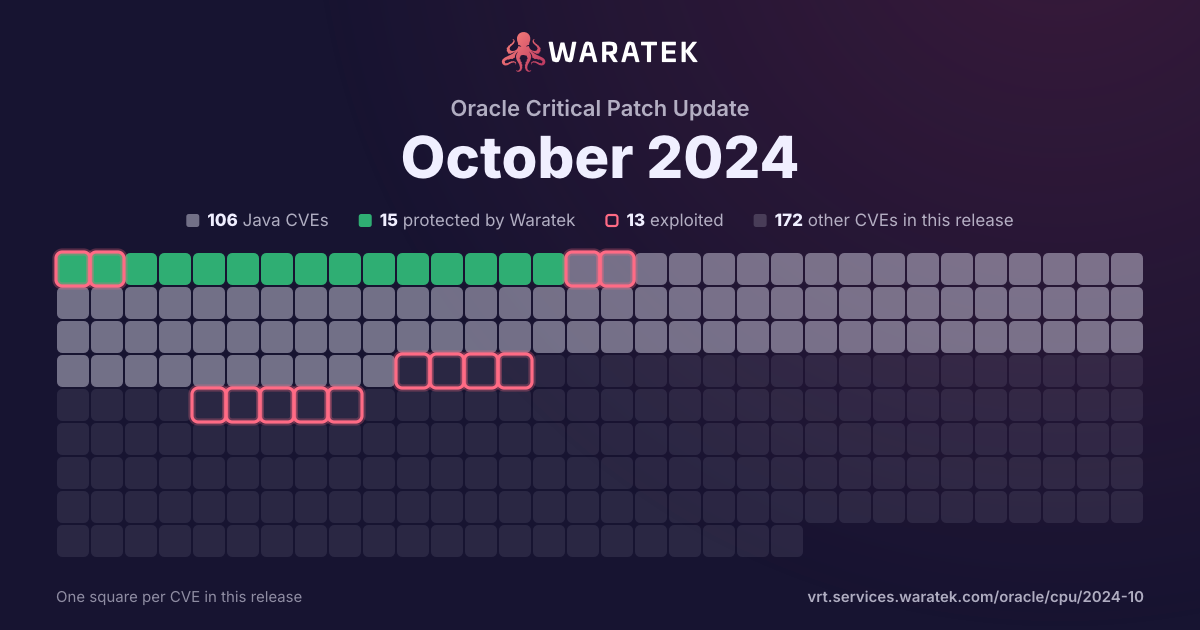
By status
15Protected by Waratek3Mitigation candidate88No exploit published26Outside Waratek scope144Not applicable2Withdrawn CVE
13Exploited, marked by the ring
No exploit published. For 51 of them, Oracle's security advisory is the source of public detail.
Protected by Waratek. Waratek RASP can block exploitation of these on systems that have not applied the patch yet.
Overview 28 matches · 7 in Waratek scope · 2 protected · 3 exploited · 2 CISA KEV · 6 public PoC · 7 EPSS ≥ 0.5
28matches
7in Waratek scope25.0%
2protected7.1%
3exploited10.7%
2CISA KEV7.1%
6public PoC21.4%
7EPSS ≥ 0.525.0%
Protected by Waratek
2
7.1%
Rule in development
0
0.0%
Mitigation candidate
0
0.0%
No exploit published
5
17.9%
Outside Waratek scope
5
17.9%
Not applicable
16
57.1%
Withdrawn CVE
0
0.0%
blocked by ARMR today
2
7.1%
partly blocked
0
0.0%
not blocked
26
92.9%
not established
0
0.0%
unrecorded
0
0.0%
Exploited
3
10.7%
Working exploit published
0
0.0%
Proof of concept only
6
21.4%
Forecast only
0
0.0%
No public exploit
19
67.9%
split by
peak 9 / quarter
Q2 211
Protected by Waratek1
Critical1
blocked by ARMR today1
No public exploit1
Q3 210
Q4 210
Q1 221
Protected by Waratek1
Critical1
blocked by ARMR today1
Proof of concept only1
Q2 222
Outside Waratek scope2
Critical2
not blocked2
Proof of concept only2
Q3 220
Q4 220
Q1 231
Not applicable1
Critical1
not blocked1
No public exploit1
Q2 230
Q3 231
Not applicable1
Critical1
not blocked1
Exploited1
Q4 232
No exploit published1
Outside Waratek scope1
Critical2
not blocked2
Proof of concept only1
No public exploit1
Q1 244
No exploit published1
Not applicable3
Critical4
not blocked4
No public exploit4
Q2 244
Outside Waratek scope1
Not applicable3
Critical4
not blocked4
Exploited1
Proof of concept only1
No public exploit2
Q3 249
No exploit published1
Not applicable8
Critical9
not blocked9
Exploited1
Proof of concept only1
No public exploit7
Q4 243
No exploit published2
Outside Waratek scope1
Critical3
not blocked3
No public exploit3
Q2 21Q4 21Q2 22Q4 22Q2 23Q4 23Q2 24Q4 24
| CVE | Severity | Published▾ | Status | Exploitation | Description |
|---|---|---|---|---|---|
| CVE-2024-4741 | Critical | 2024-11-13 | Outside Waratek scope | No public exploit | Issue summary: Calling the OpenSSL API function SSL_free_buffers may cause memory to be accessed that was previously freed in some situations Impact summary: A use after free can have a range of potential consequences such as the corruption of valid data, crashes or execution of arbitrary code. However, only applications that directly call the SSL_free_buffers function are affected by this issue. Applications that do not call this function are not vulnerable. Our investigations indicate that this function is rarely used by applications. The SSL_free_buffers function is used to free the internal OpenSSL buffer used when processing an incoming record from the network. The call is only expected to succeed if the buffer is not currently in use. However, two scenarios have been identified where the buffer is freed even when still in use. The first scenario occurs where a record header has been received from the network and processed by OpenSSL, but the full record body has not yet arrived. In this case calling SSL_free_buffers will succeed even though a record has only been partially processed and the buffer is still in use. The second scenario occurs where a full record containing application data has been received and processed by OpenSSL but the application has only read part of this data. Again a call to SSL_free_buffers will succeed even though the buffer is still in use. While these scenarios could occur accidentally during normal operation a malicious attacker could attempt to engineer a stituation where this occurs. We are not aware of this issue being actively exploited. The FIPS modules in 3.3, 3.2, 3.1 and 3.0 are not affected by this issue. |
| CVE-2024-21216 | Critical | 2024-10-15 | No exploit published | No public exploit | Vulnerability in the Oracle WebLogic Server product of Oracle Fusion Middleware (component: Core). Supported versions that are affected are 12.2.1.4.0 and 14.1.1.0.0. Easily exploitable vulnerability allows unauthenticated attacker with network access via T3, IIOP to compromise Oracle WebLogic Server. Successful attacks of this vulnerability can result in takeover of Oracle WebLogic Server. CVSS 3.1 Base Score 9.8 (Confidentiality, Integrity and Availability impacts). CVSS Vector: (CVSS:3.1/AV:N/AC:L/PR:N/UI:N/S:U/C:H/I:H/A:H). |
| CVE-2024-21172 | Critical | 2024-10-15 | No exploit published | No public exploit | Vulnerability in the Oracle Hospitality OPERA 5 product of Oracle Hospitality Applications (component: Opera Servlet). Supported versions that are affected are 5.6.19.19, 5.6.25.8 and 5.6.26.4. Difficult to exploit vulnerability allows unauthenticated attacker with network access via HTTP to compromise Oracle Hospitality OPERA 5. While the vulnerability is in Oracle Hospitality OPERA 5, attacks may significantly impact additional products (scope change). Successful attacks of this vulnerability can result in takeover of Oracle Hospitality OPERA 5. CVSS 3.1 Base Score 9.0 (Confidentiality, Integrity and Availability impacts). CVSS Vector: (CVSS:3.1/AV:N/AC:H/PR:N/UI:N/S:C/C:H/I:H/A:H). |
| CVE-2024-45492 | Critical | 2024-08-30 | Not applicable | No public exploit | An issue was discovered in libexpat before 2.6.3. nextScaffoldPart in xmlparse.c can have an integer overflow for m_groupSize on 32-bit platforms (where UINT_MAX equals SIZE_MAX). |
| CVE-2024-45491 | Critical | 2024-08-30 | Not applicable | No public exploit | An issue was discovered in libexpat before 2.6.3. dtdCopy in xmlparse.c can have an integer overflow for nDefaultAtts on 32-bit platforms (where UINT_MAX equals SIZE_MAX). |
| CVE-2024-45490 | Critical | 2024-08-30 | Not applicable | No public exploit | An issue was discovered in libexpat before 2.6.3. xmlparse.c does not reject a negative length for XML_ParseBuffer. |
| CVE-2024-29736 | Critical | 2024-07-19 | No exploit published | No public exploit | A SSRF vulnerability in WADL service description in versions of Apache CXF before 4.0.5, 3.6.4 and 3.5.9 allows an attacker to perform SSRF style attacks on REST webservices. The attack only applies if a custom stylesheet parameter is configured. |
| CVE-2024-40898 | Critical | 2024-07-18 | Not applicable | No public exploit | SSRF in Apache HTTP Server on Windows with mod_rewrite in server/vhost context, allows to potentially leak NTML hashes to a malicious server via SSRF and malicious requests. Users are recommended to upgrade to version 2.4.62 which fixes this issue. |
| CVE-2024-38999 | Critical | 2024-07-01 | Not applicable | Proof of concept only | jrburke requirejs v2.3.6 was discovered to contain a prototype pollution via the function s.contexts._.configure. This vulnerability allows attackers to execute arbitrary code or cause a Denial of Service (DoS) via injecting arbitrary properties. |
| CVE-2024-38476 | Critical | 2024-07-01 | Not applicable | No public exploit | Vulnerability in core of Apache HTTP Server 2.4.59 and earlier are vulnerably to information disclosure, SSRF or local script execution via backend applications whose response headers are malicious or exploitable. Users are recommended to upgrade to version 2.4.60, which fixes this issue. |
| CVE-2024-38475 | Critical | 2024-07-01 | Not applicable | Exploited | Improper escaping of output in mod_rewrite in Apache HTTP Server 2.4.59 and earlier allows an attacker to map URLs to filesystem locations that are permitted to be served by the server but are not intentionally/directly reachable by any URL, resulting in code execution or source code disclosure. Substitutions in server context that use a backreferences or variables as the first segment of the substitution are affected. Some unsafe RewiteRules will be broken by this change and the rewrite flag "UnsafePrefixStat" can be used to opt back in once ensuring the substitution is appropriately constrained. |
| CVE-2024-38474 | Critical | 2024-07-01 | Not applicable | No public exploit | Substitution encoding issue in mod_rewrite in Apache HTTP Server 2.4.59 and earlier allows attacker to execute scripts in directories permitted by the configuration but not directly reachable by any URL or source disclosure of scripts meant to only to be executed as CGI. Users are recommended to upgrade to version 2.4.60, which fixes this issue. Some RewriteRules that capture and substitute unsafely will now fail unless rewrite flag "UnsafeAllow3F" is specified. |
| CVE-2024-37371 | Critical | 2024-06-28 | Not applicable | No public exploit | In MIT Kerberos 5 (aka krb5) before 1.21.3, an attacker can cause invalid memory reads during GSS message token handling by sending message tokens with invalid length fields. |
| CVE-2024-5535 | Critical | 2024-06-27 | Outside Waratek scope | No public exploit | Issue summary: Calling the OpenSSL API function SSL_select_next_proto with an empty supported client protocols buffer may cause a crash or memory contents to be sent to the peer. Impact summary: A buffer overread can have a range of potential consequences such as unexpected application beahviour or a crash. In particular this issue could result in up to 255 bytes of arbitrary private data from memory being sent to the peer leading to a loss of confidentiality. However, only applications that directly call the SSL_select_next_proto function with a 0 length list of supported client protocols are affected by this issue. This would normally never be a valid scenario and is typically not under attacker control but may occur by accident in the case of a configuration or programming error in the calling application. The OpenSSL API function SSL_select_next_proto is typically used by TLS applications that support ALPN (Application Layer Protocol Negotiation) or NPN (Next Protocol Negotiation). NPN is older, was never standardised and is deprecated in favour of ALPN. We believe that ALPN is significantly more widely deployed than NPN. The SSL_select_next_proto function accepts a list of protocols from the server and a list of protocols from the client and returns the first protocol that appears in the server list that also appears in the client list. In the case of no overlap between the two lists it returns the first item in the client list. In either case it will signal whether an overlap between the two lists was found. In the case where SSL_select_next_proto is called with a zero length client list it fails to notice this condition and returns the memory immediately following the client list pointer (and reports that there was no overlap in the lists). This function is typically called from a server side application callback for ALPN or a client side application callback for NPN. In the case of ALPN the list of protocols supplied by the client is guaranteed by libssl to never be zero in length. The list of server protocols comes from the application and should never normally be expected to be of zero length. In this case if the SSL_select_next_proto function has been called as expected (with the list supplied by the client passed in the client/client_len parameters), then the application will not be vulnerable to this issue. If the application has accidentally been configured with a zero length server list, and has accidentally passed that zero length server list in the client/client_len parameters, and has additionally failed to correctly handle a "no overlap" response (which would normally result in a handshake failure in ALPN) then it will be vulnerable to this problem. In the case of NPN, the protocol permits the client to opportunistically select a protocol when there is no overlap. OpenSSL returns the first client protocol in the no overlap case in support of this. The list of client protocols comes from the application and should never normally be expected to be of zero length. However if the SSL_select_next_proto function is accidentally called with a client_len of 0 then an invalid memory pointer will be returned instead. If the application uses this output as the opportunistic protocol then the loss of confidentiality will occur. This issue has been assessed as Low severity because applications are most likely to be vulnerable if they are using NPN instead of ALPN - but NPN is not widely used. It also requires an application configuration or programming error. Finally, this issue would not typically be under attacker control making active exploitation unlikely. The FIPS modules in 3.3, 3.2, 3.1 and 3.0 are not affected by this issue. Due to the low severity of this issue we are not issuing new releases of OpenSSL at this time. The fix will be included in the next releases when they become available. |
| CVE-2024-4577 | Critical | 2024-06-09 | Not applicable | Exploited | In PHP versions 8.1.* before 8.1.29, 8.2.* before 8.2.20, 8.3.* before 8.3.8, when using Apache and PHP-CGI on Windows, if the system is set up to use certain code pages, Windows may use "Best-Fit" behavior to replace characters in command line given to Win32 API functions. PHP CGI module may misinterpret those characters as PHP options, which may allow a malicious user to pass options to PHP binary being run, and thus reveal the source code of scripts, run arbitrary PHP code on the server, etc. |
| CVE-2024-1874 | Critical | 2024-04-29 | Not applicable | Proof of concept only | In PHP versions 8.1.* before 8.1.28, 8.2.* before 8.2.18, 8.3.* before 8.3.5, when using proc_open() command with array syntax, due to insufficient escaping, if the arguments of the executed command are controlled by a malicious user, the user can supply arguments that would execute arbitrary commands in Windows shell. |
| CVE-2024-28752 | Critical | 2024-03-15 | No exploit published | No public exploit | A SSRF vulnerability using the Aegis DataBinding in versions of Apache CXF before 4.0.4, 3.6.3 and 3.5.8 allows an attacker to perform SSRF style attacks on webservices that take at least one parameter of any type. Users of other data bindings (including the default databinding) are not impacted. |
| CVE-2024-23807 | Critical | 2024-02-29 | Not applicable | No public exploit | The Apache Xerces C++ XML parser on versions 3.0.0 before 3.2.5 contains a use-after-free error triggered during the scanning of external DTDs. Users are recommended to upgrade to version 3.2.5 which fixes the issue, or mitigate the issue by disabling DTD processing. This can be accomplished via the DOM using a standard parser feature, or via SAX using the XERCES_DISABLE_DTD environment variable. This issue has been disclosed before as CVE-2018-1311, but unfortunately that advisory incorrectly stated the issue would be fixed in version 3.2.3 or 3.2.4. |
| CVE-2022-34381 | Critical | 2024-02-02 | Not applicable | No public exploit | Dell BSAFE SSL-J version 7.0 and all versions prior to 6.5, and Dell BSAFE Crypto-J versions prior to 6.2.6.1 contain an unmaintained third-party component vulnerability. An unauthenticated remote attacker could potentially exploit this vulnerability, leading to the compromise of the impacted system. This is a Critical vulnerability and Dell recommends customers to upgrade at the earliest opportunity. |
| CVE-2023-6816 | Critical | 2024-01-18 | Not applicable | No public exploit | A flaw was found in X.Org server. Both DeviceFocusEvent and the XIQueryPointer reply contain a bit for each logical button currently down. Buttons can be arbitrarily mapped to any value up to 255, but the X.Org Server was only allocating space for the device's particular number of buttons, leading to a heap overflow if a bigger value was used. |
| CVE-2022-46337 | Critical | 2023-11-20 | No exploit published | No public exploit | A cleverly devised username might bypass LDAP authentication checks. In LDAP-authenticated Derby installations, this could let an attacker fill up the disk by creating junk Derby databases. In LDAP-authenticated Derby installations, this could also allow the attacker to execute malware which was visible to and executable by the account which booted the Derby server. In LDAP-protected databases which weren't also protected by SQL GRANT/REVOKE authorization, this vulnerability could also let an attacker view and corrupt sensitive data and run sensitive database functions and procedures. Mitigation: Users should upgrade to Java 21 and Derby 10.17.1.0. Alternatively, users who wish to remain on older Java versions should build their own Derby distribution from one of the release families to which the fix was backported: 10.16, 10.15, and 10.14. Those are the releases which correspond, respectively, with Java LTS versions 17, 11, and 8. |
| CVE-2023-38545 | Critical | 2023-10-18 | Outside Waratek scope | Proof of concept only | This flaw makes curl overflow a heap based buffer in the SOCKS5 proxy handshake. When curl is asked to pass along the host name to the SOCKS5 proxy to allow that to resolve the address instead of it getting done by curl itself, the maximum length that host name can be is 255 bytes. If the host name is detected to be longer, curl switches to local name resolving and instead passes on the resolved address only. Due to this bug, the local variable that means "let the host resolve the name" could get the wrong value during a slow SOCKS5 handshake, and contrary to the intention, copy the too long host name to the target buffer instead of copying just the resolved address there. The target buffer being a heap based buffer, and the host name coming from the URL that curl has been told to operate with. |
| CVE-2023-38408 | Critical | 2023-07-20 | Not applicable | Exploited | The PKCS#11 feature in ssh-agent in OpenSSH before 9.3p2 has an insufficiently trustworthy search path, leading to remote code execution if an agent is forwarded to an attacker-controlled system. (Code in /usr/lib is not necessarily safe for loading into ssh-agent.) NOTE: this issue exists because of an incomplete fix for CVE-2016-10009. |
| CVE-2022-36760 | Critical | 2023-01-17 | Not applicable | No public exploit | Inconsistent Interpretation of HTTP Requests ('HTTP Request Smuggling') vulnerability in mod_proxy_ajp of Apache HTTP Server allows an attacker to smuggle requests to the AJP server it forwards requests to. This issue affects Apache HTTP Server Apache HTTP Server 2.4 version 2.4.54 and prior versions. |
| CVE-2022-2068 | Critical | 2022-06-21 | Outside Waratek scope | Proof of concept only | In addition to the c_rehash shell command injection identified in CVE-2022-1292, further circumstances where the c_rehash script does not properly sanitise shell metacharacters to prevent command injection were found by code review. When the CVE-2022-1292 was fixed it was not discovered that there are other places in the script where the file names of certificates being hashed were possibly passed to a command executed through the shell. This script is distributed by some operating systems in a manner where it is automatically executed. On such operating systems, an attacker could execute arbitrary commands with the privileges of the script. Use of the c_rehash script is considered obsolete and should be replaced by the OpenSSL rehash command line tool. Fixed in OpenSSL 3.0.4 (Affected 3.0.0,3.0.1,3.0.2,3.0.3). Fixed in OpenSSL 1.1.1p (Affected 1.1.1-1.1.1o). Fixed in OpenSSL 1.0.2zf (Affected 1.0.2-1.0.2ze). |
| CVE-2022-1292 | Critical | 2022-05-03 | Outside Waratek scope | Proof of concept only | The c_rehash script does not properly sanitise shell metacharacters to prevent command injection. This script is distributed by some operating systems in a manner where it is automatically executed. On such operating systems, an attacker could execute arbitrary commands with the privileges of the script. Use of the c_rehash script is considered obsolete and should be replaced by the OpenSSL rehash command line tool. Fixed in OpenSSL 3.0.3 (Affected 3.0.0,3.0.1,3.0.2). Fixed in OpenSSL 1.1.1o (Affected 1.1.1-1.1.1n). Fixed in OpenSSL 1.0.2ze (Affected 1.0.2-1.0.2zd). |
| CVE-2022-23305 | Critical | 2022-01-18 | Protected by Waratek | Proof of concept only | By design, the JDBCAppender in Log4j 1.2.x accepts an SQL statement as a configuration parameter where the values to be inserted are converters from PatternLayout. The message converter, %m, is likely to always be included. This allows attackers to manipulate the SQL by entering crafted strings into input fields or headers of an application that are logged allowing unintended SQL queries to be executed. Note this issue only affects Log4j 1.x when specifically configured to use the JDBCAppender, which is not the default. Beginning in version 2.0-beta8, the JDBCAppender was re-introduced with proper support for parameterized SQL queries and further customization over the columns written to in logs. Apache Log4j 1.2 reached end of life in August 2015. Users should upgrade to Log4j 2 as it addresses numerous other issues from the previous versions. |
| CVE-2020-9493 | Critical | 2021-06-16 | Protected by Waratek | No public exploit | A deserialization flaw was found in Apache Chainsaw versions prior to 2.1.0 which could lead to malicious code execution. |