
Oracle Critical Patch Update October 2024
Released October 2024 · Oracle's advisory ↗ · ← Critical Patch Update, July 2024 · Critical Patch Update, January 2025 →
278 CVEs in this release, one square each
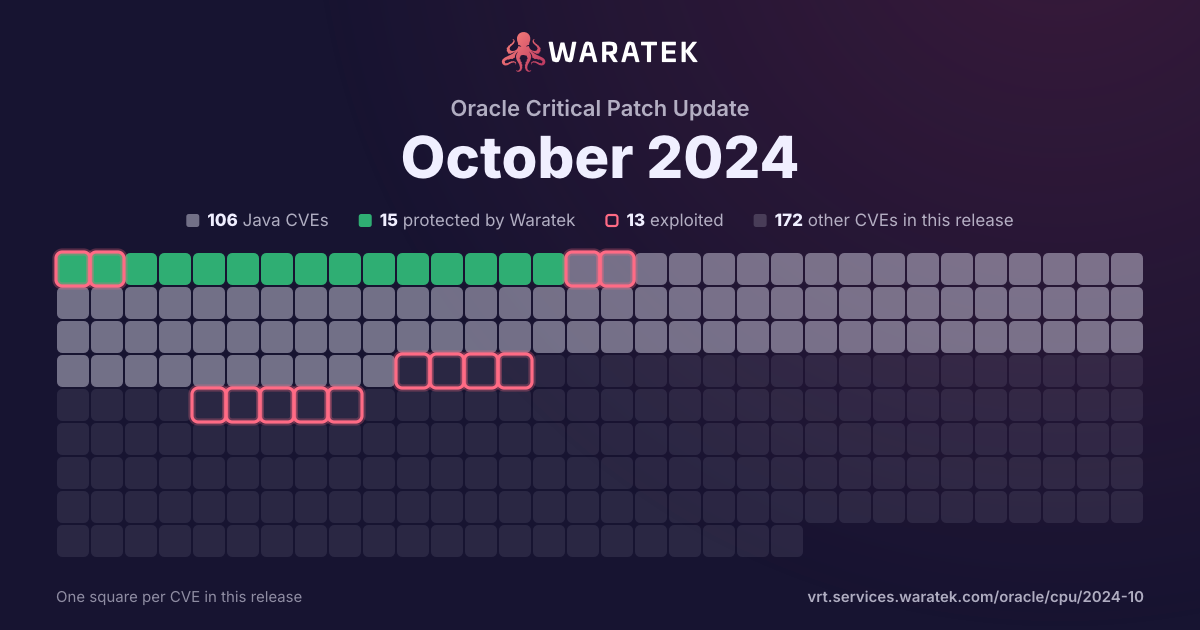
By status
15Protected by Waratek3Mitigation candidate88No exploit published26Outside Waratek scope144Not applicable2Withdrawn CVE
13Exploited, marked by the ring
No exploit published. For 51 of them, Oracle's security advisory is the source of public detail.
Protected by Waratek. Waratek RASP can block exploitation of these on systems that have not applied the patch yet.
Overview 2 matches · 0 protected · 0 exploited · 0 CISA KEV · 0 public PoC · 0 EPSS ≥ 0.5
2matches
0protected0.0%
0exploited0.0%
0CISA KEV0.0%
0public PoC0.0%
0EPSS ≥ 0.50.0%
Protected by Waratek
0
0.0%
Rule in development
0
0.0%
Mitigation candidate
0
0.0%
No exploit published
2
100.0%
blocked by ARMR today
0
0.0%
partly blocked
0
0.0%
not blocked
2
100.0%
not established
0
0.0%
unrecorded
0
0.0%
Exploited
0
0.0%
Working exploit published
0
0.0%
Proof of concept only
2
100.0%
Forecast only
0
0.0%
No public exploit
0
0.0%
split by
peak 1 / month
Feb 24Mar 24
| CVE | Severity | Published▾ | Status | Exploitation | Description |
|---|---|---|---|---|---|
| CVE-2024-29025 | Medium | 2024-03-25 | No exploit published | Proof of concept only | Netty is an asynchronous event-driven network application framework for rapid development of maintainable high performance protocol servers & clients. The `HttpPostRequestDecoder` can be tricked to accumulate data. While the decoder can store items on the disk if configured so, there are no limits to the number of fields the form can have, an attacher can send a chunked post consisting of many small fields that will be accumulated in the `bodyListHttpData` list. The decoder cumulates bytes in the `undecodedChunk` buffer until it can decode a field, this field can cumulate data without limits. This vulnerability is fixed in 4.1.108.Final. |
| CVE-2023-51775 | Medium | 2024-02-29 | No exploit published | Proof of concept only | The jose4j component before 0.9.4 for Java allows attackers to cause a denial of service (CPU consumption) via a large p2c (aka PBES2 Count) value. |