
Oracle Critical Patch Update July 2024
Released July 2024 · Oracle's advisory ↗ · ← Critical Patch Update, April 2024 · Critical Patch Update, October 2024 →
231 CVEs in this release, one square each
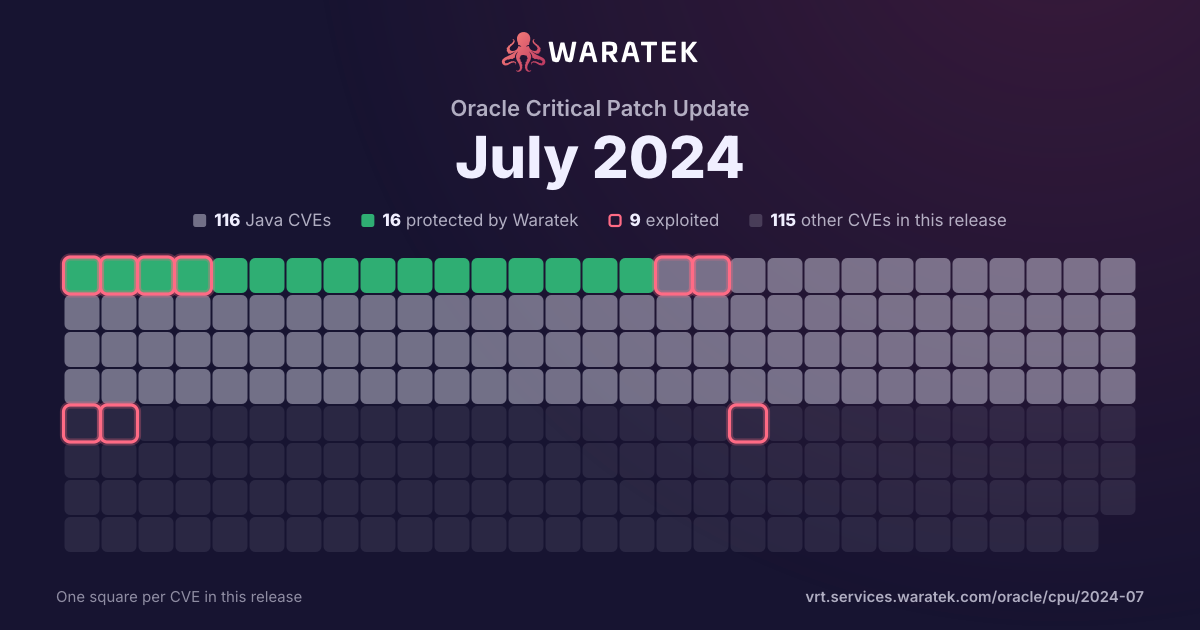
By status
16Protected by Waratek4Mitigation candidate96No exploit published18Outside Waratek scope97Not applicable
9Exploited, marked by the ring
No exploit published. For 35 of them, Oracle's security advisory is the source of public detail.
Protected by Waratek. Waratek RASP can block exploitation of these on systems that have not applied the patch yet.
Overview 9 matches · 5 protected · 5 exploited · 3 CISA KEV · 4 EPSS ≥ 0.5
Protected by Waratek
5
55.6%
Rule in development
0
0.0%
Mitigation candidate
4
44.4%
No exploit published
0
0.0%
blocked by ARMR today
5
55.6%
partly blocked
0
0.0%
not blocked
4
44.4%
not established
0
0.0%
unrecorded
0
0.0%
Exploited
5
55.6%
Working exploit published
0
0.0%
Proof of concept only
4
44.4%
Forecast only
0
0.0%
No public exploit
0
0.0%
split by
peak 3 / quarter
Q2 221
Protected by Waratek1
Critical1
blocked by ARMR today1
Exploited1
Q3 223
Protected by Waratek2
Mitigation candidate1
Critical1
High2
blocked by ARMR today2
not blocked1
Proof of concept only3
Q4 220
Q1 230
Q2 230
Q3 230
Q4 231
Mitigation candidate1
High1
not blocked1
Exploited1
Q1 242
Protected by Waratek1
Mitigation candidate1
Critical1
High1
blocked by ARMR today1
not blocked1
Exploited1
Proof of concept only1
Q2 241
Mitigation candidate1
High1
not blocked1
Exploited1
Q3 241
Protected by Waratek1
High1
blocked by ARMR today1
Exploited1
Q2 22Q3 22Q4 22Q1 23Q2 23Q3 23Q4 23Q1 24Q2 24Q3 24
| CVE | Severity | Published▾ | Status | Exploitation | Description |
|---|---|---|---|---|---|
| CVE-2024-21136 | High | 2024-07-16 | Protected by Waratek | Exploited | Vulnerability in the Oracle Retail Xstore Office product of Oracle Retail Applications (component: Security). Supported versions that are affected are 19.0.5, 20.0.3, 20.0.4, 22.0.0 and 23.0.1. Easily exploitable vulnerability allows unauthenticated attacker with network access via HTTP to compromise Oracle Retail Xstore Office. While the vulnerability is in Oracle Retail Xstore Office, attacks may significantly impact additional products (scope change). Successful attacks of this vulnerability can result in unauthorized access to critical data or complete access to all Oracle Retail Xstore Office accessible data. CVSS 3.1 Base Score 8.6 (Confidentiality impacts). CVSS Vector: (CVSS:3.1/AV:N/AC:L/PR:N/UI:N/S:C/C:H/I:N/A:N). |
| CVE-2024-32114 | High | 2024-05-02 | Mitigation candidate | Exploited | In Apache ActiveMQ 6.x, the default configuration doesn't secure the API web context (where the Jolokia JMX REST API and the Message REST API are located). It means that anyone can use these layers without any required authentication. Potentially, anyone can interact with the broker (using Jolokia JMX REST API) and/or produce/consume messages or purge/delete destinations (using the Message REST API). To mitigate, users can update the default conf/jetty.xml configuration file to add authentication requirement: <bean id="securityConstraintMapping" class="org.eclipse.jetty.security.ConstraintMapping"> <property name="constraint" ref="securityConstraint" /> <property name="pathSpec" value="/" /> </bean> Or we encourage users to upgrade to Apache ActiveMQ 6.1.2 where the default configuration has been updated with authentication by default. |
| CVE-2024-24549 | High | 2024-03-13 | Mitigation candidate | Proof of concept only | Denial of Service due to improper input validation vulnerability for HTTP/2 requests in Apache Tomcat. When processing an HTTP/2 request, if the request exceeded any of the configured limits for headers, the associated HTTP/2 stream was not reset until after all of the headers had been processed.This issue affects Apache Tomcat: from 11.0.0-M1 through 11.0.0-M16, from 10.1.0-M1 through 10.1.18, from 9.0.0-M1 through 9.0.85, from 8.5.0 through 8.5.98. Other, older, EOL versions may also be affected. Users are recommended to upgrade to version 11.0.0-M17, 10.1.19, 9.0.86 or 8.5.99 which fix the issue. |
| CVE-2024-23897 | Critical | 2024-01-24 | Protected by Waratek | Exploited | Jenkins 2.441 and earlier, LTS 2.426.2 and earlier does not disable a feature of its CLI command parser that replaces an '@' character followed by a file path in an argument with the file's contents, allowing unauthenticated attackers to read arbitrary files on the Jenkins controller file system. |
| CVE-2023-44487 | High | 2023-10-10 | Mitigation candidate | Exploited | The HTTP/2 protocol allows a denial of service (server resource consumption) because request cancellation can reset many streams quickly, as exploited in the wild in August through October 2023. |
| CVE-2022-36944 | Critical | 2022-09-23 | Protected by Waratek | Proof of concept only | Scala 2.13.x before 2.13.9 has a Java deserialization chain in its JAR file. On its own, it cannot be exploited. There is only a risk in conjunction with Java object deserialization within an application. In such situations, it allows attackers to erase contents of arbitrary files, make network connections, or possibly run arbitrary code (specifically, Function0 functions) via a gadget chain. |
| CVE-2022-40146 | High | 2022-09-22 | Mitigation candidate | Proof of concept only | Server-Side Request Forgery (SSRF) vulnerability in Batik of Apache XML Graphics allows an attacker to access files using a Jar url. This issue affects Apache XML Graphics Batik 1.14. |
| CVE-2022-34169 | High | 2022-07-19 | Protected by Waratek | Proof of concept only | The Apache Xalan Java XSLT library is vulnerable to an integer truncation issue when processing malicious XSLT stylesheets. This can be used to corrupt Java class files generated by the internal XSLTC compiler and execute arbitrary Java bytecode. Users are recommended to update to version 2.7.3 or later. Note: Java runtimes (such as OpenJDK) include repackaged copies of Xalan. |
| CVE-2022-22965 | Critical | 2022-04-01 | Protected by Waratek | Exploited | A Spring MVC or Spring WebFlux application running on JDK 9+ may be vulnerable to remote code execution (RCE) via data binding. The specific exploit requires the application to run on Tomcat as a WAR deployment. If the application is deployed as a Spring Boot executable jar, i.e. the default, it is not vulnerable to the exploit. However, the nature of the vulnerability is more general, and there may be other ways to exploit it. |