
Oracle Critical Patch Update April 2024
Released April 2024 · Oracle's advisory ↗ · ← Critical Patch Update, January 2024 · Critical Patch Update, July 2024 →
312 CVEs in this release, one square each
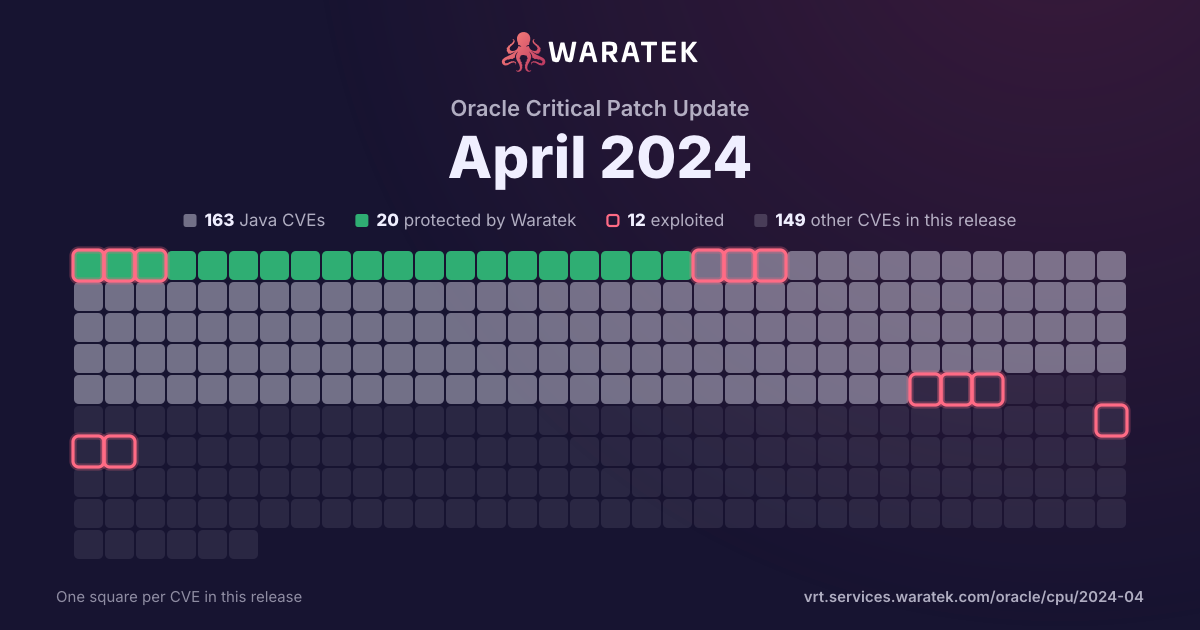
By status
21Protected by Waratek7Mitigation candidate137No exploit published15Outside Waratek scope131Not applicable1Withdrawn CVE
12Exploited, marked by the ring
No exploit published. For 81 of them, Oracle's security advisory is the source of public detail.
Protected by Waratek. Waratek RASP can block exploitation of these on systems that have not applied the patch yet.
Overview 18 matches · 10 in Waratek scope · 0 protected · 2 exploited · 2 CISA KEV · 2 public PoC · 2 EPSS ≥ 0.5
18matches
10in Waratek scope55.6%
0protected0.0%
2exploited11.1%
2CISA KEV11.1%
2public PoC11.1%
2EPSS ≥ 0.511.1%
Protected by Waratek
0
0.0%
Rule in development
0
0.0%
Mitigation candidate
0
0.0%
No exploit published
10
55.6%
Outside Waratek scope
1
5.6%
Not applicable
7
38.9%
Withdrawn CVE
0
0.0%
blocked by ARMR today
0
0.0%
partly blocked
0
0.0%
not blocked
18
100.0%
not established
0
0.0%
unrecorded
0
0.0%
Exploited
2
11.1%
Working exploit published
0
0.0%
Proof of concept only
1
5.6%
Forecast only
0
0.0%
No public exploit
15
83.3%
| CVE | Severity | Published▾ | Status | Exploitation | Description |
|---|---|---|---|---|---|
| CVE-2023-41074 | High | 2023-09-27 | Not applicable | No public exploit | The issue was addressed with improved checks. This issue is fixed in tvOS 17, Safari 17, watchOS 10, iOS 17 and iPadOS 17, macOS Sonoma 14. Processing web content may lead to arbitrary code execution. |
| CVE-2023-0833 | Medium | 2023-09-27 | No exploit published | No public exploit | A flaw was found in Red Hat's AMQ-Streams, which ships a version of the OKHttp component with an information disclosure flaw via an exception triggered by a header containing an illegal value. This issue could allow an authenticated attacker to access information outside of their regular permissions. |
| CVE-2023-5156 | High | 2023-09-25 | Not applicable | No public exploit | A flaw was found in the GNU C Library. A recent fix for CVE-2023-4806 introduced the potential for a memory leak, which may result in an application crash. |
| CVE-2023-41993 | High | 2023-09-21 | Not applicable | Exploited | The issue was addressed with improved checks. This issue is fixed in macOS Sonoma 14. Processing web content may lead to arbitrary code execution. Apple is aware of a report that this issue may have been actively exploited against versions of iOS before iOS 16.7. |
| CVE-2023-43498 | High | 2023-09-20 | No exploit published | No public exploit | In Jenkins 2.423 and earlier, LTS 2.414.1 and earlier, processing file uploads using MultipartFormDataParser creates temporary files in the default system temporary directory with the default permissions for newly created files, potentially allowing attackers with access to the Jenkins controller file system to read and write the files before they are used. |
| CVE-2023-43497 | High | 2023-09-20 | No exploit published | No public exploit | In Jenkins 2.423 and earlier, LTS 2.414.1 and earlier, processing file uploads using the Stapler web framework creates temporary files in the default system temporary directory with the default permissions for newly created files, potentially allowing attackers with access to the Jenkins controller file system to read and write the files before they are used. |
| CVE-2023-43496 | High | 2023-09-20 | No exploit published | No public exploit | Jenkins 2.423 and earlier, LTS 2.414.1 and earlier creates a temporary file in the system temporary directory with the default permissions for newly created files when installing a plugin from a URL, potentially allowing attackers with access to the system temporary directory to replace the file before it is installed in Jenkins, potentially resulting in arbitrary code execution. |
| CVE-2023-43495 | Medium | 2023-09-20 | No exploit published | No public exploit | Jenkins 2.423 and earlier, LTS 2.414.1 and earlier does not escape the value of the 'caption' constructor parameter of 'ExpandableDetailsNote', resulting in a stored cross-site scripting (XSS) vulnerability exploitable by attackers able to control this parameter. |
| CVE-2023-43494 | Medium | 2023-09-20 | No exploit published | No public exploit | Jenkins 2.50 through 2.423 (both inclusive), LTS 2.60.1 through 2.414.1 (both inclusive) does not exclude sensitive build variables (e.g., password parameter values) from the search in the build history widget, allowing attackers with Item/Read permission to obtain values of sensitive variables used in builds by iteratively testing different characters until the correct sequence is discovered. |
| CVE-2023-4806 | Medium | 2023-09-18 | Not applicable | No public exploit | A flaw has been identified in glibc. In an extremely rare situation, the getaddrinfo function may access memory that has been freed, resulting in an application crash. This issue is only exploitable when a NSS module implements only the _nss_*_gethostbyname2_r and _nss_*_getcanonname_r hooks without implementing the _nss_*_gethostbyname3_r hook. The resolved name should return a large number of IPv6 and IPv4, and the call to the getaddrinfo function should have the AF_INET6 address family with AI_CANONNAME, AI_ALL and AI_V4MAPPED as flags. |
| CVE-2023-4527 | Medium | 2023-09-18 | Not applicable | No public exploit | A flaw was found in glibc. When the getaddrinfo function is called with the AF_UNSPEC address family and the system is configured with no-aaaa mode via /etc/resolv.conf, a DNS response via TCP larger than 2048 bytes can potentially disclose stack contents through the function returned address data, and may cause a crash. |
| CVE-2023-41900 | Medium | 2023-09-15 | No exploit published | No public exploit | Jetty is a Java based web server and servlet engine. Versions 9.4.21 through 9.4.51, 10.0.15, and 11.0.15 are vulnerable to weak authentication. If a Jetty `OpenIdAuthenticator` uses the optional nested `LoginService`, and that `LoginService` decides to revoke an already authenticated user, then the current request will still treat the user as authenticated. The authentication is then cleared from the session and subsequent requests will not be treated as authenticated. So a request on a previously authenticated session could be allowed to bypass authentication after it had been rejected by the `LoginService`. This impacts usages of the jetty-openid which have configured a nested `LoginService` and where that `LoginService` will is capable of rejecting previously authenticated users. Versions 9.4.52, 10.0.16, and 11.0.16 have a patch for this issue. |
| CVE-2023-40167 | Medium | 2023-09-15 | No exploit published | No public exploit | Jetty is a Java based web server and servlet engine. Prior to versions 9.4.52, 10.0.16, 11.0.16, and 12.0.1, Jetty accepts the `+` character proceeding the content-length value in a HTTP/1 header field. This is more permissive than allowed by the RFC and other servers routinely reject such requests with 400 responses. There is no known exploit scenario, but it is conceivable that request smuggling could result if jetty is used in combination with a server that does not close the connection after sending such a 400 response. Versions 9.4.52, 10.0.16, 11.0.16, and 12.0.1 contain a patch for this issue. There is no workaround as there is no known exploit scenario. |
| CVE-2023-38039 | High | 2023-09-15 | Not applicable | Proof of concept only | When curl retrieves an HTTP response, it stores the incoming headers so that they can be accessed later via the libcurl headers API. However, curl did not have a limit in how many or how large headers it would accept in a response, allowing a malicious server to stream an endless series of headers and eventually cause curl to run out of heap memory. |
| CVE-2023-36479 | Low | 2023-09-15 | No exploit published | No public exploit | Eclipse Jetty Canonical Repository is the canonical repository for the Jetty project. Users of the CgiServlet with a very specific command structure may have the wrong command executed. If a user sends a request to a org.eclipse.jetty.servlets.CGI Servlet for a binary with a space in its name, the servlet will escape the command by wrapping it in quotation marks. This wrapped command, plus an optional command prefix, will then be executed through a call to Runtime.exec. If the original binary name provided by the user contains a quotation mark followed by a space, the resulting command line will contain multiple tokens instead of one. This issue was patched in version 9.4.52, 10.0.16, 11.0.16 and 12.0.0-beta2. |
| CVE-2023-42503 | Medium | 2023-09-14 | No exploit published | No public exploit | Improper Input Validation, Uncontrolled Resource Consumption vulnerability in Apache Commons Compress in TAR parsing.This issue affects Apache Commons Compress: from 1.22 before 1.24.0. Users are recommended to upgrade to version 1.24.0, which fixes the issue. A third party can create a malformed TAR file by manipulating file modification times headers, which when parsed with Apache Commons Compress, will cause a denial of service issue via CPU consumption. In version 1.22 of Apache Commons Compress, support was added for file modification times with higher precision (issue # COMPRESS-612 [1]). The format for the PAX extended headers carrying this data consists of two numbers separated by a period [2], indicating seconds and subsecond precision (for example “1647221103.5998539”). The impacted fields are “atime”, “ctime”, “mtime” and “LIBARCHIVE.creationtime”. No input validation is performed prior to the parsing of header values. Parsing of these numbers uses the BigDecimal [3] class from the JDK which has a publicly known algorithmic complexity issue when doing operations on large numbers, causing denial of service (see issue # JDK-6560193 [4]). A third party can manipulate file time headers in a TAR file by placing a number with a very long fraction (300,000 digits) or a number with exponent notation (such as “9e9999999”) within a file modification time header, and the parsing of files with these headers will take hours instead of seconds, leading to a denial of service via exhaustion of CPU resources. This issue is similar to CVE-2012-2098 [5]. [1]: https://issues.apache.org/jira/browse/COMPRESS-612 [2]: https://pubs.opengroup.org/onlinepubs/9699919799/utilities/pax.html#tag_20_92_13_05 [3]: https://docs.oracle.com/javase/8/docs/api/java/math/BigDecimal.html [4]: https://bugs.openjdk.org/browse/JDK-6560193 [5]: https://cve.mitre.org/cgi-bin/cvename.cgi?name=CVE-2012-2098 Only applications using CompressorStreamFactory class (with auto-detection of file types), TarArchiveInputStream and TarFile classes to parse TAR files are impacted. Since this code was introduced in v1.22, only that version and later versions are impacted. |
| CVE-2023-4863 | High | 2023-09-12 | Outside Waratek scope | Exploited | Heap buffer overflow in libwebp in Google Chrome prior to 116.0.5845.187 and libwebp 1.3.2 allowed a remote attacker to perform an out of bounds memory write via a crafted HTML page. (Chromium security severity: Critical) |
| CVE-2023-4807 | High | 2023-09-08 | Not applicable | No public exploit | Issue summary: The POLY1305 MAC (message authentication code) implementation contains a bug that might corrupt the internal state of applications on the Windows 64 platform when running on newer X86_64 processors supporting the AVX512-IFMA instructions. Impact summary: If in an application that uses the OpenSSL library an attacker can influence whether the POLY1305 MAC algorithm is used, the application state might be corrupted with various application dependent consequences. The POLY1305 MAC (message authentication code) implementation in OpenSSL does not save the contents of non-volatile XMM registers on Windows 64 platform when calculating the MAC of data larger than 64 bytes. Before returning to the caller all the XMM registers are set to zero rather than restoring their previous content. The vulnerable code is used only on newer x86_64 processors supporting the AVX512-IFMA instructions. The consequences of this kind of internal application state corruption can be various - from no consequences, if the calling application does not depend on the contents of non-volatile XMM registers at all, to the worst consequences, where the attacker could get complete control of the application process. However given the contents of the registers are just zeroized so the attacker cannot put arbitrary values inside, the most likely consequence, if any, would be an incorrect result of some application dependent calculations or a crash leading to a denial of service. The POLY1305 MAC algorithm is most frequently used as part of the CHACHA20-POLY1305 AEAD (authenticated encryption with associated data) algorithm. The most common usage of this AEAD cipher is with TLS protocol versions 1.2 and 1.3 and a malicious client can influence whether this AEAD cipher is used by the server. This implies that server applications using OpenSSL can be potentially impacted. However we are currently not aware of any concrete application that would be affected by this issue therefore we consider this a Low severity security issue. As a workaround the AVX512-IFMA instructions support can be disabled at runtime by setting the environment variable OPENSSL_ia32cap: OPENSSL_ia32cap=:~0x200000 The FIPS provider is not affected by this issue. |