
Oracle Critical Patch Update April 2024
Released April 2024 · Oracle's advisory ↗ · ← Critical Patch Update, January 2024 · Critical Patch Update, July 2024 →
312 CVEs in this release, one square each
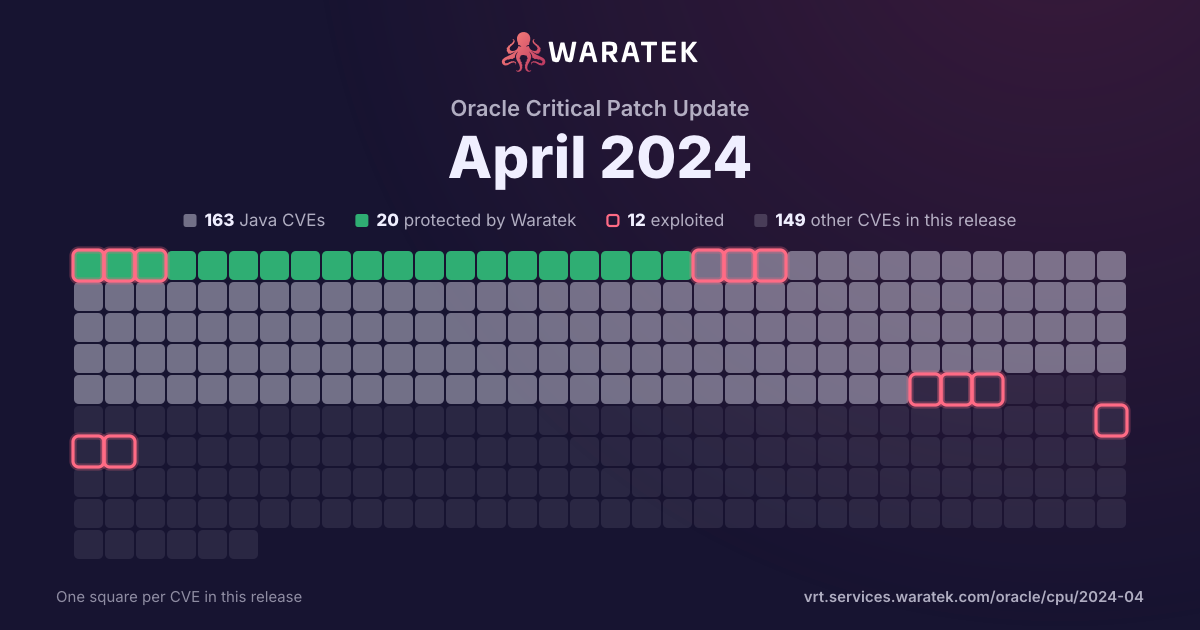
By status
20Protected by Waratek6Mitigation candidate137No exploit published40Outside Waratek scope108Not applicable1Withdrawn CVE
12Exploited, marked by the ring
No exploit published. For 82 of them, Oracle's security advisory is the source of public detail.
Protected by Waratek. Waratek RASP can block exploitation of these on systems that have not applied the patch yet.
Overview 9 matches · 4 protected · 5 exploited · 2 CISA KEV · 6 EPSS ≥ 0.5
Protected by Waratek
4
44.4%
Rule in development
0
0.0%
Mitigation candidate
5
55.6%
No exploit published
0
0.0%
blocked by ARMR today
4
44.4%
partly blocked
0
0.0%
not blocked
5
55.6%
not established
0
0.0%
unrecorded
0
0.0%
Exploited
5
55.6%
Working exploit published
0
0.0%
Proof of concept only
4
44.4%
Forecast only
0
0.0%
No public exploit
0
0.0%
split by
peak 3 / quarter
Q3 221
Protected by Waratek1
High1
blocked by ARMR today1
Proof of concept only1
Q4 223
Protected by Waratek2
Mitigation candidate1
Critical3
blocked by ARMR today2
not blocked1
Exploited2
Proof of concept only1
Q1 230
Q2 230
Q3 231
Mitigation candidate1
Medium1
not blocked1
Proof of concept only1
Q4 232
Protected by Waratek1
Mitigation candidate1
Critical1
High1
blocked by ARMR today1
not blocked1
Exploited2
Q1 241
Mitigation candidate1
High1
not blocked1
Exploited1
Q2 241
Mitigation candidate1
High1
not blocked1
Proof of concept only1
Q3 22Q4 22Q1 23Q2 23Q3 23Q4 23Q1 24Q2 24
| CVE | Severity | Published▾ | Status | Exploitation | Description |
|---|---|---|---|---|---|
| CVE-2024-21006 | High | 2024-04-16 | Mitigation candidate | Proof of concept only | Vulnerability in the Oracle WebLogic Server product of Oracle Fusion Middleware (component: Core). Supported versions that are affected are 12.2.1.4.0 and 14.1.1.0.0. Easily exploitable vulnerability allows unauthenticated attacker with network access via T3, IIOP to compromise Oracle WebLogic Server. Successful attacks of this vulnerability can result in unauthorized access to critical data or complete access to all Oracle WebLogic Server accessible data. CVSS 3.1 Base Score 7.5 (Confidentiality impacts). CVSS Vector: (CVSS:3.1/AV:N/AC:L/PR:N/UI:N/S:U/C:H/I:N/A:N). |
| CVE-2023-50386 | High | 2024-02-09 | Mitigation candidate | Exploited | Improper Control of Dynamically-Managed Code Resources, Unrestricted Upload of File with Dangerous Type, Inclusion of Functionality from Untrusted Control Sphere vulnerability in Apache Solr.This issue affects Apache Solr: from 6.0.0 through 8.11.2, from 9.0.0 before 9.4.1. In the affected versions, Solr ConfigSets accepted Java jar and class files to be uploaded through the ConfigSets API. When backing up Solr Collections, these configSet files would be saved to disk when using the LocalFileSystemRepository (the default for backups). If the backup was saved to a directory that Solr uses in its ClassPath/ClassLoaders, then the jar and class files would be available to use with any ConfigSet, trusted or untrusted. When Solr is run in a secure way (Authorization enabled), as is strongly suggested, this vulnerability is limited to extending the Backup permissions with the ability to add libraries. Users are recommended to upgrade to version 8.11.3 or 9.4.1, which fix the issue. In these versions, the following protections have been added: * Users are no longer able to upload files to a configSet that could be executed via a Java ClassLoader. * The Backup API restricts saving backups to directories that are used in the ClassLoader. |
| CVE-2023-46604 | Critical | 2023-10-27 | Protected by Waratek | Exploited | The Java OpenWire protocol marshaller is vulnerable to Remote Code Execution. This vulnerability may allow a remote attacker with network access to either a Java-based OpenWire broker or client to run arbitrary shell commands by manipulating serialized class types in the OpenWire protocol to cause either the client or the broker (respectively) to instantiate any class on the classpath. Users are recommended to upgrade both brokers and clients to version 5.15.16, 5.16.7, 5.17.6, or 5.18.3 which fixes this issue. |
| CVE-2023-44487 | High | 2023-10-10 | Mitigation candidate | Exploited | The HTTP/2 protocol allows a denial of service (server resource consumption) because request cancellation can reset many streams quickly, as exploited in the wild in August through October 2023. |
| CVE-2023-41080 | Medium | 2023-08-25 | Mitigation candidate | Proof of concept only | URL Redirection to Untrusted Site ('Open Redirect') vulnerability in FORM authentication feature Apache Tomcat.This issue affects Apache Tomcat: from 11.0.0-M1 through 11.0.0-M10, from 10.1.0-M1 through 10.0.12, from 9.0.0-M1 through 9.0.79 and from 8.5.0 through 8.5.92. Older, EOL versions may also be affected. The vulnerability is limited to the ROOT (default) web application. |
| CVE-2022-46364 | Critical | 2022-12-13 | Mitigation candidate | Proof of concept only | A SSRF vulnerability in parsing the href attribute of XOP:Include in MTOM requests in versions of Apache CXF before 3.5.5 and 3.4.10 allows an attacker to perform SSRF style attacks on webservices that take at least one parameter of any type. |
| CVE-2022-1471 | Critical | 2022-12-01 | Protected by Waratek | Exploited | SnakeYaml's Constructor() class does not restrict types which can be instantiated during deserialization. Deserializing yaml content provided by an attacker can lead to remote code execution. We recommend using SnakeYaml's SafeConsturctor when parsing untrusted content to restrict deserialization. We recommend upgrading to version 2.0 and beyond. |
| CVE-2022-42889 | Critical | 2022-10-13 | Protected by Waratek | Exploited | Apache Commons Text performs variable interpolation, allowing properties to be dynamically evaluated and expanded. The standard format for interpolation is "${prefix:name}", where "prefix" is used to locate an instance of org.apache.commons.text.lookup.StringLookup that performs the interpolation. Starting with version 1.5 and continuing through 1.9, the set of default Lookup instances included interpolators that could result in arbitrary code execution or contact with remote servers. These lookups are: - "script" - execute expressions using the JVM script execution engine (javax.script) - "dns" - resolve dns records - "url" - load values from urls, including from remote servers Applications using the interpolation defaults in the affected versions may be vulnerable to remote code execution or unintentional contact with remote servers if untrusted configuration values are used. Users are recommended to upgrade to Apache Commons Text 1.10.0, which disables the problematic interpolators by default. |
| CVE-2022-34169 | High | 2022-07-19 | Protected by Waratek | Proof of concept only | The Apache Xalan Java XSLT library is vulnerable to an integer truncation issue when processing malicious XSLT stylesheets. This can be used to corrupt Java class files generated by the internal XSLTC compiler and execute arbitrary Java bytecode. Users are recommended to update to version 2.7.3 or later. Note: Java runtimes (such as OpenJDK) include repackaged copies of Xalan. |