
Oracle Critical Patch Update April 2024
Released April 2024 · Oracle's advisory ↗ · ← Critical Patch Update, January 2024 · Critical Patch Update, July 2024 →
312 CVEs in this release, one square each
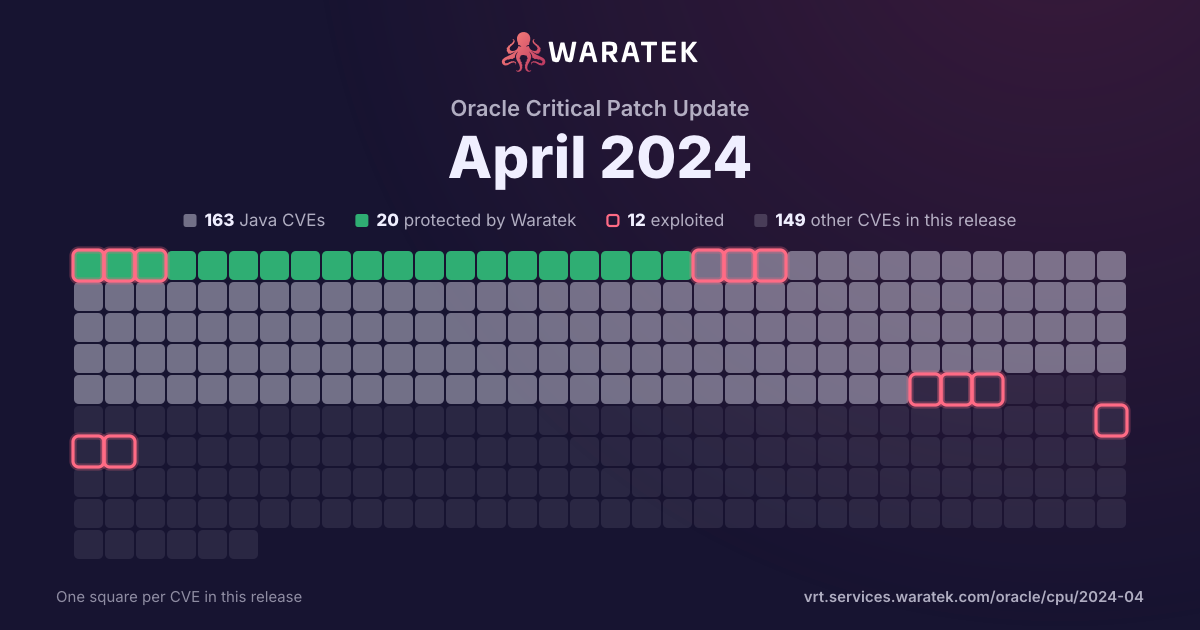
By status
20Protected by Waratek6Mitigation candidate137No exploit published40Outside Waratek scope108Not applicable1Withdrawn CVE
12Exploited, marked by the ring
No exploit published. For 82 of them, Oracle's security advisory is the source of public detail.
Protected by Waratek. Waratek RASP can block exploitation of these on systems that have not applied the patch yet.
Overview 7 matches · 2 in Waratek scope · 0 protected · 5 CISA KEV · 6 public PoC · 4 EPSS ≥ 0.5
Protected by Waratek
0
0.0%
Rule in development
0
0.0%
Mitigation candidate
2
28.6%
No exploit published
0
0.0%
Outside Waratek scope
2
28.6%
Not applicable
3
42.9%
Withdrawn CVE
0
0.0%
blocked by ARMR today
0
0.0%
partly blocked
0
0.0%
not blocked
7
100.0%
not established
0
0.0%
unrecorded
0
0.0%
Exploited
7
100.0%
Working exploit published
0
0.0%
Proof of concept only
0
0.0%
Forecast only
0
0.0%
No public exploit
0
0.0%
split by
peak 2 / month
Sep 232
Outside Waratek scope2
High2
not blocked2
Exploited2
Oct 232
Mitigation candidate1
Not applicable1
High2
not blocked2
Exploited2
Nov 231
Not applicable1
High1
not blocked1
Exploited1
Dec 230
Jan 241
Not applicable1
High1
not blocked1
Exploited1
Feb 241
Mitigation candidate1
High1
not blocked1
Exploited1
Sep 23Oct 23Nov 23Dec 23Jan 24Feb 24
| CVE | Severity | Published▾ | Status | Exploitation | Description |
|---|---|---|---|---|---|
| CVE-2023-50386 | High | 2024-02-09 | Mitigation candidate | Exploited | Improper Control of Dynamically-Managed Code Resources, Unrestricted Upload of File with Dangerous Type, Inclusion of Functionality from Untrusted Control Sphere vulnerability in Apache Solr.This issue affects Apache Solr: from 6.0.0 through 8.11.2, from 9.0.0 before 9.4.1. In the affected versions, Solr ConfigSets accepted Java jar and class files to be uploaded through the ConfigSets API. When backing up Solr Collections, these configSet files would be saved to disk when using the LocalFileSystemRepository (the default for backups). If the backup was saved to a directory that Solr uses in its ClassPath/ClassLoaders, then the jar and class files would be available to use with any ConfigSet, trusted or untrusted. When Solr is run in a secure way (Authorization enabled), as is strongly suggested, this vulnerability is limited to extending the Backup permissions with the ability to add libraries. Users are recommended to upgrade to version 8.11.3 or 9.4.1, which fix the issue. In these versions, the following protections have been added: * Users are no longer able to upload files to a configSet that could be executed via a Java ClassLoader. * The Backup API restricts saving backups to directories that are used in the ClassLoader. |
| CVE-2024-21626 | High | 2024-01-31 | Not applicable | Exploited | runc is a CLI tool for spawning and running containers on Linux according to the OCI specification. In runc 1.1.11 and earlier, due to an internal file descriptor leak, an attacker could cause a newly-spawned container process (from runc exec) to have a working directory in the host filesystem namespace, allowing for a container escape by giving access to the host filesystem ("attack 2"). The same attack could be used by a malicious image to allow a container process to gain access to the host filesystem through runc run ("attack 1"). Variants of attacks 1 and 2 could be also be used to overwrite semi-arbitrary host binaries, allowing for complete container escapes ("attack 3a" and "attack 3b"). runc 1.1.12 includes patches for this issue. |
| CVE-2023-42917 | High | 2023-11-30 | Not applicable | Exploited | A memory corruption vulnerability was addressed with improved locking. This issue is fixed in iOS 17.1.2 and iPadOS 17.1.2, macOS Sonoma 14.1.2, Safari 17.1.2. Processing web content may lead to arbitrary code execution. Apple is aware of a report that this issue may have been exploited against versions of iOS before iOS 16.7.1. |
| CVE-2023-44487 | High | 2023-10-10 | Mitigation candidate | Exploited | The HTTP/2 protocol allows a denial of service (server resource consumption) because request cancellation can reset many streams quickly, as exploited in the wild in August through October 2023. |
| CVE-2023-4911 | High | 2023-10-03 | Not applicable | Exploited | A buffer overflow was discovered in the GNU C Library's dynamic loader ld.so while processing the GLIBC_TUNABLES environment variable. This issue could allow a local attacker to use maliciously crafted GLIBC_TUNABLES environment variables when launching binaries with SUID permission to execute code with elevated privileges. |
| CVE-2023-41993 | High | 2023-09-21 | Outside Waratek scope | Exploited | The issue was addressed with improved checks. This issue is fixed in macOS Sonoma 14. Processing web content may lead to arbitrary code execution. Apple is aware of a report that this issue may have been actively exploited against versions of iOS before iOS 16.7. |
| CVE-2023-4863 | High | 2023-09-12 | Outside Waratek scope | Exploited | Heap buffer overflow in libwebp in Google Chrome prior to 116.0.5845.187 and libwebp 1.3.2 allowed a remote attacker to perform an out of bounds memory write via a crafted HTML page. (Chromium security severity: Critical) |