
Oracle Critical Patch Update April 2024
Released April 2024 · Oracle's advisory ↗ · ← Critical Patch Update, January 2024 · Critical Patch Update, July 2024 →
312 CVEs in this release, one square each
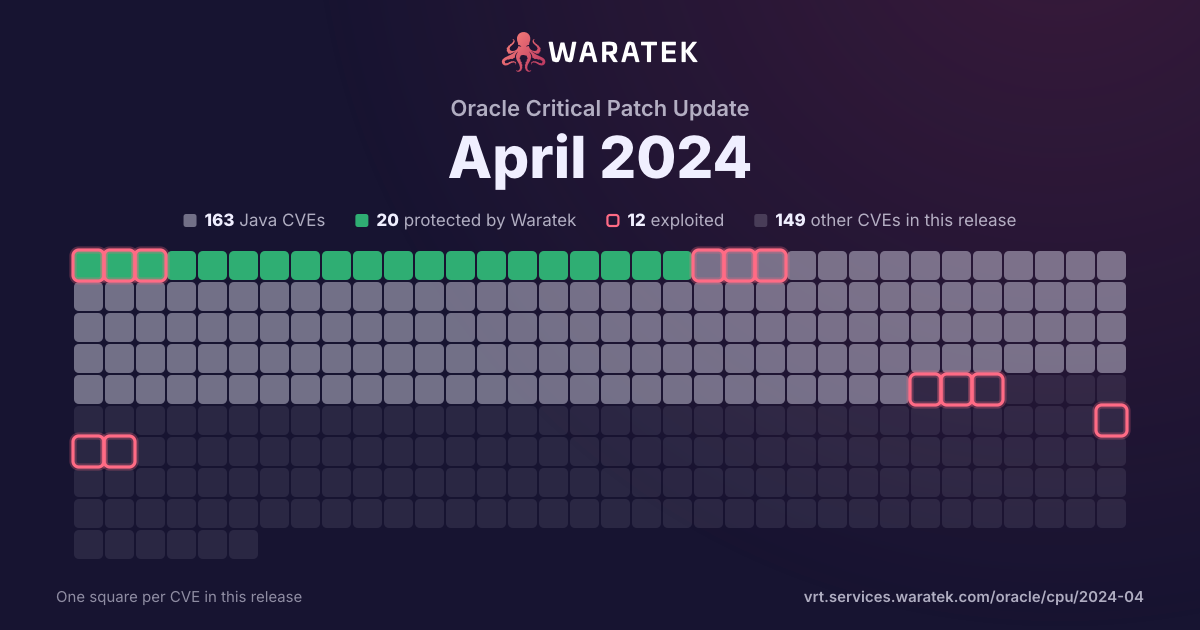
By status
20Protected by Waratek6Mitigation candidate137No exploit published40Outside Waratek scope108Not applicable1Withdrawn CVE
12Exploited, marked by the ring
No exploit published. For 82 of them, Oracle's security advisory is the source of public detail.
Protected by Waratek. Waratek RASP can block exploitation of these on systems that have not applied the patch yet.
Overview 18 matches · 9 in Waratek scope · 4 protected · 10 exploited · 5 CISA KEV · 10 EPSS ≥ 0.5
Protected by Waratek
4
22.2%
Rule in development
0
0.0%
Mitigation candidate
5
27.8%
No exploit published
0
0.0%
Outside Waratek scope
4
22.2%
Not applicable
5
27.8%
Withdrawn CVE
0
0.0%
blocked by ARMR today
4
22.2%
partly blocked
0
0.0%
not blocked
14
77.8%
not established
0
0.0%
unrecorded
0
0.0%
Exploited
10
55.6%
Working exploit published
2
11.1%
Proof of concept only
6
33.3%
Forecast only
0
0.0%
No public exploit
0
0.0%
split by
peak 5 / quarter
Q3 221
Protected by Waratek1
High1
blocked by ARMR today1
Proof of concept only1
Q4 223
Protected by Waratek2
Mitigation candidate1
Critical3
blocked by ARMR today2
not blocked1
Exploited2
Proof of concept only1
Q1 230
Q2 230
Q3 233
Mitigation candidate1
Outside Waratek scope2
High2
Medium1
not blocked3
Exploited2
Proof of concept only1
Q4 235
Protected by Waratek1
Mitigation candidate1
Outside Waratek scope2
Not applicable1
Critical2
High2
Medium1
blocked by ARMR today1
not blocked4
Exploited4
Proof of concept only1
Q1 244
Mitigation candidate1
Not applicable3
High4
not blocked4
Exploited2
Working exploit published1
Proof of concept only1
Q2 242
Mitigation candidate1
Not applicable1
High2
not blocked2
Working exploit published1
Proof of concept only1
Q3 22Q4 22Q1 23Q2 23Q3 23Q4 23Q1 24Q2 24
| CVE | Severity | Published▾ | Status | Exploitation | Description |
|---|---|---|---|---|---|
| CVE-2024-21111 | High | 2024-04-16 | Not applicable | Working exploit published | Vulnerability in the Oracle VM VirtualBox product of Oracle Virtualization (component: Core). Supported versions that are affected are Prior to 7.0.16. Easily exploitable vulnerability allows low privileged attacker with logon to the infrastructure where Oracle VM VirtualBox executes to compromise Oracle VM VirtualBox. Successful attacks of this vulnerability can result in takeover of Oracle VM VirtualBox. Note: This vulnerability applies to Windows hosts only. CVSS 3.1 Base Score 7.8 (Confidentiality, Integrity and Availability impacts). CVSS Vector: (CVSS:3.1/AV:L/AC:L/PR:L/UI:N/S:U/C:H/I:H/A:H). |
| CVE-2024-21006 | High | 2024-04-16 | Mitigation candidate | Proof of concept only | Vulnerability in the Oracle WebLogic Server product of Oracle Fusion Middleware (component: Core). Supported versions that are affected are 12.2.1.4.0 and 14.1.1.0.0. Easily exploitable vulnerability allows unauthenticated attacker with network access via T3, IIOP to compromise Oracle WebLogic Server. Successful attacks of this vulnerability can result in unauthorized access to critical data or complete access to all Oracle WebLogic Server accessible data. CVSS 3.1 Base Score 7.5 (Confidentiality impacts). CVSS Vector: (CVSS:3.1/AV:N/AC:L/PR:N/UI:N/S:U/C:H/I:N/A:N). |
| CVE-2024-22243 | High | 2024-02-23 | Not applicable | Proof of concept only | Applications that use UriComponentsBuilder to parse an externally provided URL (e.g. through a query parameter) AND perform validation checks on the host of the parsed URL may be vulnerable to a open redirect https://cwe.mitre.org/data/definitions/601.html attack or to a SSRF attack if the URL is used after passing validation checks. |
| CVE-2023-50386 | High | 2024-02-09 | Mitigation candidate | Exploited | Improper Control of Dynamically-Managed Code Resources, Unrestricted Upload of File with Dangerous Type, Inclusion of Functionality from Untrusted Control Sphere vulnerability in Apache Solr.This issue affects Apache Solr: from 6.0.0 through 8.11.2, from 9.0.0 before 9.4.1. In the affected versions, Solr ConfigSets accepted Java jar and class files to be uploaded through the ConfigSets API. When backing up Solr Collections, these configSet files would be saved to disk when using the LocalFileSystemRepository (the default for backups). If the backup was saved to a directory that Solr uses in its ClassPath/ClassLoaders, then the jar and class files would be available to use with any ConfigSet, trusted or untrusted. When Solr is run in a secure way (Authorization enabled), as is strongly suggested, this vulnerability is limited to extending the Backup permissions with the ability to add libraries. Users are recommended to upgrade to version 8.11.3 or 9.4.1, which fix the issue. In these versions, the following protections have been added: * Users are no longer able to upload files to a configSet that could be executed via a Java ClassLoader. * The Backup API restricts saving backups to directories that are used in the ClassLoader. |
| CVE-2024-21626 | High | 2024-01-31 | Not applicable | Exploited | runc is a CLI tool for spawning and running containers on Linux according to the OCI specification. In runc 1.1.11 and earlier, due to an internal file descriptor leak, an attacker could cause a newly-spawned container process (from runc exec) to have a working directory in the host filesystem namespace, allowing for a container escape by giving access to the host filesystem ("attack 2"). The same attack could be used by a malicious image to allow a container process to gain access to the host filesystem through runc run ("attack 1"). Variants of attacks 1 and 2 could be also be used to overwrite semi-arbitrary host binaries, allowing for complete container escapes ("attack 3a" and "attack 3b"). runc 1.1.12 includes patches for this issue. |
| CVE-2023-6246 | High | 2024-01-31 | Not applicable | Working exploit published | A heap-based buffer overflow was found in the __vsyslog_internal function of the glibc library. This function is called by the syslog and vsyslog functions. This issue occurs when the openlog function was not called, or called with the ident argument set to NULL, and the program name (the basename of argv[0]) is bigger than 1024 bytes, resulting in an application crash or local privilege escalation. This issue affects glibc 2.36 and newer. |
| CVE-2023-48795 | Medium | 2023-12-18 | Outside Waratek scope | Exploited | The SSH transport protocol with certain OpenSSH extensions, found in OpenSSH before 9.6 and other products, allows remote attackers to bypass integrity checks such that some packets are omitted (from the extension negotiation message), and a client and server may consequently end up with a connection for which some security features have been downgraded or disabled, aka a Terrapin attack. This occurs because the SSH Binary Packet Protocol (BPP), implemented by these extensions, mishandles the handshake phase and mishandles use of sequence numbers. For example, there is an effective attack against SSH's use of ChaCha20-Poly1305 (and CBC with Encrypt-then-MAC). The bypass occurs in chacha20-poly1305@openssh.com and (if CBC is used) the -etm@openssh.com MAC algorithms. This also affects Maverick Synergy Java SSH API before 3.1.0-SNAPSHOT, Dropbear through 2022.83, Ssh before 5.1.1 in Erlang/OTP, PuTTY before 0.80, AsyncSSH before 2.14.2, golang.org/x/crypto before 0.17.0, libssh before 0.10.6, libssh2 through 1.11.0, Thorn Tech SFTP Gateway before 3.4.6, Tera Term before 5.1, Paramiko before 3.4.0, jsch before 0.2.15, SFTPGo before 2.5.6, Netgate pfSense Plus through 23.09.1, Netgate pfSense CE through 2.7.2, HPN-SSH through 18.2.0, ProFTPD before 1.3.8b (and before 1.3.9rc2), ORYX CycloneSSH before 2.3.4, NetSarang XShell 7 before Build 0144, CrushFTP before 10.6.0, ConnectBot SSH library before 2.2.22, Apache MINA sshd through 2.11.0, sshj through 0.37.0, TinySSH through 20230101, trilead-ssh2 6401, LANCOM LCOS and LANconfig, FileZilla before 3.66.4, Nova before 11.8, PKIX-SSH before 14.4, SecureCRT before 9.4.3, Transmit5 before 5.10.4, Win32-OpenSSH before 9.5.0.0p1-Beta, WinSCP before 6.2.2, Bitvise SSH Server before 9.32, Bitvise SSH Client before 9.33, KiTTY through 0.76.1.13, the net-ssh gem 7.2.0 for Ruby, the mscdex ssh2 module before 1.15.0 for Node.js, the thrussh library before 0.35.1 for Rust, and the Russh crate before 0.40.2 for Rust. |
| CVE-2023-46604 | Critical | 2023-10-27 | Protected by Waratek | Exploited | The Java OpenWire protocol marshaller is vulnerable to Remote Code Execution. This vulnerability may allow a remote attacker with network access to either a Java-based OpenWire broker or client to run arbitrary shell commands by manipulating serialized class types in the OpenWire protocol to cause either the client or the broker (respectively) to instantiate any class on the classpath. Users are recommended to upgrade both brokers and clients to version 5.15.16, 5.16.7, 5.17.6, or 5.18.3 which fixes this issue. |
| CVE-2023-38545 | Critical | 2023-10-18 | Outside Waratek scope | Proof of concept only | This flaw makes curl overflow a heap based buffer in the SOCKS5 proxy handshake. When curl is asked to pass along the host name to the SOCKS5 proxy to allow that to resolve the address instead of it getting done by curl itself, the maximum length that host name can be is 255 bytes. If the host name is detected to be longer, curl switches to local name resolving and instead passes on the resolved address only. Due to this bug, the local variable that means "let the host resolve the name" could get the wrong value during a slow SOCKS5 handshake, and contrary to the intention, copy the too long host name to the target buffer instead of copying just the resolved address there. The target buffer being a heap based buffer, and the host name coming from the URL that curl has been told to operate with. |
| CVE-2023-44487 | High | 2023-10-10 | Mitigation candidate | Exploited | The HTTP/2 protocol allows a denial of service (server resource consumption) because request cancellation can reset many streams quickly, as exploited in the wild in August through October 2023. |
| CVE-2023-4911 | High | 2023-10-03 | Not applicable | Exploited | A buffer overflow was discovered in the GNU C Library's dynamic loader ld.so while processing the GLIBC_TUNABLES environment variable. This issue could allow a local attacker to use maliciously crafted GLIBC_TUNABLES environment variables when launching binaries with SUID permission to execute code with elevated privileges. |
| CVE-2023-41993 | High | 2023-09-21 | Outside Waratek scope | Exploited | The issue was addressed with improved checks. This issue is fixed in macOS Sonoma 14. Processing web content may lead to arbitrary code execution. Apple is aware of a report that this issue may have been actively exploited against versions of iOS before iOS 16.7. |
| CVE-2023-4863 | High | 2023-09-12 | Outside Waratek scope | Exploited | Heap buffer overflow in libwebp in Google Chrome prior to 116.0.5845.187 and libwebp 1.3.2 allowed a remote attacker to perform an out of bounds memory write via a crafted HTML page. (Chromium security severity: Critical) |
| CVE-2023-41080 | Medium | 2023-08-25 | Mitigation candidate | Proof of concept only | URL Redirection to Untrusted Site ('Open Redirect') vulnerability in FORM authentication feature Apache Tomcat.This issue affects Apache Tomcat: from 11.0.0-M1 through 11.0.0-M10, from 10.1.0-M1 through 10.0.12, from 9.0.0-M1 through 9.0.79 and from 8.5.0 through 8.5.92. Older, EOL versions may also be affected. The vulnerability is limited to the ROOT (default) web application. |
| CVE-2022-46364 | Critical | 2022-12-13 | Mitigation candidate | Proof of concept only | A SSRF vulnerability in parsing the href attribute of XOP:Include in MTOM requests in versions of Apache CXF before 3.5.5 and 3.4.10 allows an attacker to perform SSRF style attacks on webservices that take at least one parameter of any type. |
| CVE-2022-1471 | Critical | 2022-12-01 | Protected by Waratek | Exploited | SnakeYaml's Constructor() class does not restrict types which can be instantiated during deserialization. Deserializing yaml content provided by an attacker can lead to remote code execution. We recommend using SnakeYaml's SafeConsturctor when parsing untrusted content to restrict deserialization. We recommend upgrading to version 2.0 and beyond. |
| CVE-2022-42889 | Critical | 2022-10-13 | Protected by Waratek | Exploited | Apache Commons Text performs variable interpolation, allowing properties to be dynamically evaluated and expanded. The standard format for interpolation is "${prefix:name}", where "prefix" is used to locate an instance of org.apache.commons.text.lookup.StringLookup that performs the interpolation. Starting with version 1.5 and continuing through 1.9, the set of default Lookup instances included interpolators that could result in arbitrary code execution or contact with remote servers. These lookups are: - "script" - execute expressions using the JVM script execution engine (javax.script) - "dns" - resolve dns records - "url" - load values from urls, including from remote servers Applications using the interpolation defaults in the affected versions may be vulnerable to remote code execution or unintentional contact with remote servers if untrusted configuration values are used. Users are recommended to upgrade to Apache Commons Text 1.10.0, which disables the problematic interpolators by default. |
| CVE-2022-34169 | High | 2022-07-19 | Protected by Waratek | Proof of concept only | The Apache Xalan Java XSLT library is vulnerable to an integer truncation issue when processing malicious XSLT stylesheets. This can be used to corrupt Java class files generated by the internal XSLTC compiler and execute arbitrary Java bytecode. Users are recommended to update to version 2.7.3 or later. Note: Java runtimes (such as OpenJDK) include repackaged copies of Xalan. |