
Oracle Critical Patch Update January 2024
Released January 2024 · Oracle's advisory ↗ · ← Critical Patch Update, October 2023 · Critical Patch Update, April 2024 →
236 CVEs in this release, one square each
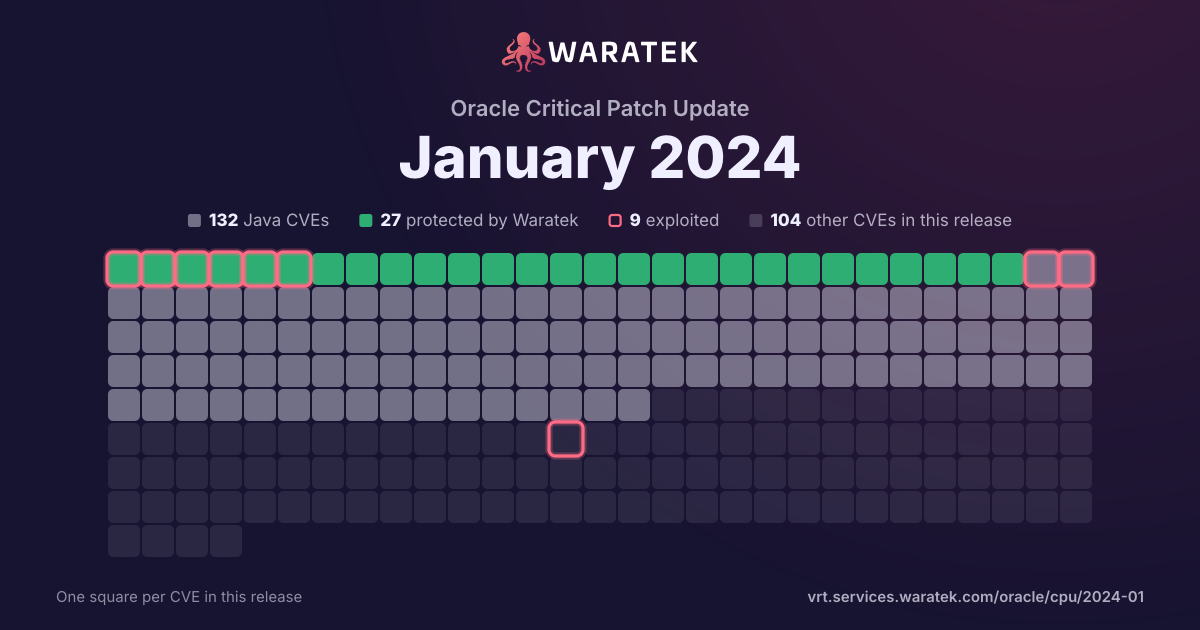
By status
22Protected by Waratek8Mitigation candidate105No exploit published10Outside Waratek scope91Not applicable
9Exploited, marked by the ring
No exploit published. For 38 of them, Oracle's security advisory is the source of public detail.
Protected by Waratek. Waratek RASP can block exploitation of these on systems that have not applied the patch yet.
Overview 3 matches · 2 protected · 0 exploited · 0 CISA KEV · 2 public PoC · 0 EPSS ≥ 0.5
Protected by Waratek
2
66.7%
Rule in development
0
0.0%
Mitigation candidate
1
33.3%
No exploit published
0
0.0%
blocked by ARMR today
2
66.7%
partly blocked
0
0.0%
not blocked
1
33.3%
not established
0
0.0%
unrecorded
0
0.0%
Exploited
0
0.0%
Working exploit published
0
0.0%
Proof of concept only
3
100.0%
Forecast only
0
0.0%
No public exploit
0
0.0%
split by
peak 1 / month
Sep 221
Protected by Waratek1
Critical1
blocked by ARMR today1
Proof of concept only1
Oct 221
Mitigation candidate1
Critical1
not blocked1
Proof of concept only1
Nov 220
Dec 220
Jan 230
Feb 230
Mar 230
Apr 230
May 230
Jun 230
Jul 230
Aug 230
Sep 230
Oct 230
Nov 230
Dec 231
Protected by Waratek1
Critical1
blocked by ARMR today1
Proof of concept only1
Oct 22Dec 22Feb 23Apr 23Jun 23Aug 23Oct 23Dec 23
| CVE | Severity | Published▾ | Status | Exploitation | Description |
|---|---|---|---|---|---|
| CVE-2023-49093 | Critical | 2023-12-04 | Protected by Waratek | Proof of concept only | HtmlUnit is a GUI-less browser for Java programs. HtmlUnit is vulnerable to Remote Code Execution (RCE) via XSTL, when browsing the attacker’s webpage. This vulnerability has been patched in version 3.9.0 |
| CVE-2022-31692 | Critical | 2022-10-31 | Mitigation candidate | Proof of concept only | Spring Security, versions 5.7 prior to 5.7.5 and 5.6 prior to 5.6.9 could be susceptible to authorization rules bypass via forward or include dispatcher types. Specifically, an application is vulnerable when all of the following are true: The application expects that Spring Security applies security to forward and include dispatcher types. The application uses the AuthorizationFilter either manually or via the authorizeHttpRequests() method. The application configures the FilterChainProxy to apply to forward and/or include requests (e.g. spring.security.filter.dispatcher-types = request, error, async, forward, include). The application may forward or include the request to a higher privilege-secured endpoint.The application configures Spring Security to apply to every dispatcher type via authorizeHttpRequests().shouldFilterAllDispatcherTypes(true) |
| CVE-2022-36944 | Critical | 2022-09-23 | Protected by Waratek | Proof of concept only | Scala 2.13.x before 2.13.9 has a Java deserialization chain in its JAR file. On its own, it cannot be exploited. There is only a risk in conjunction with Java object deserialization within an application. In such situations, it allows attackers to erase contents of arbitrary files, make network connections, or possibly run arbitrary code (specifically, Function0 functions) via a gadget chain. |