
Oracle Critical Patch Update January 2024
Released January 2024 · Oracle's advisory ↗ · ← Critical Patch Update, October 2023 · Critical Patch Update, April 2024 →
236 CVEs in this release, one square each
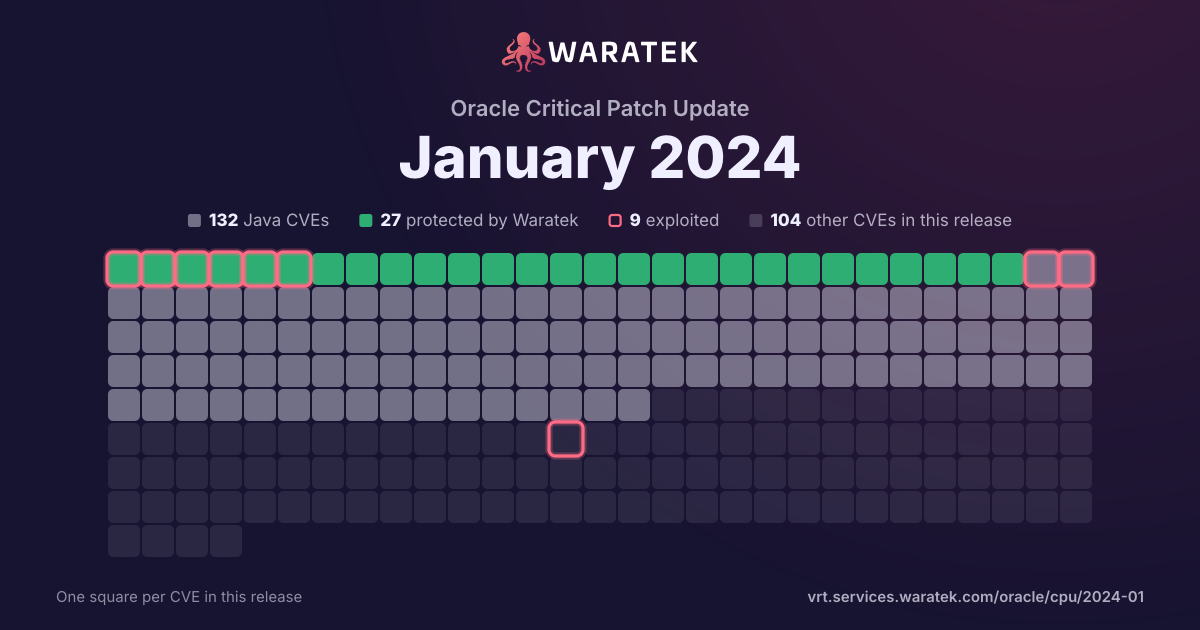
By status
21Protected by Waratek2Rule in development6Mitigation candidate103No exploit published9Outside Waratek scope95Not applicable
9Exploited, marked by the ring
No exploit published. For 38 of them, Oracle's security advisory is the source of public detail.
Protected by Waratek. Waratek RASP can block exploitation of these on systems that have not applied the patch yet.
Overview 36 matches · 10 protected · 3 exploited · 1 CISA KEV · 6 public PoC · 3 EPSS ≥ 0.5
Protected by Waratek
10
27.8%
Rule in development
1
2.8%
Mitigation candidate
1
2.8%
No exploit published
24
66.7%
blocked by ARMR today
10
27.8%
partly blocked
0
0.0%
not blocked
26
72.2%
not established
0
0.0%
unrecorded
0
0.0%
Exploited
3
8.3%
Working exploit published
0
0.0%
Proof of concept only
6
16.7%
Forecast only
0
0.0%
No public exploit
27
75.0%
split by
peak 9 / quarter
Q3 191
Protected by Waratek1
High1
blocked by ARMR today1
No public exploit1
Q4 190
Q1 200
Q2 201
Protected by Waratek1
High1
blocked by ARMR today1
Exploited1
Q3 201
No exploit published1
Medium1
not blocked1
No public exploit1
Q4 201
Protected by Waratek1
Medium1
blocked by ARMR today1
No public exploit1
Q1 210
Q2 211
Protected by Waratek1
Medium1
blocked by ARMR today1
No public exploit1
Q3 214
No exploit published4
High4
not blocked4
No public exploit4
Q4 210
Q1 220
Q2 224
Protected by Waratek1
No exploit published3
High2
Medium1
Low1
blocked by ARMR today1
not blocked3
No public exploit4
Q3 223
Protected by Waratek3
Critical1
High1
Medium1
blocked by ARMR today3
Proof of concept only3
Q4 229
Protected by Waratek2
Mitigation candidate1
No exploit published6
Critical3
High5
Medium1
blocked by ARMR today2
not blocked7
Exploited1
Proof of concept only1
No public exploit7
Q1 234
Rule in development1
No exploit published3
High4
not blocked4
Exploited1
Proof of concept only2
No public exploit1
Q2 234
No exploit published4
High3
Medium1
not blocked4
No public exploit4
Q3 233
No exploit published3
Critical1
High1
Medium1
not blocked3
No public exploit3
Q3 19Q1 20Q3 20Q1 21Q3 21Q1 22Q3 22Q1 23Q3 23
| CVE | Severity | Published▾ | Status | Exploitation | Description |
|---|---|---|---|---|---|
| CVE-2023-34034 | Critical | 2023-07-19 | No exploit published | No public exploit | Using "**" as a pattern in Spring Security configuration for WebFlux creates a mismatch in pattern matching between Spring Security and Spring WebFlux, and the potential for a security bypass. |
| CVE-2023-34035 | High | 2023-07-18 | No exploit published | No public exploit | Spring Security versions 5.8 prior to 5.8.5, 6.0 prior to 6.0.5, and 6.1 prior to 6.1.2 could be susceptible to authorization rule misconfiguration if the application uses requestMatchers(String) and multiple servlets, one of them being Spring MVC’s DispatcherServlet. (DispatcherServlet is a Spring MVC component that maps HTTP endpoints to methods on @Controller-annotated classes.) Specifically, an application is vulnerable when all of the following are true: * Spring MVC is on the classpath * Spring Security is securing more than one servlet in a single application (one of them being Spring MVC’s DispatcherServlet) * The application uses requestMatchers(String) to refer to endpoints that are not Spring MVC endpoints An application is not vulnerable if any of the following is true: * The application does not have Spring MVC on the classpath * The application secures no servlets other than Spring MVC’s DispatcherServlet * The application uses requestMatchers(String) only for Spring MVC endpoints |
| CVE-2023-33201 | Medium | 2023-07-05 | No exploit published | No public exploit | Bouncy Castle For Java before 1.74 is affected by an LDAP injection vulnerability. The vulnerability only affects applications that use an LDAP CertStore from Bouncy Castle to validate X.509 certificates. During the certificate validation process, Bouncy Castle inserts the certificate's Subject Name into an LDAP search filter without any escaping, which leads to an LDAP injection vulnerability. |
| CVE-2023-34462 | Medium | 2023-06-22 | No exploit published | No public exploit | Netty is an asynchronous event-driven network application framework for rapid development of maintainable high performance protocol servers & clients. The `SniHandler` can allocate up to 16MB of heap for each channel during the TLS handshake. When the handler or the channel does not have an idle timeout, it can be used to make a TCP server using the `SniHandler` to allocate 16MB of heap. The `SniHandler` class is a handler that waits for the TLS handshake to configure a `SslHandler` according to the indicated server name by the `ClientHello` record. For this matter it allocates a `ByteBuf` using the value defined in the `ClientHello` record. Normally the value of the packet should be smaller than the handshake packet but there are not checks done here and the way the code is written, it is possible to craft a packet that makes the `SslClientHelloHandler`. This vulnerability has been fixed in version 4.1.94.Final. |
| CVE-2023-34981 | High | 2023-06-21 | No exploit published | No public exploit | A regression in the fix for bug 66512 in Apache Tomcat 11.0.0-M5, 10.1.8, 9.0.74 and 8.5.88 meant that, if a response did not include any HTTP headers no AJP SEND_HEADERS messare woudl be sent for the response which in turn meant that at least one AJP proxy (mod_proxy_ajp) would use the response headers from the previous request leading to an information leak. |
| CVE-2023-2976 | High | 2023-06-14 | No exploit published | No public exploit | Use of Java's default temporary directory for file creation in `FileBackedOutputStream` in Google Guava versions 1.0 to 31.1 on Unix systems and Android Ice Cream Sandwich allows other users and apps on the machine with access to the default Java temporary directory to be able to access the files created by the class. Even though the security vulnerability is fixed in version 32.0.0, we recommend using version 32.0.1 as version 32.0.0 breaks some functionality under Windows. |
| CVE-2023-20883 | High | 2023-05-26 | No exploit published | No public exploit | In Spring Boot versions 3.0.0 - 3.0.6, 2.7.0 - 2.7.11, 2.6.0 - 2.6.14, 2.5.0 - 2.5.14 and older unsupported versions, there is potential for a denial-of-service (DoS) attack if Spring MVC is used together with a reverse proxy cache. |
| CVE-2023-1436 | High | 2023-03-22 | No exploit published | Proof of concept only | An infinite recursion is triggered in Jettison when constructing a JSONArray from a Collection that contains a self-reference in one of its elements. This leads to a StackOverflowError exception being thrown. |
| CVE-2023-1370 | High | 2023-03-22 | No exploit published | Proof of concept only | [Json-smart](https://netplex.github.io/json-smart/) is a performance focused, JSON processor lib. When reaching a ‘[‘ or ‘{‘ character in the JSON input, the code parses an array or an object respectively. It was discovered that the code does not have any limit to the nesting of such arrays or objects. Since the parsing of nested arrays and objects is done recursively, nesting too many of them can cause a stack exhaustion (stack overflow) and crash the software. |
| CVE-2023-24998 | High | 2023-02-20 | No exploit published | No public exploit | Apache Commons FileUpload before 1.5 does not limit the number of request parts to be processed resulting in the possibility of an attacker triggering a DoS with a malicious upload or series of uploads. Note that, like all of the file upload limits, the new configuration option (FileUploadBase#setFileCountMax) is not enabled by default and must be explicitly configured. |
| CVE-2023-25194 | High | 2023-02-07 | Rule in development | Exploited | A possible security vulnerability has been identified in Apache Kafka Connect API. This requires access to a Kafka Connect worker, and the ability to create/modify connectors on it with an arbitrary Kafka client SASL JAAS config and a SASL-based security protocol, which has been possible on Kafka Connect clusters since Apache Kafka Connect 2.3.0. When configuring the connector via the Kafka Connect REST API, an authenticated operator can set the `sasl.jaas.config` property for any of the connector's Kafka clients to "com.sun.security.auth.module.JndiLoginModule", which can be done via the `producer.override.sasl.jaas.config`, `consumer.override.sasl.jaas.config`, or `admin.override.sasl.jaas.config` properties. This will allow the server to connect to the attacker's LDAP server and deserialize the LDAP response, which the attacker can use to execute java deserialization gadget chains on the Kafka connect server. Attacker can cause unrestricted deserialization of untrusted data (or) RCE vulnerability when there are gadgets in the classpath. Since Apache Kafka 3.0.0, users are allowed to specify these properties in connector configurations for Kafka Connect clusters running with out-of-the-box configurations. Before Apache Kafka 3.0.0, users may not specify these properties unless the Kafka Connect cluster has been reconfigured with a connector client override policy that permits them. Since Apache Kafka 3.4.0, we have added a system property ("-Dorg.apache.kafka.disallowed.login.modules") to disable the problematic login modules usage in SASL JAAS configuration. Also by default "com.sun.security.auth.module.JndiLoginModule" is disabled in Apache Kafka Connect 3.4.0. We advise the Kafka Connect users to validate connector configurations and only allow trusted JNDI configurations. Also examine connector dependencies for vulnerable versions and either upgrade their connectors, upgrading that specific dependency, or removing the connectors as options for remediation. Finally, in addition to leveraging the "org.apache.kafka.disallowed.login.modules" system property, Kafka Connect users can also implement their own connector client config override policy, which can be used to control which Kafka client properties can be overridden directly in a connector config and which cannot. |
| CVE-2021-37533 | Medium | 2022-12-03 | No exploit published | No public exploit | Prior to Apache Commons Net 3.9.0, Net's FTP client trusts the host from PASV response by default. A malicious server can redirect the Commons Net code to use a different host, but the user has to connect to the malicious server in the first place. This may lead to leakage of information about services running on the private network of the client. The default in version 3.9.0 is now false to ignore such hosts, as cURL does. See https://issues.apache.org/jira/browse/NET-711. |
| CVE-2022-1471 | Critical | 2022-12-01 | Protected by Waratek | Exploited | SnakeYaml's Constructor() class does not restrict types which can be instantiated during deserialization. Deserializing yaml content provided by an attacker can lead to remote code execution. We recommend using SnakeYaml's SafeConsturctor when parsing untrusted content to restrict deserialization. We recommend upgrading to version 2.0 and beyond. |
| CVE-2022-42920 | Critical | 2022-11-07 | Protected by Waratek | No public exploit | Apache Commons BCEL has a number of APIs that would normally only allow changing specific class characteristics. However, due to an out-of-bounds writing issue, these APIs can be used to produce arbitrary bytecode. This could be abused in applications that pass attacker-controllable data to those APIs, giving the attacker more control over the resulting bytecode than otherwise expected. Update to Apache Commons BCEL 6.6.0. |
| CVE-2022-31692 | Critical | 2022-10-31 | Mitigation candidate | Proof of concept only | Spring Security, versions 5.7 prior to 5.7.5 and 5.6 prior to 5.6.9 could be susceptible to authorization rules bypass via forward or include dispatcher types. Specifically, an application is vulnerable when all of the following are true: The application expects that Spring Security applies security to forward and include dispatcher types. The application uses the AuthorizationFilter either manually or via the authorizeHttpRequests() method. The application configures the FilterChainProxy to apply to forward and/or include requests (e.g. spring.security.filter.dispatcher-types = request, error, async, forward, include). The application may forward or include the request to a higher privilege-secured endpoint.The application configures Spring Security to apply to every dispatcher type via authorizeHttpRequests().shouldFilterAllDispatcherTypes(true) |
| CVE-2022-31690 | High | 2022-10-31 | No exploit published | No public exploit | Spring Security, versions 5.7 prior to 5.7.5, and 5.6 prior to 5.6.9, and older unsupported versions could be susceptible to a privilege escalation under certain conditions. A malicious user or attacker can modify a request initiated by the Client (via the browser) to the Authorization Server which can lead to a privilege escalation on the subsequent approval. This scenario can happen if the Authorization Server responds with an OAuth2 Access Token Response containing an empty scope list (per RFC 6749, Section 5.1) on the subsequent request to the token endpoint to obtain the access token. |
| CVE-2022-42890 | High | 2022-10-25 | No exploit published | No public exploit | A vulnerability in Batik of Apache XML Graphics allows an attacker to run Java code from untrusted SVG via JavaScript. This issue affects Apache XML Graphics prior to 1.16. Users are recommended to upgrade to version 1.16. |
| CVE-2022-41704 | High | 2022-10-25 | No exploit published | No public exploit | A vulnerability in Batik of Apache XML Graphics allows an attacker to run untrusted Java code from an SVG. This issue affects Apache XML Graphics prior to 1.16. It is recommended to update to version 1.16. |
| CVE-2022-42004 | High | 2022-10-02 | No exploit published | No public exploit | In FasterXML jackson-databind before 2.13.4, resource exhaustion can occur because of a lack of a check in BeanDeserializer._deserializeFromArray to prevent use of deeply nested arrays. An application is vulnerable only with certain customized choices for deserialization. |
| CVE-2022-42003 | High | 2022-10-02 | No exploit published | No public exploit | In FasterXML jackson-databind before versions 2.13.4.1 and 2.12.17.1, resource exhaustion can occur because of a lack of a check in primitive value deserializers to avoid deep wrapper array nesting, when the UNWRAP_SINGLE_VALUE_ARRAYS feature is enabled. |
| CVE-2022-36944 | Critical | 2022-09-23 | Protected by Waratek | Proof of concept only | Scala 2.13.x before 2.13.9 has a Java deserialization chain in its JAR file. On its own, it cannot be exploited. There is only a risk in conjunction with Java object deserialization within an application. In such situations, it allows attackers to erase contents of arbitrary files, make network connections, or possibly run arbitrary code (specifically, Function0 functions) via a gadget chain. |
| CVE-2022-36033 | Medium | 2022-08-29 | Protected by Waratek | Proof of concept only | jsoup is a Java HTML parser, built for HTML editing, cleaning, scraping, and cross-site scripting (XSS) safety. jsoup may incorrectly sanitize HTML including `javascript:` URL expressions, which could allow XSS attacks when a reader subsequently clicks that link. If the non-default `SafeList.preserveRelativeLinks` option is enabled, HTML including `javascript:` URLs that have been crafted with control characters will not be sanitized. If the site that this HTML is published on does not set a Content Security Policy, an XSS attack is then possible. This issue is patched in jsoup 1.15.3. Users should upgrade to this version. Additionally, as the unsanitized input may have been persisted, old content should be cleaned again using the updated version. To remediate this issue without immediately upgrading: - disable `SafeList.preserveRelativeLinks`, which will rewrite input URLs as absolute URLs - ensure an appropriate [Content Security Policy](https://developer.mozilla.org/en-US/docs/Web/HTTP/CSP) is defined. (This should be used regardless of upgrading, as a defence-in-depth best practice.) |
| CVE-2022-34169 | High | 2022-07-19 | Protected by Waratek | Proof of concept only | The Apache Xalan Java XSLT library is vulnerable to an integer truncation issue when processing malicious XSLT stylesheets. This can be used to corrupt Java class files generated by the internal XSLTC compiler and execute arbitrary Java bytecode. Users are recommended to update to version 2.7.3 or later. Note: Java runtimes (such as OpenJDK) include repackaged copies of Xalan. |
| CVE-2022-33879 | Low | 2022-06-27 | No exploit published | No public exploit | The initial fixes in CVE-2022-30126 and CVE-2022-30973 for regexes in the StandardsExtractingContentHandler were insufficient, and we found a separate, new regex DoS in a different regex in the StandardsExtractingContentHandler. These are now fixed in 1.28.4 and 2.4.1. |
| CVE-2022-22979 | High | 2022-06-21 | No exploit published | No public exploit | In Spring Cloud Function versions prior to 3.2.6, it is possible for a user who directly interacts with framework provided lookup functionality to cause a denial-of-service condition due to the caching issue in the Function Catalog component of the framework. |
| CVE-2022-25647 | High | 2022-05-01 | Protected by Waratek | No public exploit | The package com.google.code.gson:gson before 2.8.9 are vulnerable to Deserialization of Untrusted Data via the writeReplace() method in internal classes, which may lead to DoS attacks. |
| CVE-2022-22969 | Medium | 2022-04-21 | No exploit published | No public exploit | <Issue Description> Spring Security OAuth versions 2.5.x prior to 2.5.2 and older unsupported versions are susceptible to a Denial-of-Service (DoS) attack via the initiation of the Authorization Request in an OAuth 2.0 Client application. A malicious user or attacker can send multiple requests initiating the Authorization Request for the Authorization Code Grant, which has the potential of exhausting system resources using a single session. This vulnerability exposes OAuth 2.0 Client applications only. |
| CVE-2021-36090 | High | 2021-07-13 | No exploit published | No public exploit | When reading a specially crafted ZIP archive, Compress can be made to allocate large amounts of memory that finally leads to an out of memory error even for very small inputs. This could be used to mount a denial of service attack against services that use Compress' zip package. |
| CVE-2021-35517 | High | 2021-07-13 | No exploit published | No public exploit | When reading a specially crafted TAR archive, Compress can be made to allocate large amounts of memory that finally leads to an out of memory error even for very small inputs. This could be used to mount a denial of service attack against services that use Compress' tar package. |
| CVE-2021-35516 | High | 2021-07-13 | No exploit published | No public exploit | When reading a specially crafted 7Z archive, Compress can be made to allocate large amounts of memory that finally leads to an out of memory error even for very small inputs. This could be used to mount a denial of service attack against services that use Compress' sevenz package. |
| CVE-2021-35515 | High | 2021-07-13 | No exploit published | No public exploit | When reading a specially crafted 7Z archive, the construction of the list of codecs that decompress an entry can result in an infinite loop. This could be used to mount a denial of service attack against services that use Compress' sevenz package. |
| CVE-2021-29425 | Medium | 2021-04-13 | Protected by Waratek | No public exploit | In Apache Commons IO before 2.7, When invoking the method FileNameUtils.normalize with an improper input string, like "//../foo", or "\\..\foo", the result would be the same value, thus possibly providing access to files in the parent directory, but not further above (thus "limited" path traversal), if the calling code would use the result to construct a path value. |
| CVE-2020-15250 | Medium | 2020-10-12 | Protected by Waratek | No public exploit | In JUnit4 from version 4.7 and before 4.13.1, the test rule TemporaryFolder contains a local information disclosure vulnerability. On Unix like systems, the system's temporary directory is shared between all users on that system. Because of this, when files and directories are written into this directory they are, by default, readable by other users on that same system. This vulnerability does not allow other users to overwrite the contents of these directories or files. This is purely an information disclosure vulnerability. This vulnerability impacts you if the JUnit tests write sensitive information, like API keys or passwords, into the temporary folder, and the JUnit tests execute in an environment where the OS has other untrusted users. Because certain JDK file system APIs were only added in JDK 1.7, this this fix is dependent upon the version of the JDK you are using. For Java 1.7 and higher users: this vulnerability is fixed in 4.13.1. For Java 1.6 and lower users: no patch is available, you must use the workaround below. If you are unable to patch, or are stuck running on Java 1.6, specifying the `java.io.tmpdir` system environment variable to a directory that is exclusively owned by the executing user will fix this vulnerability. For more information, including an example of vulnerable code, see the referenced GitHub Security Advisory. |
| CVE-2020-5421 | Medium | 2020-09-19 | No exploit published | No public exploit | In Spring Framework versions 5.2.0 - 5.2.8, 5.1.0 - 5.1.17, 5.0.0 - 5.0.18, 4.3.0 - 4.3.28, and older unsupported versions, the protections against RFD attacks from CVE-2015-5211 may be bypassed depending on the browser used through the use of a jsessionid path parameter. |
| CVE-2020-5410 | High | 2020-06-02 | Protected by Waratek | Exploited | Spring Cloud Config, versions 2.2.x prior to 2.2.3, versions 2.1.x prior to 2.1.9, and older unsupported versions allow applications to serve arbitrary configuration files through the spring-cloud-config-server module. A malicious user, or attacker, can send a request using a specially crafted URL that can lead to a directory traversal attack. |
| CVE-2019-10086 | High | 2019-08-20 | Protected by Waratek | No public exploit | In Apache Commons Beanutils 1.9.2, a special BeanIntrospector class was added which allows suppressing the ability for an attacker to access the classloader via the class property available on all Java objects. We, however were not using this by default characteristic of the PropertyUtilsBean. |