
Oracle Critical Patch Update January 2024
Released January 2024 · Oracle's advisory ↗ · ← Critical Patch Update, October 2023 · Critical Patch Update, April 2024 →
236 CVEs in this release, one square each
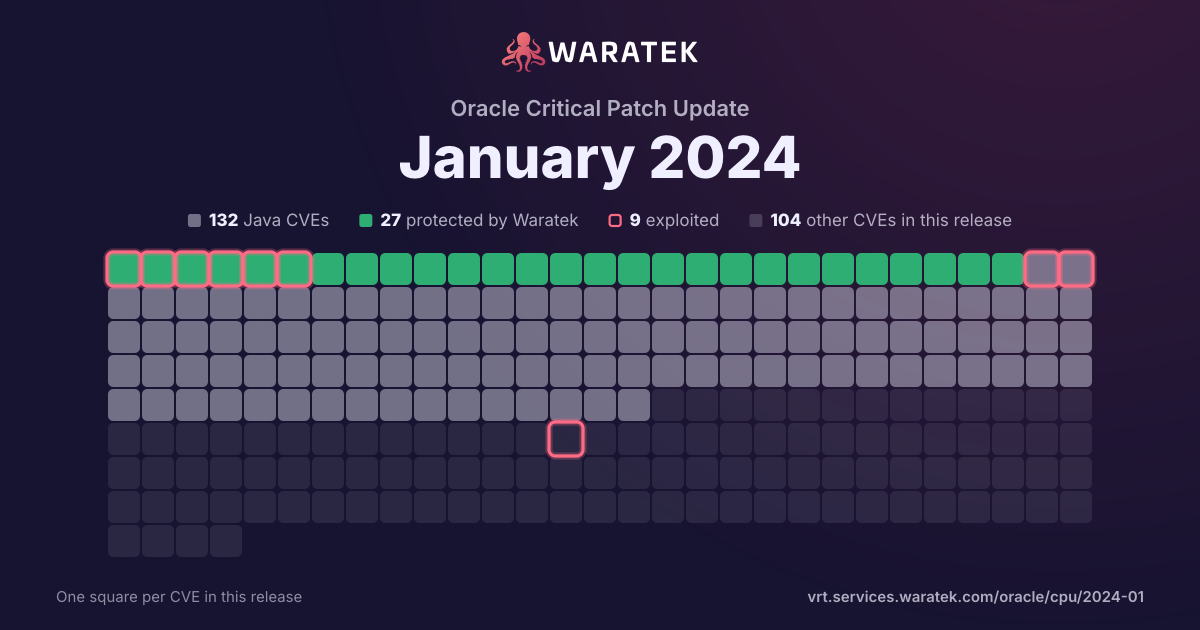
By status
27Protected by Waratek4Mitigation candidate101No exploit published26Outside Waratek scope78Not applicable
9Exploited, marked by the ring
No exploit published. For 47 of them, Oracle's security advisory is the source of public detail.
Protected by Waratek. Waratek RASP can block exploitation of these on systems that have not applied the patch yet.
Overview 8 matches · 2 exploited · 1 CISA KEV · 4 public PoC · 4 EPSS ≥ 0.5
Protected by Waratek
8
100.0%
Rule in development
0
0.0%
Mitigation candidate
0
0.0%
No exploit published
0
0.0%
blocked by ARMR today
8
100.0%
partly blocked
0
0.0%
not blocked
0
0.0%
not established
0
0.0%
unrecorded
0
0.0%
split by
peak 2 / quarter
Q4 211
Protected by Waratek1
Critical1
blocked by ARMR today1
No public exploit1
Q1 222
Protected by Waratek2
Critical2
blocked by ARMR today2
Working exploit published1
Proof of concept only1
Q2 220
Q3 221
Protected by Waratek1
Critical1
blocked by ARMR today1
Proof of concept only1
Q4 222
Protected by Waratek2
Critical2
blocked by ARMR today2
Exploited1
No public exploit1
Q1 230
Q2 230
Q3 230
Q4 232
Protected by Waratek2
Critical2
blocked by ARMR today2
Exploited1
Proof of concept only1
Q4 21Q1 22Q2 22Q3 22Q4 22Q1 23Q2 23Q3 23Q4 23
| CVE | Severity | Published▾ | Status | Exploitation | Description |
|---|---|---|---|---|---|
| CVE-2023-49093 | Critical | 2023-12-04 | Protected by Waratek | Proof of concept only | HtmlUnit is a GUI-less browser for Java programs. HtmlUnit is vulnerable to Remote Code Execution (RCE) via XSTL, when browsing the attacker’s webpage. This vulnerability has been patched in version 3.9.0 |
| CVE-2023-46604 | Critical | 2023-10-27 | Protected by Waratek | Exploited | The Java OpenWire protocol marshaller is vulnerable to Remote Code Execution. This vulnerability may allow a remote attacker with network access to either a Java-based OpenWire broker or client to run arbitrary shell commands by manipulating serialized class types in the OpenWire protocol to cause either the client or the broker (respectively) to instantiate any class on the classpath. Users are recommended to upgrade both brokers and clients to version 5.15.16, 5.16.7, 5.17.6, or 5.18.3 which fixes this issue. |
| CVE-2022-1471 | Critical | 2022-12-01 | Protected by Waratek | Exploited | SnakeYaml's Constructor() class does not restrict types which can be instantiated during deserialization. Deserializing yaml content provided by an attacker can lead to remote code execution. We recommend using SnakeYaml's SafeConsturctor when parsing untrusted content to restrict deserialization. We recommend upgrading to version 2.0 and beyond. |
| CVE-2022-42920 | Critical | 2022-11-07 | Protected by Waratek | No public exploit | Apache Commons BCEL has a number of APIs that would normally only allow changing specific class characteristics. However, due to an out-of-bounds writing issue, these APIs can be used to produce arbitrary bytecode. This could be abused in applications that pass attacker-controllable data to those APIs, giving the attacker more control over the resulting bytecode than otherwise expected. Update to Apache Commons BCEL 6.6.0. |
| CVE-2022-36944 | Critical | 2022-09-23 | Protected by Waratek | Proof of concept only | Scala 2.13.x before 2.13.9 has a Java deserialization chain in its JAR file. On its own, it cannot be exploited. There is only a risk in conjunction with Java object deserialization within an application. In such situations, it allows attackers to erase contents of arbitrary files, make network connections, or possibly run arbitrary code (specifically, Function0 functions) via a gadget chain. |
| CVE-2022-23221 | Critical | 2022-01-19 | Protected by Waratek | Proof of concept only | H2 Console before 2.1.210 allows remote attackers to execute arbitrary code via a jdbc:h2:mem JDBC URL containing the IGNORE_UNKNOWN_SETTINGS=TRUE;FORBID_CREATION=FALSE;INIT=RUNSCRIPT substring, a different vulnerability than CVE-2021-42392. |
| CVE-2021-42392 | Critical | 2022-01-10 | Protected by Waratek | Working exploit published | The org.h2.util.JdbcUtils.getConnection method of the H2 database takes as parameters the class name of the driver and URL of the database. An attacker may pass a JNDI driver name and a URL leading to a LDAP or RMI servers, causing remote code execution. This can be exploited through various attack vectors, most notably through the H2 Console which leads to unauthenticated remote code execution. |
| CVE-2021-42575 | Critical | 2021-10-18 | Protected by Waratek | No public exploit | The OWASP Java HTML Sanitizer before 20211018.1 does not properly enforce policies associated with the SELECT, STYLE, and OPTION elements. |