
Oracle Critical Patch Update October 2023
Released October 2023 · Oracle's advisory ↗ · ← Critical Patch Update, July 2023 · Critical Patch Update, January 2024 →
245 CVEs in this release, one square each
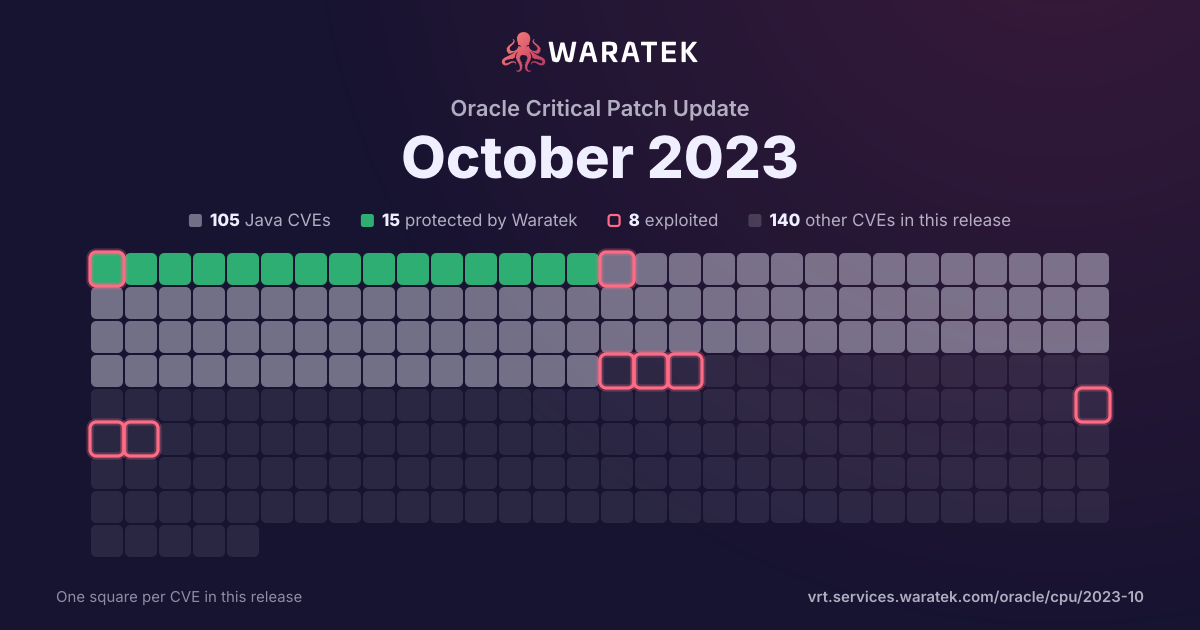
By status
15Protected by Waratek3Mitigation candidate87No exploit published44Outside Waratek scope96Not applicable
8Exploited, marked by the ring
No exploit published. For 35 of them, Oracle's security advisory is the source of public detail.
Protected by Waratek. Waratek RASP can block exploitation of these on systems that have not applied the patch yet.
Overview 95 matches · 42 in Waratek scope · 6 protected · 0 exploited · 0 CISA KEV · 3 public PoC · 3 EPSS ≥ 0.5
95matches
42in Waratek scope44.2%
6protected6.3%
0exploited0.0%
0CISA KEV0.0%
3public PoC3.2%
3EPSS ≥ 0.53.2%
Protected by Waratek
6
6.3%
Rule in development
0
0.0%
Mitigation candidate
0
0.0%
No exploit published
36
37.9%
Outside Waratek scope
7
7.4%
Not applicable
46
48.4%
Withdrawn CVE
0
0.0%
blocked by ARMR today
6
6.3%
partly blocked
0
0.0%
not blocked
89
93.7%
not established
0
0.0%
unrecorded
0
0.0%
Exploited
0
0.0%
Working exploit published
0
0.0%
Proof of concept only
26
27.4%
Forecast only
2
2.1%
No public exploit
67
70.5%
split by
peak 15 / quarter
Q3 191
Protected by Waratek1
High1
blocked by ARMR today1
No public exploit1
Q4 191
Outside Waratek scope1
High1
not blocked1
No public exploit1
Q1 200
Q2 200
Q3 202
Outside Waratek scope2
High2
not blocked2
No public exploit2
Q4 201
No exploit published1
High1
not blocked1
No public exploit1
Q1 212
No exploit published2
High2
not blocked2
No public exploit2
Q2 211
No exploit published1
High1
not blocked1
Forecast only1
Q3 212
No exploit published2
High2
not blocked2
No public exploit2
Q4 213
Protected by Waratek1
Not applicable2
High3
blocked by ARMR today1
not blocked2
No public exploit3
Q1 223
No exploit published1
Outside Waratek scope1
Not applicable1
High3
not blocked3
No public exploit3
Q2 228
Protected by Waratek2
No exploit published2
Outside Waratek scope1
Not applicable3
High8
blocked by ARMR today2
not blocked6
Proof of concept only3
No public exploit5
Q3 223
No exploit published2
Not applicable1
High3
not blocked3
Proof of concept only3
Q4 2214
Protected by Waratek1
No exploit published6
Outside Waratek scope2
Not applicable5
High14
blocked by ARMR today1
not blocked13
Proof of concept only6
No public exploit8
Q1 2315
No exploit published5
Not applicable10
High15
not blocked15
Proof of concept only5
No public exploit10
Q2 2313
Protected by Waratek1
No exploit published5
Not applicable7
High13
blocked by ARMR today1
not blocked12
Proof of concept only3
No public exploit10
Q3 2313
No exploit published3
Not applicable10
High13
not blocked13
Proof of concept only5
Forecast only1
No public exploit7
Q4 2313
No exploit published6
Not applicable7
High13
not blocked13
Proof of concept only1
No public exploit12
Q4 19Q2 20Q4 20Q2 21Q4 21Q2 22Q4 22Q2 23Q4 23
| CVE | Severity | Published▾ | Status | Exploitation | Description |
|---|---|---|---|---|---|
| CVE-2023-30590 | High | 2023-11-28 | Not applicable | No public exploit | The generateKeys() API function returned from crypto.createDiffieHellman() only generates missing (or outdated) keys, that is, it only generates a private key if none has been set yet, but the function is also needed to compute the corresponding public key after calling setPrivateKey(). However, the documentation says this API call: "Generates private and public Diffie-Hellman key values". The documented behavior is very different from the actual behavior, and this difference could easily lead to security issues in applications that use these APIs as the DiffieHellman may be used as the basis for application-level security, implications are consequently broad. |
| CVE-2023-30585 | High | 2023-11-28 | Not applicable | No public exploit | A vulnerability has been identified in the Node.js (.msi version) installation process, specifically affecting Windows users who install Node.js using the .msi installer. This vulnerability emerges during the repair operation, where the "msiexec.exe" process, running under the NT AUTHORITY\SYSTEM context, attempts to read the %USERPROFILE% environment variable from the current user's registry. The issue arises when the path referenced by the %USERPROFILE% environment variable does not exist. In such cases, the "msiexec.exe" process attempts to create the specified path in an unsafe manner, potentially leading to the creation of arbitrary folders in arbitrary locations. The severity of this vulnerability is heightened by the fact that the %USERPROFILE% environment variable in the Windows registry can be modified by standard (or "non-privileged") users. Consequently, unprivileged actors, including malicious entities or trojans, can manipulate the environment variable key to deceive the privileged "msiexec.exe" process. This manipulation can result in the creation of folders in unintended and potentially malicious locations. It is important to note that this vulnerability is specific to Windows users who install Node.js using the .msi installer. Users who opt for other installation methods are not affected by this particular issue. |
| CVE-2023-22108 | High | 2023-10-17 | No exploit published | No public exploit | Vulnerability in the Oracle WebLogic Server product of Oracle Fusion Middleware (component: Core). Supported versions that are affected are 12.2.1.4.0 and 14.1.1.0.0. Easily exploitable vulnerability allows unauthenticated attacker with network access via T3, IIOP to compromise Oracle WebLogic Server. Successful attacks of this vulnerability can result in unauthorized access to critical data or complete access to all Oracle WebLogic Server accessible data. CVSS 3.1 Base Score 7.5 (Confidentiality impacts). CVSS Vector: (CVSS:3.1/AV:N/AC:L/PR:N/UI:N/S:U/C:H/I:N/A:N). |
| CVE-2023-22102 | High | 2023-10-17 | No exploit published | No public exploit | Vulnerability in the MySQL Connectors product of Oracle MySQL (component: Connector/J). Supported versions that are affected are 8.1.0 and prior. Difficult to exploit vulnerability allows unauthenticated attacker with network access via multiple protocols to compromise MySQL Connectors. Successful attacks require human interaction from a person other than the attacker and while the vulnerability is in MySQL Connectors, attacks may significantly impact additional products (scope change). Successful attacks of this vulnerability can result in takeover of MySQL Connectors. CVSS 3.1 Base Score 8.3 (Confidentiality, Integrity and Availability impacts). CVSS Vector: (CVSS:3.1/AV:N/AC:H/PR:N/UI:R/S:C/C:H/I:H/A:H). |
| CVE-2023-22101 | High | 2023-10-17 | No exploit published | No public exploit | Vulnerability in the Oracle WebLogic Server product of Oracle Fusion Middleware (component: Core). Supported versions that are affected are 12.2.1.4.0 and 14.1.1.0.0. Difficult to exploit vulnerability allows unauthenticated attacker with network access via T3, IIOP to compromise Oracle WebLogic Server. Successful attacks of this vulnerability can result in takeover of Oracle WebLogic Server. CVSS 3.1 Base Score 8.1 (Confidentiality, Integrity and Availability impacts). CVSS Vector: (CVSS:3.1/AV:N/AC:H/PR:N/UI:N/S:U/C:H/I:H/A:H). |
| CVE-2023-22100 | High | 2023-10-17 | Not applicable | No public exploit | Vulnerability in the Oracle VM VirtualBox product of Oracle Virtualization (component: Core). Supported versions that are affected are Prior to 7.0.12. Easily exploitable vulnerability allows high privileged attacker with logon to the infrastructure where Oracle VM VirtualBox executes to compromise Oracle VM VirtualBox. While the vulnerability is in Oracle VM VirtualBox, attacks may significantly impact additional products (scope change). Successful attacks of this vulnerability can result in unauthorized access to critical data or complete access to all Oracle VM VirtualBox accessible data and unauthorized ability to cause a hang or frequently repeatable crash (complete DOS) of Oracle VM VirtualBox. Note: Only applicable to 7.0.x platform. CVSS 3.1 Base Score 7.9 (Confidentiality and Availability impacts). CVSS Vector: (CVSS:3.1/AV:L/AC:L/PR:H/UI:N/S:C/C:H/I:N/A:H). |
| CVE-2023-22099 | High | 2023-10-17 | Not applicable | No public exploit | Vulnerability in the Oracle VM VirtualBox product of Oracle Virtualization (component: Core). Supported versions that are affected are Prior to 7.0.12. Easily exploitable vulnerability allows high privileged attacker with logon to the infrastructure where Oracle VM VirtualBox executes to compromise Oracle VM VirtualBox. While the vulnerability is in Oracle VM VirtualBox, attacks may significantly impact additional products (scope change). Successful attacks of this vulnerability can result in takeover of Oracle VM VirtualBox. Note: Only applicable to 7.0.x platform. CVSS 3.1 Base Score 8.2 (Confidentiality, Integrity and Availability impacts). CVSS Vector: (CVSS:3.1/AV:L/AC:L/PR:H/UI:N/S:C/C:H/I:H/A:H). |
| CVE-2023-22098 | High | 2023-10-17 | Not applicable | Proof of concept only | Vulnerability in the Oracle VM VirtualBox product of Oracle Virtualization (component: Core). Supported versions that are affected are Prior to 7.0.12. Easily exploitable vulnerability allows high privileged attacker with logon to the infrastructure where Oracle VM VirtualBox executes to compromise Oracle VM VirtualBox. While the vulnerability is in Oracle VM VirtualBox, attacks may significantly impact additional products (scope change). Successful attacks of this vulnerability can result in takeover of Oracle VM VirtualBox. Note: Only applicable to 7.0.x platform. CVSS 3.1 Base Score 8.2 (Confidentiality, Integrity and Availability impacts). CVSS Vector: (CVSS:3.1/AV:L/AC:L/PR:H/UI:N/S:C/C:H/I:H/A:H). |
| CVE-2023-22094 | High | 2023-10-17 | Not applicable | No public exploit | Vulnerability in the MySQL Installer product of Oracle MySQL (component: Installer: General). Supported versions that are affected are Prior to 1.6.8. Easily exploitable vulnerability allows low privileged attacker with logon to the infrastructure where MySQL Installer executes to compromise MySQL Installer. Successful attacks require human interaction from a person other than the attacker and while the vulnerability is in MySQL Installer, attacks may significantly impact additional products (scope change). Successful attacks of this vulnerability can result in unauthorized creation, deletion or modification access to critical data or all MySQL Installer accessible data and unauthorized ability to cause a hang or frequently repeatable crash (complete DOS) of MySQL Installer. Note: This patch is used in MySQL Server bundled version 8.0.35 and 5.7.44. CVSS 3.1 Base Score 7.9 (Integrity and Availability impacts). CVSS Vector: (CVSS:3.1/AV:L/AC:L/PR:L/UI:R/S:C/C:N/I:H/A:H). |
| CVE-2023-22087 | High | 2023-10-17 | No exploit published | No public exploit | Vulnerability in the Hospitality OPERA 5 Property Services product of Oracle Hospitality Applications (component: Opera). The supported version that is affected is 5.6. Easily exploitable vulnerability allows low privileged attacker with network access via HTTP to compromise Hospitality OPERA 5 Property Services. Successful attacks of this vulnerability can result in takeover of Hospitality OPERA 5 Property Services. CVSS 3.1 Base Score 8.8 (Confidentiality, Integrity and Availability impacts). CVSS Vector: (CVSS:3.1/AV:N/AC:L/PR:L/UI:N/S:U/C:H/I:H/A:H). |
| CVE-2023-22086 | High | 2023-10-17 | No exploit published | No public exploit | Vulnerability in the Oracle WebLogic Server product of Oracle Fusion Middleware (component: Core). Supported versions that are affected are 12.2.1.4.0 and 14.1.1.0.0. Easily exploitable vulnerability allows unauthenticated attacker with network access via T3, IIOP to compromise Oracle WebLogic Server. Successful attacks of this vulnerability can result in unauthorized access to critical data or complete access to all Oracle WebLogic Server accessible data. CVSS 3.1 Base Score 7.5 (Confidentiality impacts). CVSS Vector: (CVSS:3.1/AV:N/AC:L/PR:N/UI:N/S:U/C:H/I:N/A:N). |
| CVE-2023-22085 | High | 2023-10-17 | No exploit published | No public exploit | Vulnerability in the Hospitality OPERA 5 Property Services product of Oracle Hospitality Applications (component: Opera). The supported version that is affected is 5.6. Easily exploitable vulnerability allows low privileged attacker with network access via HTTP to compromise Hospitality OPERA 5 Property Services. Successful attacks of this vulnerability can result in takeover of Hospitality OPERA 5 Property Services. CVSS 3.1 Base Score 8.8 (Confidentiality, Integrity and Availability impacts). CVSS Vector: (CVSS:3.1/AV:N/AC:L/PR:L/UI:N/S:U/C:H/I:H/A:H). |
| CVE-2023-22019 | High | 2023-10-17 | Not applicable | No public exploit | Vulnerability in the Oracle HTTP Server product of Oracle Fusion Middleware (component: Web Listener). The supported version that is affected is 12.2.1.4.0. Easily exploitable vulnerability allows unauthenticated attacker with network access via HTTP to compromise Oracle HTTP Server. Successful attacks of this vulnerability can result in unauthorized access to critical data or complete access to all Oracle HTTP Server accessible data. CVSS 3.1 Base Score 7.5 (Confidentiality impacts). CVSS Vector: (CVSS:3.1/AV:N/AC:L/PR:N/UI:N/S:U/C:H/I:N/A:N). |
| CVE-2023-38039 | High | 2023-09-15 | Not applicable | Proof of concept only | When curl retrieves an HTTP response, it stores the incoming headers so that they can be accessed later via the libcurl headers API. However, curl did not have a limit in how many or how large headers it would accept in a response, allowing a malicious server to stream an endless series of headers and eventually cause curl to run out of heap memory. |
| CVE-2022-44729 | High | 2023-08-22 | No exploit published | No public exploit | Server-Side Request Forgery (SSRF) vulnerability in Apache Software Foundation Apache XML Graphics Batik.This issue affects Apache XML Graphics Batik: 1.16. On version 1.16, a malicious SVG could trigger loading external resources by default, causing resource consumption or in some cases even information disclosure. Users are recommended to upgrade to version 1.17 or later. |
| CVE-2023-3823 | High | 2023-08-11 | Not applicable | No public exploit | In PHP versions 8.0.* before 8.0.30, 8.1.* before 8.1.22, and 8.2.* before 8.2.8 various XML functions rely on libxml global state to track configuration variables, like whether external entities are loaded. This state is assumed to be unchanged unless the user explicitly changes it by calling appropriate function. However, since the state is process-global, other modules - such as ImageMagick - may also use this library within the same process, and change that global state for their internal purposes, and leave it in a state where external entities loading is enabled. This can lead to the situation where external XML is parsed with external entities loaded, which can lead to disclosure of any local files accessible to PHP. This vulnerable state may persist in the same process across many requests, until the process is shut down. |
| CVE-2023-4004 | High | 2023-07-31 | Not applicable | No public exploit | A use-after-free flaw was found in the Linux kernel's netfilter in the way a user triggers the nft_pipapo_remove function with the element, without a NFT_SET_EXT_KEY_END. This issue could allow a local user to crash the system or potentially escalate their privileges on the system. |
| CVE-2023-3776 | High | 2023-07-21 | Not applicable | No public exploit | A use-after-free vulnerability in the Linux kernel's net/sched: cls_fw component can be exploited to achieve local privilege escalation. If tcf_change_indev() fails, fw_set_parms() will immediately return an error after incrementing or decrementing the reference counter in tcf_bind_filter(). If an attacker can control the reference counter and set it to zero, they can cause the reference to be freed, leading to a use-after-free vulnerability. We recommend upgrading past commit 0323bce598eea038714f941ce2b22541c46d488f. |
| CVE-2023-34035 | High | 2023-07-18 | No exploit published | No public exploit | Spring Security versions 5.8 prior to 5.8.5, 6.0 prior to 6.0.5, and 6.1 prior to 6.1.2 could be susceptible to authorization rule misconfiguration if the application uses requestMatchers(String) and multiple servlets, one of them being Spring MVC’s DispatcherServlet. (DispatcherServlet is a Spring MVC component that maps HTTP endpoints to methods on @Controller-annotated classes.) Specifically, an application is vulnerable when all of the following are true: * Spring MVC is on the classpath * Spring Security is securing more than one servlet in a single application (one of them being Spring MVC’s DispatcherServlet) * The application uses requestMatchers(String) to refer to endpoints that are not Spring MVC endpoints An application is not vulnerable if any of the following is true: * The application does not have Spring MVC on the classpath * The application secures no servlets other than Spring MVC’s DispatcherServlet * The application uses requestMatchers(String) only for Spring MVC endpoints |
| CVE-2022-41409 | High | 2023-07-18 | Not applicable | Proof of concept only | Integer overflow vulnerability in pcre2test before 10.41 allows attackers to cause a denial of service or other unspecified impacts via negative input. |
| CVE-2023-38325 | High | 2023-07-14 | Not applicable | Proof of concept only | The cryptography package before 41.0.2 for Python mishandles SSH certificates that have critical options. |
| CVE-2022-24834 | High | 2023-07-13 | Not applicable | Proof of concept only | Redis is an in-memory database that persists on disk. A specially crafted Lua script executing in Redis can trigger a heap overflow in the cjson library, and result with heap corruption and potentially remote code execution. The problem exists in all versions of Redis with Lua scripting support, starting from 2.6, and affects only authenticated and authorized users. The problem is fixed in versions 7.0.12, 6.2.13, and 6.0.20. |
| CVE-2023-3635 | High | 2023-07-12 | No exploit published | No public exploit | GzipSource does not handle an exception that might be raised when parsing a malformed gzip buffer. This may lead to denial of service of the Okio client when handling a crafted GZIP archive, by using the GzipSource class. |
| CVE-2023-36824 | High | 2023-07-11 | Not applicable | Forecast only | Redis is an in-memory database that persists on disk. In Redit 7.0 prior to 7.0.12, extracting key names from a command and a list of arguments may, in some cases, trigger a heap overflow and result in reading random heap memory, heap corruption and potentially remote code execution. Several scenarios that may lead to authenticated users executing a specially crafted `COMMAND GETKEYS` or `COMMAND GETKEYSANDFLAGS`and authenticated users who were set with ACL rules that match key names, executing a specially crafted command that refers to a variadic list of key names. The vulnerability is patched in Redis 7.0.12. |
| CVE-2023-35001 | High | 2023-07-05 | Not applicable | Proof of concept only | Linux Kernel nftables Out-Of-Bounds Read/Write Vulnerability; nft_byteorder poorly handled vm register contents when CAP_NET_ADMIN is in any user or network namespace |
| CVE-2023-30589 | High | 2023-07-01 | Not applicable | No public exploit | The llhttp parser in the http module in Node v20.2.0 does not strictly use the CRLF sequence to delimit HTTP requests. This can lead to HTTP Request Smuggling (HRS). The CR character (without LF) is sufficient to delimit HTTP header fields in the llhttp parser. According to RFC7230 section 3, only the CRLF sequence should delimit each header-field. This impacts all Node.js active versions: v16, v18, and, v20 |
| CVE-2023-3390 | High | 2023-06-28 | Not applicable | No public exploit | A use-after-free vulnerability was found in the Linux kernel's netfilter subsystem in net/netfilter/nf_tables_api.c. Mishandled error handling with NFT_MSG_NEWRULE makes it possible to use a dangling pointer in the same transaction causing a use-after-free vulnerability. This flaw allows a local attacker with user access to cause a privilege escalation issue. We recommend upgrading past commit 1240eb93f0616b21c675416516ff3d74798fdc97 |
| CVE-2023-3090 | High | 2023-06-28 | Not applicable | Proof of concept only | A heap out-of-bounds write vulnerability in the Linux Kernel ipvlan network driver can be exploited to achieve local privilege escalation. The out-of-bounds write is caused by missing skb->cb initialization in the ipvlan network driver. The vulnerability is reachable if CONFIG_IPVLAN is enabled. We recommend upgrading past commit 90cbed5247439a966b645b34eb0a2e037836ea8e. |
| CVE-2023-34981 | High | 2023-06-21 | No exploit published | No public exploit | A regression in the fix for bug 66512 in Apache Tomcat 11.0.0-M5, 10.1.8, 9.0.74 and 8.5.88 meant that, if a response did not include any HTTP headers no AJP SEND_HEADERS messare woudl be sent for the response which in turn meant that at least one AJP proxy (mod_proxy_ajp) would use the response headers from the previous request leading to an information leak. |
| CVE-2023-35788 | High | 2023-06-16 | Not applicable | Proof of concept only | An issue was discovered in fl_set_geneve_opt in net/sched/cls_flower.c in the Linux kernel before 6.3.7. It allows an out-of-bounds write in the flower classifier code via TCA_FLOWER_KEY_ENC_OPTS_GENEVE packets. This may result in denial of service or privilege escalation. |
| CVE-2023-34396 | High | 2023-06-14 | No exploit published | No public exploit | Allocation of Resources Without Limits or Throttling vulnerability in Apache Software Foundation Apache Struts.This issue affects Apache Struts: through 2.5.30, through 6.1.2. Upgrade to Struts 2.5.31 or 6.1.2.1 or greater |
| CVE-2023-2976 | High | 2023-06-14 | No exploit published | No public exploit | Use of Java's default temporary directory for file creation in `FileBackedOutputStream` in Google Guava versions 1.0 to 31.1 on Unix systems and Android Ice Cream Sandwich allows other users and apps on the machine with access to the default Java temporary directory to be able to access the files created by the class. Even though the security vulnerability is fixed in version 32.0.0, we recommend using version 32.0.1 as version 32.0.0 breaks some functionality under Windows. |
| CVE-2023-2603 | High | 2023-06-06 | Not applicable | No public exploit | A vulnerability was found in libcap. This issue occurs in the _libcap_strdup() function and can lead to an integer overflow if the input string is close to 4GiB. |
| CVE-2023-28319 | High | 2023-05-26 | Not applicable | Proof of concept only | A use after free vulnerability exists in curl <v8.1.0 in the way libcurl offers a feature to verify an SSH server's public key using a SHA 256 hash. When this check fails, libcurl would free the memory for the fingerprint before it returns an error message containing the (now freed) hash. This flaw risks inserting sensitive heap-based data into the error message that might be shown to users or otherwise get leaked and revealed. |
| CVE-2023-20883 | High | 2023-05-26 | No exploit published | No public exploit | In Spring Boot versions 3.0.0 - 3.0.6, 2.7.0 - 2.7.11, 2.6.0 - 2.6.14, 2.5.0 - 2.5.14 and older unsupported versions, there is potential for a denial-of-service (DoS) attack if Spring MVC is used together with a reverse proxy cache. |
| CVE-2023-28709 | High | 2023-05-22 | No exploit published | No public exploit | The fix for CVE-2023-24998 was incomplete for Apache Tomcat 11.0.0-M2 to 11.0.0-M4, 10.1.5 to 10.1.7, 9.0.71 to 9.0.73 and 8.5.85 to 8.5.87. If non-default HTTP connector settings were used such that the maxParameterCount could be reached using query string parameters and a request was submitted that supplied exactly maxParameterCount parameters in the query string, the limit for uploaded request parts could be bypassed with the potential for a denial of service to occur. |
| CVE-2023-30861 | High | 2023-05-02 | Not applicable | No public exploit | Flask is a lightweight WSGI web application framework. When all of the following conditions are met, a response containing data intended for one client may be cached and subsequently sent by the proxy to other clients. If the proxy also caches `Set-Cookie` headers, it may send one client's `session` cookie to other clients. The severity depends on the application's use of the session and the proxy's behavior regarding cookies. The risk depends on all these conditions being met. 1. The application must be hosted behind a caching proxy that does not strip cookies or ignore responses with cookies. 2. The application sets `session.permanent = True` 3. The application does not access or modify the session at any point during a request. 4. `SESSION_REFRESH_EACH_REQUEST` enabled (the default). 5. The application does not set a `Cache-Control` header to indicate that a page is private or should not be cached. This happens because vulnerable versions of Flask only set the `Vary: Cookie` header when the session is accessed or modified, not when it is refreshed (re-sent to update the expiration) without being accessed or modified. This issue has been fixed in versions 2.3.2 and 2.2.5. |
| CVE-2023-30535 | High | 2023-04-14 | Protected by Waratek | No public exploit | Snowflake JDBC provides a JDBC type 4 driver that supports core functionality, allowing Java program to connect to Snowflake. Users of the Snowflake JDBC driver were vulnerable to a command injection vulnerability. An attacker could set up a malicious, publicly accessible server which responds to the SSO URL with an attack payload. If the attacker then tricked a user into visiting the maliciously crafted connection URL, the user’s local machine would render the malicious payload, leading to a remote code execution. The vulnerability was patched on March 17, 2023 as part of Snowflake JDBC driver Version 3.13.29. All users should immediately upgrade the Snowflake JDBC driver to the latest version: 3.13.29. |
| CVE-2023-29491 | High | 2023-04-14 | Not applicable | No public exploit | ncurses before 6.4 20230408, when used by a setuid application, allows local users to trigger security-relevant memory corruption via malformed data in a terminfo database file that is found in $HOME/.terminfo or reached via the TERMINFO or TERM environment variable. |
| CVE-2022-4899 | High | 2023-03-31 | Not applicable | No public exploit | A vulnerability was found in zstd v1.4.10, where an attacker can supply empty string as an argument to the command line tool to cause buffer overrun. |
| CVE-2023-27534 | High | 2023-03-30 | Not applicable | Proof of concept only | A path traversal vulnerability exists in curl <8.0.0 SFTP implementation causes the tilde (~) character to be wrongly replaced when used as a prefix in the first path element, in addition to its intended use as the first element to indicate a path relative to the user's home directory. Attackers can exploit this flaw to bypass filtering or execute arbitrary code by crafting a path like /~2/foo while accessing a server with a specific user. |
| CVE-2023-20860 | High | 2023-03-27 | No exploit published | No public exploit | Spring Framework running version 6.0.0 - 6.0.6 or 5.3.0 - 5.3.25 using "**" as a pattern in Spring Security configuration with the mvcRequestMatcher creates a mismatch in pattern matching between Spring Security and Spring MVC, and the potential for a security bypass. |
| CVE-2023-1436 | High | 2023-03-22 | No exploit published | Proof of concept only | An infinite recursion is triggered in Jettison when constructing a JSONArray from a Collection that contains a self-reference in one of its elements. This leads to a StackOverflowError exception being thrown. |
| CVE-2023-1370 | High | 2023-03-22 | No exploit published | Proof of concept only | [Json-smart](https://netplex.github.io/json-smart/) is a performance focused, JSON processor lib. When reaching a ‘[‘ or ‘{‘ character in the JSON input, the code parses an array or an object respectively. It was discovered that the code does not have any limit to the nesting of such arrays or objects. Since the parsing of nested arrays and objects is done recursively, nesting too many of them can cause a stack exhaustion (stack overflow) and crash the software. |
| CVE-2023-0464 | High | 2023-03-22 | Not applicable | No public exploit | A security vulnerability has been identified in all supported versions of OpenSSL related to the verification of X.509 certificate chains that include policy constraints. Attackers may be able to exploit this vulnerability by creating a malicious certificate chain that triggers exponential use of computational resources, leading to a denial-of-service (DoS) attack on affected systems. Policy processing is disabled by default but can be enabled by passing the `-policy' argument to the command line utilities or by calling the `X509_VERIFY_PARAM_set1_policies()' function. |
| CVE-2023-27522 | High | 2023-03-07 | Not applicable | No public exploit | HTTP Response Smuggling vulnerability in Apache HTTP Server via mod_proxy_uwsgi. This issue affects Apache HTTP Server: from 2.4.30 through 2.4.55. Special characters in the origin response header can truncate/split the response forwarded to the client. |
| CVE-2023-26604 | High | 2023-03-03 | Not applicable | Proof of concept only | systemd before 247 does not adequately block local privilege escalation for some Sudo configurations, e.g., plausible sudoers files in which the "systemctl status" command may be executed. Specifically, systemd does not set LESSSECURE to 1, and thus other programs may be launched from the less program. This presents a substantial security risk when running systemctl from Sudo, because less executes as root when the terminal size is too small to show the complete systemctl output. |
| CVE-2023-0567 | High | 2023-03-01 | Not applicable | No public exploit | In PHP 8.0.X before 8.0.28, 8.1.X before 8.1.16 and 8.2.X before 8.2.3, password_verify() function may accept some invalid Blowfish hashes as valid. If such invalid hash ever ends up in the password database, it may lead to an application allowing any password for this entry as valid. |
| CVE-2022-4492 | High | 2023-02-23 | No exploit published | No public exploit | The undertow client is not checking the server identity presented by the server certificate in https connections. This is a compulsory step (at least it should be performed by default) in https and in http/2. I would add it to any TLS client protocol. |
| CVE-2023-24998 | High | 2023-02-20 | No exploit published | No public exploit | Apache Commons FileUpload before 1.5 does not limit the number of request parts to be processed resulting in the possibility of an attacker triggering a DoS with a malicious upload or series of uploads. Note that, like all of the file upload limits, the new configuration option (FileUploadBase#setFileCountMax) is not enabled by default and must be explicitly configured. |
| CVE-2023-0662 | High | 2023-02-16 | Not applicable | No public exploit | In PHP 8.0.X before 8.0.28, 8.1.X before 8.1.16 and 8.2.X before 8.2.3, excessive number of parts in HTTP form upload can cause high resource consumption and excessive number of log entries. This can cause denial of service on the affected server by exhausting CPU resources or disk space. |
| CVE-2023-0568 | High | 2023-02-16 | Not applicable | No public exploit | In PHP 8.0.X before 8.0.28, 8.1.X before 8.1.16 and 8.2.X before 8.2.3, core path resolution function allocate buffer one byte too small. When resolving paths with lengths close to system MAXPATHLEN setting, this may lead to the byte after the allocated buffer being overwritten with NUL value, which might lead to unauthorized data access or modification. |
| CVE-2023-0361 | High | 2023-02-15 | Not applicable | Proof of concept only | A timing side-channel in the handling of RSA ClientKeyExchange messages was discovered in GnuTLS. This side-channel can be sufficient to recover the key encrypted in the RSA ciphertext across a network in a Bleichenbacher style attack. To achieve a successful decryption the attacker would need to send a large amount of specially crafted messages to the vulnerable server. By recovering the secret from the ClientKeyExchange message, the attacker would be able to decrypt the application data exchanged over that connection. |
| CVE-2022-48285 | High | 2023-01-29 | Not applicable | No public exploit | loadAsync in JSZip before 3.8.0 allows Directory Traversal via a crafted ZIP archive. |
| CVE-2022-41966 | High | 2022-12-28 | No exploit published | Proof of concept only | XStream serializes Java objects to XML and back again. Versions prior to 1.4.20 may allow a remote attacker to terminate the application with a stack overflow error, resulting in a denial of service only via manipulation the processed input stream. The attack uses the hash code implementation for collections and maps to force recursive hash calculation causing a stack overflow. This issue is patched in version 1.4.20 which handles the stack overflow and raises an InputManipulationException instead. A potential workaround for users who only use HashMap or HashSet and whose XML refers these only as default map or set, is to change the default implementation of java.util.Map and java.util per the code example in the referenced advisory. However, this implies that your application does not care about the implementation of the map and all elements are comparable. |
| CVE-2022-42898 | High | 2022-12-25 | Not applicable | No public exploit | PAC parsing in MIT Kerberos 5 (aka krb5) before 1.19.4 and 1.20.x before 1.20.1 has integer overflows that may lead to remote code execution (in KDC, kadmind, or a GSS or Kerberos application server) on 32-bit platforms (which have a resultant heap-based buffer overflow), and cause a denial of service on other platforms. This occurs in krb5_pac_parse in lib/krb5/krb/pac.c. Heimdal before 7.7.1 has "a similar bug." |
| CVE-2022-43551 | High | 2022-12-23 | Outside Waratek scope | Proof of concept only | A vulnerability exists in curl <7.87.0 HSTS check that could be bypassed to trick it to keep using HTTP. Using its HSTS support, curl can be instructed to use HTTPS instead of using an insecure clear-text HTTP step even when HTTP is provided in the URL. However, the HSTS mechanism could be bypassed if the host name in the given URL first uses IDN characters that get replaced to ASCII counterparts as part of the IDN conversion. Like using the character UTF-8 U+3002 (IDEOGRAPHIC FULL STOP) instead of the common ASCII full stop (U+002E) `.`. Then in a subsequent request, it does not detect the HSTS state and makes a clear text transfer. Because it would store the info IDN encoded but look for it IDN decoded. |
| CVE-2022-45690 | High | 2022-12-13 | No exploit published | Proof of concept only | A stack overflow in the org.json.JSONTokener.nextValue::JSONTokener.java component of hutool-json v5.8.10 allows attackers to cause a Denial of Service (DoS) via crafted JSON or XML data. |
| CVE-2022-45688 | High | 2022-12-13 | No exploit published | Proof of concept only | A stack overflow in the XML.toJSONObject component of hutool-json v5.8.10 allows attackers to cause a Denial of Service (DoS) via crafted JSON or XML data. |
| CVE-2022-41881 | High | 2022-12-12 | No exploit published | Proof of concept only | Netty project is an event-driven asynchronous network application framework. In versions prior to 4.1.86.Final, a StackOverflowError can be raised when parsing a malformed crafted message due to an infinite recursion. This issue is patched in version 4.1.86.Final. There is no workaround, except using a custom HaProxyMessageDecoder. |
| CVE-2022-23491 | High | 2022-12-07 | Outside Waratek scope | No public exploit | Certifi is a curated collection of Root Certificates for validating the trustworthiness of SSL certificates while verifying the identity of TLS hosts. Certifi 2022.12.07 removes root certificates from "TrustCor" from the root store. These are in the process of being removed from Mozilla's trust store. TrustCor's root certificates are being removed pursuant to an investigation prompted by media reporting that TrustCor's ownership also operated a business that produced spyware. Conclusions of Mozilla's investigation can be found in the linked google group discussion. |
| CVE-2022-45061 | High | 2022-11-09 | Not applicable | Proof of concept only | An issue was discovered in Python before 3.11.1. An unnecessary quadratic algorithm exists in one path when processing some inputs to the IDNA (RFC 3490) decoder, such that a crafted, unreasonably long name being presented to the decoder could lead to a CPU denial of service. Hostnames are often supplied by remote servers that could be controlled by a malicious actor; in such a scenario, they could trigger excessive CPU consumption on the client attempting to make use of an attacker-supplied supposed hostname. For example, the attack payload could be placed in the Location header of an HTTP response with status code 302. A fix is planned in 3.11.1, 3.10.9, 3.9.16, 3.8.16, and 3.7.16. |
| CVE-2022-42919 | High | 2022-11-07 | Not applicable | No public exploit | Python 3.9.x before 3.9.16 and 3.10.x before 3.10.9 on Linux allows local privilege escalation in a non-default configuration. The Python multiprocessing library, when used with the forkserver start method on Linux, allows pickles to be deserialized from any user in the same machine local network namespace, which in many system configurations means any user on the same machine. Pickles can execute arbitrary code. Thus, this allows for local user privilege escalation to the user that any forkserver process is running as. Setting multiprocessing.util.abstract_sockets_supported to False is a workaround. The forkserver start method for multiprocessing is not the default start method. This issue is Linux specific because only Linux supports abstract namespace sockets. CPython before 3.9 does not make use of Linux abstract namespace sockets by default. Support for users manually specifying an abstract namespace socket was added as a bugfix in 3.7.8 and 3.8.3, but users would need to make specific uncommon API calls in order to do that in CPython before 3.9. |
| CVE-2022-42915 | High | 2022-10-29 | Not applicable | No public exploit | curl before 7.86.0 has a double free. If curl is told to use an HTTP proxy for a transfer with a non-HTTP(S) URL, it sets up the connection to the remote server by issuing a CONNECT request to the proxy, and then tunnels the rest of the protocol through. An HTTP proxy might refuse this request (HTTP proxies often only allow outgoing connections to specific port numbers, like 443 for HTTPS) and instead return a non-200 status code to the client. Due to flaws in the error/cleanup handling, this could trigger a double free in curl if one of the following schemes were used in the URL for the transfer: dict, gopher, gophers, ldap, ldaps, rtmp, rtmps, or telnet. The earliest affected version is 7.77.0. |
| CVE-2022-43680 | High | 2022-10-24 | Not applicable | No public exploit | In libexpat through 2.4.9, there is a use-after free caused by overeager destruction of a shared DTD in XML_ExternalEntityParserCreate in out-of-memory situations. |
| CVE-2022-3171 | High | 2022-10-12 | No exploit published | No public exploit | A parsing issue with binary data in protobuf-java core and lite versions prior to 3.21.7, 3.20.3, 3.19.6 and 3.16.3 can lead to a denial of service attack. Inputs containing multiple instances of non-repeated embedded messages with repeated or unknown fields causes objects to be converted back-n-forth between mutable and immutable forms, resulting in potentially long garbage collection pauses. We recommend updating to the versions mentioned above. |
| CVE-2022-42004 | High | 2022-10-02 | Protected by Waratek | No public exploit | In FasterXML jackson-databind before 2.13.4, resource exhaustion can occur because of a lack of a check in BeanDeserializer._deserializeFromArray to prevent use of deeply nested arrays. An application is vulnerable only with certain customized choices for deserialization. |
| CVE-2022-42003 | High | 2022-10-02 | No exploit published | No public exploit | In FasterXML jackson-databind before versions 2.13.4.1 and 2.12.17.1, resource exhaustion can occur because of a lack of a check in primitive value deserializers to avoid deep wrapper array nesting, when the UNWRAP_SINGLE_VALUE_ARRAYS feature is enabled. |
| CVE-2022-40152 | High | 2022-09-16 | No exploit published | Proof of concept only | Those using Woodstox to parse XML data may be vulnerable to Denial of Service attacks (DOS) if DTD support is enabled. If the parser is running on user supplied input, an attacker may supply content that causes the parser to crash by stackoverflow. This effect may support a denial of service attack. |
| CVE-2022-40151 | High | 2022-09-16 | No exploit published | Proof of concept only | Those using Xstream to seralize XML data may be vulnerable to Denial of Service attacks (DOS). If the parser is running on user supplied input, an attacker may supply content that causes the parser to crash by stackoverflow. This effect may support a denial of service attack. |
| CVE-2022-31129 | High | 2022-07-06 | Not applicable | Proof of concept only | moment is a JavaScript date library for parsing, validating, manipulating, and formatting dates. Affected versions of moment were found to use an inefficient parsing algorithm. Specifically using string-to-date parsing in moment (more specifically rfc2822 parsing, which is tried by default) has quadratic (N^2) complexity on specific inputs. Users may notice a noticeable slowdown is observed with inputs above 10k characters. Users who pass user-provided strings without sanity length checks to moment constructor are vulnerable to (Re)DoS attacks. The problem is patched in 2.29.4, the patch can be applied to all affected versions with minimal tweaking. Users are advised to upgrade. Users unable to upgrade should consider limiting date lengths accepted from user input. |
| CVE-2021-33036 | High | 2022-06-15 | Protected by Waratek | No public exploit | In Apache Hadoop 2.2.0 to 2.10.1, 3.0.0-alpha1 to 3.1.4, 3.2.0 to 3.2.2, and 3.3.0 to 3.3.1, a user who can escalate to yarn user can possibly run arbitrary commands as root user. Users should upgrade to Apache Hadoop 2.10.2, 3.2.3, 3.3.2 or higher. |
| CVE-2022-27782 | High | 2022-06-02 | Not applicable | Proof of concept only | libcurl would reuse a previously created connection even when a TLS or SSHrelated option had been changed that should have prohibited reuse.libcurl keeps previously used connections in a connection pool for subsequenttransfers to reuse if one of them matches the setup. However, several TLS andSSH settings were left out from the configuration match checks, making themmatch too easily. |
| CVE-2022-27781 | High | 2022-06-02 | Not applicable | Proof of concept only | libcurl provides the `CURLOPT_CERTINFO` option to allow applications torequest details to be returned about a server's certificate chain.Due to an erroneous function, a malicious server could make libcurl built withNSS get stuck in a never-ending busy-loop when trying to retrieve thatinformation. |
| CVE-2022-27780 | High | 2022-06-02 | Not applicable | Proof of concept only | The curl URL parser wrongly accepts percent-encoded URL separators like '/'when decoding the host name part of a URL, making it a *different* URL usingthe wrong host name when it is later retrieved.For example, a URL like `http://example.com%2F127.0.0.1/`, would be allowed bythe parser and get transposed into `http://example.com/127.0.0.1/`. This flawcan be used to circumvent filters, checks and more. |
| CVE-2022-27778 | High | 2022-06-02 | Outside Waratek scope | No public exploit | A use of incorrectly resolved name vulnerability fixed in 7.83.1 might remove the wrong file when `--no-clobber` is used together with `--remove-on-error`. |
| CVE-2022-25647 | High | 2022-05-01 | Protected by Waratek | No public exploit | The package com.google.code.gson:gson before 2.8.9 are vulnerable to Deserialization of Untrusted Data via the writeReplace() method in internal classes, which may lead to DoS attacks. |
| CVE-2022-29546 | High | 2022-04-25 | No exploit published | No public exploit | HtmlUnit NekoHtml Parser before 2.61.0 suffers from a denial of service vulnerability. Crafted input associated with the parsing of Processing Instruction (PI) data leads to heap memory consumption. This is similar to CVE-2022-28366 but affects a much later version of the product. |
| CVE-2022-24839 | High | 2022-04-11 | No exploit published | No public exploit | org.cyberneko.html is an html parser written in Java. The fork of `org.cyberneko.html` used by Nokogiri (Rubygem) raises a `java.lang.OutOfMemoryError` exception when parsing ill-formed HTML markup. Users are advised to upgrade to `>= 1.9.22.noko2`. Note: The upstream library `org.cyberneko.html` is no longer maintained. Nokogiri uses its own fork of this library located at https://github.com/sparklemotion/nekohtml and this CVE applies only to that fork. Other forks of nekohtml may have a similar vulnerability. |
| CVE-2020-36518 | High | 2022-03-11 | No exploit published | No public exploit | jackson-databind before 2.13.0 allows a Java StackOverflow exception and denial of service via a large depth of nested objects. |
| CVE-2022-23990 | High | 2022-01-26 | Outside Waratek scope | No public exploit | Expat (aka libexpat) before 2.4.4 has an integer overflow in the doProlog function. |
| CVE-2021-43045 | High | 2022-01-06 | Not applicable | No public exploit | A vulnerability in the .NET SDK of Apache Avro allows an attacker to allocate excessive resources, potentially causing a denial-of-service attack. This issue affects .NET applications using Apache Avro version 1.10.2 and prior versions. Users should update to version 1.11.0 which addresses this issue. |
| CVE-2021-41165 | High | 2021-11-17 | Not applicable | No public exploit | CKEditor4 is an open source WYSIWYG HTML editor. In affected version a vulnerability has been discovered in the core HTML processing module and may affect all plugins used by CKEditor 4. The vulnerability allowed to inject malformed comments HTML bypassing content sanitization, which could result in executing JavaScript code. It affects all users using the CKEditor 4 at version < 4.17.0. The problem has been recognized and patched. The fix will be available in version 4.17.0. |
| CVE-2021-41164 | High | 2021-11-17 | Not applicable | No public exploit | CKEditor4 is an open source WYSIWYG HTML editor. In affected versions a vulnerability has been discovered in the Advanced Content Filter (ACF) module and may affect all plugins used by CKEditor 4. The vulnerability allowed to inject malformed HTML bypassing content sanitization, which could result in executing JavaScript code. It affects all users using the CKEditor 4 at version < 4.17.0. The problem has been recognized and patched. The fix will be available in version 4.17.0. |
| CVE-2021-37136 | High | 2021-10-19 | Protected by Waratek | No public exploit | The Bzip2 decompression decoder function doesn't allow setting size restrictions on the decompressed output data (which affects the allocation size used during decompression). All users of Bzip2Decoder are affected. The malicious input can trigger an OOME and so a DoS attack |
| CVE-2021-40690 | High | 2021-09-19 | No exploit published | No public exploit | All versions of Apache Santuario - XML Security for Java prior to 2.2.3 and 2.1.7 are vulnerable to an issue where the "secureValidation" property is not passed correctly when creating a KeyInfo from a KeyInfoReference element. This allows an attacker to abuse an XPath Transform to extract any local .xml files in a RetrievalMethod element. |
| CVE-2021-37714 | High | 2021-08-18 | No exploit published | No public exploit | jsoup is a Java library for working with HTML. Those using jsoup versions prior to 1.14.2 to parse untrusted HTML or XML may be vulnerable to DOS attacks. If the parser is run on user supplied input, an attacker may supply content that causes the parser to get stuck (loop indefinitely until cancelled), to complete more slowly than usual, or to throw an unexpected exception. This effect may support a denial of service attack. The issue is patched in version 1.14.2. There are a few available workarounds. Users may rate limit input parsing, limit the size of inputs based on system resources, and/or implement thread watchdogs to cap and timeout parse runtimes. |
| CVE-2021-28165 | High | 2021-04-01 | No exploit published | Forecast only | In Eclipse Jetty 7.2.2 to 9.4.38, 10.0.0.alpha0 to 10.0.1, and 11.0.0.alpha0 to 11.0.1, CPU usage can reach 100% upon receiving a large invalid TLS frame. |
| CVE-2020-11988 | High | 2021-02-24 | No exploit published | No public exploit | Apache XmlGraphics Commons 2.4 and earlier is vulnerable to server-side request forgery, caused by improper input validation by the XMPParser. By using a specially-crafted argument, an attacker could exploit this vulnerability to cause the underlying server to make arbitrary GET requests. Users should upgrade to 2.6 or later. |
| CVE-2020-9492 | High | 2021-01-26 | No exploit published | No public exploit | In Apache Hadoop 3.2.0 to 3.2.1, 3.0.0-alpha1 to 3.1.3, and 2.0.0-alpha to 2.10.0, WebHDFS client might send SPNEGO authorization header to remote URL without proper verification. |
| CVE-2020-7760 | High | 2020-10-30 | No exploit published | No public exploit | This affects the package codemirror before 5.58.2; the package org.apache.marmotta.webjars:codemirror before 5.58.2. The vulnerable regular expression is located in https://github.com/codemirror/CodeMirror/blob/cdb228ac736369c685865b122b736cd0d397836c/mode/javascript/javascript.jsL129. The ReDOS vulnerability of the regex is mainly due to the sub-pattern (s|/*.*?*/)* |
| CVE-2019-20916 | High | 2020-09-04 | Outside Waratek scope | No public exploit | The pip package before 19.2 for Python allows Directory Traversal when a URL is given in an install command, because a Content-Disposition header can have ../ in a filename, as demonstrated by overwriting the /root/.ssh/authorized_keys file. This occurs in _download_http_url in _internal/download.py. |
| CVE-2019-20907 | High | 2020-07-13 | Outside Waratek scope | No public exploit | In Lib/tarfile.py in Python through 3.8.3, an attacker is able to craft a TAR archive leading to an infinite loop when opened by tarfile.open, because _proc_pax lacks header validation. |
| CVE-2019-17498 | High | 2019-10-21 | Outside Waratek scope | No public exploit | In libssh2 v1.9.0 and earlier versions, the SSH_MSG_DISCONNECT logic in packet.c has an integer overflow in a bounds check, enabling an attacker to specify an arbitrary (out-of-bounds) offset for a subsequent memory read. A crafted SSH server may be able to disclose sensitive information or cause a denial of service condition on the client system when a user connects to the server. |
| CVE-2019-10086 | High | 2019-08-20 | Protected by Waratek | No public exploit | In Apache Commons Beanutils 1.9.2, a special BeanIntrospector class was added which allows suppressing the ability for an attacker to access the classloader via the class property available on all Java objects. We, however were not using this by default characteristic of the PropertyUtilsBean. |