
Oracle Critical Patch Update October 2023
Released October 2023 · Oracle's advisory ↗ · ← Critical Patch Update, July 2023 · Critical Patch Update, January 2024 →
245 CVEs in this release, one square each
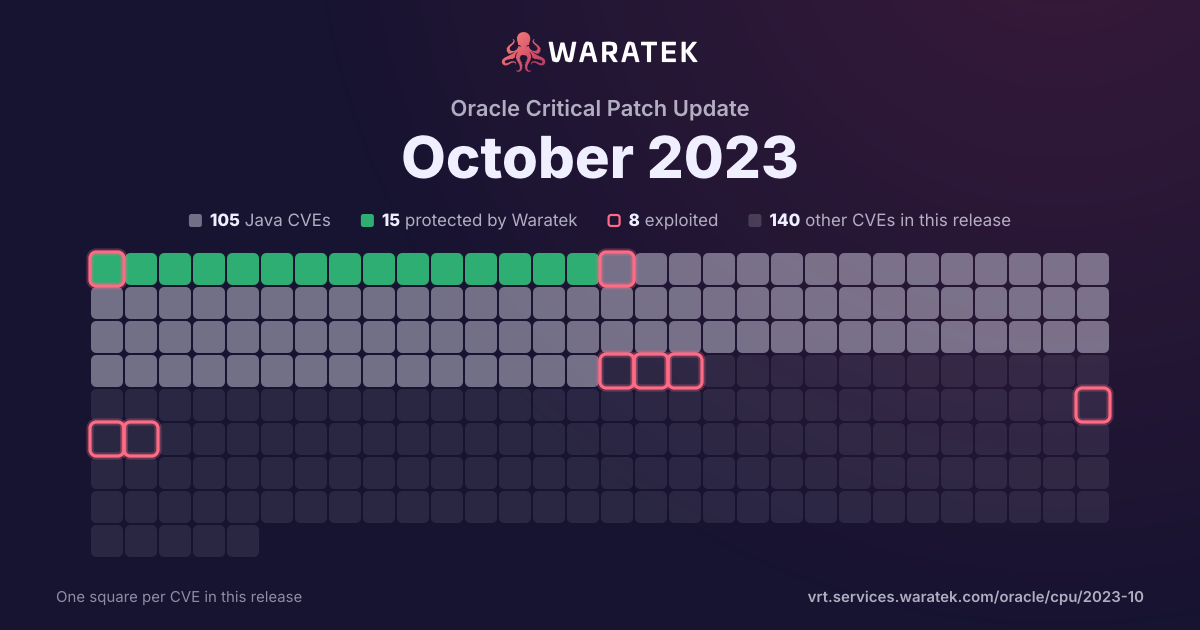
By status
15Protected by Waratek3Mitigation candidate87No exploit published44Outside Waratek scope96Not applicable
8Exploited, marked by the ring
No exploit published. For 35 of them, Oracle's security advisory is the source of public detail.
Protected by Waratek. Waratek RASP can block exploitation of these on systems that have not applied the patch yet.
Overview 12 matches · 2 in Waratek scope · 1 protected · 6 exploited · 1 CISA KEV · 7 public PoC
Protected by Waratek
1
8.3%
Rule in development
0
0.0%
Mitigation candidate
0
0.0%
No exploit published
1
8.3%
Outside Waratek scope
4
33.3%
Not applicable
6
50.0%
Withdrawn CVE
0
0.0%
blocked by ARMR today
1
8.3%
partly blocked
0
0.0%
not blocked
11
91.7%
not established
0
0.0%
unrecorded
0
0.0%
Exploited
6
50.0%
Working exploit published
0
0.0%
Proof of concept only
2
16.7%
Forecast only
4
33.3%
No public exploit
0
0.0%
split by
peak 3 / quarter
Q2 191
Outside Waratek scope1
Medium1
not blocked1
Exploited1
Q3 190
Q4 190
Q1 200
Q2 202
Outside Waratek scope2
Medium2
not blocked2
Exploited2
Q3 200
Q4 200
Q1 210
Q2 211
No exploit published1
High1
not blocked1
Forecast only1
Q3 210
Q4 210
Q1 220
Q2 220
Q3 220
Q4 221
Protected by Waratek1
Critical1
blocked by ARMR today1
Exploited1
Q1 232
Not applicable2
Critical1
Medium1
not blocked2
Exploited1
Forecast only1
Q2 231
Not applicable1
Medium1
not blocked1
Forecast only1
Q3 233
Not applicable3
Critical1
High2
not blocked3
Exploited1
Proof of concept only1
Forecast only1
Q4 231
Outside Waratek scope1
Critical1
not blocked1
Proof of concept only1
Q2 19Q4 19Q2 20Q4 20Q2 21Q4 21Q2 22Q4 22Q2 23Q4 23
| CVE | Severity | Published▾ | Status | Exploitation | Description |
|---|---|---|---|---|---|
| CVE-2023-38545 | Critical | 2023-10-18 | Outside Waratek scope | Proof of concept only | This flaw makes curl overflow a heap based buffer in the SOCKS5 proxy handshake. When curl is asked to pass along the host name to the SOCKS5 proxy to allow that to resolve the address instead of it getting done by curl itself, the maximum length that host name can be is 255 bytes. If the host name is detected to be longer, curl switches to local name resolving and instead passes on the resolved address only. Due to this bug, the local variable that means "let the host resolve the name" could get the wrong value during a slow SOCKS5 handshake, and contrary to the intention, copy the too long host name to the target buffer instead of copying just the resolved address there. The target buffer being a heap based buffer, and the host name coming from the URL that curl has been told to operate with. |
| CVE-2023-38039 | High | 2023-09-15 | Not applicable | Proof of concept only | When curl retrieves an HTTP response, it stores the incoming headers so that they can be accessed later via the libcurl headers API. However, curl did not have a limit in how many or how large headers it would accept in a response, allowing a malicious server to stream an endless series of headers and eventually cause curl to run out of heap memory. |
| CVE-2023-38408 | Critical | 2023-07-20 | Not applicable | Exploited | The PKCS#11 feature in ssh-agent in OpenSSH before 9.3p2 has an insufficiently trustworthy search path, leading to remote code execution if an agent is forwarded to an attacker-controlled system. (Code in /usr/lib is not necessarily safe for loading into ssh-agent.) NOTE: this issue exists because of an incomplete fix for CVE-2016-10009. |
| CVE-2023-36824 | High | 2023-07-11 | Not applicable | Forecast only | Redis is an in-memory database that persists on disk. In Redit 7.0 prior to 7.0.12, extracting key names from a command and a list of arguments may, in some cases, trigger a heap overflow and result in reading random heap memory, heap corruption and potentially remote code execution. Several scenarios that may lead to authenticated users executing a specially crafted `COMMAND GETKEYS` or `COMMAND GETKEYSANDFLAGS`and authenticated users who were set with ACL rules that match key names, executing a specially crafted command that refers to a variadic list of key names. The vulnerability is patched in Redis 7.0.12. |
| CVE-2023-2650 | Medium | 2023-05-30 | Not applicable | Forecast only | Issue summary: Processing some specially crafted ASN.1 object identifiers or data containing them may be very slow. Impact summary: Applications that use OBJ_obj2txt() directly, or use any of the OpenSSL subsystems OCSP, PKCS7/SMIME, CMS, CMP/CRMF or TS with no message size limit may experience notable to very long delays when processing those messages, which may lead to a Denial of Service. An OBJECT IDENTIFIER is composed of a series of numbers - sub-identifiers - most of which have no size limit. OBJ_obj2txt() may be used to translate an ASN.1 OBJECT IDENTIFIER given in DER encoding form (using the OpenSSL type ASN1_OBJECT) to its canonical numeric text form, which are the sub-identifiers of the OBJECT IDENTIFIER in decimal form, separated by periods. When one of the sub-identifiers in the OBJECT IDENTIFIER is very large (these are sizes that are seen as absurdly large, taking up tens or hundreds of KiBs), the translation to a decimal number in text may take a very long time. The time complexity is O(n^2) with 'n' being the size of the sub-identifiers in bytes (*). With OpenSSL 3.0, support to fetch cryptographic algorithms using names / identifiers in string form was introduced. This includes using OBJECT IDENTIFIERs in canonical numeric text form as identifiers for fetching algorithms. Such OBJECT IDENTIFIERs may be received through the ASN.1 structure AlgorithmIdentifier, which is commonly used in multiple protocols to specify what cryptographic algorithm should be used to sign or verify, encrypt or decrypt, or digest passed data. Applications that call OBJ_obj2txt() directly with untrusted data are affected, with any version of OpenSSL. If the use is for the mere purpose of display, the severity is considered low. In OpenSSL 3.0 and newer, this affects the subsystems OCSP, PKCS7/SMIME, CMS, CMP/CRMF or TS. It also impacts anything that processes X.509 certificates, including simple things like verifying its signature. The impact on TLS is relatively low, because all versions of OpenSSL have a 100KiB limit on the peer's certificate chain. Additionally, this only impacts clients, or servers that have explicitly enabled client authentication. In OpenSSL 1.1.1 and 1.0.2, this only affects displaying diverse objects, such as X.509 certificates. This is assumed to not happen in such a way that it would cause a Denial of Service, so these versions are considered not affected by this issue in such a way that it would be cause for concern, and the severity is therefore considered low. |
| CVE-2023-25690 | Critical | 2023-03-07 | Not applicable | Exploited | Some mod_proxy configurations on Apache HTTP Server versions 2.4.0 through 2.4.55 allow a HTTP Request Smuggling attack. Configurations are affected when mod_proxy is enabled along with some form of RewriteRule or ProxyPassMatch in which a non-specific pattern matches some portion of the user-supplied request-target (URL) data and is then re-inserted into the proxied request-target using variable substitution. For example, something like: RewriteEngine on RewriteRule "^/here/(.*)" "http://example.com:8080/elsewhere?$1"; [P] ProxyPassReverse /here/ http://example.com:8080/ Request splitting/smuggling could result in bypass of access controls in the proxy server, proxying unintended URLs to existing origin servers, and cache poisoning. Users are recommended to update to at least version 2.4.56 of Apache HTTP Server. |
| CVE-2022-37436 | Medium | 2023-01-17 | Not applicable | Forecast only | Prior to Apache HTTP Server 2.4.55, a malicious backend can cause the response headers to be truncated early, resulting in some headers being incorporated into the response body. If the later headers have any security purpose, they will not be interpreted by the client. |
| CVE-2022-1471 | Critical | 2022-12-01 | Protected by Waratek | Exploited | SnakeYaml's Constructor() class does not restrict types which can be instantiated during deserialization. Deserializing yaml content provided by an attacker can lead to remote code execution. We recommend using SnakeYaml's SafeConsturctor when parsing untrusted content to restrict deserialization. We recommend upgrading to version 2.0 and beyond. |
| CVE-2021-28165 | High | 2021-04-01 | No exploit published | Forecast only | In Eclipse Jetty 7.2.2 to 9.4.38, 10.0.0.alpha0 to 10.0.1, and 11.0.0.alpha0 to 11.0.1, CPU usage can reach 100% upon receiving a large invalid TLS frame. |
| CVE-2020-11023 | Medium | 2020-04-29 | Outside Waratek scope | Exploited | In jQuery versions greater than or equal to 1.0.3 and before 3.5.0, passing HTML containing <option> elements from untrusted sources - even after sanitizing it - to one of jQuery's DOM manipulation methods (i.e. .html(), .append(), and others) may execute untrusted code. This problem is patched in jQuery 3.5.0. |
| CVE-2020-11022 | Medium | 2020-04-29 | Outside Waratek scope | Exploited | In jQuery starting with 1.12.0 and before 3.5.0, passing HTML from untrusted sources - even after sanitizing it - to one of jQuery's DOM manipulation methods (i.e. .html(), .append(), and others) may execute untrusted code. This problem is patched in jQuery 3.5.0. |
| CVE-2019-11358 | Medium | 2019-04-20 | Outside Waratek scope | Exploited | jQuery before 3.4.0, as used in Drupal, Backdrop CMS, and other products, mishandles jQuery.extend(true, {}, ...) because of Object.prototype pollution. If an unsanitized source object contained an enumerable __proto__ property, it could extend the native Object.prototype. |