
Oracle Critical Patch Update July 2023
Released July 2023 · Oracle's advisory ↗ · ← Critical Patch Update, April 2023 · Critical Patch Update, October 2023 →
269 CVEs in this release, one square each
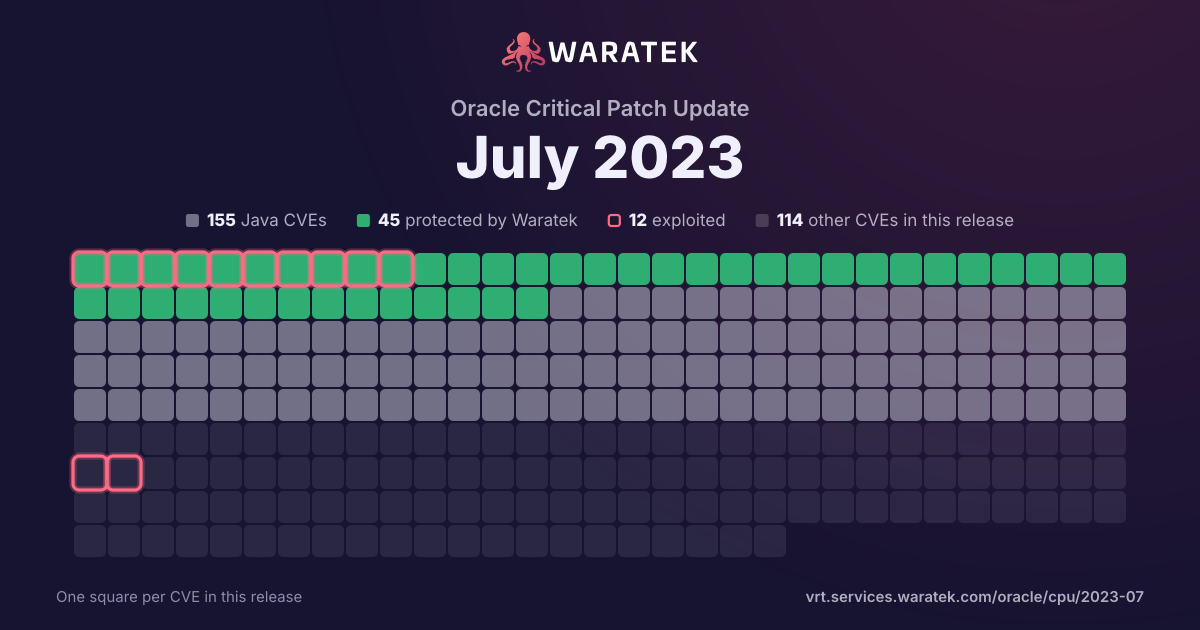
By status
43Protected by Waratek1Rule in development6Mitigation candidate112No exploit published5Outside Waratek scope102Not applicable
12Exploited, marked by the ring
No exploit published. For 28 of them, Oracle's security advisory is the source of public detail.
Protected by Waratek. Waratek RASP can block exploitation of these on systems that have not applied the patch yet.
Overview 11 matches · 8 protected · 1 exploited · 1 CISA KEV · 4 public PoC · 4 EPSS ≥ 0.5
Protected by Waratek
8
72.7%
Rule in development
0
0.0%
Mitigation candidate
1
9.1%
No exploit published
2
18.2%
blocked by ARMR today
8
72.7%
partly blocked
0
0.0%
not blocked
3
27.3%
not established
0
0.0%
unrecorded
0
0.0%
Exploited
1
9.1%
Working exploit published
0
0.0%
Proof of concept only
4
36.4%
Forecast only
1
9.1%
No public exploit
5
45.5%
split by
peak 3 / quarter
Q3 191
Protected by Waratek1
Critical1
blocked by ARMR today1
No public exploit1
Q4 192
Protected by Waratek1
No exploit published1
Critical2
blocked by ARMR today1
not blocked1
Proof of concept only1
No public exploit1
Q1 200
Q2 200
Q3 201
Protected by Waratek1
Critical1
blocked by ARMR today1
Forecast only1
Q4 200
Q1 211
Protected by Waratek1
Critical1
blocked by ARMR today1
No public exploit1
Q2 210
Q3 210
Q4 213
Protected by Waratek2
No exploit published1
Critical3
blocked by ARMR today2
not blocked1
Exploited1
No public exploit2
Q1 221
Protected by Waratek1
Critical1
blocked by ARMR today1
Proof of concept only1
Q2 221
Protected by Waratek1
Critical1
blocked by ARMR today1
Proof of concept only1
Q3 221
Mitigation candidate1
Critical1
not blocked1
Proof of concept only1
Q3 19Q1 20Q3 20Q1 21Q3 21Q1 22Q3 22
| CVE | Severity | Published▾ | Status | Exploitation | Description |
|---|---|---|---|---|---|
| CVE-2022-33980 | Critical | 2022-07-06 | Mitigation candidate | Proof of concept only | Apache Commons Configuration performs variable interpolation, allowing properties to be dynamically evaluated and expanded. The standard format for interpolation is "${prefix:name}", where "prefix" is used to locate an instance of org.apache.commons.configuration2.interpol.Lookup that performs the interpolation. Starting with version 2.4 and continuing through 2.7, the set of default Lookup instances included interpolators that could result in arbitrary code execution or contact with remote servers. These lookups are: - "script" - execute expressions using the JVM script execution engine (javax.script) - "dns" - resolve dns records - "url" - load values from urls, including from remote servers Applications using the interpolation defaults in the affected versions may be vulnerable to remote code execution or unintentional contact with remote servers if untrusted configuration values are used. Users are recommended to upgrade to Apache Commons Configuration 2.8.0, which disables the problematic interpolators by default. |
| CVE-2022-23457 | Critical | 2022-04-25 | Protected by Waratek | Proof of concept only | ESAPI (The OWASP Enterprise Security API) is a free, open source, web application security control library. Prior to version 2.3.0.0, the default implementation of `Validator.getValidDirectoryPath(String, String, File, boolean)` may incorrectly treat the tested input string as a child of the specified parent directory. This potentially could allow control-flow bypass checks to be defeated if an attack can specify the entire string representing the 'input' path. This vulnerability is patched in release 2.3.0.0 of ESAPI. As a workaround, it is possible to write one's own implementation of the Validator interface. However, maintainers do not recommend this. |
| CVE-2022-23305 | Critical | 2022-01-18 | Protected by Waratek | Proof of concept only | By design, the JDBCAppender in Log4j 1.2.x accepts an SQL statement as a configuration parameter where the values to be inserted are converters from PatternLayout. The message converter, %m, is likely to always be included. This allows attackers to manipulate the SQL by entering crafted strings into input fields or headers of an application that are logged allowing unintended SQL queries to be executed. Note this issue only affects Log4j 1.x when specifically configured to use the JDBCAppender, which is not the default. Beginning in version 2.0-beta8, the JDBCAppender was re-introduced with proper support for parameterized SQL queries and further customization over the columns written to in logs. Apache Log4j 1.2 reached end of life in August 2015. Users should upgrade to Log4j 2 as it addresses numerous other issues from the previous versions. |
| CVE-2021-43113 | Critical | 2021-12-15 | Protected by Waratek | No public exploit | iTextPDF in iText 7 and up to (excluding 4.4.13.3) 7.1.17 allows command injection via a CompareTool filename that is mishandled on the gs (aka Ghostscript) command line in GhostscriptHelper.java. |
| CVE-2021-45046 | Critical | 2021-12-14 | Protected by Waratek | Exploited | It was found that the fix to address CVE-2021-44228 in Apache Log4j 2.15.0 was incomplete in certain non-default configurations. This could allows attackers with control over Thread Context Map (MDC) input data when the logging configuration uses a non-default Pattern Layout with either a Context Lookup (for example, $${ctx:loginId}) or a Thread Context Map pattern (%X, %mdc, or %MDC) to craft malicious input data using a JNDI Lookup pattern resulting in an information leak and remote code execution in some environments and local code execution in all environments. Log4j 2.16.0 (Java 8) and 2.12.2 (Java 7) fix this issue by removing support for message lookup patterns and disabling JNDI functionality by default. |
| CVE-2021-42575 | Critical | 2021-10-18 | No exploit published | No public exploit | The OWASP Java HTML Sanitizer before 20211018.1 does not properly enforce policies associated with the SELECT, STYLE, and OPTION elements. |
| CVE-2021-23926 | Critical | 2021-01-14 | Protected by Waratek | No public exploit | The XML parsers used by XMLBeans up to version 2.6.0 did not set the properties needed to protect the user from malicious XML input. Vulnerabilities include possibilities for XML Entity Expansion attacks. Affects XMLBeans up to and including v2.6.0. |
| CVE-2020-11998 | Critical | 2020-09-10 | Protected by Waratek | Forecast only | A regression has been introduced in the commit preventing JMX re-bind. By passing an empty environment map to RMIConnectorServer, instead of the map that contains the authentication credentials, it leaves ActiveMQ open to the following attack: https://docs.oracle.com/javase/8/docs/technotes/guides/management/agent.html "A remote client could create a javax.management.loading.MLet MBean and use it to create new MBeans from arbitrary URLs, at least if there is no security manager. In other words, a rogue remote client could make your Java application execute arbitrary code." Mitigation: Upgrade to Apache ActiveMQ 5.15.13 |
| CVE-2019-17571 | Critical | 2019-12-20 | Protected by Waratek | Proof of concept only | Included in Log4j 1.2 is a SocketServer class that is vulnerable to deserialization of untrusted data which can be exploited to remotely execute arbitrary code when combined with a deserialization gadget when listening to untrusted network traffic for log data. This affects Log4j versions up to 1.2 up to 1.2.17. |
| CVE-2019-17531 | Critical | 2019-10-12 | No exploit published | No public exploit | A Polymorphic Typing issue was discovered in FasterXML jackson-databind 2.0.0 through 2.9.10. When Default Typing is enabled (either globally or for a specific property) for an externally exposed JSON endpoint and the service has the apache-log4j-extra (version 1.2.x) jar in the classpath, and an attacker can provide a JNDI service to access, it is possible to make the service execute a malicious payload. |
| CVE-2019-13990 | Critical | 2019-07-26 | Protected by Waratek | No public exploit | initDocumentParser in xml/XMLSchedulingDataProcessor.java in Terracotta Quartz Scheduler through 2.3.0 allows XXE attacks via a job description. |