
Oracle Critical Patch Update July 2023
Released July 2023 · Oracle's advisory ↗ · ← Critical Patch Update, April 2023 · Critical Patch Update, October 2023 →
269 CVEs in this release, one square each
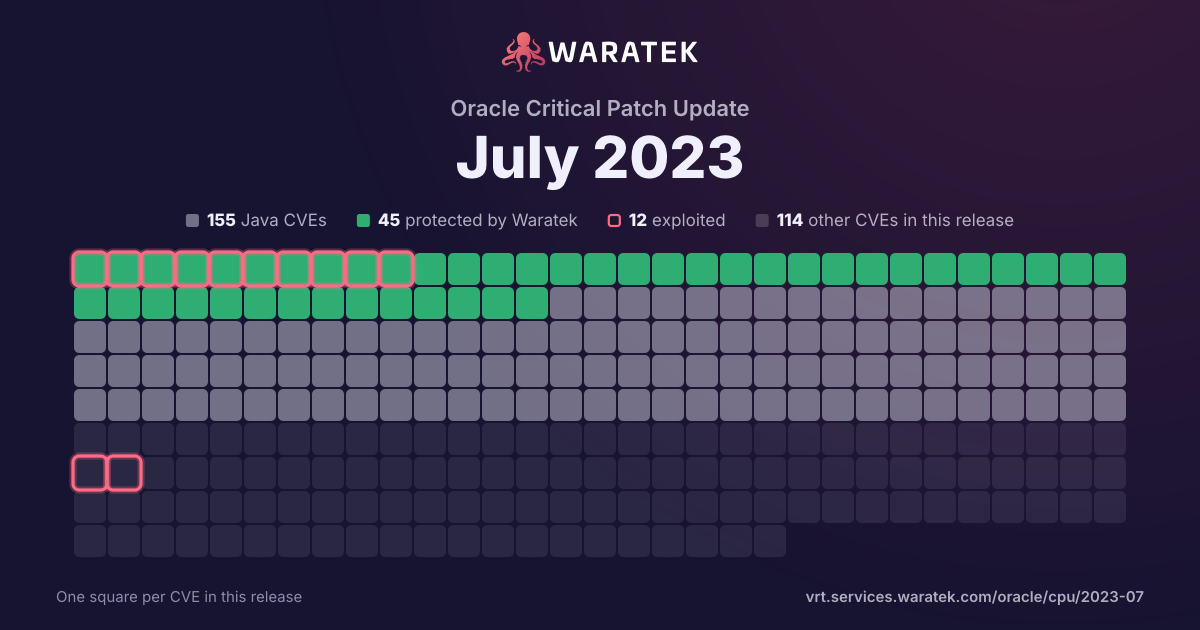
By status
43Protected by Waratek1Rule in development6Mitigation candidate112No exploit published5Outside Waratek scope102Not applicable
12Exploited, marked by the ring
No exploit published. For 28 of them, Oracle's security advisory is the source of public detail.
Protected by Waratek. Waratek RASP can block exploitation of these on systems that have not applied the patch yet.
Overview 9 matches · 6 protected · 4 exploited · 0 CISA KEV · 4 EPSS ≥ 0.5
Protected by Waratek
6
66.7%
Rule in development
0
0.0%
Mitigation candidate
3
33.3%
No exploit published
0
0.0%
blocked by ARMR today
6
66.7%
partly blocked
0
0.0%
not blocked
3
33.3%
not established
0
0.0%
unrecorded
0
0.0%
Exploited
4
44.4%
Working exploit published
0
0.0%
Proof of concept only
5
55.6%
Forecast only
0
0.0%
No public exploit
0
0.0%
split by
peak 2 / month
Jul 211
Protected by Waratek1
Medium1
blocked by ARMR today1
Exploited1
Aug 210
Sep 210
Oct 210
Nov 210
Dec 211
Protected by Waratek1
Medium1
blocked by ARMR today1
Exploited1
Jan 221
Protected by Waratek1
Critical1
blocked by ARMR today1
Proof of concept only1
Feb 220
Mar 220
Apr 220
May 220
Jun 221
Protected by Waratek1
Medium1
blocked by ARMR today1
Exploited1
Jul 220
Aug 220
Sep 222
Protected by Waratek1
Mitigation candidate1
Critical1
High1
blocked by ARMR today1
not blocked1
Proof of concept only2
Oct 221
Mitigation candidate1
Critical1
not blocked1
Proof of concept only1
Nov 220
Dec 222
Protected by Waratek1
Mitigation candidate1
Critical2
blocked by ARMR today1
not blocked1
Exploited1
Proof of concept only1
Aug 21Oct 21Dec 21Feb 22Apr 22Jun 22Aug 22Oct 22Dec 22
| CVE | Severity | Published▾ | Status | Exploitation | Description |
|---|---|---|---|---|---|
| CVE-2022-46364 | Critical | 2022-12-13 | Mitigation candidate | Proof of concept only | A SSRF vulnerability in parsing the href attribute of XOP:Include in MTOM requests in versions of Apache CXF before 3.5.5 and 3.4.10 allows an attacker to perform SSRF style attacks on webservices that take at least one parameter of any type. |
| CVE-2022-1471 | Critical | 2022-12-01 | Protected by Waratek | Exploited | SnakeYaml's Constructor() class does not restrict types which can be instantiated during deserialization. Deserializing yaml content provided by an attacker can lead to remote code execution. We recommend using SnakeYaml's SafeConsturctor when parsing untrusted content to restrict deserialization. We recommend upgrading to version 2.0 and beyond. |
| CVE-2022-31692 | Critical | 2022-10-31 | Mitigation candidate | Proof of concept only | Spring Security, versions 5.7 prior to 5.7.5 and 5.6 prior to 5.6.9 could be susceptible to authorization rules bypass via forward or include dispatcher types. Specifically, an application is vulnerable when all of the following are true: The application expects that Spring Security applies security to forward and include dispatcher types. The application uses the AuthorizationFilter either manually or via the authorizeHttpRequests() method. The application configures the FilterChainProxy to apply to forward and/or include requests (e.g. spring.security.filter.dispatcher-types = request, error, async, forward, include). The application may forward or include the request to a higher privilege-secured endpoint.The application configures Spring Security to apply to every dispatcher type via authorizeHttpRequests().shouldFilterAllDispatcherTypes(true) |
| CVE-2022-36944 | Critical | 2022-09-23 | Protected by Waratek | Proof of concept only | Scala 2.13.x before 2.13.9 has a Java deserialization chain in its JAR file. On its own, it cannot be exploited. There is only a risk in conjunction with Java object deserialization within an application. In such situations, it allows attackers to erase contents of arbitrary files, make network connections, or possibly run arbitrary code (specifically, Function0 functions) via a gadget chain. |
| CVE-2022-40146 | High | 2022-09-22 | Mitigation candidate | Proof of concept only | Server-Side Request Forgery (SSRF) vulnerability in Batik of Apache XML Graphics allows an attacker to access files using a Jar url. This issue affects Apache XML Graphics Batik 1.14. |
| CVE-2022-34305 | Medium | 2022-06-23 | Protected by Waratek | Exploited | In Apache Tomcat 10.1.0-M1 to 10.1.0-M16, 10.0.0-M1 to 10.0.22, 9.0.30 to 9.0.64 and 8.5.50 to 8.5.81 the Form authentication example in the examples web application displayed user provided data without filtering, exposing a XSS vulnerability. |
| CVE-2022-23305 | Critical | 2022-01-18 | Protected by Waratek | Proof of concept only | By design, the JDBCAppender in Log4j 1.2.x accepts an SQL statement as a configuration parameter where the values to be inserted are converters from PatternLayout. The message converter, %m, is likely to always be included. This allows attackers to manipulate the SQL by entering crafted strings into input fields or headers of an application that are logged allowing unintended SQL queries to be executed. Note this issue only affects Log4j 1.x when specifically configured to use the JDBCAppender, which is not the default. Beginning in version 2.0-beta8, the JDBCAppender was re-introduced with proper support for parameterized SQL queries and further customization over the columns written to in logs. Apache Log4j 1.2 reached end of life in August 2015. Users should upgrade to Log4j 2 as it addresses numerous other issues from the previous versions. |
| CVE-2021-45105 | Medium | 2021-12-18 | Protected by Waratek | Exploited | Apache Log4j2 versions 2.0-alpha1 through 2.16.0 (excluding 2.12.3 and 2.3.1) did not protect from uncontrolled recursion from self-referential lookups. This allows an attacker with control over Thread Context Map data to cause a denial of service when a crafted string is interpreted. This issue was fixed in Log4j 2.17.0, 2.12.3, and 2.3.1. |
| CVE-2021-34429 | Medium | 2021-07-15 | Protected by Waratek | Exploited | For Eclipse Jetty versions 9.4.37-9.4.42, 10.0.1-10.0.5 & 11.0.1-11.0.5, URIs can be crafted using some encoded characters to access the content of the WEB-INF directory and/or bypass some security constraints. This is a variation of the vulnerability reported in CVE-2021-28164/GHSA-v7ff-8wcx-gmc5. |