
Oracle Critical Patch Update April 2023
Released April 2023 · Oracle's advisory ↗ · ← Critical Patch Update, January 2023 · Critical Patch Update, July 2023 →
328 CVEs in this release, one square each
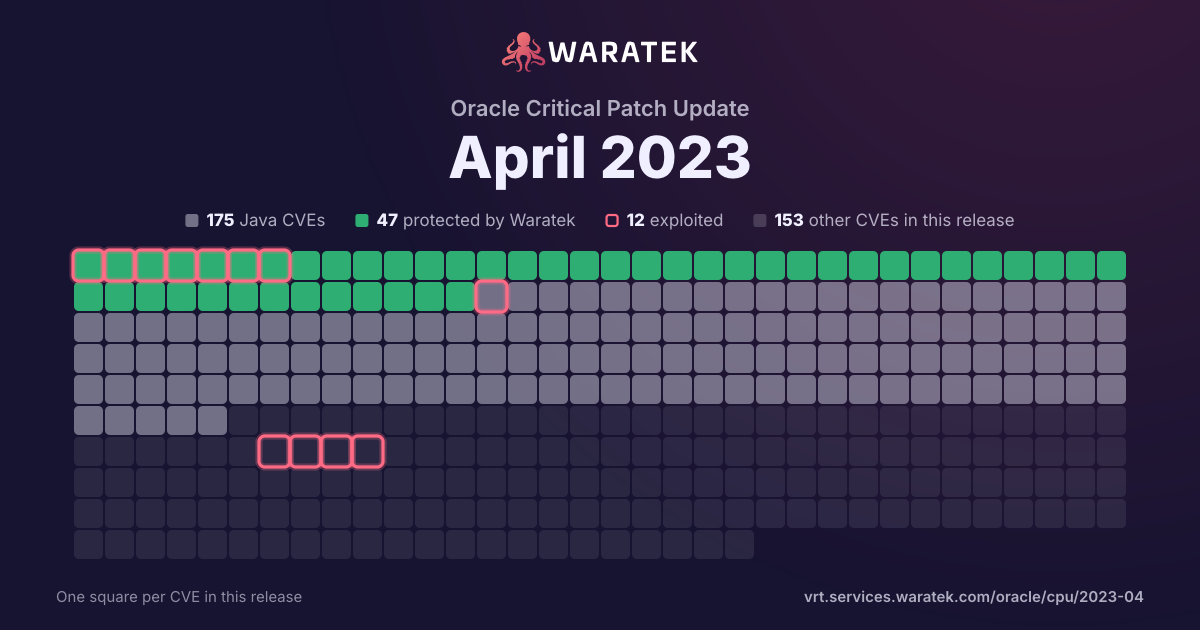
By status
47Protected by Waratek9Mitigation candidate119No exploit published35Outside Waratek scope118Not applicable
12Exploited, marked by the ring
No exploit published. For 56 of them, Oracle's security advisory is the source of public detail.
Protected by Waratek. Waratek RASP can block exploitation of these on systems that have not applied the patch yet.
Overview 58 matches · 0 protected · 0 exploited · 0 CISA KEV · 0 public PoC · 0 EPSS ≥ 0.5
58matches
0protected0.0%
0exploited0.0%
0CISA KEV0.0%
0public PoC0.0%
0EPSS ≥ 0.50.0%
Protected by Waratek
0
0.0%
Rule in development
0
0.0%
Mitigation candidate
0
0.0%
No exploit published
58
100.0%
Outside Waratek scope
0
0.0%
Not applicable
0
0.0%
Withdrawn CVE
0
0.0%
blocked by ARMR today
0
0.0%
partly blocked
0
0.0%
not blocked
58
100.0%
not established
0
0.0%
unrecorded
0
0.0%
Exploited
0
0.0%
Working exploit published
0
0.0%
Proof of concept only
3
5.2%
Forecast only
0
0.0%
No public exploit
55
94.8%
split by
peak 39 / quarter
Q2 201
No exploit published1
Medium1
not blocked1
No public exploit1
Q3 200
Q4 201
No exploit published1
Medium1
not blocked1
No public exploit1
Q1 210
Q2 211
No exploit published1
Medium1
not blocked1
No public exploit1
Q3 214
No exploit published4
Medium4
not blocked4
No public exploit4
Q4 211
No exploit published1
Medium1
not blocked1
No public exploit1
Q1 221
No exploit published1
Medium1
not blocked1
No public exploit1
Q2 223
No exploit published3
Medium3
not blocked3
Proof of concept only1
No public exploit2
Q3 223
No exploit published3
Medium3
not blocked3
No public exploit3
Q4 222
No exploit published2
Medium2
not blocked2
Proof of concept only1
No public exploit1
Q1 232
No exploit published2
Medium2
not blocked2
Proof of concept only1
No public exploit1
Q2 2339
No exploit published39
Medium39
not blocked39
No public exploit39
Q2 20Q4 20Q2 21Q4 21Q2 22Q4 22Q2 23
| CVE | Severity | Published▾ | Status | Exploitation | Description |
|---|---|---|---|---|---|
| CVE-2023-21997 | Medium | 2023-04-18 | No exploit published | No public exploit | Vulnerability in the Oracle User Management product of Oracle E-Business Suite (component: Proxy User Delegation). Supported versions that are affected are 12.2.3-12.2.12. Easily exploitable vulnerability allows low privileged attacker with network access via HTTP to compromise Oracle User Management. Successful attacks of this vulnerability can result in unauthorized read access to a subset of Oracle User Management accessible data. CVSS 3.1 Base Score 4.3 (Confidentiality impacts). CVSS Vector: (CVSS:3.1/AV:N/AC:L/PR:L/UI:N/S:U/C:L/I:N/A:N). |
| CVE-2023-21993 | Medium | 2023-04-18 | No exploit published | No public exploit | Vulnerability in the Oracle Clinical Remote Data Capture product of Oracle Health Sciences Applications (component: Forms). The supported version that is affected is 5.4.0.2. Easily exploitable vulnerability allows low privileged attacker with network access via HTTP to compromise Oracle Clinical Remote Data Capture. Successful attacks of this vulnerability can result in unauthorized access to critical data or complete access to all Oracle Clinical Remote Data Capture accessible data. CVSS 3.1 Base Score 6.5 (Confidentiality impacts). CVSS Vector: (CVSS:3.1/AV:N/AC:L/PR:L/UI:N/S:U/C:H/I:N/A:N). |
| CVE-2023-21992 | Medium | 2023-04-18 | No exploit published | No public exploit | Vulnerability in the PeopleSoft Enterprise HCM Human Resources product of Oracle PeopleSoft (component: Administer Workforce). The supported version that is affected is 9.2. Easily exploitable vulnerability allows low privileged attacker with network access via HTTP to compromise PeopleSoft Enterprise HCM Human Resources. Successful attacks of this vulnerability can result in unauthorized update, insert or delete access to some of PeopleSoft Enterprise HCM Human Resources accessible data as well as unauthorized read access to a subset of PeopleSoft Enterprise HCM Human Resources accessible data. CVSS 3.1 Base Score 5.4 (Confidentiality and Integrity impacts). CVSS Vector: (CVSS:3.1/AV:N/AC:L/PR:L/UI:N/S:U/C:L/I:L/A:N). |
| CVE-2023-21986 | Medium | 2023-04-18 | No exploit published | No public exploit | Vulnerability in the Oracle GraalVM Enterprise Edition product of Oracle Java SE (component: Native Image). Supported versions that are affected are Oracle GraalVM Enterprise Edition: 20.3.9, 21.3.5 and 22.3.1. Easily exploitable vulnerability allows unauthenticated attacker with logon to the infrastructure where Oracle GraalVM Enterprise Edition executes to compromise Oracle GraalVM Enterprise Edition. While the vulnerability is in Oracle GraalVM Enterprise Edition, attacks may significantly impact additional products (scope change). Successful attacks of this vulnerability can result in unauthorized update, insert or delete access to some of Oracle GraalVM Enterprise Edition accessible data and unauthorized ability to cause a partial denial of service (partial DOS) of Oracle GraalVM Enterprise Edition. CVSS 3.1 Base Score 5.7 (Integrity and Availability impacts). CVSS Vector: (CVSS:3.1/AV:L/AC:L/PR:N/UI:N/S:C/C:N/I:L/A:L). |
| CVE-2023-21981 | Medium | 2023-04-18 | No exploit published | No public exploit | Vulnerability in the PeopleSoft Enterprise PeopleTools product of Oracle PeopleSoft (component: Elastic Search). Supported versions that are affected are 8.58, 8.59 and 8.60. Easily exploitable vulnerability allows high privileged attacker with network access via HTTP to compromise PeopleSoft Enterprise PeopleTools. Successful attacks of this vulnerability can result in unauthorized access to critical data or complete access to all PeopleSoft Enterprise PeopleTools accessible data. CVSS 3.1 Base Score 4.9 (Confidentiality impacts). CVSS Vector: (CVSS:3.1/AV:N/AC:L/PR:H/UI:N/S:U/C:H/I:N/A:N). |
| CVE-2023-21978 | Medium | 2023-04-18 | No exploit published | No public exploit | Vulnerability in the Oracle Application Object Library product of Oracle E-Business Suite (component: GUI). Supported versions that are affected are 12.2.3-12.2.11. Easily exploitable vulnerability allows low privileged attacker with network access via HTTP to compromise Oracle Application Object Library. Successful attacks require human interaction from a person other than the attacker and while the vulnerability is in Oracle Application Object Library, attacks may significantly impact additional products (scope change). Successful attacks of this vulnerability can result in unauthorized update, insert or delete access to some of Oracle Application Object Library accessible data as well as unauthorized read access to a subset of Oracle Application Object Library accessible data and unauthorized ability to cause a partial denial of service (partial DOS) of Oracle Application Object Library. CVSS 3.1 Base Score 6.5 (Confidentiality, Integrity and Availability impacts). CVSS Vector: (CVSS:3.1/AV:N/AC:L/PR:L/UI:R/S:C/C:L/I:L/A:L). |
| CVE-2023-21973 | Medium | 2023-04-18 | No exploit published | No public exploit | Vulnerability in the Oracle iProcurement product of Oracle E-Business Suite (component: E-Content Manager Catalog). Supported versions that are affected are 12.2.3-12.2.12. Easily exploitable vulnerability allows low privileged attacker with network access via HTTP to compromise Oracle iProcurement. Successful attacks require human interaction from a person other than the attacker and while the vulnerability is in Oracle iProcurement, attacks may significantly impact additional products (scope change). Successful attacks of this vulnerability can result in unauthorized update, insert or delete access to some of Oracle iProcurement accessible data as well as unauthorized read access to a subset of Oracle iProcurement accessible data. CVSS 3.1 Base Score 5.4 (Confidentiality and Integrity impacts). CVSS Vector: (CVSS:3.1/AV:N/AC:L/PR:L/UI:R/S:C/C:L/I:L/A:N). |
| CVE-2023-21971 | Medium | 2023-04-18 | No exploit published | No public exploit | Vulnerability in the MySQL Connectors product of Oracle MySQL (component: Connector/J). Supported versions that are affected are 8.0.32 and prior. Difficult to exploit vulnerability allows high privileged attacker with network access via multiple protocols to compromise MySQL Connectors. Successful attacks require human interaction from a person other than the attacker. Successful attacks of this vulnerability can result in unauthorized ability to cause a hang or frequently repeatable crash (complete DOS) of MySQL Connectors as well as unauthorized update, insert or delete access to some of MySQL Connectors accessible data and unauthorized read access to a subset of MySQL Connectors accessible data. CVSS 3.1 Base Score 5.3 (Confidentiality, Integrity and Availability impacts). CVSS Vector: (CVSS:3.1/AV:N/AC:H/PR:H/UI:R/S:U/C:L/I:L/A:H). |
| CVE-2023-21970 | Medium | 2023-04-18 | No exploit published | No public exploit | Vulnerability in the Oracle BI Publisher product of Oracle Analytics (component: Security). The supported version that is affected is 6.4.0.0.0. Easily exploitable vulnerability allows low privileged attacker with network access via HTTP to compromise Oracle BI Publisher. Successful attacks require human interaction from a person other than the attacker. Successful attacks of this vulnerability can result in unauthorized access to critical data or complete access to all Oracle BI Publisher accessible data. CVSS 3.1 Base Score 5.7 (Confidentiality impacts). CVSS Vector: (CVSS:3.1/AV:N/AC:L/PR:L/UI:R/S:U/C:H/I:N/A:N). |
| CVE-2023-21969 | Medium | 2023-04-18 | No exploit published | No public exploit | Vulnerability in Oracle SQL Developer (component: Installation). Supported versions that are affected are Prior to 23.1.0. Easily exploitable vulnerability allows high privileged attacker with logon to the infrastructure where Oracle SQL Developer executes to compromise Oracle SQL Developer. Successful attacks of this vulnerability can result in takeover of Oracle SQL Developer. CVSS 3.1 Base Score 6.7 (Confidentiality, Integrity and Availability impacts). CVSS Vector: (CVSS:3.1/AV:L/AC:L/PR:H/UI:N/S:U/C:H/I:H/A:H). |
| CVE-2023-21967 | Medium | 2023-04-18 | No exploit published | No public exploit | Vulnerability in the Oracle Java SE, Oracle GraalVM Enterprise Edition product of Oracle Java SE (component: JSSE). Supported versions that are affected are Oracle Java SE: 8u361, 8u361-perf, 11.0.18, 17.0.6, 20; Oracle GraalVM Enterprise Edition: 20.3.9, 21.3.5 and 22.3.1. Difficult to exploit vulnerability allows unauthenticated attacker with network access via HTTPS to compromise Oracle Java SE, Oracle GraalVM Enterprise Edition. Successful attacks of this vulnerability can result in unauthorized ability to cause a hang or frequently repeatable crash (complete DOS) of Oracle Java SE, Oracle GraalVM Enterprise Edition. Note: This vulnerability applies to Java deployments, typically in clients running sandboxed Java Web Start applications or sandboxed Java applets, that load and run untrusted code (e.g., code that comes from the internet) and rely on the Java sandbox for security. This vulnerability can also be exploited by using APIs in the specified Component, e.g., through a web service which supplies data to the APIs. CVSS 3.1 Base Score 5.9 (Availability impacts). CVSS Vector: (CVSS:3.1/AV:N/AC:H/PR:N/UI:N/S:U/C:N/I:N/A:H). |
| CVE-2023-21965 | Medium | 2023-04-18 | No exploit published | No public exploit | Vulnerability in the Oracle Business Intelligence Enterprise Edition product of Oracle Analytics (component: Analytics Server). The supported version that is affected is 6.4.0.0.0. Easily exploitable vulnerability allows low privileged attacker with network access via HTTP to compromise Oracle Business Intelligence Enterprise Edition. Successful attacks require human interaction from a person other than the attacker. Successful attacks of this vulnerability can result in unauthorized access to critical data or complete access to all Oracle Business Intelligence Enterprise Edition accessible data. CVSS 3.1 Base Score 5.7 (Confidentiality impacts). CVSS Vector: (CVSS:3.1/AV:N/AC:L/PR:L/UI:R/S:U/C:H/I:N/A:N). |
| CVE-2023-21960 | Medium | 2023-04-18 | No exploit published | No public exploit | Vulnerability in the Oracle WebLogic Server product of Oracle Fusion Middleware (component: Core). Supported versions that are affected are 12.2.1.3.0 and 12.2.1.4.0. Difficult to exploit vulnerability allows unauthenticated attacker with network access via HTTP to compromise Oracle WebLogic Server. Successful attacks of this vulnerability can result in unauthorized update, insert or delete access to some of Oracle WebLogic Server accessible data as well as unauthorized read access to a subset of Oracle WebLogic Server accessible data and unauthorized ability to cause a partial denial of service (partial DOS) of Oracle WebLogic Server. CVSS 3.1 Base Score 5.6 (Confidentiality, Integrity and Availability impacts). CVSS Vector: (CVSS:3.1/AV:N/AC:H/PR:N/UI:N/S:U/C:L/I:L/A:L). |
| CVE-2023-21959 | Medium | 2023-04-18 | No exploit published | No public exploit | Vulnerability in the Oracle iReceivables product of Oracle E-Business Suite (component: Attachments). Supported versions that are affected are 12.2.3-12.2.12. Easily exploitable vulnerability allows low privileged attacker with network access via HTTP to compromise Oracle iReceivables. Successful attacks of this vulnerability can result in unauthorized read access to a subset of Oracle iReceivables accessible data. CVSS 3.1 Base Score 4.3 (Confidentiality impacts). CVSS Vector: (CVSS:3.1/AV:N/AC:L/PR:L/UI:N/S:U/C:L/I:N/A:N). |
| CVE-2023-21956 | Medium | 2023-04-18 | No exploit published | No public exploit | Vulnerability in the Oracle WebLogic Server product of Oracle Fusion Middleware (component: Web Container). Supported versions that are affected are 12.2.1.4.0 and 14.1.1.0.0. Easily exploitable vulnerability allows unauthenticated attacker with network access via HTTP to compromise Oracle WebLogic Server. Successful attacks require human interaction from a person other than the attacker and while the vulnerability is in Oracle WebLogic Server, attacks may significantly impact additional products (scope change). Successful attacks of this vulnerability can result in unauthorized update, insert or delete access to some of Oracle WebLogic Server accessible data as well as unauthorized read access to a subset of Oracle WebLogic Server accessible data. CVSS 3.1 Base Score 6.1 (Confidentiality and Integrity impacts). CVSS Vector: (CVSS:3.1/AV:N/AC:L/PR:N/UI:R/S:C/C:L/I:L/A:N). |
| CVE-2023-21954 | Medium | 2023-04-18 | No exploit published | No public exploit | Vulnerability in the Oracle Java SE, Oracle GraalVM Enterprise Edition product of Oracle Java SE (component: Hotspot). Supported versions that are affected are Oracle Java SE: 8u361, 8u361-perf, 11.0.18, 17.0.6; Oracle GraalVM Enterprise Edition: 20.3.9, 21.3.5 and 22.3.1. Difficult to exploit vulnerability allows unauthenticated attacker with network access via multiple protocols to compromise Oracle Java SE, Oracle GraalVM Enterprise Edition. Successful attacks of this vulnerability can result in unauthorized access to critical data or complete access to all Oracle Java SE, Oracle GraalVM Enterprise Edition accessible data. Note: This vulnerability applies to Java deployments, typically in clients running sandboxed Java Web Start applications or sandboxed Java applets, that load and run untrusted code (e.g., code that comes from the internet) and rely on the Java sandbox for security. This vulnerability can also be exploited by using APIs in the specified Component, e.g., through a web service which supplies data to the APIs. CVSS 3.1 Base Score 5.9 (Confidentiality impacts). CVSS Vector: (CVSS:3.1/AV:N/AC:H/PR:N/UI:N/S:U/C:H/I:N/A:N). |
| CVE-2023-21952 | Medium | 2023-04-18 | No exploit published | No public exploit | Vulnerability in the Oracle Business Intelligence Enterprise Edition product of Oracle Analytics (component: Analytics Server). The supported version that is affected is 6.4.0.0.0. Easily exploitable vulnerability allows low privileged attacker with network access via HTTP to compromise Oracle Business Intelligence Enterprise Edition. Successful attacks require human interaction from a person other than the attacker. Successful attacks of this vulnerability can result in unauthorized access to critical data or complete access to all Oracle Business Intelligence Enterprise Edition accessible data. CVSS 3.1 Base Score 5.7 (Confidentiality impacts). CVSS Vector: (CVSS:3.1/AV:N/AC:L/PR:L/UI:R/S:U/C:H/I:N/A:N). |
| CVE-2023-21944 | Medium | 2023-04-18 | No exploit published | No public exploit | Vulnerability in Oracle Essbase (component: Security and Provisioning). The supported version that is affected is 21.4. Difficult to exploit vulnerability allows unauthenticated attacker with network access via HTTP to compromise Oracle Essbase. Successful attacks require human interaction from a person other than the attacker. Successful attacks of this vulnerability can result in unauthorized access to critical data or complete access to all Oracle Essbase accessible data. CVSS 3.1 Base Score 5.3 (Confidentiality impacts). CVSS Vector: (CVSS:3.1/AV:N/AC:H/PR:N/UI:R/S:U/C:H/I:N/A:N). |
| CVE-2023-21943 | Medium | 2023-04-18 | No exploit published | No public exploit | Vulnerability in Oracle Essbase (component: Security and Provisioning). The supported version that is affected is 21.4. Difficult to exploit vulnerability allows unauthenticated attacker with network access via HTTP to compromise Oracle Essbase. Successful attacks require human interaction from a person other than the attacker. Successful attacks of this vulnerability can result in unauthorized access to critical data or complete access to all Oracle Essbase accessible data. CVSS 3.1 Base Score 5.3 (Confidentiality impacts). CVSS Vector: (CVSS:3.1/AV:N/AC:H/PR:N/UI:R/S:U/C:H/I:N/A:N). |
| CVE-2023-21942 | Medium | 2023-04-18 | No exploit published | No public exploit | Vulnerability in Oracle Essbase (component: Security and Provisioning). The supported version that is affected is 21.4. Difficult to exploit vulnerability allows unauthenticated attacker with network access via HTTP to compromise Oracle Essbase. Successful attacks require human interaction from a person other than the attacker. Successful attacks of this vulnerability can result in unauthorized access to critical data or complete access to all Oracle Essbase accessible data. CVSS 3.1 Base Score 5.3 (Confidentiality impacts). CVSS Vector: (CVSS:3.1/AV:N/AC:H/PR:N/UI:R/S:U/C:H/I:N/A:N). |
| CVE-2023-21941 | Medium | 2023-04-18 | No exploit published | No public exploit | Vulnerability in the Oracle BI Publisher product of Oracle Analytics (component: Web Server). Supported versions that are affected are 6.4.0.0.0 and 12.2.1.4.0. Easily exploitable vulnerability allows low privileged attacker with network access via HTTP to compromise Oracle BI Publisher. Successful attacks of this vulnerability can result in unauthorized read access to a subset of Oracle BI Publisher accessible data. CVSS 3.1 Base Score 4.3 (Confidentiality impacts). CVSS Vector: (CVSS:3.1/AV:N/AC:L/PR:L/UI:N/S:U/C:L/I:N/A:N). |
| CVE-2023-21936 | Medium | 2023-04-18 | No exploit published | No public exploit | Vulnerability in the JD Edwards EnterpriseOne Tools product of Oracle JD Edwards (component: Web Runtime SEC). Supported versions that are affected are Prior to 9.2.7.3. Easily exploitable vulnerability allows low privileged attacker with network access via HTTP to compromise JD Edwards EnterpriseOne Tools. Successful attacks require human interaction from a person other than the attacker and while the vulnerability is in JD Edwards EnterpriseOne Tools, attacks may significantly impact additional products (scope change). Successful attacks of this vulnerability can result in unauthorized update, insert or delete access to some of JD Edwards EnterpriseOne Tools accessible data as well as unauthorized read access to a subset of JD Edwards EnterpriseOne Tools accessible data. CVSS 3.1 Base Score 5.4 (Confidentiality and Integrity impacts). CVSS Vector: (CVSS:3.1/AV:N/AC:L/PR:L/UI:R/S:C/C:L/I:L/A:N). |
| CVE-2023-21927 | Medium | 2023-04-18 | No exploit published | No public exploit | Vulnerability in the JD Edwards EnterpriseOne Tools product of Oracle JD Edwards (component: Interoperability SEC). Supported versions that are affected are Prior to 9.2.7.3. Easily exploitable vulnerability allows low privileged attacker with network access via HTTP to compromise JD Edwards EnterpriseOne Tools. Successful attacks of this vulnerability can result in unauthorized read access to a subset of JD Edwards EnterpriseOne Tools accessible data. CVSS 3.1 Base Score 4.3 (Confidentiality impacts). CVSS Vector: (CVSS:3.1/AV:N/AC:L/PR:L/UI:N/S:U/C:L/I:N/A:N). |
| CVE-2023-21926 | Medium | 2023-04-18 | No exploit published | No public exploit | Vulnerability in the Oracle Health Sciences InForm product of Oracle Health Sciences Applications (component: Core). Supported versions that are affected are Prior to 6.3.1.3 and Prior to 7.0.0.1. Easily exploitable vulnerability allows unauthenticated attacker with logon to the infrastructure where Oracle Health Sciences InForm executes to compromise Oracle Health Sciences InForm. Successful attacks require human interaction from a person other than the attacker. Successful attacks of this vulnerability can result in unauthorized access to critical data or complete access to all Oracle Health Sciences InForm accessible data. CVSS 3.1 Base Score 5.5 (Confidentiality impacts). CVSS Vector: (CVSS:3.1/AV:L/AC:L/PR:N/UI:R/S:U/C:H/I:N/A:N). |
| CVE-2023-21925 | Medium | 2023-04-18 | No exploit published | No public exploit | Vulnerability in the Oracle Health Sciences InForm product of Oracle Health Sciences Applications (component: Core). Supported versions that are affected are Prior to 6.3.1.3 and Prior to 7.0.0.1. Easily exploitable vulnerability allows unauthenticated attacker with network access via HTTP to compromise Oracle Health Sciences InForm. Successful attacks of this vulnerability can result in unauthorized ability to cause a partial denial of service (partial DOS) of Oracle Health Sciences InForm. CVSS 3.1 Base Score 5.3 (Availability impacts). CVSS Vector: (CVSS:3.1/AV:N/AC:L/PR:N/UI:N/S:U/C:N/I:N/A:L). |
| CVE-2023-21924 | Medium | 2023-04-18 | No exploit published | No public exploit | Vulnerability in the Oracle Health Sciences InForm product of Oracle Health Sciences Applications (component: Core). Supported versions that are affected are Prior to 6.3.1.3 and Prior to 7.0.0.1. Easily exploitable vulnerability allows high privileged attacker with network access via HTTP to compromise Oracle Health Sciences InForm. Successful attacks require human interaction from a person other than the attacker and while the vulnerability is in Oracle Health Sciences InForm, attacks may significantly impact additional products (scope change). Successful attacks of this vulnerability can result in unauthorized update, insert or delete access to some of Oracle Health Sciences InForm accessible data as well as unauthorized read access to a subset of Oracle Health Sciences InForm accessible data and unauthorized ability to cause a partial denial of service (partial DOS) of Oracle Health Sciences InForm. CVSS 3.1 Base Score 5.9 (Confidentiality, Integrity and Availability impacts). CVSS Vector: (CVSS:3.1/AV:N/AC:L/PR:H/UI:R/S:C/C:L/I:L/A:L). |
| CVE-2023-21922 | Medium | 2023-04-18 | No exploit published | No public exploit | Vulnerability in the Oracle Health Sciences InForm product of Oracle Health Sciences Applications (component: Core). Supported versions that are affected are Prior to 6.3.1.3 and Prior to 7.0.0.1. Difficult to exploit vulnerability allows unauthenticated attacker with network access via HTTP to compromise Oracle Health Sciences InForm. Successful attacks require human interaction from a person other than the attacker. Successful attacks of this vulnerability can result in unauthorized creation, deletion or modification access to critical data or all Oracle Health Sciences InForm accessible data as well as unauthorized access to critical data or complete access to all Oracle Health Sciences InForm accessible data. CVSS 3.1 Base Score 6.8 (Confidentiality and Integrity impacts). CVSS Vector: (CVSS:3.1/AV:N/AC:H/PR:N/UI:R/S:U/C:H/I:H/A:N). |
| CVE-2023-21921 | Medium | 2023-04-18 | No exploit published | No public exploit | Vulnerability in the Oracle Health Sciences InForm product of Oracle Health Sciences Applications (component: Core). Supported versions that are affected are Prior to 6.3.1.3 and Prior to 7.0.0.1. Easily exploitable vulnerability allows low privileged attacker with network access via HTTP to compromise Oracle Health Sciences InForm. Successful attacks of this vulnerability can result in unauthorized update, insert or delete access to some of Oracle Health Sciences InForm accessible data as well as unauthorized read access to a subset of Oracle Health Sciences InForm accessible data. CVSS 3.1 Base Score 5.4 (Confidentiality and Integrity impacts). CVSS Vector: (CVSS:3.1/AV:N/AC:L/PR:L/UI:N/S:U/C:L/I:L/A:N). |
| CVE-2023-21916 | Medium | 2023-04-18 | No exploit published | No public exploit | Vulnerability in the PeopleSoft Enterprise PeopleTools product of Oracle PeopleSoft (component: Web Server). Supported versions that are affected are 8.58, 8.59 and 8.60. Easily exploitable vulnerability allows unauthenticated attacker with network access via HTTP to compromise PeopleSoft Enterprise PeopleTools. Successful attacks of this vulnerability can result in unauthorized read access to a subset of PeopleSoft Enterprise PeopleTools accessible data. CVSS 3.1 Base Score 5.3 (Confidentiality impacts). CVSS Vector: (CVSS:3.1/AV:N/AC:L/PR:N/UI:N/S:U/C:L/I:N/A:N). |
| CVE-2023-21915 | Medium | 2023-04-18 | No exploit published | No public exploit | Vulnerability in the Oracle Banking Payments product of Oracle Financial Services Applications (component: Book/Internal Transfer). Supported versions that are affected are 14.5, 14.6 and 14.7. Easily exploitable vulnerability allows low privileged attacker with network access via HTTP to compromise Oracle Banking Payments. Successful attacks require human interaction from a person other than the attacker. Successful attacks of this vulnerability can result in unauthorized update, insert or delete access to some of Oracle Banking Payments accessible data as well as unauthorized read access to a subset of Oracle Banking Payments accessible data. CVSS 3.1 Base Score 4.6 (Confidentiality and Integrity impacts). CVSS Vector: (CVSS:3.1/AV:N/AC:L/PR:L/UI:R/S:U/C:L/I:L/A:N). |
| CVE-2023-21910 | Medium | 2023-04-18 | No exploit published | No public exploit | Vulnerability in the Oracle Business Intelligence Enterprise Edition product of Oracle Analytics (component: Analytics Web General). Supported versions that are affected are 6.4.0.0.0 and 12.2.1.4.0. Easily exploitable vulnerability allows low privileged attacker with network access via HTTP to compromise Oracle Business Intelligence Enterprise Edition. Successful attacks of this vulnerability can result in unauthorized access to critical data or complete access to all Oracle Business Intelligence Enterprise Edition accessible data. CVSS 3.1 Base Score 6.5 (Confidentiality impacts). CVSS Vector: (CVSS:3.1/AV:N/AC:L/PR:L/UI:N/S:U/C:H/I:N/A:N). |
| CVE-2023-21909 | Medium | 2023-04-18 | No exploit published | No public exploit | Vulnerability in the Siebel CRM product of Oracle Siebel CRM (component: UI Framework). Supported versions that are affected are 23.3 and prior. Easily exploitable vulnerability allows low privileged attacker with network access via HTTP to compromise Siebel CRM. Successful attacks of this vulnerability can result in unauthorized access to critical data or complete access to all Siebel CRM accessible data. CVSS 3.1 Base Score 6.5 (Confidentiality impacts). CVSS Vector: (CVSS:3.1/AV:N/AC:L/PR:L/UI:N/S:U/C:H/I:N/A:N). |
| CVE-2023-21908 | Medium | 2023-04-18 | No exploit published | No public exploit | Vulnerability in the Oracle Banking Virtual Account Management product of Oracle Financial Services Applications (component: OBVAM Trn Journal Domain). Supported versions that are affected are 14.5, 14.6 and 14.7. Difficult to exploit vulnerability allows high privileged attacker with network access via HTTP to compromise Oracle Banking Virtual Account Management. Successful attacks require human interaction from a person other than the attacker. Successful attacks of this vulnerability can result in unauthorized access to critical data or complete access to all Oracle Banking Virtual Account Management accessible data as well as unauthorized update, insert or delete access to some of Oracle Banking Virtual Account Management accessible data and unauthorized ability to cause a hang or frequently repeatable crash (complete DOS) of Oracle Banking Virtual Account Management. CVSS 3.1 Base Score 6.0 (Confidentiality, Integrity and Availability impacts). CVSS Vector: (CVSS:3.1/AV:N/AC:H/PR:H/UI:R/S:U/C:H/I:L/A:H). |
| CVE-2023-21907 | Medium | 2023-04-18 | No exploit published | No public exploit | Vulnerability in the Oracle Banking Virtual Account Management product of Oracle Financial Services Applications (component: OBVAM Trn Journal Domain). Supported versions that are affected are 14.5, 14.6 and 14.7. Difficult to exploit vulnerability allows high privileged attacker with network access via HTTP to compromise Oracle Banking Virtual Account Management. Successful attacks require human interaction from a person other than the attacker. Successful attacks of this vulnerability can result in unauthorized access to critical data or complete access to all Oracle Banking Virtual Account Management accessible data as well as unauthorized update, insert or delete access to some of Oracle Banking Virtual Account Management accessible data and unauthorized ability to cause a hang or frequently repeatable crash (complete DOS) of Oracle Banking Virtual Account Management. CVSS 3.1 Base Score 6.0 (Confidentiality, Integrity and Availability impacts). CVSS Vector: (CVSS:3.1/AV:N/AC:H/PR:H/UI:R/S:U/C:H/I:L/A:H). |
| CVE-2023-21906 | Medium | 2023-04-18 | No exploit published | No public exploit | Vulnerability in the Oracle Banking Virtual Account Management product of Oracle Financial Services Applications (component: SMS Module). Supported versions that are affected are 14.5, 14.6 and 14.7. Easily exploitable vulnerability allows high privileged attacker with network access via HTTP to compromise Oracle Banking Virtual Account Management. Successful attacks require human interaction from a person other than the attacker. Successful attacks of this vulnerability can result in unauthorized creation, deletion or modification access to critical data or all Oracle Banking Virtual Account Management accessible data as well as unauthorized access to critical data or complete access to all Oracle Banking Virtual Account Management accessible data. CVSS 3.1 Base Score 6.1 (Confidentiality and Integrity impacts). CVSS Vector: (CVSS:3.1/AV:N/AC:L/PR:H/UI:R/S:U/C:H/I:H/A:N). |
| CVE-2023-21905 | Medium | 2023-04-18 | No exploit published | No public exploit | Vulnerability in the Oracle Banking Virtual Account Management product of Oracle Financial Services Applications (component: Routing Hub). Supported versions that are affected are 14.5, 14.6 and 14.7. Easily exploitable vulnerability allows high privileged attacker with network access via HTTP to compromise Oracle Banking Virtual Account Management. Successful attacks require human interaction from a person other than the attacker. Successful attacks of this vulnerability can result in unauthorized creation, deletion or modification access to critical data or all Oracle Banking Virtual Account Management accessible data as well as unauthorized access to critical data or complete access to all Oracle Banking Virtual Account Management accessible data. CVSS 3.1 Base Score 6.1 (Confidentiality and Integrity impacts). CVSS Vector: (CVSS:3.1/AV:N/AC:L/PR:H/UI:R/S:U/C:H/I:H/A:N). |
| CVE-2023-21904 | Medium | 2023-04-18 | No exploit published | No public exploit | Vulnerability in the Oracle Banking Virtual Account Management product of Oracle Financial Services Applications (component: OBVAM Trn Journal Domain). Supported versions that are affected are 14.5, 14.6 and 14.7. Difficult to exploit vulnerability allows high privileged attacker with network access via HTTP to compromise Oracle Banking Virtual Account Management. Successful attacks require human interaction from a person other than the attacker. Successful attacks of this vulnerability can result in unauthorized access to critical data or complete access to all Oracle Banking Virtual Account Management accessible data as well as unauthorized update, insert or delete access to some of Oracle Banking Virtual Account Management accessible data and unauthorized ability to cause a partial denial of service (partial DOS) of Oracle Banking Virtual Account Management. CVSS 3.1 Base Score 5.3 (Confidentiality, Integrity and Availability impacts). CVSS Vector: (CVSS:3.1/AV:N/AC:H/PR:H/UI:R/S:U/C:H/I:L/A:L). |
| CVE-2023-21903 | Medium | 2023-04-18 | No exploit published | No public exploit | Vulnerability in the Oracle Banking Virtual Account Management product of Oracle Financial Services Applications (component: OBVAM Internal Tfr Domain). Supported versions that are affected are 14.5, 14.6 and 14.7. Difficult to exploit vulnerability allows high privileged attacker with network access via HTTP to compromise Oracle Banking Virtual Account Management. Successful attacks require human interaction from a person other than the attacker. Successful attacks of this vulnerability can result in unauthorized access to critical data or complete access to all Oracle Banking Virtual Account Management accessible data as well as unauthorized update, insert or delete access to some of Oracle Banking Virtual Account Management accessible data and unauthorized ability to cause a partial denial of service (partial DOS) of Oracle Banking Virtual Account Management. CVSS 3.1 Base Score 5.3 (Confidentiality, Integrity and Availability impacts). CVSS Vector: (CVSS:3.1/AV:N/AC:H/PR:H/UI:R/S:U/C:H/I:L/A:L). |
| CVE-2023-21902 | Medium | 2023-04-18 | No exploit published | No public exploit | Vulnerability in the Oracle Financial Services Behavior Detection Platform product of Oracle Financial Services Applications (component: Application). The supported version that is affected is 8.0.8.1. Easily exploitable vulnerability allows low privileged attacker with network access via HTTP to compromise Oracle Financial Services Behavior Detection Platform. Successful attacks of this vulnerability can result in unauthorized read access to a subset of Oracle Financial Services Behavior Detection Platform accessible data. CVSS 3.1 Base Score 4.3 (Confidentiality impacts). CVSS Vector: (CVSS:3.1/AV:N/AC:L/PR:L/UI:N/S:U/C:L/I:N/A:N). |
| CVE-2023-28708 | Medium | 2023-03-22 | No exploit published | No public exploit | When using the RemoteIpFilter with requests received from a reverse proxy via HTTP that include the X-Forwarded-Proto header set to https, session cookies created by Apache Tomcat 11.0.0-M1 to 11.0.0.-M2, 10.1.0-M1 to 10.1.5, 9.0.0-M1 to 9.0.71 and 8.5.0 to 8.5.85 did not include the secure attribute. This could result in the user agent transmitting the session cookie over an insecure channel. Older, EOL versions may also be affected. |
| CVE-2023-22899 | Medium | 2023-01-10 | No exploit published | Proof of concept only | Zip4j through 2.11.2, as used in Threema and other products, does not always check the MAC when decrypting a ZIP archive. |
| CVE-2022-41915 | Medium | 2022-12-13 | No exploit published | Proof of concept only | Netty project is an event-driven asynchronous network application framework. Starting in version 4.1.83.Final and prior to 4.1.86.Final, when calling `DefaultHttpHeadesr.set` with an _iterator_ of values, header value validation was not performed, allowing malicious header values in the iterator to perform HTTP Response Splitting. This issue has been patched in version 4.1.86.Final. Integrators can work around the issue by changing the `DefaultHttpHeaders.set(CharSequence, Iterator<?>)` call, into a `remove()` call, and call `add()` in a loop over the iterator of values. |
| CVE-2021-37533 | Medium | 2022-12-03 | No exploit published | No public exploit | Prior to Apache Commons Net 3.9.0, Net's FTP client trusts the host from PASV response by default. A malicious server can redirect the Commons Net code to use a different host, but the user has to connect to the malicious server in the first place. This may lead to leakage of information about services running on the private network of the client. The default in version 3.9.0 is now false to ignore such hosts, as cURL does. See https://issues.apache.org/jira/browse/NET-711. |
| CVE-2022-38751 | Medium | 2022-09-05 | No exploit published | No public exploit | Using snakeYAML to parse untrusted YAML files may be vulnerable to Denial of Service attacks (DOS). If the parser is running on user supplied input, an attacker may supply content that causes the parser to crash by stackoverflow. |
| CVE-2022-38750 | Medium | 2022-09-05 | No exploit published | No public exploit | Using snakeYAML to parse untrusted YAML files may be vulnerable to Denial of Service attacks (DOS). If the parser is running on user supplied input, an attacker may supply content that causes the parser to crash by stackoverflow. |
| CVE-2022-38749 | Medium | 2022-09-05 | No exploit published | No public exploit | Using snakeYAML to parse untrusted YAML files may be vulnerable to Denial of Service attacks (DOS). If the parser is running on user supplied input, an attacker may supply content that causes the parser to crash by stackoverflow. |
| CVE-2022-22976 | Medium | 2022-05-19 | No exploit published | No public exploit | Spring Security versions 5.5.x prior to 5.5.7, 5.6.x prior to 5.6.4, and earlier unsupported versions contain an integer overflow vulnerability. When using the BCrypt class with the maximum work factor (31), the encoder does not perform any salt rounds, due to an integer overflow error. The default settings are not affected by this CVE. |
| CVE-2022-22970 | Medium | 2022-05-12 | No exploit published | No public exploit | In spring framework versions prior to 5.3.20+ , 5.2.22+ and old unsupported versions, applications that handle file uploads are vulnerable to DoS attack if they rely on data binding to set a MultipartFile or javax.servlet.Part to a field in a model object. |
| CVE-2022-24891 | Medium | 2022-04-27 | No exploit published | Proof of concept only | ESAPI (The OWASP Enterprise Security API) is a free, open source, web application security control library. Prior to version 2.3.0.0, there is a potential for a cross-site scripting vulnerability in ESAPI caused by a incorrect regular expression for "onsiteURL" in the **antisamy-esapi.xml** configuration file that can cause "javascript:" URLs to fail to be correctly sanitized. This issue is patched in ESAPI 2.3.0.0. As a workaround, manually edit the **antisamy-esapi.xml** configuration files to change the "onsiteURL" regular expression. More information about remediation of the vulnerability, including the workaround, is available in the maintainers' release notes and security bulletin. |
| CVE-2022-23437 | Medium | 2022-01-24 | No exploit published | No public exploit | There's a vulnerability within the Apache Xerces Java (XercesJ) XML parser when handling specially crafted XML document payloads. This causes, the XercesJ XML parser to wait in an infinite loop, which may sometimes consume system resources for prolonged duration. This vulnerability is present within XercesJ version 2.12.1 and the previous versions. |
| CVE-2021-41973 | Medium | 2021-11-01 | No exploit published | No public exploit | In Apache MINA, a specifically crafted, malformed HTTP request may cause the HTTP Header decoder to loop indefinitely. The decoder assumed that the HTTP Header begins at the beginning of the buffer and loops if there is more data than expected. Please update MINA to 2.1.5 or greater. |
| CVE-2021-35043 | Medium | 2021-07-19 | No exploit published | No public exploit | OWASP AntiSamy before 1.6.4 allows XSS via HTML attributes when using the HTML output serializer (XHTML is not affected). This was demonstrated by a javascript: URL with : as the replacement for the : character. |
| CVE-2021-36374 | Medium | 2021-07-14 | No exploit published | No public exploit | When reading a specially crafted ZIP archive, or a derived formats, an Apache Ant build can be made to allocate large amounts of memory that leads to an out of memory error, even for small inputs. This can be used to disrupt builds using Apache Ant. Commonly used derived formats from ZIP archives are for instance JAR files and many office files. Apache Ant prior to 1.9.16 and 1.10.11 were affected. |
| CVE-2021-36373 | Medium | 2021-07-14 | No exploit published | No public exploit | When reading a specially crafted TAR archive an Apache Ant build can be made to allocate large amounts of memory that finally leads to an out of memory error, even for small inputs. This can be used to disrupt builds using Apache Ant. Apache Ant prior to 1.9.16 and 1.10.11 were affected. |
| CVE-2021-30129 | Medium | 2021-07-12 | No exploit published | No public exploit | A vulnerability in sshd-core of Apache Mina SSHD allows an attacker to overflow the server causing an OutOfMemory error. This issue affects the SFTP and port forwarding features of Apache Mina SSHD version 2.0.0 and later versions. It was addressed in Apache Mina SSHD 2.7.0 |
| CVE-2020-15522 | Medium | 2021-05-20 | No exploit published | No public exploit | Bouncy Castle BC Java before 1.66, BC C# .NET before 1.8.7, BC-FJA before 1.0.1.2, 1.0.2.1, and BC-FNA before 1.0.1.1 have a timing issue within the EC math library that can expose information about the private key when an attacker is able to observe timing information for the generation of multiple deterministic ECDSA signatures. |
| CVE-2020-13954 | Medium | 2020-11-12 | No exploit published | No public exploit | By default, Apache CXF creates a /services page containing a listing of the available endpoint names and addresses. This webpage is vulnerable to a reflected Cross-Site Scripting (XSS) attack via the styleSheetPath, which allows a malicious actor to inject javascript into the web page. This vulnerability affects all versions of Apache CXF prior to 3.4.1 and 3.3.8. Please note that this is a separate issue to CVE-2019-17573. |
| CVE-2020-10693 | Medium | 2020-05-06 | No exploit published | No public exploit | A flaw was found in Hibernate Validator version 6.1.2.Final. A bug in the message interpolation processor enables invalid EL expressions to be evaluated as if they were valid. This flaw allows attackers to bypass input sanitation (escaping, stripping) controls that developers may have put in place when handling user-controlled data in error messages. |