
Oracle Critical Patch Update April 2023
Released April 2023 · Oracle's advisory ↗ · ← Critical Patch Update, January 2023 · Critical Patch Update, July 2023 →
328 CVEs in this release, one square each
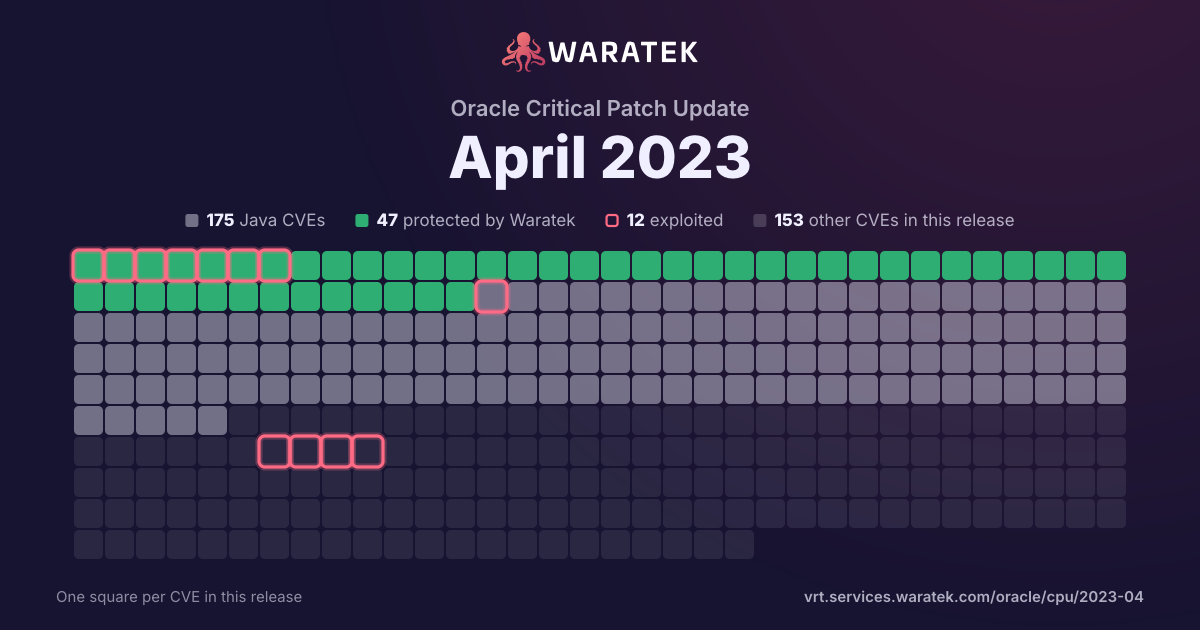
By status
47Protected by Waratek10Mitigation candidate123No exploit published3Outside Waratek scope145Not applicable
10Exploited, marked by the ring
No exploit published. For 55 of them, Oracle's security advisory is the source of public detail.
Protected by Waratek. Waratek RASP can block exploitation of these on systems that have not applied the patch yet.
Overview 35 matches · 17 in Waratek scope · 5 protected · 0 exploited · 0 CISA KEV · 11 public PoC · 4 EPSS ≥ 0.5
35matches
17in Waratek scope48.6%
5protected14.3%
0exploited0.0%
0CISA KEV0.0%
11public PoC31.4%
4EPSS ≥ 0.511.4%
Protected by Waratek
5
14.3%
Rule in development
0
0.0%
Mitigation candidate
4
11.4%
No exploit published
8
22.9%
Outside Waratek scope
1
2.9%
Not applicable
17
48.6%
Withdrawn CVE
0
0.0%
blocked by ARMR today
5
14.3%
partly blocked
0
0.0%
not blocked
30
85.7%
not established
0
0.0%
unrecorded
0
0.0%
Exploited
0
0.0%
Working exploit published
0
0.0%
Proof of concept only
35
100.0%
Forecast only
0
0.0%
No public exploit
0
0.0%
split by
peak 7 / month
Jul 225
Protected by Waratek1
Mitigation candidate1
Outside Waratek scope1
Not applicable2
Critical2
High2
Medium1
blocked by ARMR today1
not blocked4
Proof of concept only5
Aug 223
Protected by Waratek1
Not applicable2
Critical1
High1
Medium1
blocked by ARMR today1
not blocked2
Proof of concept only3
Sep 224
Protected by Waratek1
Mitigation candidate1
No exploit published2
High3
Medium1
blocked by ARMR today1
not blocked3
Proof of concept only4
Oct 222
Mitigation candidate1
Not applicable1
Critical2
not blocked2
Proof of concept only2
Nov 224
Protected by Waratek1
Not applicable3
Critical1
High3
blocked by ARMR today1
not blocked3
Proof of concept only4
Dec 227
Mitigation candidate1
No exploit published4
Not applicable2
Critical1
High5
Medium1
not blocked7
Proof of concept only7
Jan 232
No exploit published1
Not applicable1
Medium2
not blocked2
Proof of concept only2
Feb 236
Not applicable6
Critical1
High1
Medium4
not blocked6
Proof of concept only6
Mar 231
No exploit published1
High1
not blocked1
Proof of concept only1
Apr 231
Protected by Waratek1
Medium1
blocked by ARMR today1
Proof of concept only1
Jul 22Aug 22Sep 22Oct 22Nov 22Dec 22Jan 23Feb 23Mar 23Apr 23
| CVE | Severity | Published▾ | Status | Exploitation | Description |
|---|---|---|---|---|---|
| CVE-2023-21939 | Medium | 2023-04-18 | Protected by Waratek | Proof of concept only | Vulnerability in the Oracle Java SE, Oracle GraalVM Enterprise Edition product of Oracle Java SE (component: Swing). Supported versions that are affected are Oracle Java SE: 8u361, 8u361-perf, 11.0.18, 17.0.6, 20; Oracle GraalVM Enterprise Edition: 20.3.9, 21.3.5 and 22.3.1. Easily exploitable vulnerability allows unauthenticated attacker with network access via HTTP to compromise Oracle Java SE, Oracle GraalVM Enterprise Edition. Successful attacks of this vulnerability can result in unauthorized update, insert or delete access to some of Oracle Java SE, Oracle GraalVM Enterprise Edition accessible data. Note: This vulnerability applies to Java deployments, typically in clients running sandboxed Java Web Start applications or sandboxed Java applets, that load and run untrusted code (e.g., code that comes from the internet) and rely on the Java sandbox for security. This vulnerability can also be exploited by using APIs in the specified Component, e.g., through a web service which supplies data to the APIs. CVSS 3.1 Base Score 5.3 (Integrity impacts). CVSS Vector: (CVSS:3.1/AV:N/AC:L/PR:N/UI:N/S:U/C:N/I:L/A:N). |
| CVE-2023-1370 | High | 2023-03-22 | No exploit published | Proof of concept only | [Json-smart](https://netplex.github.io/json-smart/) is a performance focused, JSON processor lib. When reaching a ‘[‘ or ‘{‘ character in the JSON input, the code parses an array or an object respectively. It was discovered that the code does not have any limit to the nesting of such arrays or objects. Since the parsing of nested arrays and objects is done recursively, nesting too many of them can cause a stack exhaustion (stack overflow) and crash the software. |
| CVE-2023-23916 | Medium | 2023-02-23 | Not applicable | Proof of concept only | An allocation of resources without limits or throttling vulnerability exists in curl <v7.88.0 based on the "chained" HTTP compression algorithms, meaning that a server response can be compressed multiple times and potentially with differentalgorithms. The number of acceptable "links" in this "decompression chain" wascapped, but the cap was implemented on a per-header basis allowing a maliciousserver to insert a virtually unlimited number of compression steps simply byusing many headers. The use of such a decompression chain could result in a "malloc bomb", making curl end up spending enormous amounts of allocated heap memory, or trying to and returning out of memory errors. |
| CVE-2023-23914 | Critical | 2023-02-23 | Not applicable | Proof of concept only | A cleartext transmission of sensitive information vulnerability exists in curl <v7.88.0 that could cause HSTS functionality fail when multiple URLs are requested serially. Using its HSTS support, curl can be instructed to use HTTPS instead of usingan insecure clear-text HTTP step even when HTTP is provided in the URL. ThisHSTS mechanism would however surprisingly be ignored by subsequent transferswhen done on the same command line because the state would not be properlycarried on. |
| CVE-2023-0361 | High | 2023-02-15 | Not applicable | Proof of concept only | A timing side-channel in the handling of RSA ClientKeyExchange messages was discovered in GnuTLS. This side-channel can be sufficient to recover the key encrypted in the RSA ciphertext across a network in a Bleichenbacher style attack. To achieve a successful decryption the attacker would need to send a large amount of specially crafted messages to the vulnerable server. By recovering the secret from the ClientKeyExchange message, the attacker would be able to decrypt the application data exchanged over that connection. |
| CVE-2023-23931 | Medium | 2023-02-07 | Not applicable | Proof of concept only | cryptography is a package designed to expose cryptographic primitives and recipes to Python developers. In affected versions `Cipher.update_into` would accept Python objects which implement the buffer protocol, but provide only immutable buffers. This would allow immutable objects (such as `bytes`) to be mutated, thus violating fundamental rules of Python and resulting in corrupted output. This now correctly raises an exception. This issue has been present since `update_into` was originally introduced in cryptography 1.8. |
| CVE-2023-25136 | Medium | 2023-02-03 | Not applicable | Proof of concept only | OpenSSH server (sshd) 9.1 introduced a double-free vulnerability during options.kex_algorithms handling. This is fixed in OpenSSH 9.2. The double free can be leveraged, by an unauthenticated remote attacker in the default configuration, to jump to any location in the sshd address space. One third-party report states "remote code execution is theoretically possible." |
| CVE-2021-37519 | Medium | 2023-02-03 | Not applicable | Proof of concept only | Buffer Overflow vulnerability in authfile.c memcached 1.6.9 allows attackers to cause a denial of service via crafted authenticattion file. |
| CVE-2022-4415 | Medium | 2023-01-11 | Not applicable | Proof of concept only | A vulnerability was found in systemd. This security flaw can cause a local information leak due to systemd-coredump not respecting the fs.suid_dumpable kernel setting. |
| CVE-2023-22899 | Medium | 2023-01-10 | No exploit published | Proof of concept only | Zip4j through 2.11.2, as used in Threema and other products, does not always check the MAC when decrypting a ZIP archive. |
| CVE-2022-41966 | High | 2022-12-28 | No exploit published | Proof of concept only | XStream serializes Java objects to XML and back again. Versions prior to 1.4.20 may allow a remote attacker to terminate the application with a stack overflow error, resulting in a denial of service only via manipulation the processed input stream. The attack uses the hash code implementation for collections and maps to force recursive hash calculation causing a stack overflow. This issue is patched in version 1.4.20 which handles the stack overflow and raises an InputManipulationException instead. A potential workaround for users who only use HashMap or HashSet and whose XML refers these only as default map or set, is to change the default implementation of java.util.Map and java.util per the code example in the referenced advisory. However, this implies that your application does not care about the implementation of the map and all elements are comparable. |
| CVE-2022-43551 | High | 2022-12-23 | Not applicable | Proof of concept only | A vulnerability exists in curl <7.87.0 HSTS check that could be bypassed to trick it to keep using HTTP. Using its HSTS support, curl can be instructed to use HTTPS instead of using an insecure clear-text HTTP step even when HTTP is provided in the URL. However, the HSTS mechanism could be bypassed if the host name in the given URL first uses IDN characters that get replaced to ASCII counterparts as part of the IDN conversion. Like using the character UTF-8 U+3002 (IDEOGRAPHIC FULL STOP) instead of the common ASCII full stop (U+002E) `.`. Then in a subsequent request, it does not detect the HSTS state and makes a clear text transfer. Because it would store the info IDN encoded but look for it IDN decoded. |
| CVE-2022-46364 | Critical | 2022-12-13 | Mitigation candidate | Proof of concept only | A SSRF vulnerability in parsing the href attribute of XOP:Include in MTOM requests in versions of Apache CXF before 3.5.5 and 3.4.10 allows an attacker to perform SSRF style attacks on webservices that take at least one parameter of any type. |
| CVE-2022-45693 | High | 2022-12-13 | No exploit published | Proof of concept only | Jettison before v1.5.2 was discovered to contain a stack overflow via the map parameter. This vulnerability allows attackers to cause a Denial of Service (DoS) via a crafted string. |
| CVE-2022-41915 | Medium | 2022-12-13 | No exploit published | Proof of concept only | Netty project is an event-driven asynchronous network application framework. Starting in version 4.1.83.Final and prior to 4.1.86.Final, when calling `DefaultHttpHeadesr.set` with an _iterator_ of values, header value validation was not performed, allowing malicious header values in the iterator to perform HTTP Response Splitting. This issue has been patched in version 4.1.86.Final. Integrators can work around the issue by changing the `DefaultHttpHeaders.set(CharSequence, Iterator<?>)` call, into a `remove()` call, and call `add()` in a loop over the iterator of values. |
| CVE-2022-46908 | High | 2022-12-12 | Not applicable | Proof of concept only | SQLite through 3.40.0, when relying on --safe for execution of an untrusted CLI script, does not properly implement the azProhibitedFunctions protection mechanism, and instead allows UDF functions such as WRITEFILE. |
| CVE-2022-41881 | High | 2022-12-12 | No exploit published | Proof of concept only | Netty project is an event-driven asynchronous network application framework. In versions prior to 4.1.86.Final, a StackOverflowError can be raised when parsing a malformed crafted message due to an infinite recursion. This issue is patched in version 4.1.86.Final. There is no workaround, except using a custom HaProxyMessageDecoder. |
| CVE-2022-45047 | Critical | 2022-11-16 | Protected by Waratek | Proof of concept only | Class org.apache.sshd.server.keyprovider.SimpleGeneratorHostKeyProvider in Apache MINA SSHD <= 2.9.1 uses Java deserialization to load a serialized java.security.PrivateKey. The class is one of several implementations that an implementor using Apache MINA SSHD can choose for loading the host keys of an SSH server. |
| CVE-2022-45061 | High | 2022-11-09 | Not applicable | Proof of concept only | An issue was discovered in Python before 3.11.1. An unnecessary quadratic algorithm exists in one path when processing some inputs to the IDNA (RFC 3490) decoder, such that a crafted, unreasonably long name being presented to the decoder could lead to a CPU denial of service. Hostnames are often supplied by remote servers that could be controlled by a malicious actor; in such a scenario, they could trigger excessive CPU consumption on the client attempting to make use of an attacker-supplied supposed hostname. For example, the attack payload could be placed in the Location header of an HTTP response with status code 302. A fix is planned in 3.11.1, 3.10.9, 3.9.16, 3.8.16, and 3.7.16. |
| CVE-2022-3786 | High | 2022-11-01 | Not applicable | Proof of concept only | A buffer overrun can be triggered in X.509 certificate verification, specifically in name constraint checking. Note that this occurs after certificate chain signature verification and requires either a CA to have signed a malicious certificate or for an application to continue certificate verification despite failure to construct a path to a trusted issuer. An attacker can craft a malicious email address in a certificate to overflow an arbitrary number of bytes containing the `.' character (decimal 46) on the stack. This buffer overflow could result in a crash (causing a denial of service). In a TLS client, this can be triggered by connecting to a malicious server. In a TLS server, this can be triggered if the server requests client authentication and a malicious client connects. |
| CVE-2022-3602 | High | 2022-11-01 | Not applicable | Proof of concept only | A buffer overrun can be triggered in X.509 certificate verification, specifically in name constraint checking. Note that this occurs after certificate chain signature verification and requires either a CA to have signed the malicious certificate or for the application to continue certificate verification despite failure to construct a path to a trusted issuer. An attacker can craft a malicious email address to overflow four attacker-controlled bytes on the stack. This buffer overflow could result in a crash (causing a denial of service) or potentially remote code execution. Many platforms implement stack overflow protections which would mitigate against the risk of remote code execution. The risk may be further mitigated based on stack layout for any given platform/compiler. Pre-announcements of CVE-2022-3602 described this issue as CRITICAL. Further analysis based on some of the mitigating factors described above have led this to be downgraded to HIGH. Users are still encouraged to upgrade to a new version as soon as possible. In a TLS client, this can be triggered by connecting to a malicious server. In a TLS server, this can be triggered if the server requests client authentication and a malicious client connects. Fixed in OpenSSL 3.0.7 (Affected 3.0.0,3.0.1,3.0.2,3.0.3,3.0.4,3.0.5,3.0.6). |
| CVE-2022-31692 | Critical | 2022-10-31 | Mitigation candidate | Proof of concept only | Spring Security, versions 5.7 prior to 5.7.5 and 5.6 prior to 5.6.9 could be susceptible to authorization rules bypass via forward or include dispatcher types. Specifically, an application is vulnerable when all of the following are true: The application expects that Spring Security applies security to forward and include dispatcher types. The application uses the AuthorizationFilter either manually or via the authorizeHttpRequests() method. The application configures the FilterChainProxy to apply to forward and/or include requests (e.g. spring.security.filter.dispatcher-types = request, error, async, forward, include). The application may forward or include the request to a higher privilege-secured endpoint.The application configures Spring Security to apply to every dispatcher type via authorizeHttpRequests().shouldFilterAllDispatcherTypes(true) |
| CVE-2022-37454 | Critical | 2022-10-21 | Not applicable | Proof of concept only | The Keccak XKCP SHA-3 reference implementation before fdc6fef has an integer overflow and resultant buffer overflow that allows attackers to execute arbitrary code or eliminate expected cryptographic properties. This occurs in the sponge function interface. |
| CVE-2022-40146 | High | 2022-09-22 | Mitigation candidate | Proof of concept only | Server-Side Request Forgery (SSRF) vulnerability in Batik of Apache XML Graphics allows an attacker to access files using a Jar url. This issue affects Apache XML Graphics Batik 1.14. |
| CVE-2022-40152 | High | 2022-09-16 | No exploit published | Proof of concept only | Those using Woodstox to parse XML data may be vulnerable to Denial of Service attacks (DOS) if DTD support is enabled. If the parser is running on user supplied input, an attacker may supply content that causes the parser to crash by stackoverflow. This effect may support a denial of service attack. |
| CVE-2022-40151 | High | 2022-09-16 | No exploit published | Proof of concept only | Those using Xstream to seralize XML data may be vulnerable to Denial of Service attacks (DOS). If the parser is running on user supplied input, an attacker may supply content that causes the parser to crash by stackoverflow. This effect may support a denial of service attack. |
| CVE-2022-38752 | Medium | 2022-09-05 | Protected by Waratek | Proof of concept only | Using snakeYAML to parse untrusted YAML files may be vulnerable to Denial of Service attacks (DOS). If the parser is running on user supplied input, an attacker may supply content that causes the parser to crash by stack-overflow. |
| CVE-2022-36033 | Medium | 2022-08-29 | Protected by Waratek | Proof of concept only | jsoup is a Java HTML parser, built for HTML editing, cleaning, scraping, and cross-site scripting (XSS) safety. jsoup may incorrectly sanitize HTML including `javascript:` URL expressions, which could allow XSS attacks when a reader subsequently clicks that link. If the non-default `SafeList.preserveRelativeLinks` option is enabled, HTML including `javascript:` URLs that have been crafted with control characters will not be sanitized. If the site that this HTML is published on does not set a Content Security Policy, an XSS attack is then possible. This issue is patched in jsoup 1.15.3. Users should upgrade to this version. Additionally, as the unsanitized input may have been persisted, old content should be cleaned again using the updated version. To remediate this issue without immediately upgrading: - disable `SafeList.preserveRelativeLinks`, which will rewrite input URLs as absolute URLs - ensure an appropriate [Content Security Policy](https://developer.mozilla.org/en-US/docs/Web/HTTP/CSP) is defined. (This should be used regardless of upgrading, as a defence-in-depth best practice.) |
| CVE-2022-37434 | Critical | 2022-08-05 | Not applicable | Proof of concept only | zlib through 1.2.12 has a heap-based buffer over-read or buffer overflow in inflate in inflate.c via a large gzip header extra field. NOTE: only applications that call inflateGetHeader are affected. Some common applications bundle the affected zlib source code but may be unable to call inflateGetHeader (e.g., see the nodejs/node reference). |
| CVE-2022-35737 | High | 2022-08-03 | Not applicable | Proof of concept only | SQLite 1.0.12 through 3.39.x before 3.39.2 sometimes allows an array-bounds overflow if billions of bytes are used in a string argument to a C API. |
| CVE-2022-31160 | Medium | 2022-07-20 | Outside Waratek scope | Proof of concept only | jQuery UI is a curated set of user interface interactions, effects, widgets, and themes built on top of jQuery. Versions prior to 1.13.2 are potentially vulnerable to cross-site scripting. Initializing a checkboxradio widget on an input enclosed within a label makes that parent label contents considered as the input label. Calling `.checkboxradio( "refresh" )` on such a widget and the initial HTML contained encoded HTML entities will make them erroneously get decoded. This can lead to potentially executing JavaScript code. The bug has been patched in jQuery UI 1.13.2. To remediate the issue, someone who can change the initial HTML can wrap all the non-input contents of the `label` in a `span`. |
| CVE-2022-34169 | High | 2022-07-19 | Protected by Waratek | Proof of concept only | The Apache Xalan Java XSLT library is vulnerable to an integer truncation issue when processing malicious XSLT stylesheets. This can be used to corrupt Java class files generated by the internal XSLTC compiler and execute arbitrary Java bytecode. Users are recommended to update to version 2.7.3 or later. Note: Java runtimes (such as OpenJDK) include repackaged copies of Xalan. |
| CVE-2022-33980 | Critical | 2022-07-06 | Mitigation candidate | Proof of concept only | Apache Commons Configuration performs variable interpolation, allowing properties to be dynamically evaluated and expanded. The standard format for interpolation is "${prefix:name}", where "prefix" is used to locate an instance of org.apache.commons.configuration2.interpol.Lookup that performs the interpolation. Starting with version 2.4 and continuing through 2.7, the set of default Lookup instances included interpolators that could result in arbitrary code execution or contact with remote servers. These lookups are: - "script" - execute expressions using the JVM script execution engine (javax.script) - "dns" - resolve dns records - "url" - load values from urls, including from remote servers Applications using the interpolation defaults in the affected versions may be vulnerable to remote code execution or unintentional contact with remote servers if untrusted configuration values are used. Users are recommended to upgrade to Apache Commons Configuration 2.8.0, which disables the problematic interpolators by default. |
| CVE-2022-31129 | High | 2022-07-06 | Not applicable | Proof of concept only | moment is a JavaScript date library for parsing, validating, manipulating, and formatting dates. Affected versions of moment were found to use an inefficient parsing algorithm. Specifically using string-to-date parsing in moment (more specifically rfc2822 parsing, which is tried by default) has quadratic (N^2) complexity on specific inputs. Users may notice a noticeable slowdown is observed with inputs above 10k characters. Users who pass user-provided strings without sanity length checks to moment constructor are vulnerable to (Re)DoS attacks. The problem is patched in 2.29.4, the patch can be applied to all affected versions with minimal tweaking. Users are advised to upgrade. Users unable to upgrade should consider limiting date lengths accepted from user input. |
| CVE-2022-2274 | Critical | 2022-07-01 | Not applicable | Proof of concept only | The OpenSSL 3.0.4 release introduced a serious bug in the RSA implementation for X86_64 CPUs supporting the AVX512IFMA instructions. This issue makes the RSA implementation with 2048 bit private keys incorrect on such machines and memory corruption will happen during the computation. As a consequence of the memory corruption an attacker may be able to trigger a remote code execution on the machine performing the computation. SSL/TLS servers or other servers using 2048 bit RSA private keys running on machines supporting AVX512IFMA instructions of the X86_64 architecture are affected by this issue. |