
Oracle Critical Patch Update April 2023
Released April 2023 · Oracle's advisory ↗ · ← Critical Patch Update, January 2023 · Critical Patch Update, July 2023 →
328 CVEs in this release, one square each
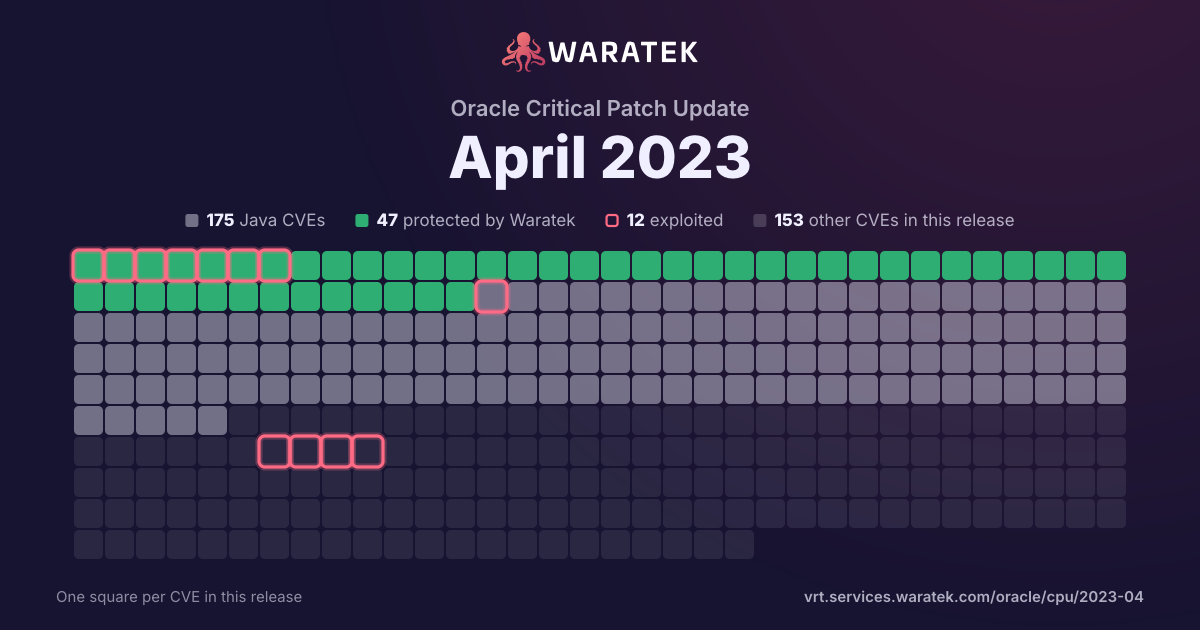
By status
43Protected by Waratek1Rule in development10Mitigation candidate123No exploit published2Outside Waratek scope149Not applicable
10Exploited, marked by the ring
No exploit published. For 44 of them, Oracle's security advisory is the source of public detail.
Protected by Waratek. Waratek RASP can block exploitation of these on systems that have not applied the patch yet.
Overview 19 matches · 0 protected · 0 exploited · 0 CISA KEV · 0 public PoC · 0 EPSS ≥ 0.5
19matches
0protected0.0%
0exploited0.0%
0CISA KEV0.0%
0public PoC0.0%
0EPSS ≥ 0.50.0%
Protected by Waratek
0
0.0%
Rule in development
0
0.0%
Mitigation candidate
0
0.0%
No exploit published
19
100.0%
blocked by ARMR today
0
0.0%
partly blocked
0
0.0%
not blocked
19
100.0%
not established
0
0.0%
unrecorded
0
0.0%
Exploited
0
0.0%
Working exploit published
0
0.0%
Proof of concept only
5
26.3%
Forecast only
0
0.0%
No public exploit
14
73.7%
split by
peak 8 / month
Nov 221
No exploit published1
High1
not blocked1
No public exploit1
Dec 226
No exploit published6
High4
Medium2
not blocked6
Proof of concept only4
No public exploit2
Jan 231
No exploit published1
High1
not blocked1
No public exploit1
Feb 231
No exploit published1
High1
not blocked1
No public exploit1
Mar 232
No exploit published2
High1
Medium1
not blocked2
Proof of concept only1
No public exploit1
Apr 238
No exploit published8
Medium8
not blocked8
No public exploit8
Nov 22Dec 22Jan 23Feb 23Mar 23Apr 23
| CVE | Severity | Published▾ | Status | Exploitation | Description |
|---|---|---|---|---|---|
| CVE-2023-21915 | Medium | 2023-04-18 | No exploit published | No public exploit | Vulnerability in the Oracle Banking Payments product of Oracle Financial Services Applications (component: Book/Internal Transfer). Supported versions that are affected are 14.5, 14.6 and 14.7. Easily exploitable vulnerability allows low privileged attacker with network access via HTTP to compromise Oracle Banking Payments. Successful attacks require human interaction from a person other than the attacker. Successful attacks of this vulnerability can result in unauthorized update, insert or delete access to some of Oracle Banking Payments accessible data as well as unauthorized read access to a subset of Oracle Banking Payments accessible data. CVSS 3.1 Base Score 4.6 (Confidentiality and Integrity impacts). CVSS Vector: (CVSS:3.1/AV:N/AC:L/PR:L/UI:R/S:U/C:L/I:L/A:N). |
| CVE-2023-21908 | Medium | 2023-04-18 | No exploit published | No public exploit | Vulnerability in the Oracle Banking Virtual Account Management product of Oracle Financial Services Applications (component: OBVAM Trn Journal Domain). Supported versions that are affected are 14.5, 14.6 and 14.7. Difficult to exploit vulnerability allows high privileged attacker with network access via HTTP to compromise Oracle Banking Virtual Account Management. Successful attacks require human interaction from a person other than the attacker. Successful attacks of this vulnerability can result in unauthorized access to critical data or complete access to all Oracle Banking Virtual Account Management accessible data as well as unauthorized update, insert or delete access to some of Oracle Banking Virtual Account Management accessible data and unauthorized ability to cause a hang or frequently repeatable crash (complete DOS) of Oracle Banking Virtual Account Management. CVSS 3.1 Base Score 6.0 (Confidentiality, Integrity and Availability impacts). CVSS Vector: (CVSS:3.1/AV:N/AC:H/PR:H/UI:R/S:U/C:H/I:L/A:H). |
| CVE-2023-21907 | Medium | 2023-04-18 | No exploit published | No public exploit | Vulnerability in the Oracle Banking Virtual Account Management product of Oracle Financial Services Applications (component: OBVAM Trn Journal Domain). Supported versions that are affected are 14.5, 14.6 and 14.7. Difficult to exploit vulnerability allows high privileged attacker with network access via HTTP to compromise Oracle Banking Virtual Account Management. Successful attacks require human interaction from a person other than the attacker. Successful attacks of this vulnerability can result in unauthorized access to critical data or complete access to all Oracle Banking Virtual Account Management accessible data as well as unauthorized update, insert or delete access to some of Oracle Banking Virtual Account Management accessible data and unauthorized ability to cause a hang or frequently repeatable crash (complete DOS) of Oracle Banking Virtual Account Management. CVSS 3.1 Base Score 6.0 (Confidentiality, Integrity and Availability impacts). CVSS Vector: (CVSS:3.1/AV:N/AC:H/PR:H/UI:R/S:U/C:H/I:L/A:H). |
| CVE-2023-21906 | Medium | 2023-04-18 | No exploit published | No public exploit | Vulnerability in the Oracle Banking Virtual Account Management product of Oracle Financial Services Applications (component: SMS Module). Supported versions that are affected are 14.5, 14.6 and 14.7. Easily exploitable vulnerability allows high privileged attacker with network access via HTTP to compromise Oracle Banking Virtual Account Management. Successful attacks require human interaction from a person other than the attacker. Successful attacks of this vulnerability can result in unauthorized creation, deletion or modification access to critical data or all Oracle Banking Virtual Account Management accessible data as well as unauthorized access to critical data or complete access to all Oracle Banking Virtual Account Management accessible data. CVSS 3.1 Base Score 6.1 (Confidentiality and Integrity impacts). CVSS Vector: (CVSS:3.1/AV:N/AC:L/PR:H/UI:R/S:U/C:H/I:H/A:N). |
| CVE-2023-21905 | Medium | 2023-04-18 | No exploit published | No public exploit | Vulnerability in the Oracle Banking Virtual Account Management product of Oracle Financial Services Applications (component: Routing Hub). Supported versions that are affected are 14.5, 14.6 and 14.7. Easily exploitable vulnerability allows high privileged attacker with network access via HTTP to compromise Oracle Banking Virtual Account Management. Successful attacks require human interaction from a person other than the attacker. Successful attacks of this vulnerability can result in unauthorized creation, deletion or modification access to critical data or all Oracle Banking Virtual Account Management accessible data as well as unauthorized access to critical data or complete access to all Oracle Banking Virtual Account Management accessible data. CVSS 3.1 Base Score 6.1 (Confidentiality and Integrity impacts). CVSS Vector: (CVSS:3.1/AV:N/AC:L/PR:H/UI:R/S:U/C:H/I:H/A:N). |
| CVE-2023-21904 | Medium | 2023-04-18 | No exploit published | No public exploit | Vulnerability in the Oracle Banking Virtual Account Management product of Oracle Financial Services Applications (component: OBVAM Trn Journal Domain). Supported versions that are affected are 14.5, 14.6 and 14.7. Difficult to exploit vulnerability allows high privileged attacker with network access via HTTP to compromise Oracle Banking Virtual Account Management. Successful attacks require human interaction from a person other than the attacker. Successful attacks of this vulnerability can result in unauthorized access to critical data or complete access to all Oracle Banking Virtual Account Management accessible data as well as unauthorized update, insert or delete access to some of Oracle Banking Virtual Account Management accessible data and unauthorized ability to cause a partial denial of service (partial DOS) of Oracle Banking Virtual Account Management. CVSS 3.1 Base Score 5.3 (Confidentiality, Integrity and Availability impacts). CVSS Vector: (CVSS:3.1/AV:N/AC:H/PR:H/UI:R/S:U/C:H/I:L/A:L). |
| CVE-2023-21903 | Medium | 2023-04-18 | No exploit published | No public exploit | Vulnerability in the Oracle Banking Virtual Account Management product of Oracle Financial Services Applications (component: OBVAM Internal Tfr Domain). Supported versions that are affected are 14.5, 14.6 and 14.7. Difficult to exploit vulnerability allows high privileged attacker with network access via HTTP to compromise Oracle Banking Virtual Account Management. Successful attacks require human interaction from a person other than the attacker. Successful attacks of this vulnerability can result in unauthorized access to critical data or complete access to all Oracle Banking Virtual Account Management accessible data as well as unauthorized update, insert or delete access to some of Oracle Banking Virtual Account Management accessible data and unauthorized ability to cause a partial denial of service (partial DOS) of Oracle Banking Virtual Account Management. CVSS 3.1 Base Score 5.3 (Confidentiality, Integrity and Availability impacts). CVSS Vector: (CVSS:3.1/AV:N/AC:H/PR:H/UI:R/S:U/C:H/I:L/A:L). |
| CVE-2023-21902 | Medium | 2023-04-18 | No exploit published | No public exploit | Vulnerability in the Oracle Financial Services Behavior Detection Platform product of Oracle Financial Services Applications (component: Application). The supported version that is affected is 8.0.8.1. Easily exploitable vulnerability allows low privileged attacker with network access via HTTP to compromise Oracle Financial Services Behavior Detection Platform. Successful attacks of this vulnerability can result in unauthorized read access to a subset of Oracle Financial Services Behavior Detection Platform accessible data. CVSS 3.1 Base Score 4.3 (Confidentiality impacts). CVSS Vector: (CVSS:3.1/AV:N/AC:L/PR:L/UI:N/S:U/C:L/I:N/A:N). |
| CVE-2023-28708 | Medium | 2023-03-22 | No exploit published | No public exploit | When using the RemoteIpFilter with requests received from a reverse proxy via HTTP that include the X-Forwarded-Proto header set to https, session cookies created by Apache Tomcat 11.0.0-M1 to 11.0.0.-M2, 10.1.0-M1 to 10.1.5, 9.0.0-M1 to 9.0.71 and 8.5.0 to 8.5.85 did not include the secure attribute. This could result in the user agent transmitting the session cookie over an insecure channel. Older, EOL versions may also be affected. |
| CVE-2023-1370 | High | 2023-03-22 | No exploit published | Proof of concept only | [Json-smart](https://netplex.github.io/json-smart/) is a performance focused, JSON processor lib. When reaching a ‘[‘ or ‘{‘ character in the JSON input, the code parses an array or an object respectively. It was discovered that the code does not have any limit to the nesting of such arrays or objects. Since the parsing of nested arrays and objects is done recursively, nesting too many of them can cause a stack exhaustion (stack overflow) and crash the software. |
| CVE-2023-24998 | High | 2023-02-20 | No exploit published | No public exploit | Apache Commons FileUpload before 1.5 does not limit the number of request parts to be processed resulting in the possibility of an attacker triggering a DoS with a malicious upload or series of uploads. Note that, like all of the file upload limits, the new configuration option (FileUploadBase#setFileCountMax) is not enabled by default and must be explicitly configured. |
| CVE-2022-45143 | High | 2023-01-03 | No exploit published | No public exploit | The JsonErrorReportValve in Apache Tomcat 8.5.83, 9.0.40 to 9.0.68 and 10.1.0-M1 to 10.1.1 did not escape the type, message or description values. In some circumstances these are constructed from user provided data and it was therefore possible for users to supply values that invalidated or manipulated the JSON output. |
| CVE-2022-41966 | High | 2022-12-28 | No exploit published | Proof of concept only | XStream serializes Java objects to XML and back again. Versions prior to 1.4.20 may allow a remote attacker to terminate the application with a stack overflow error, resulting in a denial of service only via manipulation the processed input stream. The attack uses the hash code implementation for collections and maps to force recursive hash calculation causing a stack overflow. This issue is patched in version 1.4.20 which handles the stack overflow and raises an InputManipulationException instead. A potential workaround for users who only use HashMap or HashSet and whose XML refers these only as default map or set, is to change the default implementation of java.util.Map and java.util per the code example in the referenced advisory. However, this implies that your application does not care about the implementation of the map and all elements are comparable. |
| CVE-2022-46363 | High | 2022-12-13 | No exploit published | No public exploit | A vulnerability in Apache CXF before versions 3.5.5 and 3.4.10 allows an attacker to perform a remote directory listing or code exfiltration. The vulnerability only applies when the CXFServlet is configured with both the static-resources-list and redirect-query-check attributes. These attributes are not supposed to be used together, and so the vulnerability can only arise if the CXF service is misconfigured. |
| CVE-2022-45693 | High | 2022-12-13 | No exploit published | Proof of concept only | Jettison before v1.5.2 was discovered to contain a stack overflow via the map parameter. This vulnerability allows attackers to cause a Denial of Service (DoS) via a crafted string. |
| CVE-2022-41915 | Medium | 2022-12-13 | No exploit published | Proof of concept only | Netty project is an event-driven asynchronous network application framework. Starting in version 4.1.83.Final and prior to 4.1.86.Final, when calling `DefaultHttpHeadesr.set` with an _iterator_ of values, header value validation was not performed, allowing malicious header values in the iterator to perform HTTP Response Splitting. This issue has been patched in version 4.1.86.Final. Integrators can work around the issue by changing the `DefaultHttpHeaders.set(CharSequence, Iterator<?>)` call, into a `remove()` call, and call `add()` in a loop over the iterator of values. |
| CVE-2022-41881 | High | 2022-12-12 | No exploit published | Proof of concept only | Netty project is an event-driven asynchronous network application framework. In versions prior to 4.1.86.Final, a StackOverflowError can be raised when parsing a malformed crafted message due to an infinite recursion. This issue is patched in version 4.1.86.Final. There is no workaround, except using a custom HaProxyMessageDecoder. |
| CVE-2021-37533 | Medium | 2022-12-03 | No exploit published | No public exploit | Prior to Apache Commons Net 3.9.0, Net's FTP client trusts the host from PASV response by default. A malicious server can redirect the Commons Net code to use a different host, but the user has to connect to the malicious server in the first place. This may lead to leakage of information about services running on the private network of the client. The default in version 3.9.0 is now false to ignore such hosts, as cURL does. See https://issues.apache.org/jira/browse/NET-711. |
| CVE-2022-42252 | High | 2022-11-01 | No exploit published | No public exploit | If Apache Tomcat 8.5.0 to 8.5.82, 9.0.0-M1 to 9.0.67, 10.0.0-M1 to 10.0.26 or 10.1.0-M1 to 10.1.0 was configured to ignore invalid HTTP headers via setting rejectIllegalHeader to false (the default for 8.5.x only), Tomcat did not reject a request containing an invalid Content-Length header making a request smuggling attack possible if Tomcat was located behind a reverse proxy that also failed to reject the request with the invalid header. |