
Oracle Critical Patch Update April 2023
Released April 2023 · Oracle's advisory ↗ · ← Critical Patch Update, January 2023 · Critical Patch Update, July 2023 →
328 CVEs in this release, one square each
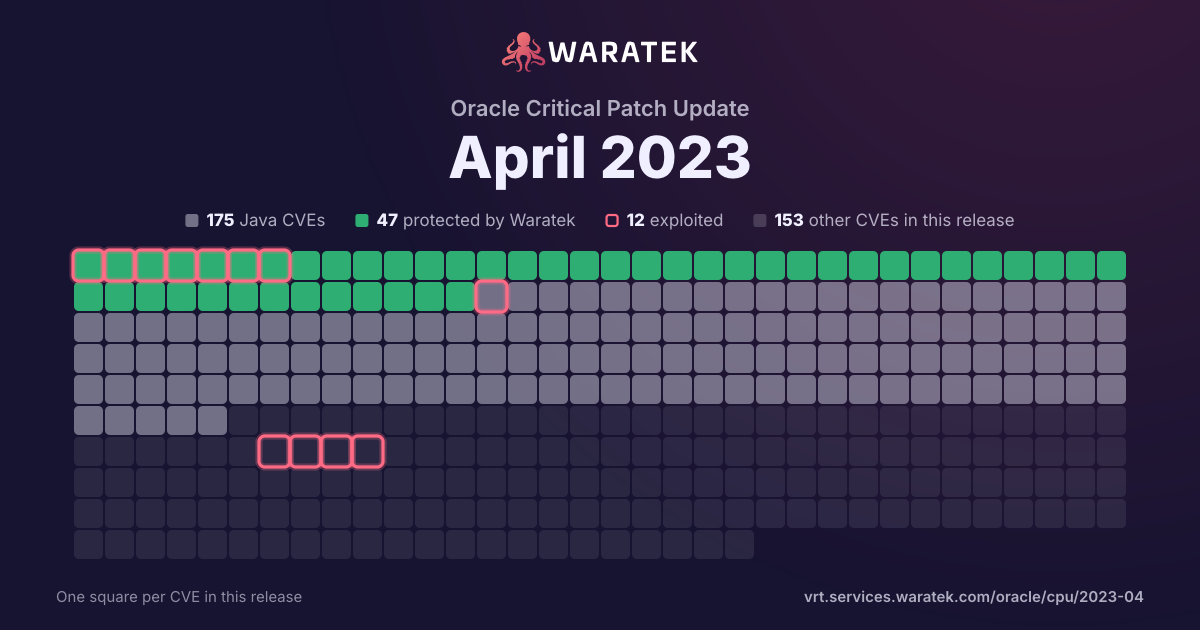
By status
43Protected by Waratek1Rule in development10Mitigation candidate123No exploit published2Outside Waratek scope149Not applicable
10Exploited, marked by the ring
No exploit published. For 44 of them, Oracle's security advisory is the source of public detail.
Protected by Waratek. Waratek RASP can block exploitation of these on systems that have not applied the patch yet.
Overview 11 matches · 0 protected · 0 exploited · 0 CISA KEV · 0 public PoC · 0 EPSS ≥ 0.5
11matches
0protected0.0%
0exploited0.0%
0CISA KEV0.0%
0public PoC0.0%
0EPSS ≥ 0.50.0%
Protected by Waratek
0
0.0%
Rule in development
0
0.0%
Mitigation candidate
0
0.0%
No exploit published
11
100.0%
blocked by ARMR today
0
0.0%
partly blocked
0
0.0%
not blocked
11
100.0%
not established
0
0.0%
unrecorded
0
0.0%
Exploited
0
0.0%
Working exploit published
0
0.0%
Proof of concept only
1
9.1%
Forecast only
0
0.0%
No public exploit
10
90.9%
split by
peak 8 / month
Dec 22Jan 23Feb 23Mar 23Apr 23
| CVE | Severity | Published▾ | Status | Exploitation | Description |
|---|---|---|---|---|---|
| CVE-2023-21915 | Medium | 2023-04-18 | No exploit published | No public exploit | Vulnerability in the Oracle Banking Payments product of Oracle Financial Services Applications (component: Book/Internal Transfer). Supported versions that are affected are 14.5, 14.6 and 14.7. Easily exploitable vulnerability allows low privileged attacker with network access via HTTP to compromise Oracle Banking Payments. Successful attacks require human interaction from a person other than the attacker. Successful attacks of this vulnerability can result in unauthorized update, insert or delete access to some of Oracle Banking Payments accessible data as well as unauthorized read access to a subset of Oracle Banking Payments accessible data. CVSS 3.1 Base Score 4.6 (Confidentiality and Integrity impacts). CVSS Vector: (CVSS:3.1/AV:N/AC:L/PR:L/UI:R/S:U/C:L/I:L/A:N). |
| CVE-2023-21908 | Medium | 2023-04-18 | No exploit published | No public exploit | Vulnerability in the Oracle Banking Virtual Account Management product of Oracle Financial Services Applications (component: OBVAM Trn Journal Domain). Supported versions that are affected are 14.5, 14.6 and 14.7. Difficult to exploit vulnerability allows high privileged attacker with network access via HTTP to compromise Oracle Banking Virtual Account Management. Successful attacks require human interaction from a person other than the attacker. Successful attacks of this vulnerability can result in unauthorized access to critical data or complete access to all Oracle Banking Virtual Account Management accessible data as well as unauthorized update, insert or delete access to some of Oracle Banking Virtual Account Management accessible data and unauthorized ability to cause a hang or frequently repeatable crash (complete DOS) of Oracle Banking Virtual Account Management. CVSS 3.1 Base Score 6.0 (Confidentiality, Integrity and Availability impacts). CVSS Vector: (CVSS:3.1/AV:N/AC:H/PR:H/UI:R/S:U/C:H/I:L/A:H). |
| CVE-2023-21907 | Medium | 2023-04-18 | No exploit published | No public exploit | Vulnerability in the Oracle Banking Virtual Account Management product of Oracle Financial Services Applications (component: OBVAM Trn Journal Domain). Supported versions that are affected are 14.5, 14.6 and 14.7. Difficult to exploit vulnerability allows high privileged attacker with network access via HTTP to compromise Oracle Banking Virtual Account Management. Successful attacks require human interaction from a person other than the attacker. Successful attacks of this vulnerability can result in unauthorized access to critical data or complete access to all Oracle Banking Virtual Account Management accessible data as well as unauthorized update, insert or delete access to some of Oracle Banking Virtual Account Management accessible data and unauthorized ability to cause a hang or frequently repeatable crash (complete DOS) of Oracle Banking Virtual Account Management. CVSS 3.1 Base Score 6.0 (Confidentiality, Integrity and Availability impacts). CVSS Vector: (CVSS:3.1/AV:N/AC:H/PR:H/UI:R/S:U/C:H/I:L/A:H). |
| CVE-2023-21906 | Medium | 2023-04-18 | No exploit published | No public exploit | Vulnerability in the Oracle Banking Virtual Account Management product of Oracle Financial Services Applications (component: SMS Module). Supported versions that are affected are 14.5, 14.6 and 14.7. Easily exploitable vulnerability allows high privileged attacker with network access via HTTP to compromise Oracle Banking Virtual Account Management. Successful attacks require human interaction from a person other than the attacker. Successful attacks of this vulnerability can result in unauthorized creation, deletion or modification access to critical data or all Oracle Banking Virtual Account Management accessible data as well as unauthorized access to critical data or complete access to all Oracle Banking Virtual Account Management accessible data. CVSS 3.1 Base Score 6.1 (Confidentiality and Integrity impacts). CVSS Vector: (CVSS:3.1/AV:N/AC:L/PR:H/UI:R/S:U/C:H/I:H/A:N). |
| CVE-2023-21905 | Medium | 2023-04-18 | No exploit published | No public exploit | Vulnerability in the Oracle Banking Virtual Account Management product of Oracle Financial Services Applications (component: Routing Hub). Supported versions that are affected are 14.5, 14.6 and 14.7. Easily exploitable vulnerability allows high privileged attacker with network access via HTTP to compromise Oracle Banking Virtual Account Management. Successful attacks require human interaction from a person other than the attacker. Successful attacks of this vulnerability can result in unauthorized creation, deletion or modification access to critical data or all Oracle Banking Virtual Account Management accessible data as well as unauthorized access to critical data or complete access to all Oracle Banking Virtual Account Management accessible data. CVSS 3.1 Base Score 6.1 (Confidentiality and Integrity impacts). CVSS Vector: (CVSS:3.1/AV:N/AC:L/PR:H/UI:R/S:U/C:H/I:H/A:N). |
| CVE-2023-21904 | Medium | 2023-04-18 | No exploit published | No public exploit | Vulnerability in the Oracle Banking Virtual Account Management product of Oracle Financial Services Applications (component: OBVAM Trn Journal Domain). Supported versions that are affected are 14.5, 14.6 and 14.7. Difficult to exploit vulnerability allows high privileged attacker with network access via HTTP to compromise Oracle Banking Virtual Account Management. Successful attacks require human interaction from a person other than the attacker. Successful attacks of this vulnerability can result in unauthorized access to critical data or complete access to all Oracle Banking Virtual Account Management accessible data as well as unauthorized update, insert or delete access to some of Oracle Banking Virtual Account Management accessible data and unauthorized ability to cause a partial denial of service (partial DOS) of Oracle Banking Virtual Account Management. CVSS 3.1 Base Score 5.3 (Confidentiality, Integrity and Availability impacts). CVSS Vector: (CVSS:3.1/AV:N/AC:H/PR:H/UI:R/S:U/C:H/I:L/A:L). |
| CVE-2023-21903 | Medium | 2023-04-18 | No exploit published | No public exploit | Vulnerability in the Oracle Banking Virtual Account Management product of Oracle Financial Services Applications (component: OBVAM Internal Tfr Domain). Supported versions that are affected are 14.5, 14.6 and 14.7. Difficult to exploit vulnerability allows high privileged attacker with network access via HTTP to compromise Oracle Banking Virtual Account Management. Successful attacks require human interaction from a person other than the attacker. Successful attacks of this vulnerability can result in unauthorized access to critical data or complete access to all Oracle Banking Virtual Account Management accessible data as well as unauthorized update, insert or delete access to some of Oracle Banking Virtual Account Management accessible data and unauthorized ability to cause a partial denial of service (partial DOS) of Oracle Banking Virtual Account Management. CVSS 3.1 Base Score 5.3 (Confidentiality, Integrity and Availability impacts). CVSS Vector: (CVSS:3.1/AV:N/AC:H/PR:H/UI:R/S:U/C:H/I:L/A:L). |
| CVE-2023-21902 | Medium | 2023-04-18 | No exploit published | No public exploit | Vulnerability in the Oracle Financial Services Behavior Detection Platform product of Oracle Financial Services Applications (component: Application). The supported version that is affected is 8.0.8.1. Easily exploitable vulnerability allows low privileged attacker with network access via HTTP to compromise Oracle Financial Services Behavior Detection Platform. Successful attacks of this vulnerability can result in unauthorized read access to a subset of Oracle Financial Services Behavior Detection Platform accessible data. CVSS 3.1 Base Score 4.3 (Confidentiality impacts). CVSS Vector: (CVSS:3.1/AV:N/AC:L/PR:L/UI:N/S:U/C:L/I:N/A:N). |
| CVE-2023-28708 | Medium | 2023-03-22 | No exploit published | No public exploit | When using the RemoteIpFilter with requests received from a reverse proxy via HTTP that include the X-Forwarded-Proto header set to https, session cookies created by Apache Tomcat 11.0.0-M1 to 11.0.0.-M2, 10.1.0-M1 to 10.1.5, 9.0.0-M1 to 9.0.71 and 8.5.0 to 8.5.85 did not include the secure attribute. This could result in the user agent transmitting the session cookie over an insecure channel. Older, EOL versions may also be affected. |
| CVE-2022-41915 | Medium | 2022-12-13 | No exploit published | Proof of concept only | Netty project is an event-driven asynchronous network application framework. Starting in version 4.1.83.Final and prior to 4.1.86.Final, when calling `DefaultHttpHeadesr.set` with an _iterator_ of values, header value validation was not performed, allowing malicious header values in the iterator to perform HTTP Response Splitting. This issue has been patched in version 4.1.86.Final. Integrators can work around the issue by changing the `DefaultHttpHeaders.set(CharSequence, Iterator<?>)` call, into a `remove()` call, and call `add()` in a loop over the iterator of values. |
| CVE-2021-37533 | Medium | 2022-12-03 | No exploit published | No public exploit | Prior to Apache Commons Net 3.9.0, Net's FTP client trusts the host from PASV response by default. A malicious server can redirect the Commons Net code to use a different host, but the user has to connect to the malicious server in the first place. This may lead to leakage of information about services running on the private network of the client. The default in version 3.9.0 is now false to ignore such hosts, as cURL does. See https://issues.apache.org/jira/browse/NET-711. |