
Oracle Critical Patch Update April 2023
Released April 2023 · Oracle's advisory ↗ · ← Critical Patch Update, January 2023 · Critical Patch Update, July 2023 →
328 CVEs in this release, one square each
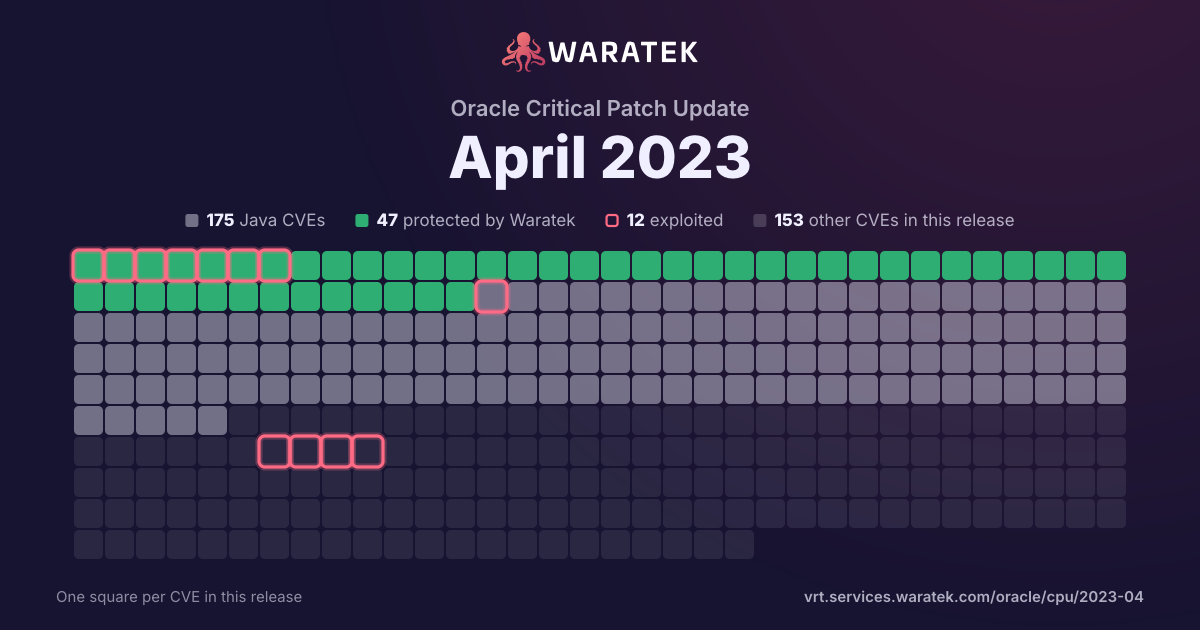
By status
47Protected by Waratek9Mitigation candidate119No exploit published35Outside Waratek scope118Not applicable
12Exploited, marked by the ring
No exploit published. For 56 of them, Oracle's security advisory is the source of public detail.
Protected by Waratek. Waratek RASP can block exploitation of these on systems that have not applied the patch yet.
Overview 48 matches · 20 in Waratek scope · 10 protected · 5 exploited · 2 CISA KEV · 12 public PoC · 8 EPSS ≥ 0.5
48matches
20in Waratek scope41.7%
10protected20.8%
5exploited10.4%
2CISA KEV4.2%
12public PoC25.0%
8EPSS ≥ 0.516.7%
Protected by Waratek
10
20.8%
Rule in development
0
0.0%
Mitigation candidate
4
8.3%
No exploit published
6
12.5%
Outside Waratek scope
7
14.6%
Not applicable
21
43.8%
Withdrawn CVE
0
0.0%
blocked by ARMR today
10
20.8%
partly blocked
0
0.0%
not blocked
38
79.2%
not established
0
0.0%
unrecorded
0
0.0%
Exploited
5
10.4%
Working exploit published
0
0.0%
Proof of concept only
14
29.2%
Forecast only
0
0.0%
No public exploit
29
60.4%
split by
peak 11 / quarter
Q4 181
Not applicable1
Critical1
not blocked1
No public exploit1
Q1 190
Q2 190
Q3 190
Q4 191
Not applicable1
Critical1
not blocked1
Exploited1
Q1 200
Q2 200
Q3 200
Q4 200
Q1 212
Protected by Waratek1
Outside Waratek scope1
Critical2
blocked by ARMR today1
not blocked1
No public exploit2
Q2 210
Q3 210
Q4 212
Protected by Waratek1
Not applicable1
Critical2
blocked by ARMR today1
not blocked1
No public exploit2
Q1 224
Protected by Waratek1
Not applicable3
Critical4
blocked by ARMR today1
not blocked3
Proof of concept only2
No public exploit2
Q2 2210
Protected by Waratek3
Mitigation candidate1
Outside Waratek scope4
Not applicable2
Critical10
blocked by ARMR today3
not blocked7
Exploited1
Proof of concept only4
No public exploit5
Q3 2211
Mitigation candidate1
No exploit published3
Outside Waratek scope2
Not applicable5
Critical11
not blocked11
Proof of concept only3
No public exploit8
Q4 2211
Protected by Waratek4
Mitigation candidate2
No exploit published2
Not applicable3
Critical11
blocked by ARMR today4
not blocked7
Exploited2
Proof of concept only4
No public exploit5
Q1 234
No exploit published1
Not applicable3
Critical4
not blocked4
Exploited1
Proof of concept only1
No public exploit2
Q2 230
Q3 230
Q4 230
Q1 242
Not applicable2
Critical2
not blocked2
No public exploit2
Q1 19Q3 19Q1 20Q3 20Q1 21Q3 21Q1 22Q3 22Q1 23Q3 23Q1 24
| CVE | Severity | Published▾ | Status | Exploitation | Description |
|---|---|---|---|---|---|
| CVE-2021-21575 | Critical | 2024-02-02 | Not applicable | No public exploit | Dell BSAFE Micro Edition Suite, versions before 4.5.2, contain an Observable Timing Discrepancy Vulnerability. |
| CVE-2020-29504 | Critical | 2024-02-02 | Not applicable | No public exploit | Dell BSAFE Crypto-C Micro Edition, versions before 4.1.5, and Dell BSAFE Micro Edition Suite, versions before 4.5.2, contain a Missing Required Cryptographic Step Vulnerability. |
| CVE-2023-25690 | Critical | 2023-03-07 | Not applicable | Exploited | Some mod_proxy configurations on Apache HTTP Server versions 2.4.0 through 2.4.55 allow a HTTP Request Smuggling attack. Configurations are affected when mod_proxy is enabled along with some form of RewriteRule or ProxyPassMatch in which a non-specific pattern matches some portion of the user-supplied request-target (URL) data and is then re-inserted into the proxied request-target using variable substitution. For example, something like: RewriteEngine on RewriteRule "^/here/(.*)" "http://example.com:8080/elsewhere?$1"; [P] ProxyPassReverse /here/ http://example.com:8080/ Request splitting/smuggling could result in bypass of access controls in the proxy server, proxying unintended URLs to existing origin servers, and cache poisoning. Users are recommended to update to at least version 2.4.56 of Apache HTTP Server. |
| CVE-2023-23914 | Critical | 2023-02-23 | Not applicable | Proof of concept only | A cleartext transmission of sensitive information vulnerability exists in curl <v7.88.0 that could cause HSTS functionality fail when multiple URLs are requested serially. Using its HSTS support, curl can be instructed to use HTTPS instead of usingan insecure clear-text HTTP step even when HTTP is provided in the URL. ThisHSTS mechanism would however surprisingly be ignored by subsequent transferswhen done on the same command line because the state would not be properlycarried on. |
| CVE-2023-25613 | Critical | 2023-02-20 | No exploit published | No public exploit | An LDAP Injection vulnerability exists in the LdapIdentityBackend of Apache Kerby before 2.0.3. |
| CVE-2022-36760 | Critical | 2023-01-17 | Not applicable | No public exploit | Inconsistent Interpretation of HTTP Requests ('HTTP Request Smuggling') vulnerability in mod_proxy_ajp of Apache HTTP Server allows an attacker to smuggle requests to the AJP server it forwards requests to. This issue affects Apache HTTP Server Apache HTTP Server 2.4 version 2.4.54 and prior versions. |
| CVE-2022-47629 | Critical | 2022-12-20 | Not applicable | No public exploit | Libksba before 1.6.3 is prone to an integer overflow vulnerability in the CRL signature parser. |
| CVE-2022-46364 | Critical | 2022-12-13 | Mitigation candidate | Proof of concept only | A SSRF vulnerability in parsing the href attribute of XOP:Include in MTOM requests in versions of Apache CXF before 3.5.5 and 3.4.10 allows an attacker to perform SSRF style attacks on webservices that take at least one parameter of any type. |
| CVE-2022-1471 | Critical | 2022-12-01 | Protected by Waratek | Exploited | SnakeYaml's Constructor() class does not restrict types which can be instantiated during deserialization. Deserializing yaml content provided by an attacker can lead to remote code execution. We recommend using SnakeYaml's SafeConsturctor when parsing untrusted content to restrict deserialization. We recommend upgrading to version 2.0 and beyond. |
| CVE-2022-45047 | Critical | 2022-11-16 | Protected by Waratek | Proof of concept only | Class org.apache.sshd.server.keyprovider.SimpleGeneratorHostKeyProvider in Apache MINA SSHD <= 2.9.1 uses Java deserialization to load a serialized java.security.PrivateKey. The class is one of several implementations that an implementor using Apache MINA SSHD can choose for loading the host keys of an SSH server. |
| CVE-2022-37865 | Critical | 2022-11-07 | Protected by Waratek | No public exploit | With Apache Ivy 2.4.0 an optional packaging attribute has been introduced that allows artifacts to be unpacked on the fly if they used pack200 or zip packaging. For artifacts using the "zip", "jar" or "war" packaging Ivy prior to 2.5.1 doesn't verify the target path when extracting the archive. An archive containing absolute paths or paths that try to traverse "upwards" using ".." sequences can then write files to any location on the local fie system that the user executing Ivy has write access to. Ivy users of version 2.4.0 to 2.5.0 should upgrade to Ivy 2.5.1. |
| CVE-2022-31692 | Critical | 2022-10-31 | Mitigation candidate | Proof of concept only | Spring Security, versions 5.7 prior to 5.7.5 and 5.6 prior to 5.6.9 could be susceptible to authorization rules bypass via forward or include dispatcher types. Specifically, an application is vulnerable when all of the following are true: The application expects that Spring Security applies security to forward and include dispatcher types. The application uses the AuthorizationFilter either manually or via the authorizeHttpRequests() method. The application configures the FilterChainProxy to apply to forward and/or include requests (e.g. spring.security.filter.dispatcher-types = request, error, async, forward, include). The application may forward or include the request to a higher privilege-secured endpoint.The application configures Spring Security to apply to every dispatcher type via authorizeHttpRequests().shouldFilterAllDispatcherTypes(true) |
| CVE-2021-46848 | Critical | 2022-10-24 | Not applicable | No public exploit | GNU Libtasn1 before 4.19.0 has an ETYPE_OK off-by-one array size check that affects asn1_encode_simple_der. |
| CVE-2022-37454 | Critical | 2022-10-21 | Not applicable | Proof of concept only | The Keccak XKCP SHA-3 reference implementation before fdc6fef has an integer overflow and resultant buffer overflow that allows attackers to execute arbitrary code or eliminate expected cryptographic properties. This occurs in the sponge function interface. |
| CVE-2022-43402 | Critical | 2022-10-19 | No exploit published | No public exploit | A sandbox bypass vulnerability involving various casts performed implicitly by the Groovy language runtime in Jenkins Pipeline: Groovy Plugin 2802.v5ea_628154b_c2 and earlier allows attackers with permission to define and run sandboxed scripts, including Pipelines, to bypass the sandbox protection and execute arbitrary code in the context of the Jenkins controller JVM. |
| CVE-2022-43401 | Critical | 2022-10-19 | No exploit published | No public exploit | A sandbox bypass vulnerability involving various casts performed implicitly by the Groovy language runtime in Jenkins Script Security Plugin 1183.v774b_0b_0a_a_451 and earlier allows attackers with permission to define and run sandboxed scripts, including Pipelines, to bypass the sandbox protection and execute arbitrary code in the context of the Jenkins controller JVM. |
| CVE-2022-42889 | Critical | 2022-10-13 | Protected by Waratek | Exploited | Apache Commons Text performs variable interpolation, allowing properties to be dynamically evaluated and expanded. The standard format for interpolation is "${prefix:name}", where "prefix" is used to locate an instance of org.apache.commons.text.lookup.StringLookup that performs the interpolation. Starting with version 1.5 and continuing through 1.9, the set of default Lookup instances included interpolators that could result in arbitrary code execution or contact with remote servers. These lookups are: - "script" - execute expressions using the JVM script execution engine (javax.script) - "dns" - resolve dns records - "url" - load values from urls, including from remote servers Applications using the interpolation defaults in the affected versions may be vulnerable to remote code execution or unintentional contact with remote servers if untrusted configuration values are used. Users are recommended to upgrade to Apache Commons Text 1.10.0, which disables the problematic interpolators by default. |
| CVE-2022-37434 | Critical | 2022-08-05 | Outside Waratek scope | Proof of concept only | zlib through 1.2.12 has a heap-based buffer over-read or buffer overflow in inflate in inflate.c via a large gzip header extra field. NOTE: only applications that call inflateGetHeader are affected. Some common applications bundle the affected zlib source code but may be unable to call inflateGetHeader (e.g., see the nodejs/node reference). |
| CVE-2020-35169 | Critical | 2022-07-11 | No exploit published | No public exploit | Dell BSAFE Crypto-C Micro Edition, versions before 4.1.5, and Dell BSAFE Micro Edition Suite, versions before 4.5.2, contain an Improper Input Validation Vulnerability. |
| CVE-2020-35168 | Critical | 2022-07-11 | Not applicable | No public exploit | Dell BSAFE Crypto-C Micro Edition, versions before 4.1.5, and Dell BSAFE Micro Edition Suite, versions before 4.6, contain an Observable Timing Discrepancy Vulnerability. |
| CVE-2020-35167 | Critical | 2022-07-11 | Not applicable | No public exploit | Dell BSAFE Crypto-C Micro Edition, versions before 4.1.5, and Dell BSAFE Micro Edition Suite, versions before 4.6, contain an Observable Timing Discrepancy Vulnerability. |
| CVE-2020-35166 | Critical | 2022-07-11 | No exploit published | No public exploit | Dell BSAFE Crypto-C Micro Edition, versions before 4.1.5, and Dell BSAFE Micro Edition Suite, versions before 4.6, contain an Observable Timing Discrepancy Vulnerability. |
| CVE-2020-35163 | Critical | 2022-07-11 | Not applicable | No public exploit | Dell BSAFE Crypto-C Micro Edition, versions before 4.1.5, and Dell BSAFE Micro Edition Suite, versions before 4.6, contain a Use of Insufficiently Random Values Vulnerability. |
| CVE-2020-29508 | Critical | 2022-07-11 | No exploit published | No public exploit | Dell BSAFE Crypto-C Micro Edition, versions before 4.1.5, and Dell BSAFE Micro Edition Suite, versions before 4.6, contain an Improper Input Validation Vulnerability. |
| CVE-2020-29507 | Critical | 2022-07-11 | Not applicable | No public exploit | Dell BSAFE Crypto-C Micro Edition, versions before 4.1.4, and Dell BSAFE Micro Edition Suite, versions before 4.4, contain an Improper Input Validation Vulnerability. |
| CVE-2020-29506 | Critical | 2022-07-11 | Not applicable | No public exploit | Dell BSAFE Crypto-C Micro Edition, versions before 4.1.5, and Dell BSAFE Micro Edition Suite, versions before 4.5.2, contain an Observable Timing Discrepancy Vulnerability. |
| CVE-2022-33980 | Critical | 2022-07-06 | Mitigation candidate | Proof of concept only | Apache Commons Configuration performs variable interpolation, allowing properties to be dynamically evaluated and expanded. The standard format for interpolation is "${prefix:name}", where "prefix" is used to locate an instance of org.apache.commons.configuration2.interpol.Lookup that performs the interpolation. Starting with version 2.4 and continuing through 2.7, the set of default Lookup instances included interpolators that could result in arbitrary code execution or contact with remote servers. These lookups are: - "script" - execute expressions using the JVM script execution engine (javax.script) - "dns" - resolve dns records - "url" - load values from urls, including from remote servers Applications using the interpolation defaults in the affected versions may be vulnerable to remote code execution or unintentional contact with remote servers if untrusted configuration values are used. Users are recommended to upgrade to Apache Commons Configuration 2.8.0, which disables the problematic interpolators by default. |
| CVE-2022-2274 | Critical | 2022-07-01 | Outside Waratek scope | Proof of concept only | The OpenSSL 3.0.4 release introduced a serious bug in the RSA implementation for X86_64 CPUs supporting the AVX512IFMA instructions. This issue makes the RSA implementation with 2048 bit private keys incorrect on such machines and memory corruption will happen during the computation. As a consequence of the memory corruption an attacker may be able to trigger a remote code execution on the machine performing the computation. SSL/TLS servers or other servers using 2048 bit RSA private keys running on machines supporting AVX512IFMA instructions of the X86_64 architecture are affected by this issue. |
| CVE-2022-2068 | Critical | 2022-06-21 | Outside Waratek scope | Proof of concept only | In addition to the c_rehash shell command injection identified in CVE-2022-1292, further circumstances where the c_rehash script does not properly sanitise shell metacharacters to prevent command injection were found by code review. When the CVE-2022-1292 was fixed it was not discovered that there are other places in the script where the file names of certificates being hashed were possibly passed to a command executed through the shell. This script is distributed by some operating systems in a manner where it is automatically executed. On such operating systems, an attacker could execute arbitrary commands with the privileges of the script. Use of the c_rehash script is considered obsolete and should be replaced by the OpenSSL rehash command line tool. Fixed in OpenSSL 3.0.4 (Affected 3.0.0,3.0.1,3.0.2,3.0.3). Fixed in OpenSSL 1.1.1p (Affected 1.1.1-1.1.1o). Fixed in OpenSSL 1.0.2zf (Affected 1.0.2-1.0.2ze). |
| CVE-2022-29599 | Critical | 2022-05-23 | Protected by Waratek | No public exploit | In Apache Maven maven-shared-utils prior to version 3.3.3, the Commandline class can emit double-quoted strings without proper escaping, allowing shell injection attacks. |
| CVE-2022-22978 | Critical | 2022-05-19 | Mitigation candidate | Proof of concept only | In spring security versions prior to 5.4.11+, 5.5.7+ , 5.6.4+ and older unsupported versions, RegexRequestMatcher can easily be misconfigured to be bypassed on some servlet containers. Applications using RegexRequestMatcher with `.` in the regular expression are possibly vulnerable to an authorization bypass. |
| CVE-2022-1587 | Critical | 2022-05-16 | Outside Waratek scope | No public exploit | An out-of-bounds read vulnerability was discovered in the PCRE2 library in the get_recurse_data_length() function of the pcre2_jit_compile.c file. This issue affects recursions in JIT-compiled regular expressions caused by duplicate data transfers. |
| CVE-2022-1586 | Critical | 2022-05-16 | Outside Waratek scope | No public exploit | An out-of-bounds read vulnerability was discovered in the PCRE2 library in the compile_xclass_matchingpath() function of the pcre2_jit_compile.c file. This involves a unicode property matching issue in JIT-compiled regular expressions. The issue occurs because the character was not fully read in case-less matching within JIT. |
| CVE-2022-28738 | Critical | 2022-05-09 | Not applicable | No public exploit | A double free was found in the Regexp compiler in Ruby 3.x before 3.0.4 and 3.1.x before 3.1.2. If a victim attempts to create a Regexp from untrusted user input, an attacker may be able to write to unexpected memory locations. |
| CVE-2022-1292 | Critical | 2022-05-03 | Outside Waratek scope | Proof of concept only | The c_rehash script does not properly sanitise shell metacharacters to prevent command injection. This script is distributed by some operating systems in a manner where it is automatically executed. On such operating systems, an attacker could execute arbitrary commands with the privileges of the script. Use of the c_rehash script is considered obsolete and should be replaced by the OpenSSL rehash command line tool. Fixed in OpenSSL 3.0.3 (Affected 3.0.0,3.0.1,3.0.2). Fixed in OpenSSL 1.1.1o (Affected 1.1.1-1.1.1n). Fixed in OpenSSL 1.0.2ze (Affected 1.0.2-1.0.2zd). |
| CVE-2022-23457 | Critical | 2022-04-25 | Protected by Waratek | Proof of concept only | ESAPI (The OWASP Enterprise Security API) is a free, open source, web application security control library. Prior to version 2.3.0.0, the default implementation of `Validator.getValidDirectoryPath(String, String, File, boolean)` may incorrectly treat the tested input string as a child of the specified parent directory. This potentially could allow control-flow bypass checks to be defeated if an attack can specify the entire string representing the 'input' path. This vulnerability is patched in release 2.3.0.0 of ESAPI. As a workaround, it is possible to write one's own implementation of the Validator interface. However, maintainers do not recommend this. |
| CVE-2022-27404 | Critical | 2022-04-22 | Not applicable | No public exploit | FreeType commit 1e2eb65048f75c64b68708efed6ce904c31f3b2f was discovered to contain a heap buffer overflow via the function sfnt_init_face. |
| CVE-2022-22965 | Critical | 2022-04-01 | Protected by Waratek | Exploited | A Spring MVC or Spring WebFlux application running on JDK 9+ may be vulnerable to remote code execution (RCE) via data binding. The specific exploit requires the application to run on Tomcat as a WAR deployment. If the application is deployed as a Spring Boot executable jar, i.e. the default, it is not vulnerable to the exploit. However, the nature of the vulnerability is more general, and there may be other ways to exploit it. |
| CVE-2022-25315 | Critical | 2022-02-18 | Not applicable | Proof of concept only | In Expat (aka libexpat) before 2.4.5, there is an integer overflow in storeRawNames. |
| CVE-2022-25236 | Critical | 2022-02-16 | Not applicable | No public exploit | xmlparse.c in Expat (aka libexpat) before 2.4.5 allows attackers to insert namespace-separator characters into namespace URIs. |
| CVE-2022-25235 | Critical | 2022-02-16 | Not applicable | No public exploit | xmltok_impl.c in Expat (aka libexpat) before 2.4.5 lacks certain validation of encoding, such as checks for whether a UTF-8 character is valid in a certain context. |
| CVE-2022-23305 | Critical | 2022-01-18 | Protected by Waratek | Proof of concept only | By design, the JDBCAppender in Log4j 1.2.x accepts an SQL statement as a configuration parameter where the values to be inserted are converters from PatternLayout. The message converter, %m, is likely to always be included. This allows attackers to manipulate the SQL by entering crafted strings into input fields or headers of an application that are logged allowing unintended SQL queries to be executed. Note this issue only affects Log4j 1.x when specifically configured to use the JDBCAppender, which is not the default. Beginning in version 2.0-beta8, the JDBCAppender was re-introduced with proper support for parameterized SQL queries and further customization over the columns written to in logs. Apache Log4j 1.2 reached end of life in August 2015. Users should upgrade to Log4j 2 as it addresses numerous other issues from the previous versions. |
| CVE-2021-4048 | Critical | 2021-12-08 | Not applicable | No public exploit | An out-of-bounds read flaw was found in the CLARRV, DLARRV, SLARRV, and ZLARRV functions in lapack through version 3.10.0, as also used in OpenBLAS before version 0.3.18. Specially crafted inputs passed to these functions could cause an application using lapack to crash or possibly disclose portions of its memory. |
| CVE-2021-42575 | Critical | 2021-10-18 | Protected by Waratek | No public exploit | The OWASP Java HTML Sanitizer before 20211018.1 does not properly enforce policies associated with the SELECT, STYLE, and OPTION elements. |
| CVE-2020-14343 | Critical | 2021-02-09 | Outside Waratek scope | No public exploit | A vulnerability was discovered in the PyYAML library in versions before 5.4, where it is susceptible to arbitrary code execution when it processes untrusted YAML files through the full_load method or with the FullLoader loader. Applications that use the library to process untrusted input may be vulnerable to this flaw. This flaw allows an attacker to execute arbitrary code on the system by abusing the python/object/new constructor. This flaw is due to an incomplete fix for CVE-2020-1747. |
| CVE-2021-23926 | Critical | 2021-01-14 | Protected by Waratek | No public exploit | The XML parsers used by XMLBeans up to version 2.6.0 did not set the properties needed to protect the user from malicious XML input. Vulnerabilities include possibilities for XML Entity Expansion attacks. Affects XMLBeans up to and including v2.6.0. |
| CVE-2019-18935 | Critical | 2019-12-11 | Not applicable | Exploited | Progress Telerik UI for ASP.NET AJAX through 2019.3.1023 contains a .NET deserialization vulnerability in the RadAsyncUpload function. This is exploitable when the encryption keys are known due to the presence of CVE-2017-11317 or CVE-2017-11357, or other means. Exploitation can result in remote code execution. (As of 2020.1.114, a default setting prevents the exploit. In 2019.3.1023, but not earlier versions, a non-default setting can prevent exploitation.) |
| CVE-2018-20060 | Critical | 2018-12-11 | Not applicable | No public exploit | urllib3 before version 1.23 does not remove the Authorization HTTP header when following a cross-origin redirect (i.e., a redirect that differs in host, port, or scheme). This can allow for credentials in the Authorization header to be exposed to unintended hosts or transmitted in cleartext. |