
Oracle Critical Patch Update January 2023
Released January 2023 · Oracle's advisory ↗ · ← Critical Patch Update, October 2022 · Critical Patch Update, April 2023 →
183 CVEs in this release, one square each
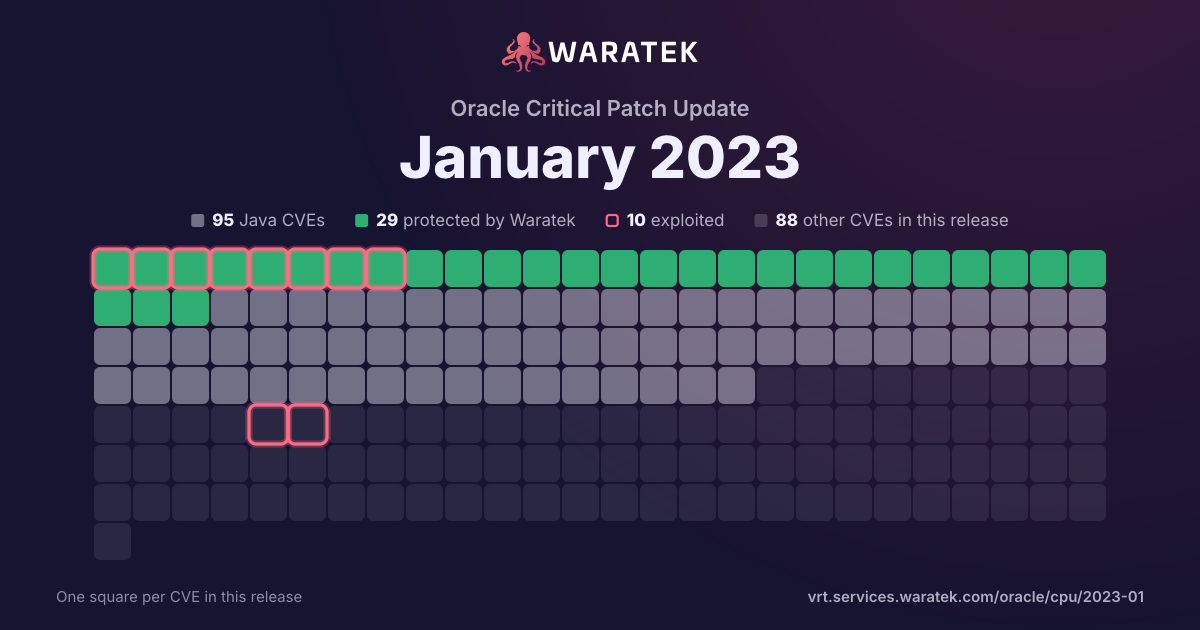
By status
29Protected by Waratek4Mitigation candidate62No exploit published13Outside Waratek scope74Not applicable1Withdrawn CVE
10Exploited, marked by the ring
No exploit published. For 39 of them, Oracle's security advisory is the source of public detail.
Protected by Waratek. Waratek RASP can block exploitation of these on systems that have not applied the patch yet.
Overview 8 matches · 4 in Waratek scope · 0 protected · 1 exploited · 1 CISA KEV · 0 EPSS ≥ 0.5
Protected by Waratek
0
0.0%
Rule in development
0
0.0%
Mitigation candidate
4
50.0%
No exploit published
0
0.0%
Outside Waratek scope
2
25.0%
Not applicable
2
25.0%
Withdrawn CVE
0
0.0%
blocked by ARMR today
0
0.0%
partly blocked
0
0.0%
not blocked
8
100.0%
not established
0
0.0%
unrecorded
0
0.0%
Exploited
1
12.5%
Working exploit published
0
0.0%
Proof of concept only
7
87.5%
Forecast only
0
0.0%
No public exploit
0
0.0%
split by
peak 2 / month
Oct 211
Outside Waratek scope1
Medium1
not blocked1
Proof of concept only1
Nov 210
Dec 210
Jan 220
Feb 220
Mar 221
Not applicable1
High1
not blocked1
Exploited1
Apr 220
May 221
Mitigation candidate1
Critical1
not blocked1
Proof of concept only1
Jun 220
Jul 222
Mitigation candidate1
Outside Waratek scope1
Critical2
not blocked2
Proof of concept only2
Aug 221
Not applicable1
High1
not blocked1
Proof of concept only1
Sep 221
Mitigation candidate1
High1
not blocked1
Proof of concept only1
Oct 221
Mitigation candidate1
Critical1
not blocked1
Proof of concept only1
Oct 21Dec 21Feb 22Apr 22Jun 22Aug 22Oct 22
| CVE | Severity | Published▾ | Status | Exploitation | Description |
|---|---|---|---|---|---|
| CVE-2022-31692 | Critical | 2022-10-31 | Mitigation candidate | Proof of concept only | Spring Security, versions 5.7 prior to 5.7.5 and 5.6 prior to 5.6.9 could be susceptible to authorization rules bypass via forward or include dispatcher types. Specifically, an application is vulnerable when all of the following are true: The application expects that Spring Security applies security to forward and include dispatcher types. The application uses the AuthorizationFilter either manually or via the authorizeHttpRequests() method. The application configures the FilterChainProxy to apply to forward and/or include requests (e.g. spring.security.filter.dispatcher-types = request, error, async, forward, include). The application may forward or include the request to a higher privilege-secured endpoint.The application configures Spring Security to apply to every dispatcher type via authorizeHttpRequests().shouldFilterAllDispatcherTypes(true) |
| CVE-2022-40146 | High | 2022-09-22 | Mitigation candidate | Proof of concept only | Server-Side Request Forgery (SSRF) vulnerability in Batik of Apache XML Graphics allows an attacker to access files using a Jar url. This issue affects Apache XML Graphics Batik 1.14. |
| CVE-2022-35737 | High | 2022-08-03 | Not applicable | Proof of concept only | SQLite 1.0.12 through 3.39.x before 3.39.2 sometimes allows an array-bounds overflow if billions of bytes are used in a string argument to a C API. |
| CVE-2022-33980 | Critical | 2022-07-06 | Mitigation candidate | Proof of concept only | Apache Commons Configuration performs variable interpolation, allowing properties to be dynamically evaluated and expanded. The standard format for interpolation is "${prefix:name}", where "prefix" is used to locate an instance of org.apache.commons.configuration2.interpol.Lookup that performs the interpolation. Starting with version 2.4 and continuing through 2.7, the set of default Lookup instances included interpolators that could result in arbitrary code execution or contact with remote servers. These lookups are: - "script" - execute expressions using the JVM script execution engine (javax.script) - "dns" - resolve dns records - "url" - load values from urls, including from remote servers Applications using the interpolation defaults in the affected versions may be vulnerable to remote code execution or unintentional contact with remote servers if untrusted configuration values are used. Users are recommended to upgrade to Apache Commons Configuration 2.8.0, which disables the problematic interpolators by default. |
| CVE-2022-2274 | Critical | 2022-07-01 | Outside Waratek scope | Proof of concept only | The OpenSSL 3.0.4 release introduced a serious bug in the RSA implementation for X86_64 CPUs supporting the AVX512IFMA instructions. This issue makes the RSA implementation with 2048 bit private keys incorrect on such machines and memory corruption will happen during the computation. As a consequence of the memory corruption an attacker may be able to trigger a remote code execution on the machine performing the computation. SSL/TLS servers or other servers using 2048 bit RSA private keys running on machines supporting AVX512IFMA instructions of the X86_64 architecture are affected by this issue. |
| CVE-2022-22978 | Critical | 2022-05-19 | Mitigation candidate | Proof of concept only | In spring security versions prior to 5.4.11+, 5.5.7+ , 5.6.4+ and older unsupported versions, RegexRequestMatcher can easily be misconfigured to be bypassed on some servlet containers. Applications using RegexRequestMatcher with `.` in the regular expression are possibly vulnerable to an authorization bypass. |
| CVE-2022-0492 | High | 2022-03-03 | Not applicable | Exploited | A vulnerability was found in the Linux kernel’s cgroup_release_agent_write in the kernel/cgroup/cgroup-v1.c function. This flaw, under certain circumstances, allows the use of the cgroups v1 release_agent feature to escalate privileges and bypass the namespace isolation unexpectedly. |
| CVE-2021-41184 | Medium | 2021-10-26 | Outside Waratek scope | Proof of concept only | jQuery-UI is the official jQuery user interface library. Prior to version 1.13.0, accepting the value of the `of` option of the `.position()` util from untrusted sources may execute untrusted code. The issue is fixed in jQuery UI 1.13.0. Any string value passed to the `of` option is now treated as a CSS selector. A workaround is to not accept the value of the `of` option from untrusted sources. |