
Oracle Critical Patch Update January 2023
Released January 2023 · Oracle's advisory ↗ · ← Critical Patch Update, October 2022 · Critical Patch Update, April 2023 →
183 CVEs in this release, one square each
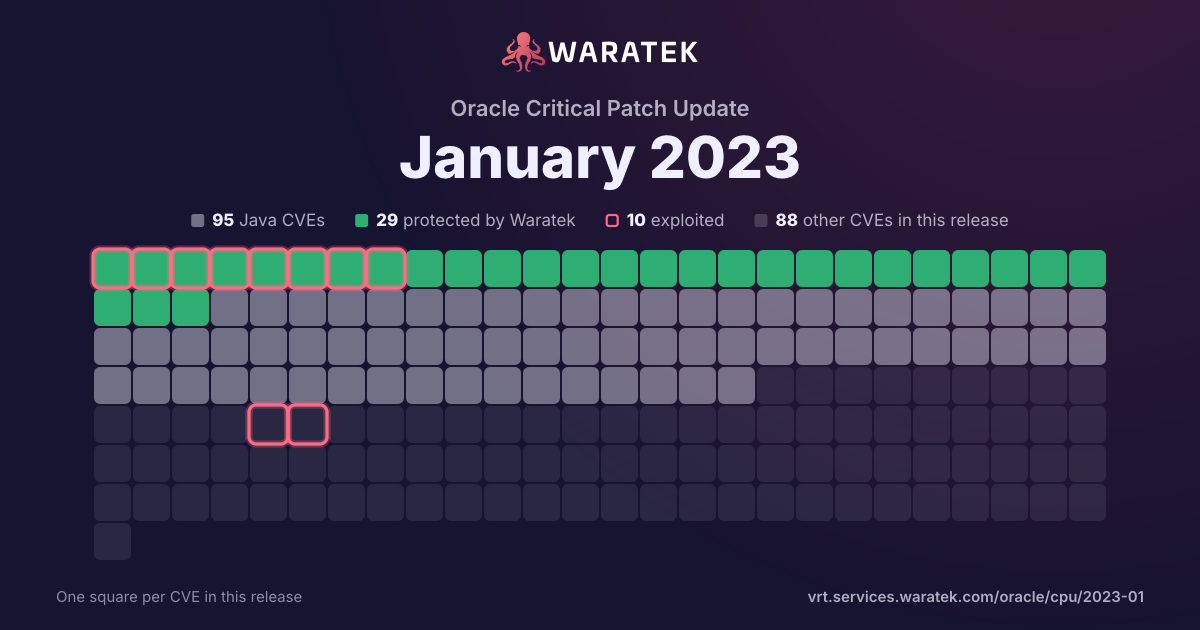
By status
28Protected by Waratek6Mitigation candidate66No exploit published3Outside Waratek scope79Not applicable1Withdrawn CVE
9Exploited, marked by the ring
No exploit published. For 35 of them, Oracle's security advisory is the source of public detail.
Protected by Waratek. Waratek RASP can block exploitation of these on systems that have not applied the patch yet.
Overview 8 matches · 1 protected · 0 exploited · 0 CISA KEV · 0 public PoC · 0 EPSS ≥ 0.5
Protected by Waratek
1
12.5%
Rule in development
0
0.0%
Mitigation candidate
0
0.0%
No exploit published
7
87.5%
blocked by ARMR today
1
12.5%
partly blocked
0
0.0%
not blocked
7
87.5%
not established
0
0.0%
unrecorded
0
0.0%
Exploited
0
0.0%
Working exploit published
0
0.0%
Proof of concept only
0
0.0%
Forecast only
0
0.0%
No public exploit
8
100.0%
| CVE | Severity | Published▾ | Status | Exploitation | Description |
|---|---|---|---|---|---|
| CVE-2022-34917 | High | 2022-09-20 | No exploit published | No public exploit | A security vulnerability has been identified in Apache Kafka. It affects all releases since 2.8.0. The vulnerability allows malicious unauthenticated clients to allocate large amounts of memory on brokers. This can lead to brokers hitting OutOfMemoryException and causing denial of service. Example scenarios: - Kafka cluster without authentication: Any clients able to establish a network connection to a broker can trigger the issue. - Kafka cluster with SASL authentication: Any clients able to establish a network connection to a broker, without the need for valid SASL credentials, can trigger the issue. - Kafka cluster with TLS authentication: Only clients able to successfully authenticate via TLS can trigger the issue. We advise the users to upgrade the Kafka installations to one of the 3.2.3, 3.1.2, 3.0.2, 2.8.2 versions. |
| CVE-2022-40150 | High | 2022-09-16 | No exploit published | No public exploit | Those using Jettison to parse untrusted XML or JSON data may be vulnerable to Denial of Service attacks (DOS). If the parser is running on user supplied input, an attacker may supply content that causes the parser to crash by Out of memory. This effect may support a denial of service attack. |
| CVE-2022-40149 | High | 2022-09-16 | No exploit published | No public exploit | Those using Jettison to parse untrusted XML or JSON data may be vulnerable to Denial of Service attacks (DOS). If the parser is running on user supplied input, an attacker may supply content that causes the parser to crash by stackoverflow. This effect may support a denial of service attack. |
| CVE-2022-1319 | High | 2022-08-31 | No exploit published | No public exploit | A flaw was found in Undertow. For an AJP 400 response, EAP 7 is improperly sending two response packets, and those packets have the reuse flag set even though JBoss EAP closes the connection. A failure occurs when the connection is reused after a 400 by CPING since it reads in the second SEND_HEADERS response packet instead of a CPONG. |
| CVE-2022-25857 | High | 2022-08-30 | Protected by Waratek | No public exploit | The package org.yaml:snakeyaml from 0 and before 1.31 are vulnerable to Denial of Service (DoS) due missing to nested depth limitation for collections. |
| CVE-2022-0084 | High | 2022-08-26 | No exploit published | No public exploit | A flaw was found in XNIO, specifically in the notifyReadClosed method. The issue revealed this method was logging a message to another expected end. This flaw allows an attacker to send flawed requests to a server, possibly causing log contention-related performance concerns or an unwanted disk fill-up. |
| CVE-2022-2053 | High | 2022-08-05 | No exploit published | No public exploit | When a POST request comes through AJP and the request exceeds the max-post-size limit (maxEntitySize), Undertow's AjpServerRequestConduit implementation closes a connection without sending any response to the client/proxy. This behavior results in that a front-end proxy marking the backend worker (application server) as an error state and not forward requests to the worker for a while. In mod_cluster, this continues until the next STATUS request (10 seconds intervals) from the application server updates the server state. So, in the worst case, it can result in "All workers are in error state" and mod_cluster responds "503 Service Unavailable" for a while (up to 10 seconds). In mod_proxy_balancer, it does not forward requests to the worker until the "retry" timeout passes. However, luckily, mod_proxy_balancer has "forcerecovery" setting (On by default; this parameter can force the immediate recovery of all workers without considering the retry parameter of the workers if all workers of a balancer are in error state.). So, unlike mod_cluster, mod_proxy_balancer does not result in responding "503 Service Unavailable". An attacker could use this behavior to send a malicious request and trigger server errors, resulting in DoS (denial of service). This flaw was fixed in Undertow 2.2.19.Final, Undertow 2.3.0.Alpha2. |
| CVE-2022-2048 | High | 2022-07-07 | No exploit published | No public exploit | In Eclipse Jetty HTTP/2 server implementation, when encountering an invalid HTTP/2 request, the error handling has a bug that can wind up not properly cleaning up the active connections and associated resources. This can lead to a Denial of Service scenario where there are no enough resources left to process good requests. |