
Oracle Critical Patch Update January 2023
Released January 2023 · Oracle's advisory ↗ · ← Critical Patch Update, October 2022 · Critical Patch Update, April 2023 →
183 CVEs in this release, one square each
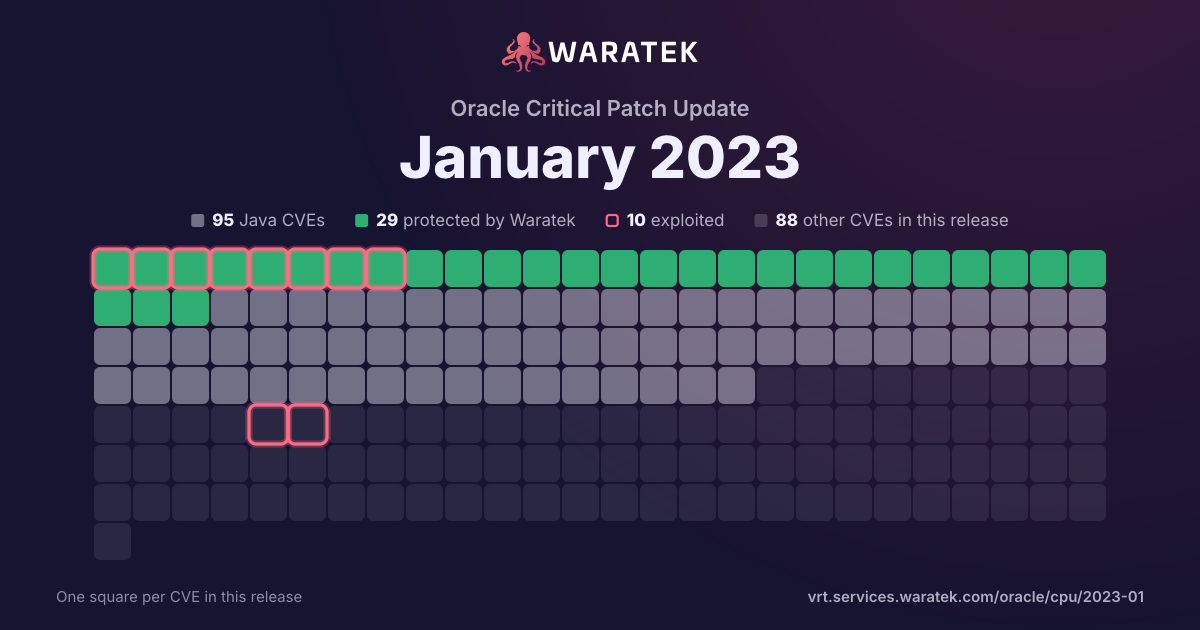
By status
29Protected by Waratek4Mitigation candidate62No exploit published13Outside Waratek scope74Not applicable1Withdrawn CVE
10Exploited, marked by the ring
No exploit published. For 39 of them, Oracle's security advisory is the source of public detail.
Protected by Waratek. Waratek RASP can block exploitation of these on systems that have not applied the patch yet.
Overview 147 matches · 73 in Waratek scope · 13 protected · 0 exploited · 0 CISA KEV · 0 public PoC · 0 EPSS ≥ 0.5
147matches
73in Waratek scope49.7%
13protected8.8%
0exploited0.0%
0CISA KEV0.0%
0public PoC0.0%
0EPSS ≥ 0.50.0%
Protected by Waratek
13
8.8%
Rule in development
0
0.0%
Mitigation candidate
0
0.0%
No exploit published
60
40.8%
Outside Waratek scope
8
5.4%
Not applicable
65
44.2%
Withdrawn CVE
1
0.7%
blocked by ARMR today
13
8.8%
partly blocked
0
0.0%
not blocked
134
91.2%
not established
0
0.0%
unrecorded
0
0.0%
Exploited
0
0.0%
Working exploit published
0
0.0%
Proof of concept only
0
0.0%
Forecast only
0
0.0%
No public exploit
147
100.0%
split by
peak 73 / quarter
Q1 181
Protected by Waratek1
Critical1
blocked by ARMR today1
No public exploit1
Q2 180
Q3 180
Q4 180
Q1 191
Not applicable1
Medium1
not blocked1
No public exploit1
Q2 190
Q3 190
Q4 191
Protected by Waratek1
Medium1
blocked by ARMR today1
No public exploit1
Q1 200
Q2 202
Protected by Waratek1
No exploit published1
Critical1
Medium1
blocked by ARMR today1
not blocked1
No public exploit2
Q3 200
Q4 202
No exploit published1
Outside Waratek scope1
High1
Medium1
not blocked2
No public exploit2
Q1 213
No exploit published1
Outside Waratek scope1
Not applicable1
Critical1
High2
not blocked3
No public exploit3
Q2 212
Protected by Waratek1
No exploit published1
Medium2
blocked by ARMR today1
not blocked1
No public exploit2
Q3 215
No exploit published2
Not applicable3
High4
Medium1
not blocked5
No public exploit5
Q4 214
Outside Waratek scope1
Not applicable3
Critical1
High2
Medium1
not blocked4
No public exploit4
Q1 229
Protected by Waratek1
No exploit published3
Outside Waratek scope1
Not applicable4
Critical1
High4
Medium4
blocked by ARMR today1
not blocked8
No public exploit9
Q2 2212
Protected by Waratek3
No exploit published3
Outside Waratek scope1
Not applicable5
Critical3
High5
Medium4
blocked by ARMR today3
not blocked9
No public exploit12
Q3 2218
Protected by Waratek1
No exploit published7
Outside Waratek scope1
Not applicable8
Withdrawn CVE1
Critical1
High14
Medium2
Unknown1
blocked by ARMR today1
not blocked17
No public exploit18
Q4 2214
Protected by Waratek1
No exploit published8
Not applicable5
Critical3
High10
Medium1
blocked by ARMR today1
not blocked13
No public exploit14
Q1 2373
Protected by Waratek3
No exploit published33
Outside Waratek scope2
Not applicable35
Critical1
High23
Medium44
Low5
blocked by ARMR today3
not blocked70
No public exploit73
Q1 18Q3 18Q1 19Q3 19Q1 20Q3 20Q1 21Q3 21Q1 22Q3 22Q1 23
| CVE | Severity | Published▾ | Status | Exploitation | Description |
|---|---|---|---|---|---|
| CVE-2022-0084 | High | 2022-08-26 | No exploit published | No public exploit | A flaw was found in XNIO, specifically in the notifyReadClosed method. The issue revealed this method was logging a message to another expected end. This flaw allows an attacker to send flawed requests to a server, possibly causing log contention-related performance concerns or an unwanted disk fill-up. |
| CVE-2022-2053 | High | 2022-08-05 | No exploit published | No public exploit | When a POST request comes through AJP and the request exceeds the max-post-size limit (maxEntitySize), Undertow's AjpServerRequestConduit implementation closes a connection without sending any response to the client/proxy. This behavior results in that a front-end proxy marking the backend worker (application server) as an error state and not forward requests to the worker for a while. In mod_cluster, this continues until the next STATUS request (10 seconds intervals) from the application server updates the server state. So, in the worst case, it can result in "All workers are in error state" and mod_cluster responds "503 Service Unavailable" for a while (up to 10 seconds). In mod_proxy_balancer, it does not forward requests to the worker until the "retry" timeout passes. However, luckily, mod_proxy_balancer has "forcerecovery" setting (On by default; this parameter can force the immediate recovery of all workers without considering the retry parameter of the workers if all workers of a balancer are in error state.). So, unlike mod_cluster, mod_proxy_balancer does not result in responding "503 Service Unavailable". An attacker could use this behavior to send a malicious request and trigger server errors, resulting in DoS (denial of service). This flaw was fixed in Undertow 2.2.19.Final, Undertow 2.3.0.Alpha2. |
| CVE-2022-2509 | High | 2022-08-01 | Not applicable | No public exploit | A vulnerability found in gnutls. This security flaw happens because of a double free error occurs during verification of pkcs7 signatures in gnutls_pkcs7_verify function. |
| CVE-2022-32212 | High | 2022-07-14 | Not applicable | No public exploit | A OS Command Injection vulnerability exists in Node.js versions <14.20.0, <16.20.0, <18.5.0 due to an insufficient IsAllowedHost check that can easily be bypassed because IsIPAddress does not properly check if an IP address is invalid before making DBS requests allowing rebinding attacks. |
| CVE-2022-2048 | High | 2022-07-07 | No exploit published | No public exploit | In Eclipse Jetty HTTP/2 server implementation, when encountering an invalid HTTP/2 request, the error handling has a bug that can wind up not properly cleaning up the active connections and associated resources. This can lead to a Denial of Service scenario where there are no enough resources left to process good requests. |
| CVE-2021-41411 | Critical | 2022-06-16 | Protected by Waratek | No public exploit | drools <=7.59.x is affected by an XML External Entity (XXE) vulnerability in KieModuleMarshaller.java. The Validator class is not used correctly, resulting in the XXE injection vulnerability. |
| CVE-2022-31813 | Critical | 2022-06-09 | Not applicable | No public exploit | Apache HTTP Server 2.4.53 and earlier may not send the X-Forwarded-* headers to the origin server based on client side Connection header hop-by-hop mechanism. This may be used to bypass IP based authentication on the origin server/application. |
| CVE-2022-30126 | Medium | 2022-05-16 | No exploit published | No public exploit | In Apache Tika, a regular expression in our StandardsText class, used by the StandardsExtractingContentHandler could lead to a denial of service caused by backtracking on a specially crafted file. This only affects users who are running the StandardsExtractingContentHandler, which is a non-standard handler. This is fixed in 1.28.2 and 2.4.0 |
| CVE-2022-22971 | Medium | 2022-05-12 | Protected by Waratek | No public exploit | In spring framework versions prior to 5.3.20+ , 5.2.22+ and old unsupported versions, application with a STOMP over WebSocket endpoint is vulnerable to a denial of service attack by an authenticated user. |
| CVE-2022-22970 | Medium | 2022-05-12 | No exploit published | No public exploit | In spring framework versions prior to 5.3.20+ , 5.2.22+ and old unsupported versions, applications that handle file uploads are vulnerable to DoS attack if they rely on data binding to set a MultipartFile or javax.servlet.Part to a field in a model object. |
| CVE-2022-30293 | High | 2022-05-06 | Not applicable | No public exploit | In WebKitGTK through 2.36.0 (and WPE WebKit), there is a heap-based buffer overflow in WebCore::TextureMapperLayer::setContentsLayer in WebCore/platform/graphics/texmap/TextureMapperLayer.cpp. |
| CVE-2022-24903 | High | 2022-05-06 | Outside Waratek scope | No public exploit | Rsyslog is a rocket-fast system for log processing. Modules for TCP syslog reception have a potential heap buffer overflow when octet-counted framing is used. This can result in a segfault or some other malfunction. As of our understanding, this vulnerability can not be used for remote code execution. But there may still be a slight chance for experts to do that. The bug occurs when the octet count is read. While there is a check for the maximum number of octets, digits are written to a heap buffer even when the octet count is over the maximum, This can be used to overrun the memory buffer. However, once the sequence of digits stop, no additional characters can be added to the buffer. In our opinion, this makes remote exploits impossible or at least highly complex. Octet-counted framing is one of two potential framing modes. It is relatively uncommon, but enabled by default on receivers. Modules `imtcp`, `imptcp`, `imgssapi`, and `imhttp` are used for regular syslog message reception. It is best practice not to directly expose them to the public. When this practice is followed, the risk is considerably lower. Module `imdiag` is a diagnostics module primarily intended for testbench runs. We do not expect it to be present on any production installation. Octet-counted framing is not very common. Usually, it needs to be specifically enabled at senders. If users do not need it, they can turn it off for the most important modules. This will mitigate the vulnerability. |
| CVE-2022-29824 | Medium | 2022-05-03 | Not applicable | No public exploit | In libxml2 before 2.9.14, several buffer handling functions in buf.c (xmlBuf*) and tree.c (xmlBuffer*) don't check for integer overflows. This can result in out-of-bounds memory writes. Exploitation requires a victim to open a crafted, multi-gigabyte XML file. Other software using libxml2's buffer functions, for example libxslt through 1.1.35, is affected as well. |
| CVE-2022-25647 | High | 2022-05-01 | Protected by Waratek | No public exploit | The package com.google.code.gson:gson before 2.8.9 are vulnerable to Deserialization of Untrusted Data via the writeReplace() method in internal classes, which may lead to DoS attacks. |
| CVE-2022-27404 | Critical | 2022-04-22 | Not applicable | No public exploit | FreeType commit 1e2eb65048f75c64b68708efed6ce904c31f3b2f was discovered to contain a heap buffer overflow via the function sfnt_init_face. |
| CVE-2022-1304 | High | 2022-04-14 | Not applicable | No public exploit | An out-of-bounds read/write vulnerability was found in e2fsprogs 1.46.5. This issue leads to a segmentation fault and possibly arbitrary code execution via a specially crafted filesystem. |
| CVE-2022-24839 | High | 2022-04-11 | No exploit published | No public exploit | org.cyberneko.html is an html parser written in Java. The fork of `org.cyberneko.html` used by Nokogiri (Rubygem) raises a `java.lang.OutOfMemoryError` exception when parsing ill-formed HTML markup. Users are advised to upgrade to `>= 1.9.22.noko2`. Note: The upstream library `org.cyberneko.html` is no longer maintained. Nokogiri uses its own fork of this library located at https://github.com/sparklemotion/nekohtml and this CVE applies only to that fork. Other forks of nekohtml may have a similar vulnerability. |
| CVE-2022-1122 | Medium | 2022-03-29 | Not applicable | No public exploit | A flaw was found in the opj2_decompress program in openjpeg2 2.4.0 in the way it handles an input directory with a large number of files. When it fails to allocate a buffer to store the filenames of the input directory, it calls free() on an uninitialized pointer, leading to a segmentation fault and a denial of service. |
| CVE-2020-36518 | High | 2022-03-11 | No exploit published | No public exploit | jackson-databind before 2.13.0 allows a Java StackOverflow exception and denial of service via a large depth of nested objects. |
| CVE-2022-26336 | Medium | 2022-03-04 | Protected by Waratek | No public exploit | A shortcoming in the HMEF package of poi-scratchpad (Apache POI) allows an attacker to cause an Out of Memory exception. This package is used to read TNEF files (Microsoft Outlook and Microsoft Exchange Server). If an application uses poi-scratchpad to parse TNEF files and the application allows untrusted users to supply them, then a carefully crafted file can cause an Out of Memory exception. This issue affects poi-scratchpad version 5.2.0 and prior versions. Users are recommended to upgrade to poi-scratchpad 5.2.1. |
| CVE-2021-3737 | High | 2022-03-04 | Not applicable | No public exploit | A flaw was found in python. An improperly handled HTTP response in the HTTP client code of python may allow a remote attacker, who controls the HTTP server, to make the client script enter an infinite loop, consuming CPU time. The highest threat from this vulnerability is to system availability. |
| CVE-2022-24329 | Medium | 2022-02-25 | No exploit published | No public exploit | In JetBrains Kotlin before 1.6.0, it was not possible to lock dependencies for Multiplatform Gradle Projects. |
| CVE-2022-24407 | High | 2022-02-24 | Outside Waratek scope | No public exploit | In Cyrus SASL 2.1.17 through 2.1.27 before 2.1.28, plugins/sql.c does not escape the password for a SQL INSERT or UPDATE statement. |
| CVE-2022-21824 | High | 2022-02-24 | Not applicable | No public exploit | Due to the formatting logic of the "console.table()" function it was not safe to allow user controlled input to be passed to the "properties" parameter while simultaneously passing a plain object with at least one property as the first parameter, which could be "__proto__". The prototype pollution has very limited control, in that it only allows an empty string to be assigned to numerical keys of the object prototype.Node.js >= 12.22.9, >= 14.18.3, >= 16.13.2, and >= 17.3.1 use a null protoype for the object these properties are being assigned to. |
| CVE-2022-25236 | Critical | 2022-02-16 | Not applicable | No public exploit | xmlparse.c in Expat (aka libexpat) before 2.4.5 allows attackers to insert namespace-separator characters into namespace URIs. |
| CVE-2022-23437 | Medium | 2022-01-24 | No exploit published | No public exploit | There's a vulnerability within the Apache Xerces Java (XercesJ) XML parser when handling specially crafted XML document payloads. This causes, the XercesJ XML parser to wait in an infinite loop, which may sometimes consume system resources for prolonged duration. This vulnerability is present within XercesJ version 2.12.1 and the previous versions. |
| CVE-2020-16156 | High | 2021-12-13 | Not applicable | No public exploit | CPAN 2.28 allows Signature Verification Bypass. |
| CVE-2021-43797 | Medium | 2021-12-09 | Outside Waratek scope | No public exploit | Netty is an asynchronous event-driven network application framework for rapid development of maintainable high performance protocol servers & clients. Netty prior to version 4.1.71.Final skips control chars when they are present at the beginning / end of the header name. It should instead fail fast as these are not allowed by the spec and could lead to HTTP request smuggling. Failing to do the validation might cause netty to "sanitize" header names before it forward these to another remote system when used as proxy. This remote system can't see the invalid usage anymore, and therefore does not do the validation itself. Users should upgrade to version 4.1.71.Final. |
| CVE-2021-42717 | High | 2021-12-07 | Not applicable | No public exploit | ModSecurity 3.x through 3.0.5 mishandles excessively nested JSON objects. Crafted JSON objects with nesting tens-of-thousands deep could result in the web server being unable to service legitimate requests. Even a moderately large (e.g., 300KB) HTTP request can occupy one of the limited NGINX worker processes for minutes and consume almost all of the available CPU on the machine. Modsecurity 2 is similarly vulnerable: the affected versions include 2.8.0 through 2.9.4. |
| CVE-2021-3918 | Critical | 2021-11-13 | Not applicable | No public exploit | json-schema is vulnerable to Improperly Controlled Modification of Object Prototype Attributes ('Prototype Pollution') |
| CVE-2021-40528 | Medium | 2021-09-06 | Not applicable | No public exploit | The ElGamal implementation in Libgcrypt before 1.9.4 allows plaintext recovery because, during interaction between two cryptographic libraries, a certain dangerous combination of the prime defined by the receiver's public key, the generator defined by the receiver's public key, and the sender's ephemeral exponents can lead to a cross-configuration attack against OpenPGP. |
| CVE-2021-36770 | High | 2021-08-11 | Not applicable | No public exploit | Encode.pm, as distributed in Perl through 5.34.0, allows local users to gain privileges via a Trojan horse Encode::ConfigLocal library (in the current working directory) that preempts dynamic module loading. Exploitation requires an unusual configuration, and certain 2021 versions of Encode.pm (3.05 through 3.11). This issue occurs because the || operator evaluates @INC in a scalar context, and thus @INC has only an integer value. |
| CVE-2021-36483 | High | 2021-08-04 | Not applicable | No public exploit | DevExpress.XtraReports.UI through v21.1 allows attackers to execute arbitrary code via insecure deserialization. |
| CVE-2021-2351 | High | 2021-07-21 | No exploit published | No public exploit | Vulnerability in the Advanced Networking Option component of Oracle Database Server. Supported versions that are affected are 12.1.0.2, 12.2.0.1 and 19c. Difficult to exploit vulnerability allows unauthenticated attacker with network access via Oracle Net to compromise Advanced Networking Option. Successful attacks require human interaction from a person other than the attacker and while the vulnerability is in Advanced Networking Option, attacks may significantly impact additional products. Successful attacks of this vulnerability can result in takeover of Advanced Networking Option. Note: The July 2021 Critical Patch Update introduces a number of Native Network Encryption changes to deal with vulnerability CVE-2021-2351 and prevent the use of weaker ciphers. Customers should review: "Changes in Native Network Encryption with the July 2021 Critical Patch Update" (Doc ID 2791571.1). CVSS 3.1 Base Score 8.3 (Confidentiality, Integrity and Availability impacts). CVSS Vector: (CVSS:3.1/AV:N/AC:H/PR:N/UI:R/S:C/C:H/I:H/A:H). |
| CVE-2021-36090 | High | 2021-07-13 | No exploit published | No public exploit | When reading a specially crafted ZIP archive, Compress can be made to allocate large amounts of memory that finally leads to an out of memory error even for very small inputs. This could be used to mount a denial of service attack against services that use Compress' zip package. |
| CVE-2021-31812 | Medium | 2021-06-12 | No exploit published | No public exploit | In Apache PDFBox, a carefully crafted PDF file can trigger an infinite loop while loading the file. This issue affects Apache PDFBox version 2.0.23 and prior 2.0.x versions. |
| CVE-2021-29425 | Medium | 2021-04-13 | Protected by Waratek | No public exploit | In Apache Commons IO before 2.7, When invoking the method FileNameUtils.normalize with an improper input string, like "//../foo", or "\\..\foo", the result would be the same value, thus possibly providing access to files in the parent directory, but not further above (thus "limited" path traversal), if the calling code would use the result to construct a path value. |
| CVE-2020-11987 | High | 2021-02-24 | No exploit published | No public exploit | Apache Batik 1.13 is vulnerable to server-side request forgery, caused by improper input validation by the NodePickerPanel. By using a specially-crafted argument, an attacker could exploit this vulnerability to cause the underlying server to make arbitrary GET requests. |
| CVE-2020-36242 | Critical | 2021-02-07 | Outside Waratek scope | No public exploit | In the cryptography package before 3.3.2 for Python, certain sequences of update calls to symmetrically encrypt multi-GB values could result in an integer overflow and buffer overflow, as demonstrated by the Fernet class. |
| CVE-2020-27844 | High | 2021-01-05 | Not applicable | No public exploit | A flaw was found in openjpeg's src/lib/openjp2/t2.c in versions prior to 2.4.0. This flaw allows an attacker to provide crafted input to openjpeg during conversion and encoding, causing an out-of-bounds write. The highest threat from this vulnerability is to confidentiality, integrity, as well as system availability. |
| CVE-2020-13956 | Medium | 2020-12-02 | Outside Waratek scope | No public exploit | Apache HttpClient versions prior to version 4.5.13 and 5.0.3 can misinterpret malformed authority component in request URIs passed to the library as java.net.URI object and pick the wrong target host for request execution. |
| CVE-2020-11979 | High | 2020-10-01 | No exploit published | No public exploit | As mitigation for CVE-2020-1945 Apache Ant 1.10.8 changed the permissions of temporary files it created so that only the current user was allowed to access them. Unfortunately the fixcrlf task deleted the temporary file and created a new one without said protection, effectively nullifying the effort. This would still allow an attacker to inject modified source files into the build process. |
| CVE-2020-10693 | Medium | 2020-05-06 | No exploit published | No public exploit | A flaw was found in Hibernate Validator version 6.1.2.Final. A bug in the message interpolation processor enables invalid EL expressions to be evaluated as if they were valid. This flaw allows attackers to bypass input sanitation (escaping, stripping) controls that developers may have put in place when handling user-controlled data in error messages. |
| CVE-2020-10683 | Critical | 2020-05-01 | Protected by Waratek | No public exploit | dom4j before 2.0.3 and 2.1.x before 2.1.3 allows external DTDs and External Entities by default, which might enable XXE attacks. However, there is popular external documentation from OWASP showing how to enable the safe, non-default behavior in any application that uses dom4j. |
| CVE-2019-12415 | Medium | 2019-10-23 | Protected by Waratek | No public exploit | In Apache POI up to 4.1.0, when using the tool XSSFExportToXml to convert user-provided Microsoft Excel documents, a specially crafted document can allow an attacker to read files from the local filesystem or from internal network resources via XML External Entity (XXE) Processing. |
| CVE-2019-7317 | Medium | 2019-02-04 | Not applicable | No public exploit | png_image_free in png.c in libpng 1.6.x before 1.6.37 has a use-after-free because png_image_free_function is called under png_safe_execute. |
| CVE-2018-7489 | Critical | 2018-02-26 | Protected by Waratek | No public exploit | FasterXML jackson-databind before 2.7.9.3, 2.8.x before 2.8.11.1 and 2.9.x before 2.9.5 allows unauthenticated remote code execution because of an incomplete fix for the CVE-2017-7525 deserialization flaw. This is exploitable by sending maliciously crafted JSON input to the readValue method of the ObjectMapper, bypassing a blacklist that is ineffective if the c3p0 libraries are available in the classpath. |