
Oracle Critical Patch Update January 2023
Released January 2023 · Oracle's advisory ↗ · ← Critical Patch Update, October 2022 · Critical Patch Update, April 2023 →
183 CVEs in this release, one square each
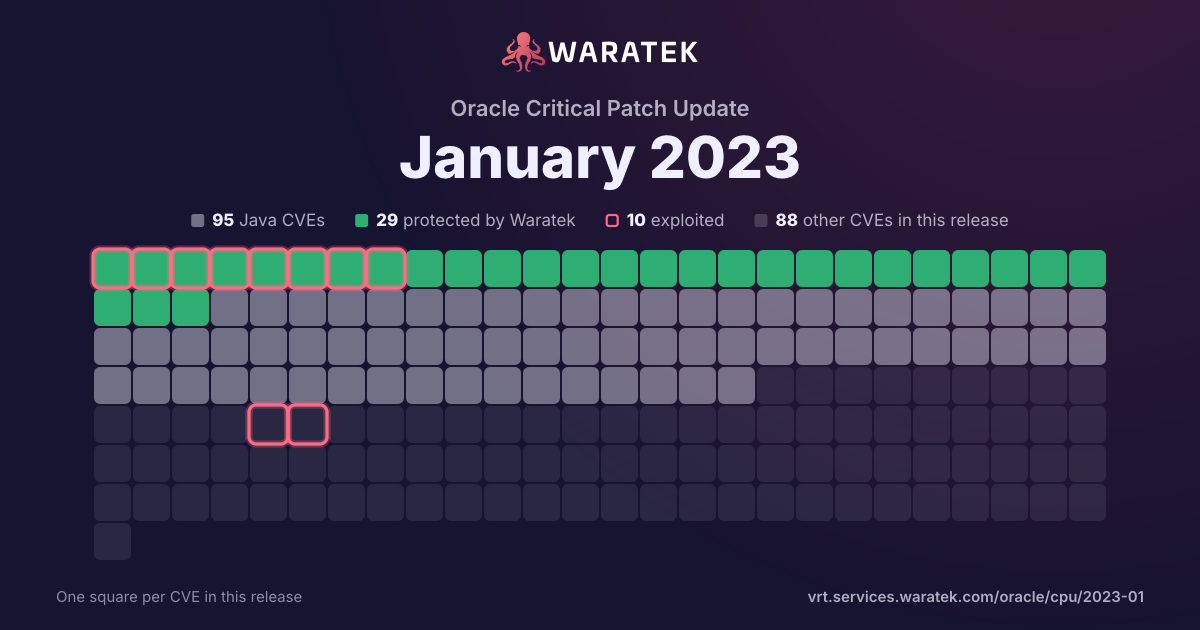
By status
28Protected by Waratek5Mitigation candidate66No exploit published3Outside Waratek scope80Not applicable1Withdrawn CVE
9Exploited, marked by the ring
No exploit published. For 35 of them, Oracle's security advisory is the source of public detail.
Protected by Waratek. Waratek RASP can block exploitation of these on systems that have not applied the patch yet.
Overview 13 matches · 3 protected · 0 exploited · 0 CISA KEV · 2 public PoC · 0 EPSS ≥ 0.5
Protected by Waratek
3
23.1%
Rule in development
0
0.0%
Mitigation candidate
1
7.7%
No exploit published
9
69.2%
blocked by ARMR today
3
23.1%
partly blocked
0
0.0%
not blocked
10
76.9%
not established
0
0.0%
unrecorded
0
0.0%
Exploited
0
0.0%
Working exploit published
0
0.0%
Proof of concept only
3
23.1%
Forecast only
0
0.0%
No public exploit
10
76.9%
split by
peak 3 / month
Mar 221
No exploit published1
High1
not blocked1
No public exploit1
Apr 220
May 221
Protected by Waratek1
High1
blocked by ARMR today1
No public exploit1
Jun 220
Jul 222
Protected by Waratek1
No exploit published1
High2
blocked by ARMR today1
not blocked1
Proof of concept only1
No public exploit1
Aug 221
Protected by Waratek1
High1
blocked by ARMR today1
No public exploit1
Sep 223
Mitigation candidate1
No exploit published2
High3
not blocked3
Proof of concept only1
No public exploit2
Oct 222
No exploit published2
High2
not blocked2
No public exploit2
Nov 221
No exploit published1
High1
not blocked1
No public exploit1
Dec 221
No exploit published1
High1
not blocked1
Proof of concept only1
Jan 231
No exploit published1
High1
not blocked1
No public exploit1
Mar 22Apr 22May 22Jun 22Jul 22Aug 22Sep 22Oct 22Nov 22Dec 22Jan 23
| CVE | Severity | Published▾ | Status | Exploitation | Description |
|---|---|---|---|---|---|
| CVE-2023-21848 | High | 2023-01-18 | No exploit published | No public exploit | Vulnerability in the Oracle Communications Convergence product of Oracle Communications Applications (component: Admin Configuration). The supported version that is affected is 3.0.3.1.0. Easily exploitable vulnerability allows low privileged attacker with network access via HTTP to compromise Oracle Communications Convergence. Successful attacks of this vulnerability can result in takeover of Oracle Communications Convergence. CVSS 3.1 Base Score 8.8 (Confidentiality, Integrity and Availability impacts). CVSS Vector: (CVSS:3.1/AV:N/AC:L/PR:L/UI:N/S:U/C:H/I:H/A:H). |
| CVE-2022-41881 | High | 2022-12-12 | No exploit published | Proof of concept only | Netty project is an event-driven asynchronous network application framework. In versions prior to 4.1.86.Final, a StackOverflowError can be raised when parsing a malformed crafted message due to an infinite recursion. This issue is patched in version 4.1.86.Final. There is no workaround, except using a custom HaProxyMessageDecoder. |
| CVE-2022-42252 | High | 2022-11-01 | No exploit published | No public exploit | If Apache Tomcat 8.5.0 to 8.5.82, 9.0.0-M1 to 9.0.67, 10.0.0-M1 to 10.0.26 or 10.1.0-M1 to 10.1.0 was configured to ignore invalid HTTP headers via setting rejectIllegalHeader to false (the default for 8.5.x only), Tomcat did not reject a request containing an invalid Content-Length header making a request smuggling attack possible if Tomcat was located behind a reverse proxy that also failed to reject the request with the invalid header. |
| CVE-2022-3171 | High | 2022-10-12 | No exploit published | No public exploit | A parsing issue with binary data in protobuf-java core and lite versions prior to 3.21.7, 3.20.3, 3.19.6 and 3.16.3 can lead to a denial of service attack. Inputs containing multiple instances of non-repeated embedded messages with repeated or unknown fields causes objects to be converted back-n-forth between mutable and immutable forms, resulting in potentially long garbage collection pauses. We recommend updating to the versions mentioned above. |
| CVE-2022-42003 | High | 2022-10-02 | No exploit published | No public exploit | In FasterXML jackson-databind before versions 2.13.4.1 and 2.12.17.1, resource exhaustion can occur because of a lack of a check in primitive value deserializers to avoid deep wrapper array nesting, when the UNWRAP_SINGLE_VALUE_ARRAYS feature is enabled. |
| CVE-2022-40146 | High | 2022-09-22 | Mitigation candidate | Proof of concept only | Server-Side Request Forgery (SSRF) vulnerability in Batik of Apache XML Graphics allows an attacker to access files using a Jar url. This issue affects Apache XML Graphics Batik 1.14. |
| CVE-2022-34917 | High | 2022-09-20 | No exploit published | No public exploit | A security vulnerability has been identified in Apache Kafka. It affects all releases since 2.8.0. The vulnerability allows malicious unauthenticated clients to allocate large amounts of memory on brokers. This can lead to brokers hitting OutOfMemoryException and causing denial of service. Example scenarios: - Kafka cluster without authentication: Any clients able to establish a network connection to a broker can trigger the issue. - Kafka cluster with SASL authentication: Any clients able to establish a network connection to a broker, without the need for valid SASL credentials, can trigger the issue. - Kafka cluster with TLS authentication: Only clients able to successfully authenticate via TLS can trigger the issue. We advise the users to upgrade the Kafka installations to one of the 3.2.3, 3.1.2, 3.0.2, 2.8.2 versions. |
| CVE-2022-40150 | High | 2022-09-16 | No exploit published | No public exploit | Those using Jettison to parse untrusted XML or JSON data may be vulnerable to Denial of Service attacks (DOS). If the parser is running on user supplied input, an attacker may supply content that causes the parser to crash by Out of memory. This effect may support a denial of service attack. |
| CVE-2022-25857 | High | 2022-08-30 | Protected by Waratek | No public exploit | The package org.yaml:snakeyaml from 0 and before 1.31 are vulnerable to Denial of Service (DoS) due missing to nested depth limitation for collections. |
| CVE-2022-34169 | High | 2022-07-19 | Protected by Waratek | Proof of concept only | The Apache Xalan Java XSLT library is vulnerable to an integer truncation issue when processing malicious XSLT stylesheets. This can be used to corrupt Java class files generated by the internal XSLTC compiler and execute arbitrary Java bytecode. Users are recommended to update to version 2.7.3 or later. Note: Java runtimes (such as OpenJDK) include repackaged copies of Xalan. |
| CVE-2022-2048 | High | 2022-07-07 | No exploit published | No public exploit | In Eclipse Jetty HTTP/2 server implementation, when encountering an invalid HTTP/2 request, the error handling has a bug that can wind up not properly cleaning up the active connections and associated resources. This can lead to a Denial of Service scenario where there are no enough resources left to process good requests. |
| CVE-2022-25647 | High | 2022-05-01 | Protected by Waratek | No public exploit | The package com.google.code.gson:gson before 2.8.9 are vulnerable to Deserialization of Untrusted Data via the writeReplace() method in internal classes, which may lead to DoS attacks. |
| CVE-2020-36518 | High | 2022-03-11 | No exploit published | No public exploit | jackson-databind before 2.13.0 allows a Java StackOverflow exception and denial of service via a large depth of nested objects. |