
Oracle Critical Patch Update January 2023
Released January 2023 · Oracle's advisory ↗ · ← Critical Patch Update, October 2022 · Critical Patch Update, April 2023 →
183 CVEs in this release, one square each
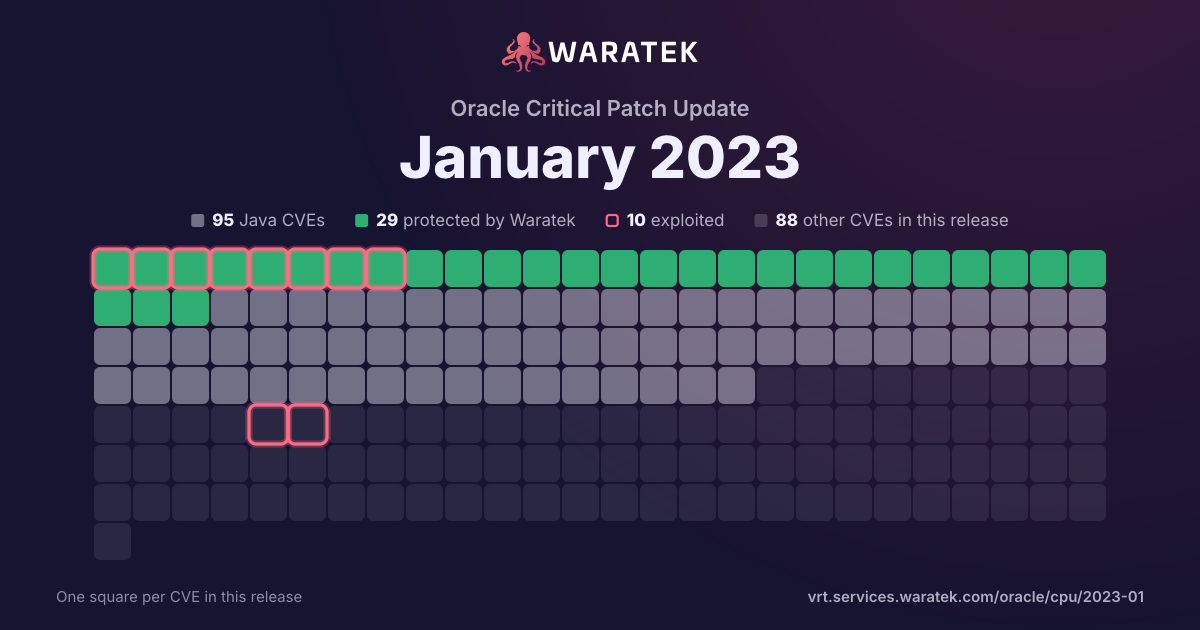
By status
28Protected by Waratek5Mitigation candidate66No exploit published3Outside Waratek scope80Not applicable1Withdrawn CVE
9Exploited, marked by the ring
No exploit published. For 35 of them, Oracle's security advisory is the source of public detail.
Protected by Waratek. Waratek RASP can block exploitation of these on systems that have not applied the patch yet.
Overview 11 matches · 3 protected · 0 exploited · 0 CISA KEV · 1 public PoC · 0 EPSS ≥ 0.5
Protected by Waratek
3
27.3%
Rule in development
0
0.0%
Mitigation candidate
0
0.0%
No exploit published
8
72.7%
blocked by ARMR today
3
27.3%
partly blocked
0
0.0%
not blocked
8
72.7%
not established
0
0.0%
unrecorded
0
0.0%
Exploited
0
0.0%
Working exploit published
0
0.0%
Proof of concept only
1
9.1%
Forecast only
0
0.0%
No public exploit
10
90.9%
split by
peak 6 / quarter
Q1 211
No exploit published1
High1
not blocked1
No public exploit1
Q2 210
Q3 212
No exploit published2
High2
not blocked2
No public exploit2
Q4 210
Q1 221
No exploit published1
High1
not blocked1
No public exploit1
Q2 221
Protected by Waratek1
High1
blocked by ARMR today1
No public exploit1
Q3 226
Protected by Waratek2
No exploit published4
High6
blocked by ARMR today2
not blocked4
Proof of concept only1
No public exploit5
Q1 21Q2 21Q3 21Q4 21Q1 22Q2 22Q3 22
| CVE | Severity | Published▾ | Status | Exploitation | Description |
|---|---|---|---|---|---|
| CVE-2022-1319 | High | 2022-08-31 | No exploit published | No public exploit | A flaw was found in Undertow. For an AJP 400 response, EAP 7 is improperly sending two response packets, and those packets have the reuse flag set even though JBoss EAP closes the connection. A failure occurs when the connection is reused after a 400 by CPING since it reads in the second SEND_HEADERS response packet instead of a CPONG. |
| CVE-2022-25857 | High | 2022-08-30 | Protected by Waratek | No public exploit | The package org.yaml:snakeyaml from 0 and before 1.31 are vulnerable to Denial of Service (DoS) due missing to nested depth limitation for collections. |
| CVE-2022-0084 | High | 2022-08-26 | No exploit published | No public exploit | A flaw was found in XNIO, specifically in the notifyReadClosed method. The issue revealed this method was logging a message to another expected end. This flaw allows an attacker to send flawed requests to a server, possibly causing log contention-related performance concerns or an unwanted disk fill-up. |
| CVE-2022-2053 | High | 2022-08-05 | No exploit published | No public exploit | When a POST request comes through AJP and the request exceeds the max-post-size limit (maxEntitySize), Undertow's AjpServerRequestConduit implementation closes a connection without sending any response to the client/proxy. This behavior results in that a front-end proxy marking the backend worker (application server) as an error state and not forward requests to the worker for a while. In mod_cluster, this continues until the next STATUS request (10 seconds intervals) from the application server updates the server state. So, in the worst case, it can result in "All workers are in error state" and mod_cluster responds "503 Service Unavailable" for a while (up to 10 seconds). In mod_proxy_balancer, it does not forward requests to the worker until the "retry" timeout passes. However, luckily, mod_proxy_balancer has "forcerecovery" setting (On by default; this parameter can force the immediate recovery of all workers without considering the retry parameter of the workers if all workers of a balancer are in error state.). So, unlike mod_cluster, mod_proxy_balancer does not result in responding "503 Service Unavailable". An attacker could use this behavior to send a malicious request and trigger server errors, resulting in DoS (denial of service). This flaw was fixed in Undertow 2.2.19.Final, Undertow 2.3.0.Alpha2. |
| CVE-2022-34169 | High | 2022-07-19 | Protected by Waratek | Proof of concept only | The Apache Xalan Java XSLT library is vulnerable to an integer truncation issue when processing malicious XSLT stylesheets. This can be used to corrupt Java class files generated by the internal XSLTC compiler and execute arbitrary Java bytecode. Users are recommended to update to version 2.7.3 or later. Note: Java runtimes (such as OpenJDK) include repackaged copies of Xalan. |
| CVE-2022-2048 | High | 2022-07-07 | No exploit published | No public exploit | In Eclipse Jetty HTTP/2 server implementation, when encountering an invalid HTTP/2 request, the error handling has a bug that can wind up not properly cleaning up the active connections and associated resources. This can lead to a Denial of Service scenario where there are no enough resources left to process good requests. |
| CVE-2022-25647 | High | 2022-05-01 | Protected by Waratek | No public exploit | The package com.google.code.gson:gson before 2.8.9 are vulnerable to Deserialization of Untrusted Data via the writeReplace() method in internal classes, which may lead to DoS attacks. |
| CVE-2020-36518 | High | 2022-03-11 | No exploit published | No public exploit | jackson-databind before 2.13.0 allows a Java StackOverflow exception and denial of service via a large depth of nested objects. |
| CVE-2021-2351 | High | 2021-07-21 | No exploit published | No public exploit | Vulnerability in the Advanced Networking Option component of Oracle Database Server. Supported versions that are affected are 12.1.0.2, 12.2.0.1 and 19c. Difficult to exploit vulnerability allows unauthenticated attacker with network access via Oracle Net to compromise Advanced Networking Option. Successful attacks require human interaction from a person other than the attacker and while the vulnerability is in Advanced Networking Option, attacks may significantly impact additional products. Successful attacks of this vulnerability can result in takeover of Advanced Networking Option. Note: The July 2021 Critical Patch Update introduces a number of Native Network Encryption changes to deal with vulnerability CVE-2021-2351 and prevent the use of weaker ciphers. Customers should review: "Changes in Native Network Encryption with the July 2021 Critical Patch Update" (Doc ID 2791571.1). CVSS 3.1 Base Score 8.3 (Confidentiality, Integrity and Availability impacts). CVSS Vector: (CVSS:3.1/AV:N/AC:H/PR:N/UI:R/S:C/C:H/I:H/A:H). |
| CVE-2021-36090 | High | 2021-07-13 | No exploit published | No public exploit | When reading a specially crafted ZIP archive, Compress can be made to allocate large amounts of memory that finally leads to an out of memory error even for very small inputs. This could be used to mount a denial of service attack against services that use Compress' zip package. |
| CVE-2020-11987 | High | 2021-02-24 | No exploit published | No public exploit | Apache Batik 1.13 is vulnerable to server-side request forgery, caused by improper input validation by the NodePickerPanel. By using a specially-crafted argument, an attacker could exploit this vulnerability to cause the underlying server to make arbitrary GET requests. |