
Oracle Critical Patch Update October 2022
Released October 2022 · Oracle's advisory ↗ · ← Critical Patch Update, July 2022 · Critical Patch Update, January 2023 →
179 CVEs in this release, one square each
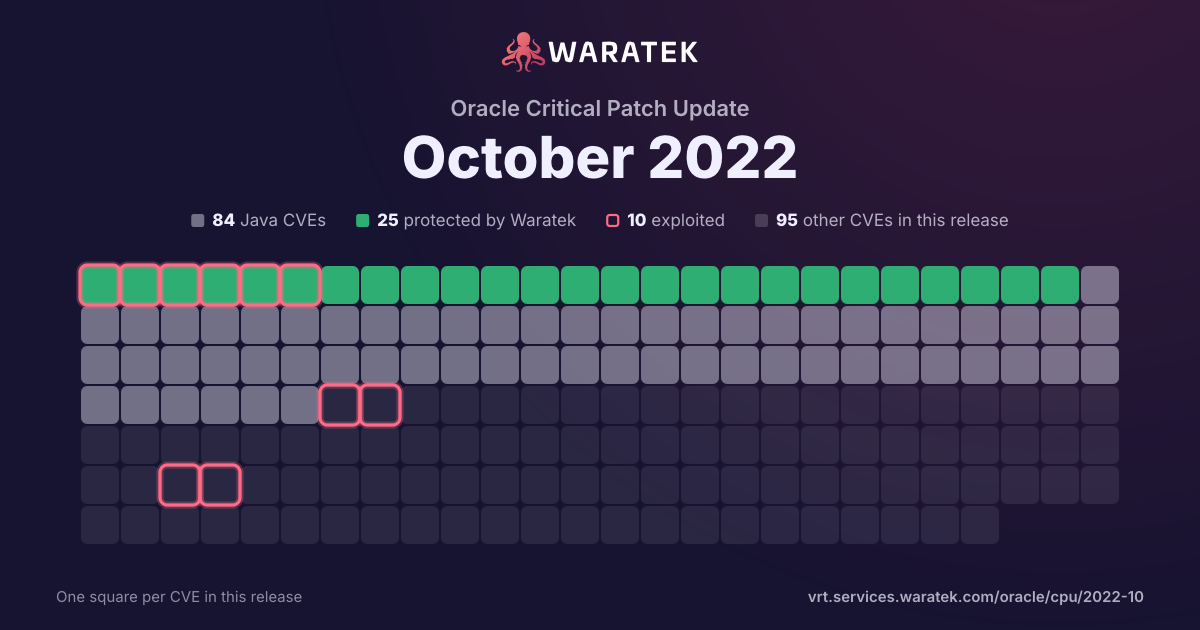
By status
26Protected by Waratek7Mitigation candidate58No exploit published3Outside Waratek scope85Not applicable
10Exploited, marked by the ring
No exploit published. For 34 of them, Oracle's security advisory is the source of public detail.
Protected by Waratek. Waratek RASP can block exploitation of these on systems that have not applied the patch yet.
Overview 4 matches · 1 in Waratek scope · 0 protected · 0 exploited · 0 CISA KEV · 0 public PoC · 0 EPSS ≥ 0.5
4matches
1in Waratek scope25.0%
0protected0.0%
0exploited0.0%
0CISA KEV0.0%
0public PoC0.0%
0EPSS ≥ 0.50.0%
Protected by Waratek
0
0.0%
Rule in development
0
0.0%
Mitigation candidate
0
0.0%
No exploit published
1
25.0%
Outside Waratek scope
0
0.0%
Not applicable
3
75.0%
Withdrawn CVE
0
0.0%
blocked by ARMR today
0
0.0%
partly blocked
0
0.0%
not blocked
4
100.0%
not established
0
0.0%
unrecorded
0
0.0%
Exploited
0
0.0%
Working exploit published
0
0.0%
Proof of concept only
2
50.0%
Forecast only
0
0.0%
No public exploit
2
50.0%
split by
peak 4 / month
Feb 22
| CVE | Severity | Published▾ | Status | Exploitation | Description |
|---|---|---|---|---|---|
| CVE-2021-21708 | Critical | 2022-02-27 | Not applicable | No public exploit | In PHP versions 7.4.x below 7.4.28, 8.0.x below 8.0.16, and 8.1.x below 8.1.3, when using filter functions with FILTER_VALIDATE_FLOAT filter and min/max limits, if the filter fails, there is a possibility to trigger use of allocated memory after free, which can result it crashes, and potentially in overwrite of other memory chunks and RCE. This issue affects: code that uses FILTER_VALIDATE_FLOAT with min/max limits. |
| CVE-2022-25315 | Critical | 2022-02-18 | Not applicable | Proof of concept only | In Expat (aka libexpat) before 2.4.5, there is an integer overflow in storeRawNames. |
| CVE-2022-23632 | High | 2022-02-17 | Not applicable | No public exploit | Traefik is an HTTP reverse proxy and load balancer. Prior to version 2.6.1, Traefik skips the router transport layer security (TLS) configuration when the host header is a fully qualified domain name (FQDN). For a request, the TLS configuration choice can be different than the router choice, which implies the use of a wrong TLS configuration. When sending a request using FQDN handled by a router configured with a dedicated TLS configuration, the TLS configuration falls back to the default configuration that might not correspond to the configured one. If the CNAME flattening is enabled, the selected TLS configuration is the SNI one and the routing uses the CNAME value, so this can skip the expected TLS configuration. Version 2.6.1 contains a patch for this issue. As a workaround, one may add the FDQN to the host rule. However, there is no workaround if the CNAME flattening is enabled. |
| CVE-2021-43859 | High | 2022-02-01 | No exploit published | Proof of concept only | XStream is an open source java library to serialize objects to XML and back again. Versions prior to 1.4.19 may allow a remote attacker to allocate 100% CPU time on the target system depending on CPU type or parallel execution of such a payload resulting in a denial of service only by manipulating the processed input stream. XStream 1.4.19 monitors and accumulates the time it takes to add elements to collections and throws an exception if a set threshold is exceeded. Users are advised to upgrade as soon as possible. Users unable to upgrade may set the NO_REFERENCE mode to prevent recursion. See GHSA-rmr5-cpv2-vgjf for further details on a workaround if an upgrade is not possible. |